
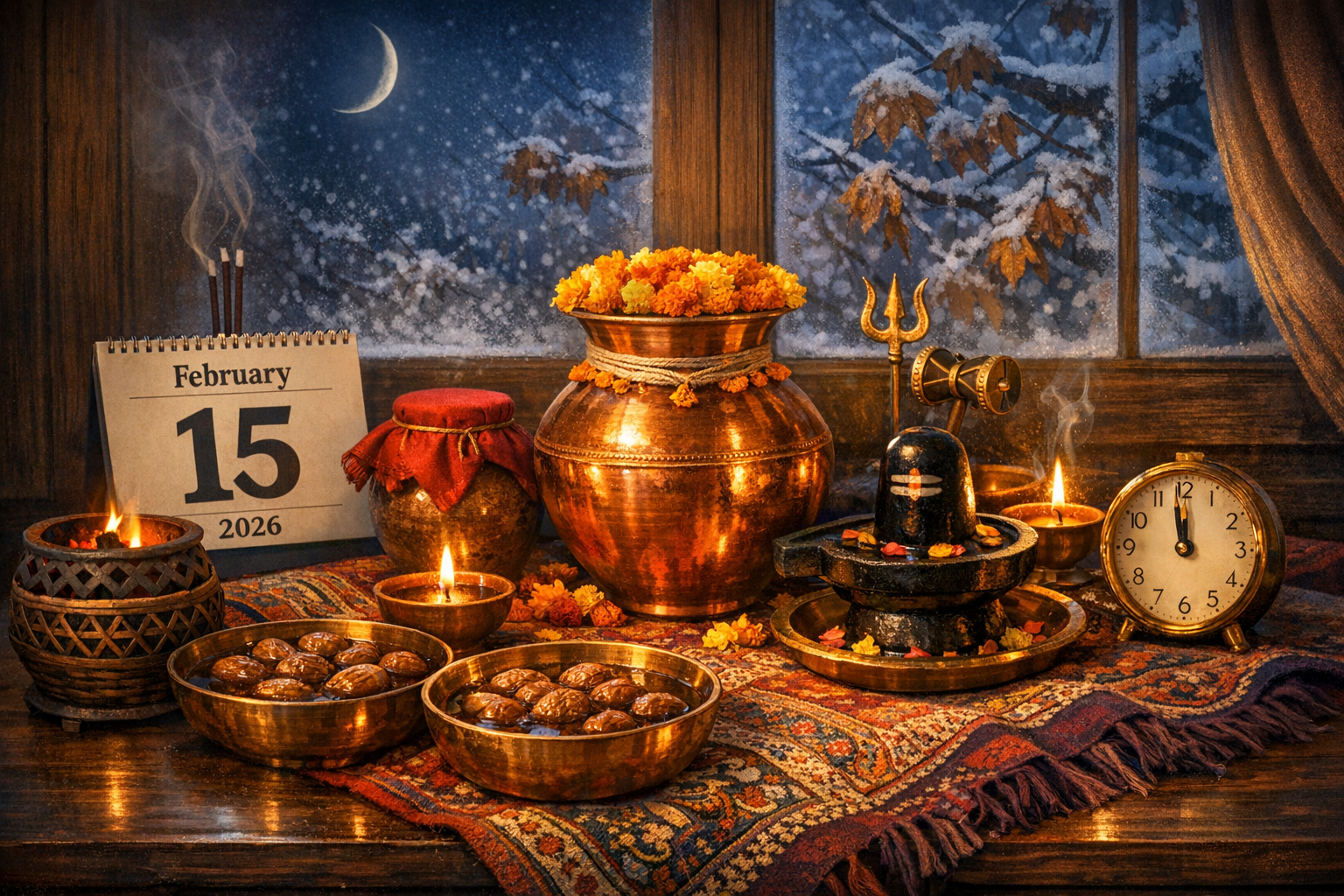
HerathKashmiri Pandits’ observance of Shivaratriis celebrated on Phalguna Krishna Trayodashi rather than the pan-Indian Chaturdashi. In 2026, Herath falls on 15 February, aligning with the community’s Jantrie (panchang) and the classical rule that the night vigil for Shiva should coincide with the Nishita Kaal around midnight. This distinctive calendrical choice preserves an unbroken ritual memory in Kashmir and its global diaspora.
From a panchanga perspective, a tithi denotes each 12-degree increment of longitudinal separation between the Sun and Moon. The night is divided into fifteen muhurtas; the central oneNishita Kaalstraddles local midnight and is prescribed for Shivaratri worship. The festival is selected so that the tithi present at Nishita governs the vrata. Dharmaśāstra digests such as Nirnaya Sindhu and related nibandhas privilege the tithi at Nishita for Shivaratri; when Chaturdashi does not prevail then, Trayodashi becomes the rightful choice. This principle, together with Kashmir’s winter-night timings, explains the longstanding Herath-on-Trayodashi practice.
Regional calendars differ in month reckoningPurnimanta in much of North India and Amanta in many southern traditionsbut the determining factor for Shivaratri remains the lunar tithi active at Nishita Kaal. Hence, even amid diverse calendrical conventions across the Hindu calendar, the selection of 15 February 2026 for Herath is internally consistent within the Kashmiri Pandit tradition.
The name “Herath” is commonly understood as a vernacular rendering of “Har-ratri” or “Hara-rātri”the Night of Hara (Shiva). Within the Kashmiri Shaivism (Trika) framework, Herath evokes Shiva as the supreme, all-pervading consciousness whose dynamic unity with Shakti underlies creation, sustenance, and dissolution. The festival’s theology foregrounds surrender, dhyana (meditation), and the transformative power of night-long vigil (jagraan) as a means of aligning the mind with the auspicious.
Textual memory in Kashmir, including references in the Nilamata Purāṇa to seasonal rites and Shiva devotion in the Valley, situates Herath within a deep arc of local sacred time. The emphasis on household-centered worship, ritual vessels, and inter-household greetings mirrors an enduring continuity that has adapted without losing its core.
Households prepare an altar featuring the Vatukan earthen or metal vessel representing Vatuk Bhairavapaired with companion vessels signifying the Divine Mother. These are ritually cleansed, filled with fresh water, and sanctified with mantras. Walnuts (doon) are placed in the vessels and in ceremonial plates of water; as the shells slowly open when soaked, they symbolize latent consciousness unfolding under Shiva’s grace. Panchopachara or Shodashopachara worship is performed, often including abhisheka with water and, where available, panchamrita. In Kashmir, walnuts frequently substitute bilva fruit due to climate and ecology, while the essence of Shivalinga Puja remains unchanged.
The central vrata is maintained through the night, with meditation, kirtan, and recitation of stotras such as the Shiva Mahimna Stotra, Shiva Sahasranama, Lingashtakam, and the Mahamrityunjaya mantra. Devotees aim to remain awake until Nishita Kaalassociated in puranic lore with the Lingodbhava momentoffering Shivalinga Puja during this window and breaking the fast the following day with sanctified water and prasad. The vrata’s disciplinesupavasa (fasting), mauna or quietude for portions of the night, and japaare understood to refine attention and cultivate inner steadiness.
The morning and the day after Herath carry a distinctive social warmth. Soaked walnuts are distributed as prasad, and elders traditionally offer “Herath kharch” to children as a blessing. The day known as “Salaam” extends greetings across households, recalling centuries of shared neighborhood life in the Valley and affirming a civic ethic of mutual respect and goodwill that many families cherish as part of their living heritage.
Herath mealtimes reflect Kashmiri Pandit cuisinerice at the center, with seasonal greens (haakh), lotus stem preparations (nadru), curd-based gravies, and classic delicacies prepared according to family and regional custom. Households balance austerity with hospitality, emphasizing satvik offerings for the deity and wholesome fare for guests once the fast concludes, thereby integrating ritual purity with convivial community life.
For families in the diaspora, observance follows the same rule of tithi at local Nishita Kaal. Community temples and family Jantries typically confirm 15 February 2026 for Herath; nonetheless, those in distant time zones are advised to verify lunar spans with a reliable Hindu calendar so that the principal puja and vigil align with local midnight. This practice upholds scriptural guidance while honoring geographic diversity.
While Herath is uniquely Kashmiri in form, its inner disciplinesfasting, self-study, mantra, and meditationresonate across dharmic traditions. Buddhist Uposatha observances, Jain practices of pratikraman and dhyana, and Sikh simran and shabad kirtan similarly cultivate introspection, ethical restraint, and devotion. These shared values underscore a civilizational kinship that honors diverse paths within Hinduism, Buddhism, Jainism, and Sikhism, while affirming unity in spiritual purpose.
In winter-bound Kashmir, families historically gathered around the kangri to sustain the vigil, a sensory memory that many in the diaspora now recreate with lamps, hymns, and communal recitation that convey the same warmth and luminosity. Such lived details carry emotional meaning: the glow of a vigil lamp, the soundscape of stotras at midnight, and the gentle resonance of blessings shared on Salaam day.
Key date for planners: Herath 2026 is on 15 February (Phalguna Krishna Trayodashi). Keeping the fast, vigil, and Shivalinga Puja through Nishita Kaal, and sharing soaked walnut prasad the next morning, completes the canonical observance. In a broader sense, the festival invites practitioners to translate inward stillness into compassionate actionan aspiration that aligns with the wider dharmic vision of harmony, mutual uplift, and cultural continuity.
Inspired by this post on Hindu Pad.
