
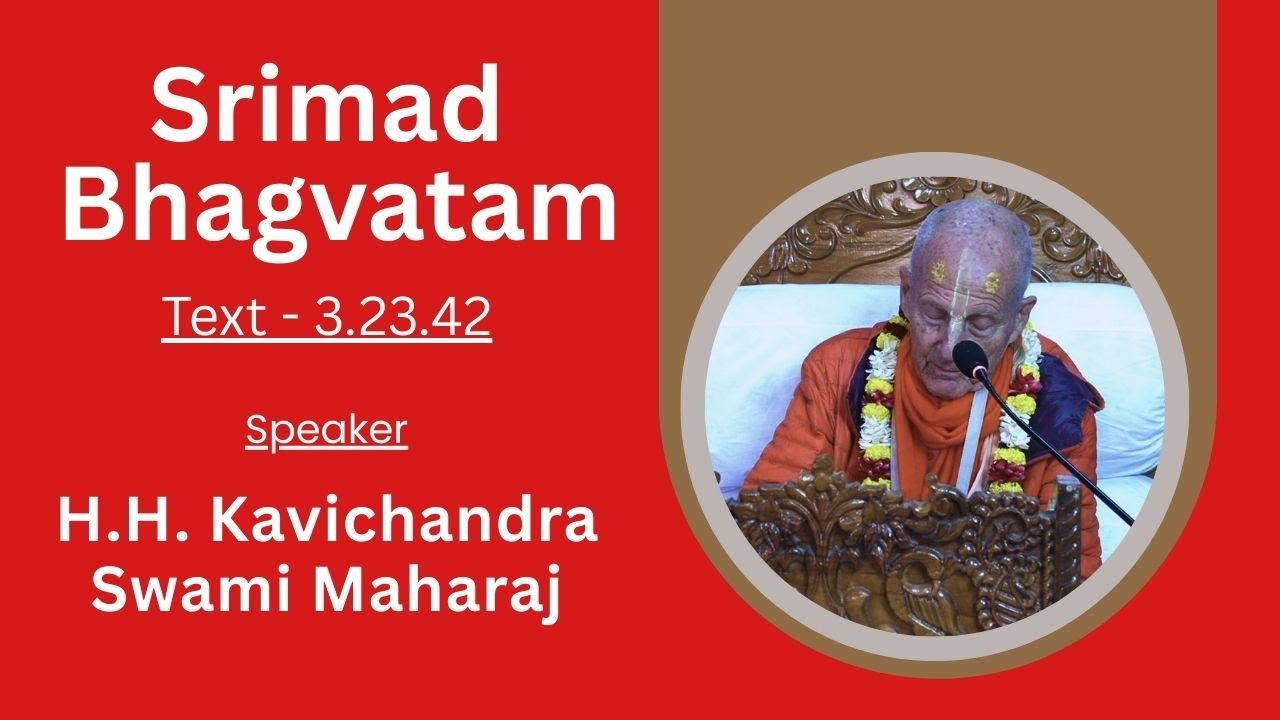
Srimad Bhagavatam 3.23.42, as presented by H.H. Kavichandra Swami Maharaj, celebrates the transformative assurance that comes when one takes shelter of the Supreme Personality of Godhead. The verse emphasizes how unwavering determination, combined with refuge at the lotus feet of the Divine, removes obstacles that seem insurmountable in ordinary life.
Rendered succinctly, the translation conveys: for those who resolutely seek shelter at the lotus feet of the Supreme Personality of Godhead, nothing remains difficult to attain. From those lotus feet emanate sacred rivers such as the Ganges (Ganga), whose purifying power brings an end to the dangers and anxieties of mundane existence.
The expression yair āśritas tīrtha-padaś caraṇaḥ is especially significant. The phrase evokes the image of the Divine feet as tīrthaboth a sacred place and a fordsignalling a crossing point from fear and fragmentation to clarity and freedom. By invoking the Ganges and other sanctifying waters, the verse situates devotion (bhakti) and surrender not as passive acts, but as dynamic movements that carry the practitioner beyond worldly turbulence.
Readers encountering this teaching often recognize a familiar inner terrain: moments of uncertainty, effort that feels fruitless, and the question of where genuine strength can be found. The Bhagavata Purana answers by linking determination with surrenderkriyā aligned with śaraṇāgatiso that spiritual effort is steadied by the assurance of higher grace. In this synthesis, courage is not self-invented; it is awakened by reliance on a transcendent source.
The symbolism also supports a wider dharmic unity. Across Hinduism, Buddhism, Jainism, and Sikhism, water and crossing-over imagery signal purification, resilience, and the journey beyond suffering. Jain thought honors the Tirthaṅkara as the “ford-maker,” guiding beings across the stream of saṁsāra. Buddhist literature frequently imagines awakening as crossing the flood to the further shore. Sikh traditions cherish sacred sarovars that cultivate remembrance and inner purity. In this light, tīrtha is a shared civilizational metaphor that invites mutual respect and celebrates diverse paths of spiritual ascent.
Practically, the verse encourages consistent sādhana anchored in devotion to Krishna (Vishnu), with the confidence that the very source of the sacred rivers is also the source of inner restoration. Determination here is not rigidity but stable intention, made supple by humility. When the heart bows to the lotus feet, the disciplines of meditation, mantra, and service gain an ease and luminosity that sheer willpower alone cannot produce.
Ultimately, Srimad Bhagavatam 3.23.42 offers a contemplative pathway for spiritual resilience. It affirms that refuge at the lotus feet of the Divine can dissolve fear, clarify purpose, and deepen compassion. By honoring the shared symbols of tīrtha and the sanctity of sacred waters, the teaching speaks across dharmic traditions, nurturing unity while preserving the distinctive riches of each path.
Inspired by this post on Dandavats.
