
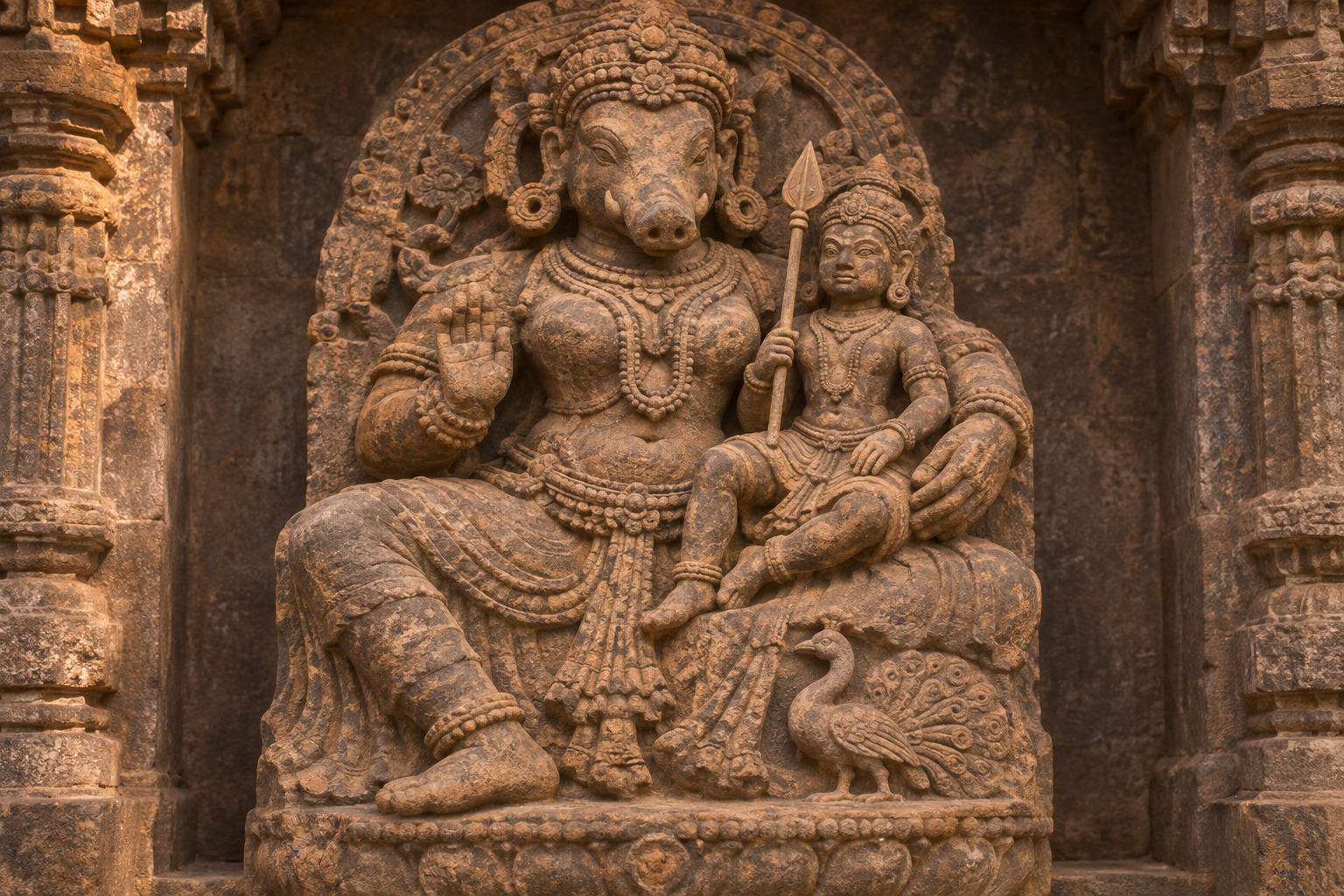
You may recognize Varahi’s boar-like face and still wonder why Kartikeya, the warrior deity, is resting on her lap. The scene looks intimate, but it is not merely a divine family portrait. Its arrangement gives you the first clue: active martial power has been placed within the care of protective Shakti.
Ancient sculptures associated with Odisha’s temple traditions preserve the rare image of Varahi seated with Kartikeya resting on her left lap. If you encounter this composition in a temple, museum, photograph, or catalogue, you can read it more accurately by attending to the relationship between the figures before assigning meanings to their individual attributes.
Identify the relationship, not just the two deities
Iconography is often approached as a checklist: identify a face, weapon, vehicle, ornament, or hand gesture, and then name the deity. That method helps, but it is incomplete here. Varahi and Kartikeya are not simply sharing a sculptural panel. One figure physically supports the other.
- Varahi is seated, giving the composition its stable centre.
- Kartikeya occupies her left lap rather than standing independently beside her.
- His resting posture makes shelter, trust, and closeness visible.
- The contact between their bodies is therefore part of the image’s meaning, not empty space filled for convenience.
This distinction matters. Two deities standing side by side may express alliance, shared presence, or participation in the same sacred event. A deity held on another’s lap introduces a more intimate visual grammar: support, guardianship, dependence, affection, or maternal care.
When identifying a damaged or poorly photographed sculpture, do not treat youthfulness alone as proof that the smaller figure is Kartikeya. Check the recorded provenance, any surviving attributes, the surrounding figures, and a reliable catalogue description. The Odisha examples give us a documented composition, but that does not make every small figure on Varahi’s lap Kartikeya.
Why the left-lap placement changes the image
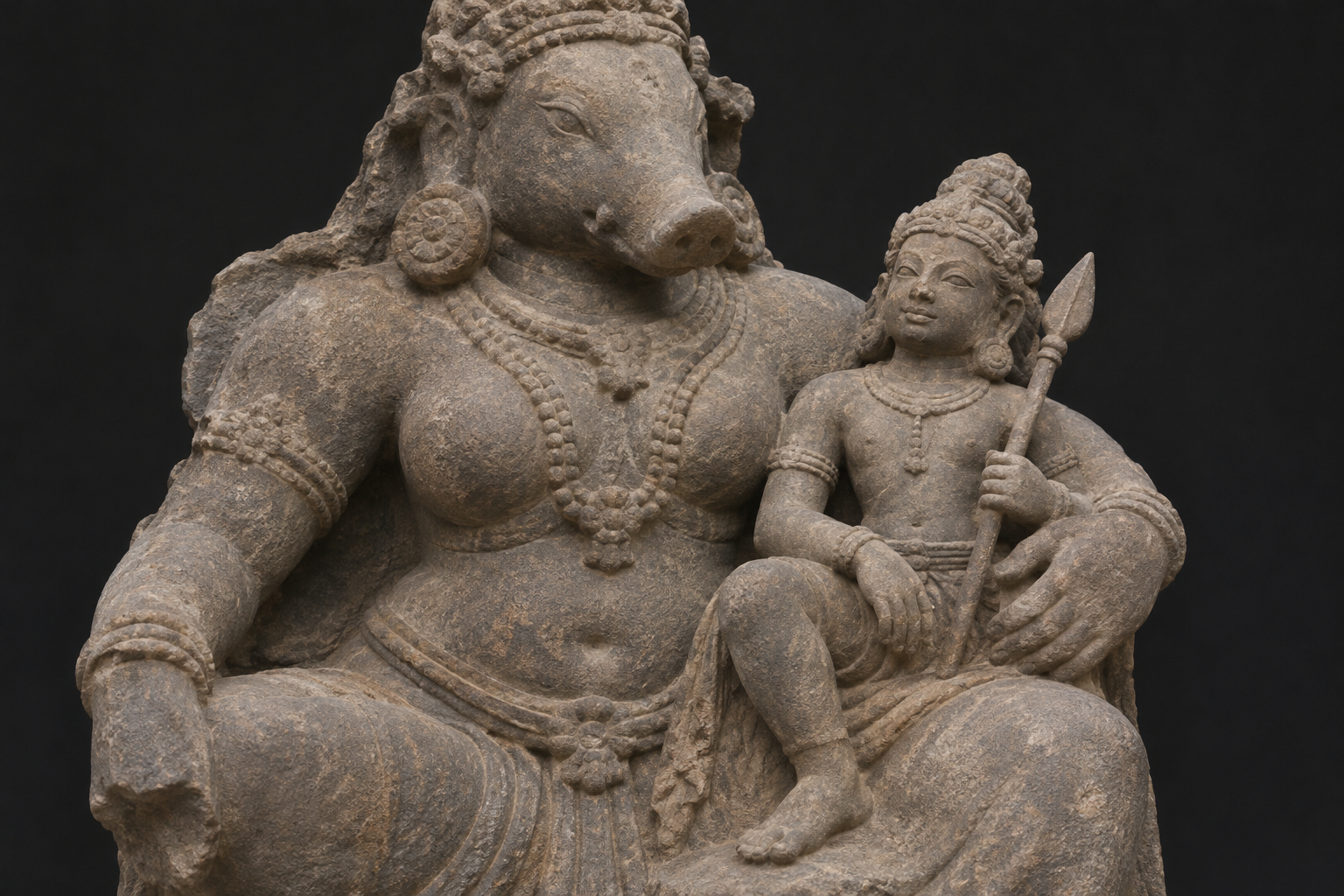
The lap is the decisive feature. Kartikeya is widely approached through courage, command, and martial readiness. In this composition, however, he is not shown advancing into conflict. He rests. The sculptor has not erased his power; the sculptor has shown that power in a protected state.
That reversal prevents a shallow reading of strength. Hindu sacred art does not always separate tenderness from force or care from sovereignty. A warrior may receive protection without becoming weak. A formidable goddess may nurture without losing her formidable character. The image asks you to see these qualities as mutually sustaining.
The detail that Kartikeya rests on the left lap should be recorded precisely, but precision is not permission to invent an explanation. Unless an inscription, established local tradition, or securely identified textual context explains the side, the responsible conclusion is limited: the surviving composition places him on Varahi’s left lap. The meanings of resting, bodily support, and intimacy are visually clear; a universal symbolic meaning for the left side is not established by the image alone.
If you are writing a caption, use two sentences instead of compressing observation and interpretation into one claim: “Varahi is seated with Kartikeya resting on her left lap. The arrangement may express maternal compassion, protection, and the sheltering power of Shakti.” That wording tells your reader what can be seen and then marks the theological reading as interpretation.
Motherhood, protection, and Shakti can coexist
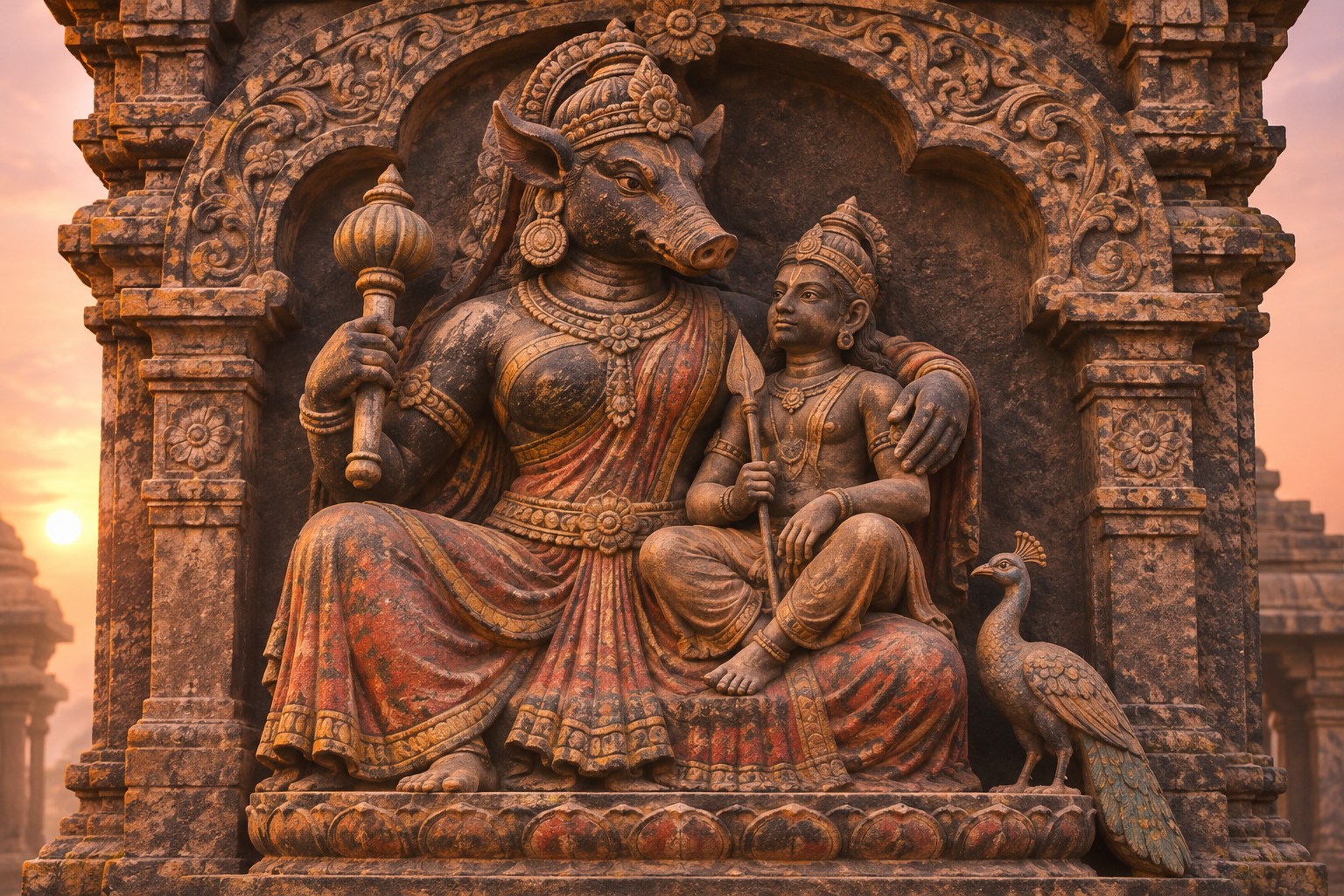
The composition becomes clearer when you allow several related meanings to operate together. Sacred images rarely have to choose between a single emotional meaning and a single theological one.
- Divine motherhood: Varahi performs the maternal act of holding and supporting. You need not turn that visual role into a literal genealogical claim. Iconographic motherhood can describe a relationship of care, refuge, and responsibility.
- Compassion: Kartikeya’s repose creates an atmosphere of trust. Compassion here is embodied rather than declared: the stronger figure provides a place in which another can rest.
- Protection: The lap functions as a zone of safety. Varahi’s fierce appearance and her protective care belong to the same divine capacity; the force that confronts danger is also the force that shelters what is precious.
- Shakti: Kartikeya’s martial identity is held within the goddess’s power. A careful reading sees relationship rather than rivalry: divine force is sustained, guarded, and made purposeful by divine energy.
This is why “mother and child” is useful but insufficient as a label. It catches the tenderness while risking the loss of the image’s theological force. “Warrior protected by Shakti” restores that force but can sound too abstract if it ignores the bodily affection of the scene. Keep both levels in view.
The image also corrects two common assumptions. Fierceness is not the opposite of compassion, and receiving care is not the opposite of strength. Varahi’s protective character gives weight to her tenderness. Kartikeya’s martial character gives weight to his repose. Each figure makes the less obvious dimension of the other visible.
How to examine the sculpture without overclaiming
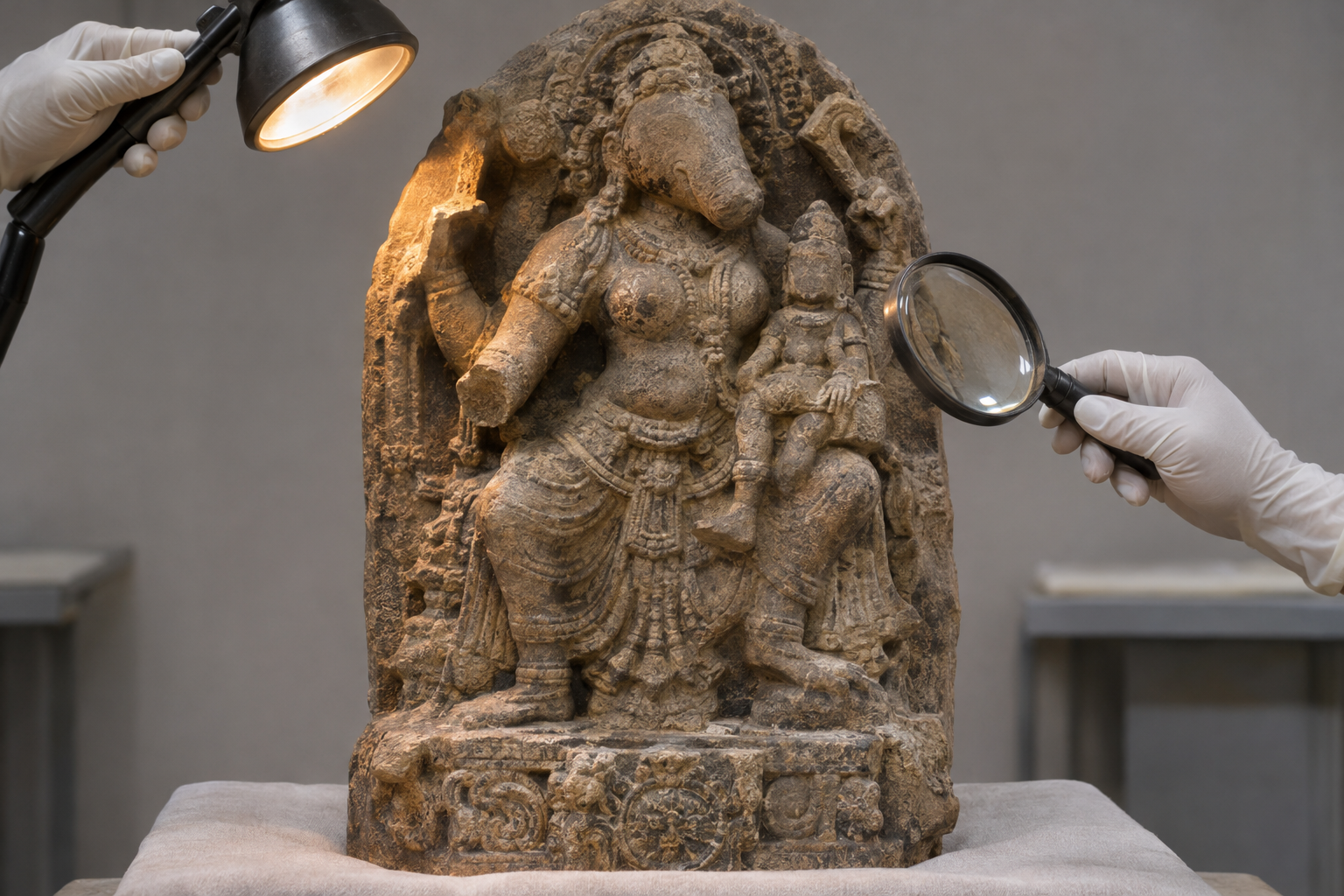
A disciplined viewing method will help you appreciate the image without turning a plausible interpretation into a supposed fact. Use the following sequence when you encounter an original sculpture or a reproduction.
- Describe what survives. Note the seated goddess, the figure on her lap, their orientation, and the points of physical contact. Record broken faces, arms, or attributes instead of silently reconstructing them.
- Confirm the identification. Look for Varahi’s characteristic boar-like visage and for evidence supporting the identification of the smaller figure as Kartikeya. Use provenance and cataloguing alongside visible features.
- Record the placement exactly. Write “left lap” when that is what the image shows. Do not reduce the relationship to the vague phrase “shown together.”
- Separate observation from interpretation. “Kartikeya rests on Varahi’s lap” describes the composition. “The scene conveys divine motherhood” interprets it. Both statements can be valuable, but they do different work.
- Preserve the regional context. Where the provenance supports it, say Odisha or eastern Bharat. Do not turn one documented regional expression into an unsupported claim about every Hindu artistic tradition.
- Use calibrated language. Say the image “may express,” “can be read as,” or “brings together” compassion, protection, and Shakti. Reserve “proves” or “must mean” for cases with much stronger evidence.
Rarity requires the same discipline. A rare composition is not automatically secret, forbidden, or marginal, and it does not by itself establish a lost sect or forgotten ritual. Rarity tells you that the arrangement deserves careful documentation. It does not supply the missing historical explanation.
You should also resist assigning a date from appearance alone. Weathering can make a recent object look older, while conservation can make an ancient surface look unexpectedly clear. If no reliable date accompanies the sculpture, describe it as an image from the relevant tradition rather than supplying a century that the available evidence cannot support.
Key takeaways for reading the image
- The rare eastern Indian composition is documented in ancient sculptures connected with Odisha’s temple traditions.
- Varahi’s seated posture and Kartikeya’s place on her left lap make bodily support central to the scene.
- The image can carry maternal, compassionate, protective, and Shakti-centred meanings at the same time.
- Divine motherhood here describes a visible relationship of care; it should not automatically be treated as a literal genealogical statement.
- The left-lap detail should be recorded, but its specific symbolism should not be invented without additional evidence.
- A sound explanation tells the reader first what the sculpture shows and then what that arrangement may mean.
The next time you meet this image, pause before naming every attribute. Follow the line of support from Varahi’s seated body to the resting Kartikeya. That simple act of looking will keep the sculpture’s central insight intact: in this eastern Hindu vision, martial strength does not stand outside compassion. It rests within the protection of Shakti.
References

Leave a Reply
You must be logged in to post a comment.