
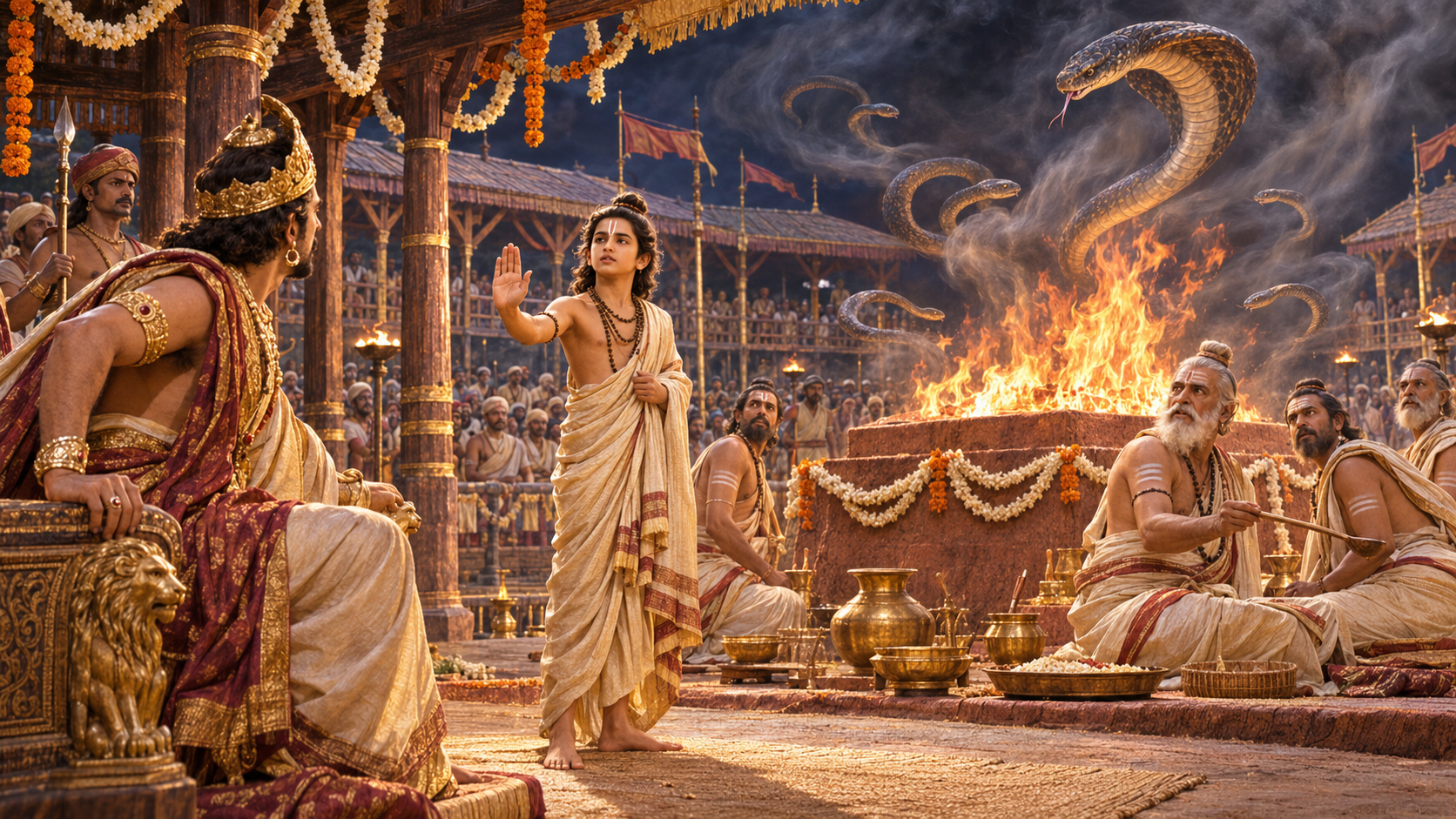
You may have come to this episode with a simple question: how could praise halt a king’s sacrifice? The answer is not that Astika found a polite way to flatter power. He understood where power was still morally reachable.
Janamejaya’s decision had already acquired the weight of royal authority and sacred procedure. Astika did not try to overpower that machinery. He changed the kind of choice placed before the king, turning a destructive undertaking into a test of generosity, truthfulness and self-command.
The sequence matters more than the miracle

Astika’s intervention is prepared long before he reaches Janamejaya. In Chapter 49 of the Astika Parva, his mother tells him that his birth has a defined purpose: to stop the sacrifice and save the Naga clan. He therefore enters the royal assembly with a settled mission, not a vague hope that something good might happen.
That detail matters. Astika is not improvising for personal advantage. He knows what must stop, whom the intervention must protect and who possesses the authority to grant his request. His praise is shaped by that clarity.
- Astika enters without making the king defend his honour. He does not begin by humiliating Janamejaya before the assembly.
- He establishes a hearing through praise. His speech recognises the dignity of the king and the gravity of the royal setting.
- The king’s favour creates an opening. Praise moves Janamejaya from presiding over a fixed course of action to considering what he can give.
- Astika turns the opening toward his actual purpose. He asks for the sacrifice to end rather than seeking wealth, position or a private advantage.
- Janamejaya accepts the interruption. The rite stops, and the Naga clan is saved from destruction.
The English expression snake sacrifice can obscure the ethical scale of the episode. The danger is not presented merely as the removal of troublesome animals. An entire Naga clan faces destruction. Once you see that collective stake, Astika’s intervention becomes more than a clever exchange between a sage and a king. It becomes an answer to punishment that has exceeded any individual wrong.
Notice also what Astika does not do. He does not confuse access with surrender, and he does not allow praise to replace the request. Praise opens the door; asking for cessation is the purpose for which he walks through it.
Why praise succeeds without becoming mere flattery
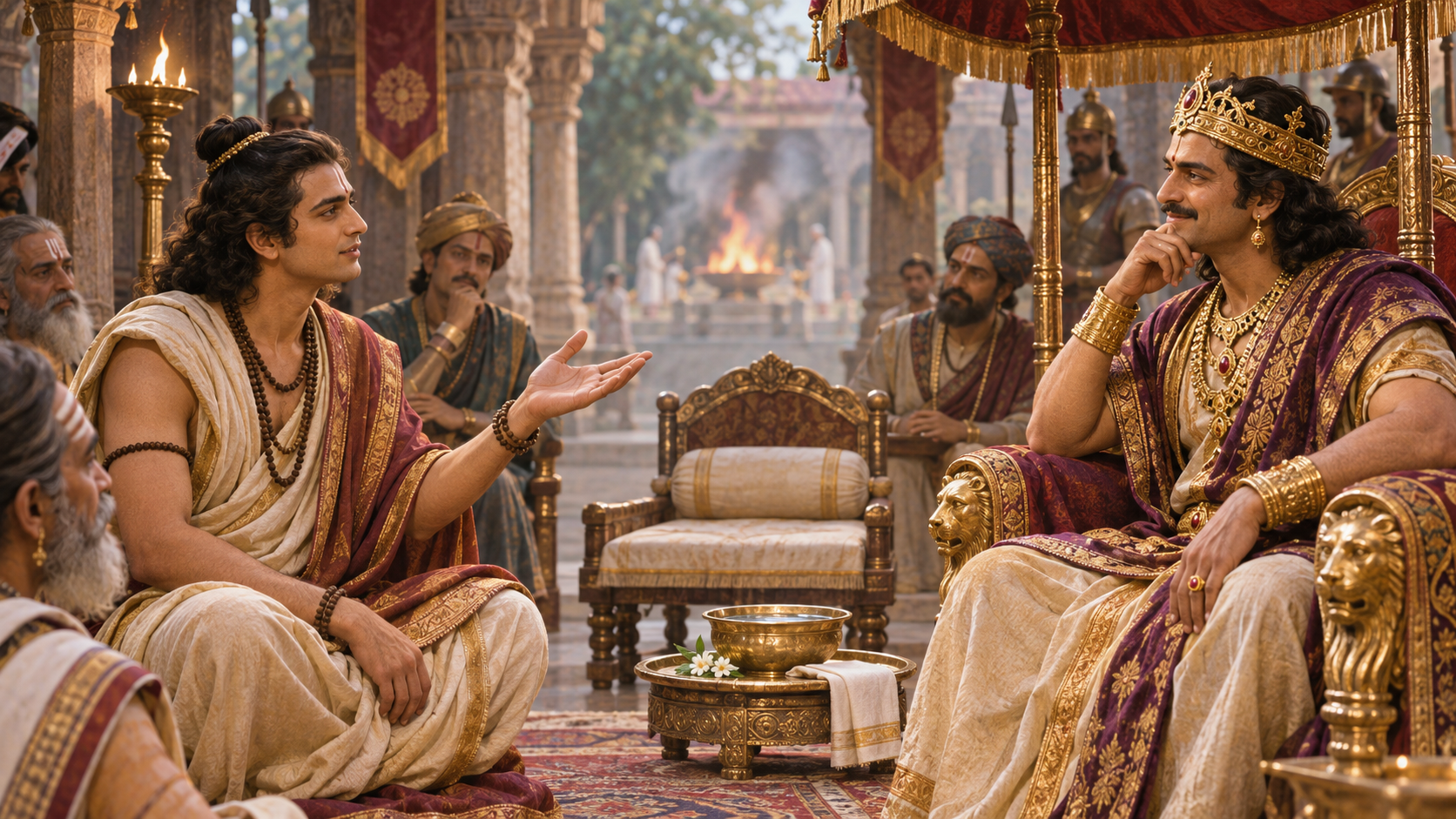
A direct accusation can force a ruler to consider two questions at once: whether the action is wrong and whether his status is under attack. The second question easily overwhelms the first. The narrative logic of Astika’s approach is to separate them. He confirms Janamejaya’s dignity and then gives that dignity a better expression.
His speech works through three movements:
- Access: Astika shows that he understands the world of the king and the seriousness with which the ceremony is being conducted.
- Moral reflection: Praise holds up an image of Janamejaya as a ruler capable of generosity, honour and fidelity to his word.
- A binding request: When the moment to ask arrives, stopping the sacrifice can be presented as an enactment of those virtues rather than a humiliating defeat.
This is why praise and flattery should not be treated as synonyms. Flattery manufactures admiration to secure the speaker’s advantage. Dharmic praise must remain answerable to truth, intention and consequence. Astika’s words are strategic, but the strategy is subordinate to the preservation of life.
You can test praise with four questions before calling it wise speech:
- Is it truthful? If you must invent a virtue, you are manipulating rather than reminding.
- What is its intended end? Praise used to obtain status for yourself is not morally equivalent to praise used to stop collective harm.
- Does the request follow clearly? Pleasant words without a definite appeal may soothe power while leaving the injury untouched.
- Who bears the cost? A supposedly peaceful solution is suspect if vulnerable people must continue suffering so that the powerful person never feels uncomfortable.
Calling Astika’s method manipulation alone is therefore too shallow. Calling it an innocent compliment is equally shallow. It is intentional rhetoric disciplined by a protective purpose. The moral quality lies not in sweetness of tone by itself, but in the truth it can activate and the destruction it can stop.
The sacrifice tests ritual authority as well as royal anger
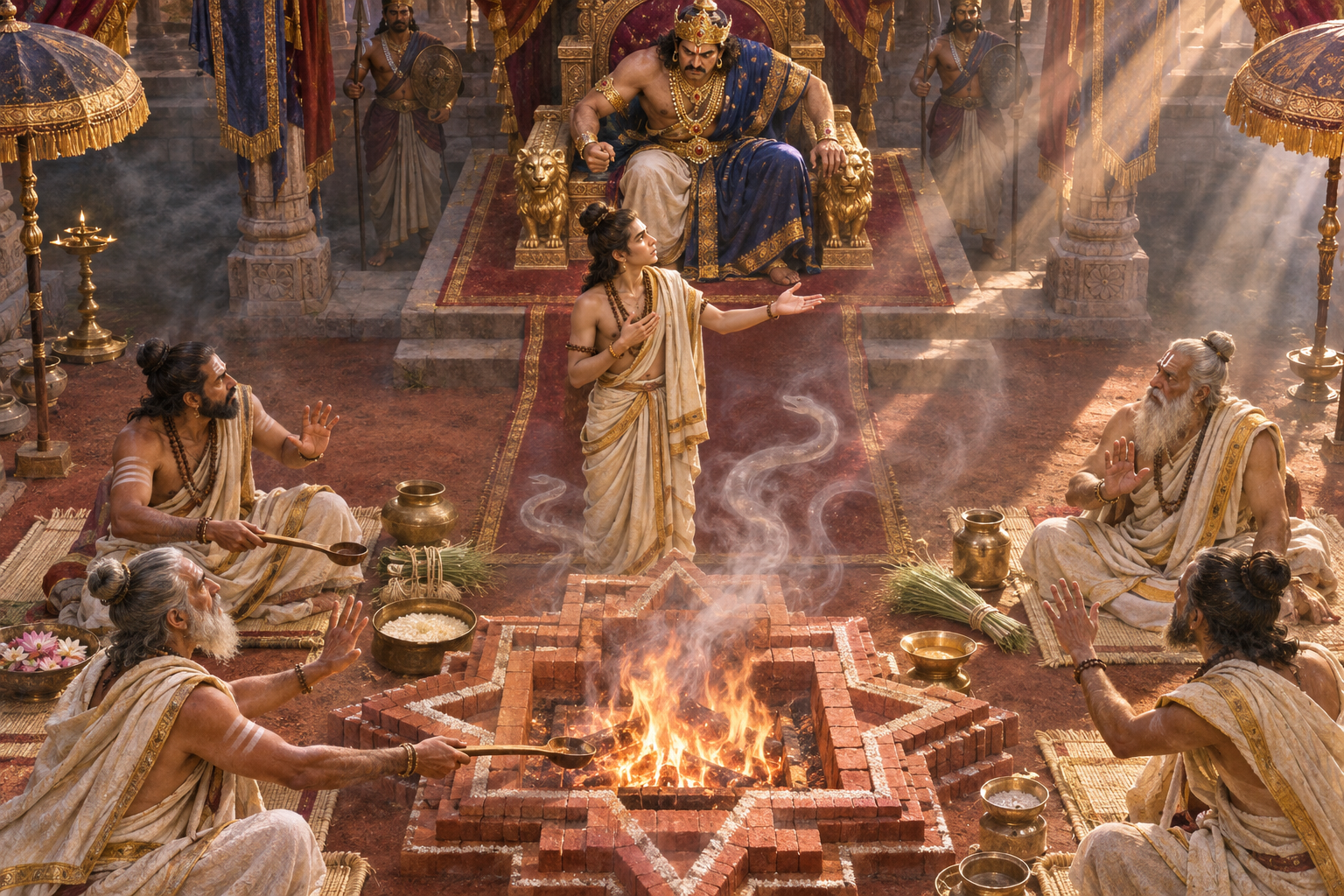
The most disturbing feature of the episode is not only that the Naga clan is endangered. The destructive undertaking has acquired sacred form. A royal command, an organised ceremony and the prestige of ritual action can make reversal appear more difficult with every passing moment.
A careful reading need not treat the episode as a rejection of yajna. It does reject the idea that ritual form is a moral blank cheque. Correct performance cannot make every intention righteous, and ceremonial momentum cannot relieve a ruler of responsibility for the result.
The episode gives you three useful tests for any action defended by authority, tradition or procedure:
- Responsibility: Is the action directed at the person responsible for a wrong, or has anger expanded until an entire group is treated as guilty?
- Proportion: Is the response still answering a wrong, or has retaliation become an independent appetite that demands more victims?
- Interruptibility: Can the person in authority hear a morally serious objection and stop, or has completing the process become more important than preventing its consequences?
The third test brings Janamejaya back to the centre of the story. If we admire only Astika’s intelligence, we miss that the rescue also requires a king who can accept interruption. Janamejaya’s willingness to honour his commitment and end a prestigious undertaking is not a footnote to Astika’s victory. It is the act that makes the rescue possible.
Changing course need not diminish authority. A ruler who cannot reverse a destructive order is no longer mastering events; he is being carried by his own command. Janamejaya’s better exercise of sovereignty occurs when he stops what he had the power to continue.
This is a distinctly useful Dharmic insight. Restraint is not passivity, and reconsideration is not necessarily weakness. Authority proves its moral seriousness when it can listen after a decision has been announced, distinguish dignity from stubbornness and bring its own machinery to a halt.
How to apply Astika’s method in a hard conversation

Do not imitate only the surface tactic by complimenting a decision-maker and hoping for mercy. Astika’s effectiveness begins before he speaks: his purpose is precise. You can adapt that structure when a harmful decision still depends on someone who retains discretion.
- Write the required outcome in one sentence. Use an observable action: stop the proceeding, pause the vote, withdraw the order or hear the affected party. Avoid a demand such as be fair, which allows agreement without change.
- Identify a real virtue or commitment. It may be the person’s stated concern for justice, the institution’s duty of impartiality or a promise already made. Use only what you can honestly affirm.
- Open by invoking that standard. The aim is to make the better decision consistent with the listener’s professed identity, not to declare that everything already done is acceptable.
- Separate the person from the destructive momentum. Give the listener room to change the decision without requiring a public confession of total moral failure.
- Make one concrete request. Do not bury the needed action beneath a catalogue of every grievance. Astika’s speech has one decisive purpose.
- Decline substitutes that leave the harm intact. Praise has failed if it earns you access, attention or a personal benefit while the endangered group remains unprotected.
A concise intervention can therefore have two parts. First, name the genuine standard the other person wants to embody. Second, state the exact action that would embody it now. The first sentence creates an honourable path; the second prevents courtesy from becoming evasion.
This approach has limits. It is persuasion, not a universal substitute for accountability. Do not rely on conciliatory speech when doing so would expose someone to danger, conceal wrongdoing that must enter the public record or require you to say what you know is false. Astika’s lesson is not that praise always works. It is that truthful praise can be a disciplined form of intervention when the listener still has the freedom to choose.
Key takeaways
- Astika approaches Janamejaya with a predetermined duty: stop the sacrifice and preserve the Naga clan.
- His praise is a means of gaining a morally effective hearing, not approval of collective destruction.
- The decisive move is the concrete request for cessation; praise that never reaches the request would be empty diplomacy.
- Janamejaya’s willingness to stop is part of the episode’s teaching about kingship, self-command and fidelity to one’s word.
- The story distinguishes sacred procedure from dharma: a ritual undertaking remains answerable to intention, proportion and consequence.
- You can apply Astika’s method by pairing one truthful appeal to a recognised virtue with one precise action that must be taken.
The next time you face a harmful decision protected by prestige, write those two sentences before you enter the room. If the praise is false, discard it. If the request is vague, sharpen it. Astika’s lesson begins where honest speech becomes decisive action.
References

Leave a Reply
You must be logged in to post a comment.