
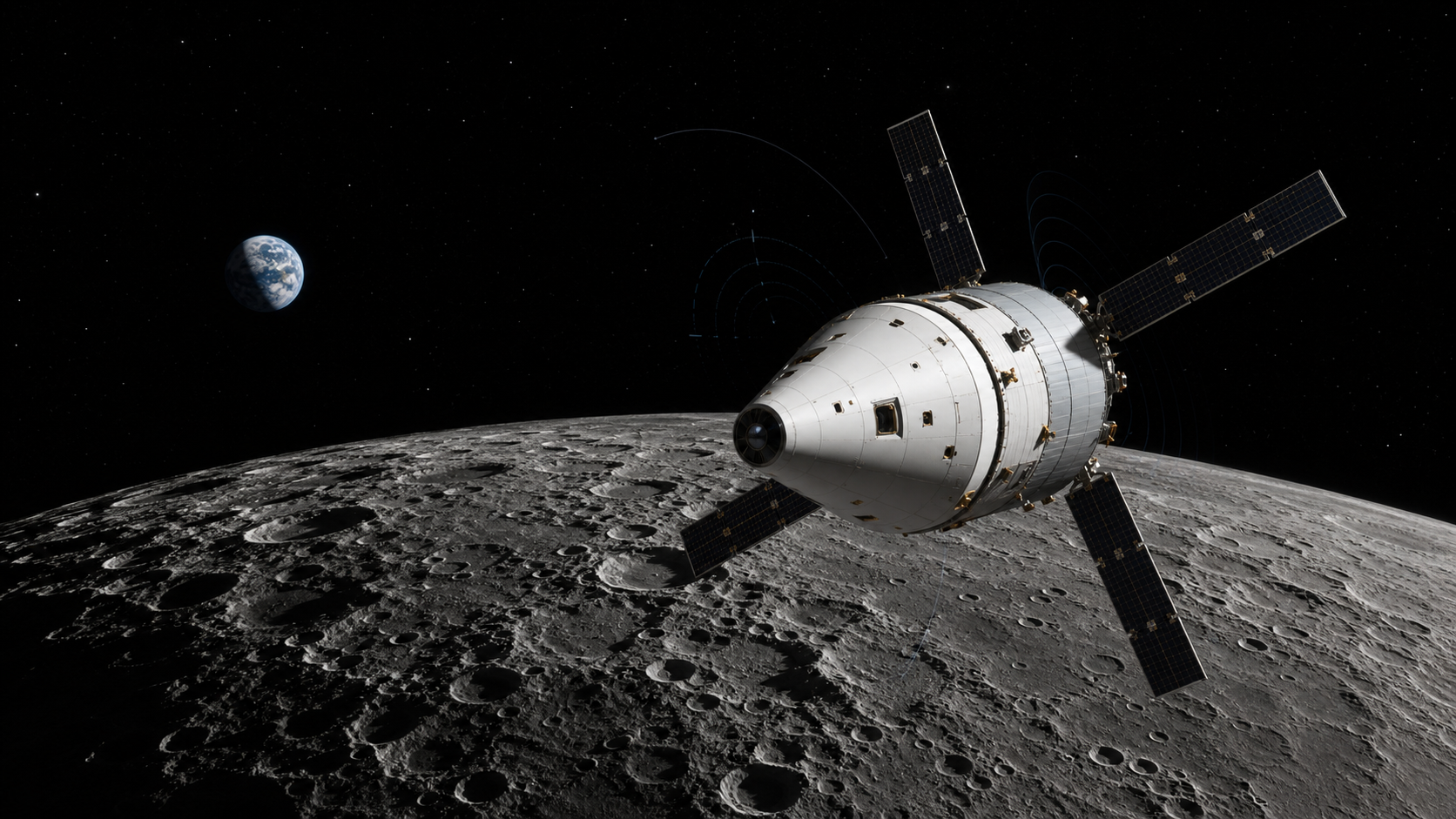
If someone tells you that Artemis I never reached the Moon, you don’t have to choose between blind trust and blanket suspicion. You can reduce the dispute to a precise claim, identify what that claim predicts, and then ask whether observations made by different instruments fit those predictions.
The narrow claim is that an uncrewed Orion spacecraft launched in November 2022, travelled to the Moon, entered a distant lunar orbit, departed that orbit and returned safely after approximately twenty-five and a half days. The useful question for you is not whether every space-agency image looks persuasive. It is whether the trajectory, communications, timing, reentry and recovered spacecraft form one coherent chain.
Verify the mission that actually flew
Start by correcting the most common category error: Artemis I was not a lunar landing. It was an uncrewed technology demonstration of the Space Launch System, Orion and the European Service Module under deep-space conditions. A photograph of astronauts on the surface was therefore never part of the claim.
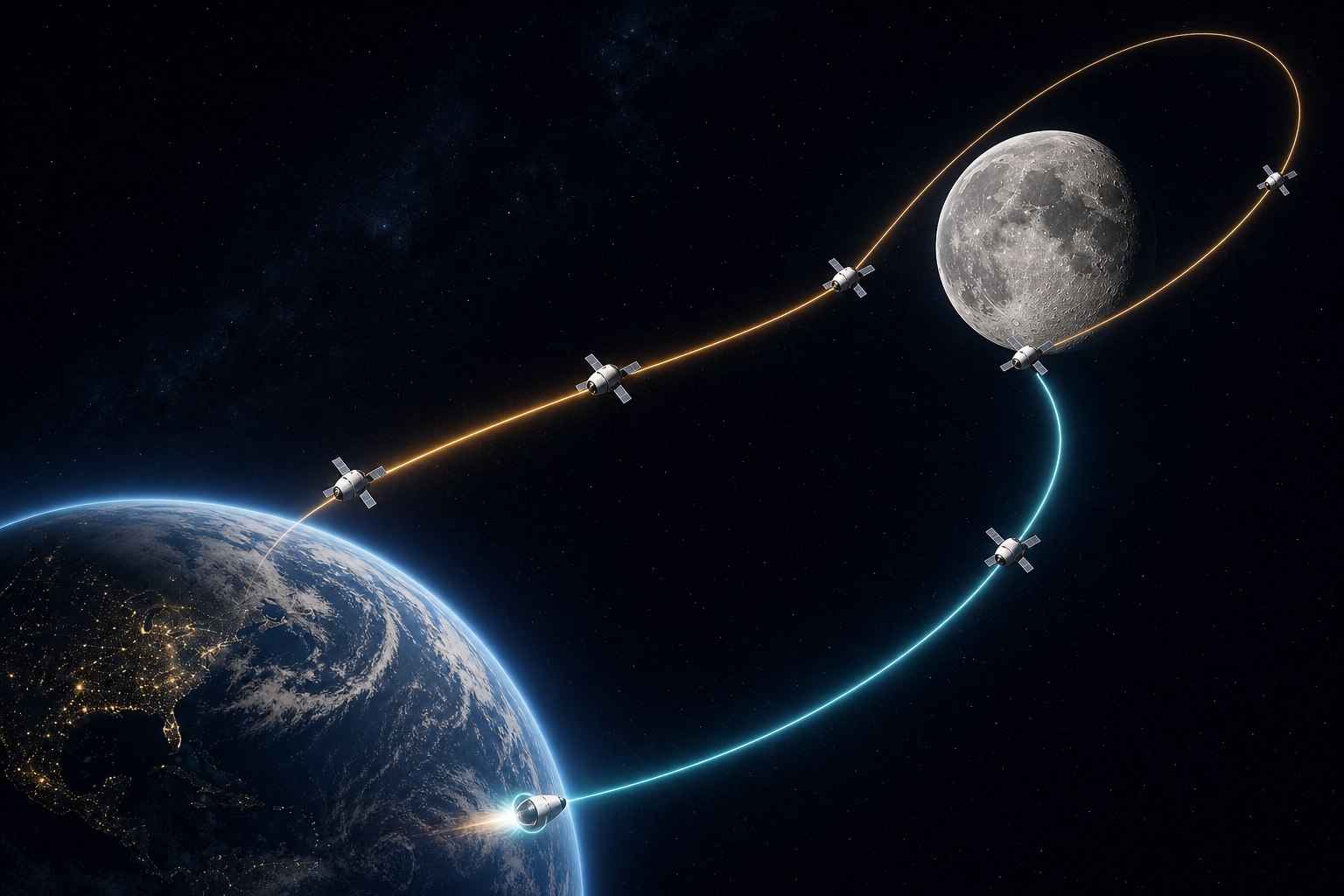
The mission profile contained several distinct stages that could be checked against one another:
- The Space Launch System placed Orion on the initial Earth-departure path.
- The upper stage performed translunar injection, sending Orion toward the Moon on a free-return corridor.
- An outbound powered flyby brought Orion to roughly 130 kilometres from the lunar surface and directed it toward a distant retrograde orbit.
- Orion spent several days in that stable, high-altitude orbit, tens of thousands of kilometres from the Moon.
- A departure manoeuvre and return powered flyby placed it on the Earth-bound trajectory.
- Orion approached Earth at close to 11 kilometres per second, performed a skip-entry over the Pacific and was recovered for inspection.
This sequence matters because a fabricated landing and a fabricated flyby would require different evidence. For Artemis I, the central test is whether a moving spacecraft followed the predicted path through deep space and returned with the energy, timing and physical condition expected from that path.
Key takeaways
- Test the claim Artemis I made: flyby, distant retrograde orbit and return, not a surface landing.
- Give more weight to measurements predicted in advance than to images interpreted afterward.
- Combine trajectory, radio, timing, reentry and hardware evidence; no single photograph has to carry the case.
- Distinguish a different organisation from a genuinely different measurement method.
- Accept only a proportionate conclusion: Artemis I is strongly supported by converging evidence, not by an expectation of institutional infallibility.
Build a chain that does not depend on one photograph
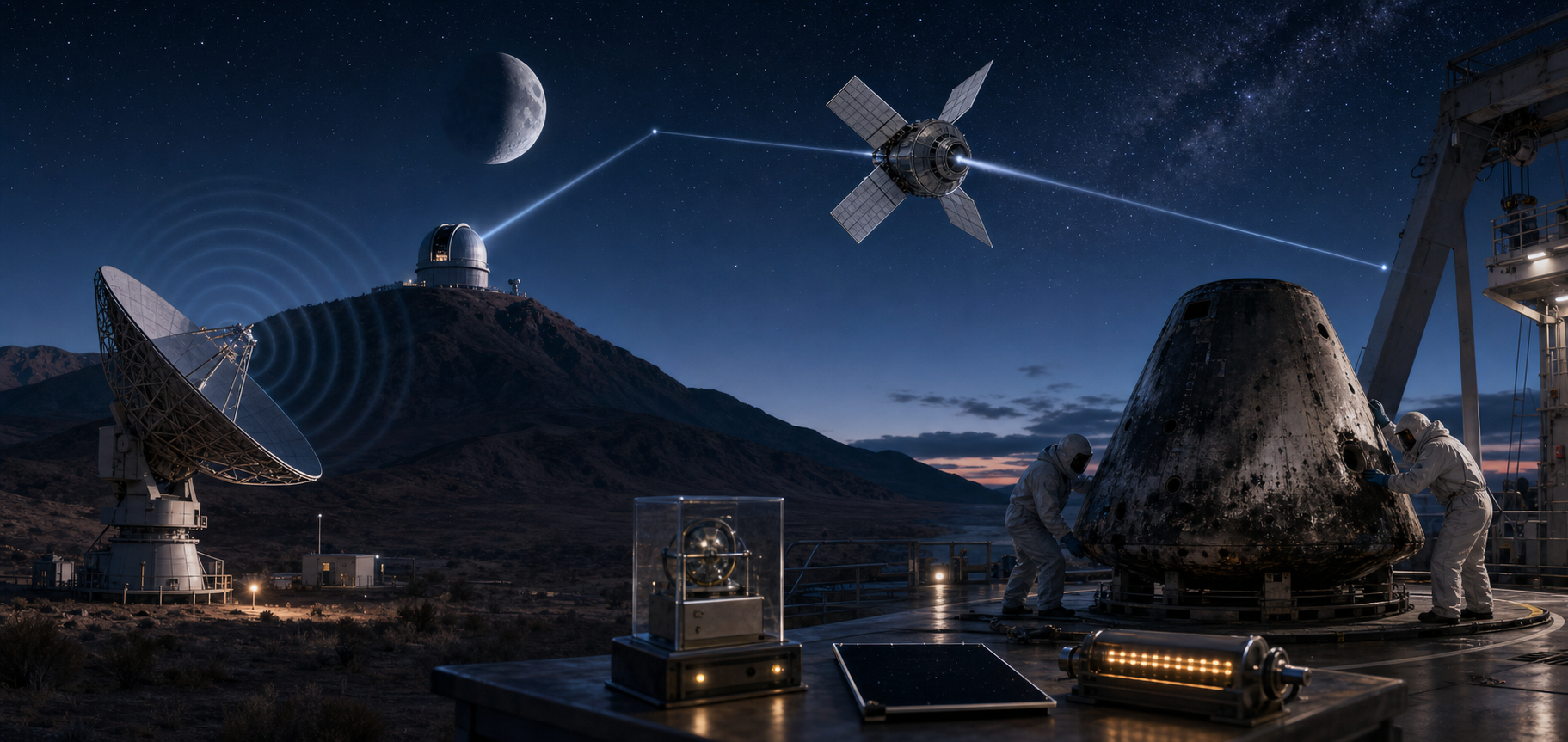
A spacecraft picture can be edited, mislabelled or misunderstood. That makes a picture weak when isolated. It does not make the whole mission weak, because a lunar flight produces effects that must agree across time, distance, direction and velocity.
Begin with predictions that existed before the observation
Public ephemerides gave Orion’s predicted position as a function of time. They allowed observers to calculate where to point an instrument and when a communications pass should occur. This is a much stronger test than searching an image afterward for something that seems compatible with the story.
A valid prediction is capable of failing. If Orion appeared in the wrong region of the sky, arrived hours away from the expected time, showed the wrong Doppler behaviour or produced an incompatible signal delay, the proposed trajectory would have a serious problem. The fact that observed passes could be correlated with published positions and communication windows is therefore evidentially important.
Combine range, Doppler, direction and timing
Range measurements address distance. Doppler measurements reveal motion toward or away from a receiver. Optical or radio pointing constrains direction. Round-trip light time adds another distance-sensitive check because radio signals cannot travel instantaneously.
One locally generated radio carrier would not establish a lunar voyage. A carrier whose frequency changes at the predicted times is more informative. Add the correct apparent direction, deep-space signal delay and continuity through scheduled manoeuvres, and a false explanation has to imitate several linked physical quantities rather than one convenient observation.
The Deep Space Network tracked Orion using range and Doppler measurements. ESA’s ESTRACK network supported communications with the European Service Module, while professional and amateur observers reported receptions during expected passes. These are not all equally independent: mission partners share objectives and operational information. They nevertheless use separate facilities, and outside observations add a further layer beyond mission operations.
Follow the chain all the way back to Earth
Verification should not stop when the spacecraft disappears behind the Moon. The outbound flyby, distant retrograde orbit, departure manoeuvre, return flyby and Earth approach have to form a continuous dynamical history. A trajectory that fits one pass but cannot produce the next event is not an adequate explanation.
The return creates an especially demanding check. Orion arrived at nearly 11 kilometres per second and used a skip-entry profile to control forces and landing dispersion. Communications handovers, guided entry and Pacific recovery occurred as parts of the same timed sequence. Engineers could then compare recorded flight behaviour with the condition of the recovered heat shield and other hardware. Recovery alone would not prove a lunar flight, but recovered hardware that matches the recorded deep-space and reentry history strengthens the chain.
Use a six-step audit when someone challenges the flyby

You do not need your own deep-space antenna to evaluate the reasoning. Use the following audit to separate a testable objection from a suspicion that changes shape whenever evidence appears.
- Write down the exact proposition. Use a bounded sentence such as: Orion did not travel on the reported Earth-Moon trajectory. Do not begin with the much broader claim that everything about spaceflight is false.
- List the events the reported trajectory requires: translunar injection, outbound lunar flyby, distant retrograde orbit, departure, return flyby, high-speed Earth entry and recovery. This prevents one puzzling image from replacing the entire mission history.
- Separate prediction from retrospective interpretation. Ask whether the spacecraft position and contact window were published or calculable before the pass. A later explanation may be useful, but it does not have the same force as a prediction that risked being wrong.
- Demand more than a detected carrier. Look for agreement among position, time, range, Doppler change and signal delay. The measurements do different jobs, so their agreement matters more than repeated copies of the same observation.
- Grade independence instead of merely counting organisations. A second press release is not a second measurement. A separate tracking station is better; an outside observatory using another instrument and matching a prior ephemeris is better still.
- Make the alternative explanation do equal work. It must account for the changing sky position, velocity-sensitive Doppler pattern, light-time behaviour, sequence of lunar manoeuvres, timed Earth return and recovered spacecraft. Prefer the explanation that predicts the whole chain with the fewest special exceptions.
This audit also gives you a stopping rule. If a critic can name the measurement that would change their view, the disagreement remains testable. If every possible result is dismissed as part of an unlimited conspiracy, the position no longer makes a risky prediction and cannot be settled by collecting one more image.
Handle the familiar objections at the right evidentiary level
Why are there no stars in many spacecraft images?
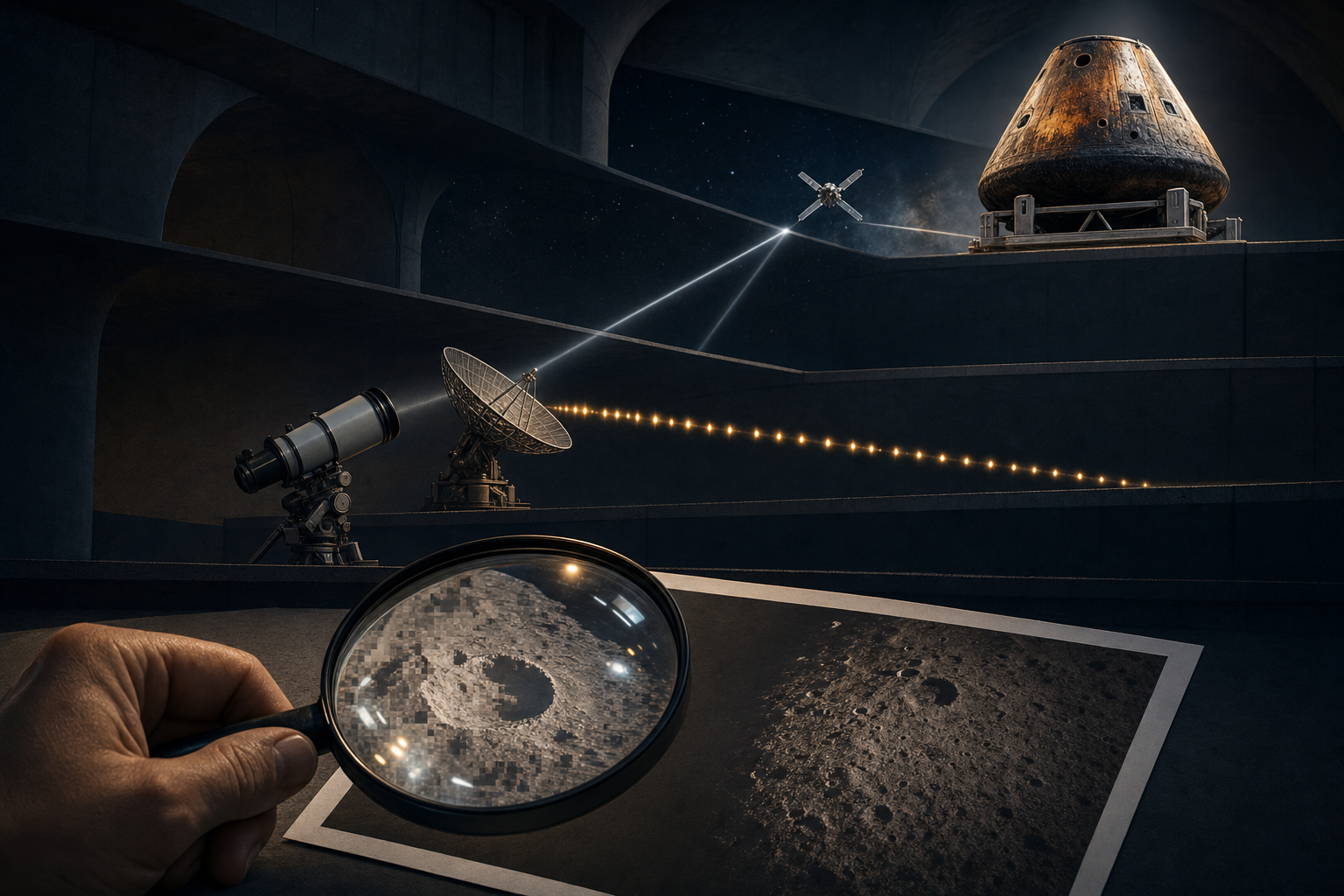
A camera exposed for the brightly illuminated Moon, Earth or spacecraft has little chance of recording faint stars in the same frame. Short exposure times and settings chosen to preserve bright surface detail leave the star field below the visible threshold. You can see the same principle whenever a camera exposes for a bright daytime subject rather than the dim background.
A starless black sky is therefore not positive evidence of a studio. To make the objection useful, you would need the exposure settings and a prediction of which stars should have exceeded the camera’s detection threshold under those settings. Without that calculation, the objection relies on intuition about photography rather than a failed mission prediction.
Does radiation make the journey impossible?
Radiation is a real engineering constraint, not an automatic barrier that destroys every vehicle leaving low Earth orbit. Exposure depends on the path, time spent in each region, shielding and the sensitivity of people or electronics. Artemis I was uncrewed and carried dosimeters so that the environment could be characterised before later crewed missions.
The right questions concern measured dose, shielding performance and design margins. Simply naming the radiation belts does not show that the reported trajectory was impossible. Equally, mission planners should not treat radiation as trivial; the purpose of an uncrewed demonstration is to replace assumptions with measurements.
Why isn’t mission video enough?
Video helps you understand orientation and context, but it is not the strongest evidence for distance. A frame does not directly disclose the spacecraft’s range or velocity. Treat imagery as one layer that should agree with telemetry and geometry, not as the foundation of the verdict.
Aren’t the tracking networks all part of the same project?
Some were operational partners, so it would be careless to portray every station as a hostile external auditor. Independence has at least two dimensions: institutional separation and methodological separation. Different facilities can provide useful cross-checks even when their organisations cooperate, while observations made outside the programme reduce shared-control concerns further.
Your task is not to label each institution trusted or untrusted. Ask who controlled the instrument, what was actually measured, whether a prediction preceded the measurement and whether the result can be reconciled with the rest of the trajectory.
Does Chandrayaan 3 prove Artemis I?
No. Bharat’s Chandrayaan 3 soft landing near the lunar south polar region was a separate achievement with its own evidence. It expands humanity’s knowledge of lunar terrain and regolith, but national pride should not be used as a substitute for mission-specific verification. The more disciplined position is to assess each mission on its own predictions and measurements, then notice where independently obtained lunar knowledge fits together.
A dharmic standard leads to confidence without credulity
Dharmic reasoning offers a practical vocabulary for this audit. Pratyaksha concerns observation; in this case, optical sightings, received radio signals and recovered hardware. Anumana concerns inference: measured range, Doppler change and timing imply a particular motion through space. Shabda concerns dependable testimony, strengthened when separate institutions and observers report results that agree with the same physical model.
No one limb should be forced to carry the whole conclusion. Testimony without observable consequences asks too much trust. Observation without inference gives you isolated lights, tones and objects with no account of what they mean. Inference without reliable measurements becomes elegant speculation. Confidence becomes reasonable when observation, inference and corroborated testimony converge.
This analogy does not reduce Hindu, Buddhist, Jain or Sikh traditions to modern laboratory practice. It identifies a shared discipline: pursue satya, exercise viveka and remain willing to correct a conclusion. Jain anekantavada is especially relevant when used carefully. A many-sided view asks you to examine different aspects of a claim; it does not require you to treat a testable trajectory and an unfalsifiable suspicion as equally well supported.
Aryabhata and Varahamihira belong to a Bharatiya tradition that treated celestial motion as something to observe, model and reason about. Honouring that inheritance means more than invoking ancient achievement. It means applying the same intellectual virtues to a modern claim, including one made by a foreign institution.
The proportionate judgement is clear: the reported Artemis I lunar flyby is supported by a mutually consistent mission sequence, predictable orbital geometry, range and Doppler tracking, signal timing, observations beyond a single facility, high-speed reentry and inspection of recovered hardware. That conclusion does not require you to believe that agencies never make mistakes. It requires only that a competing explanation account for the same evidence at least as well.
When this debate next arises, ask for one exact disputed claim and one observation that could settle it. Begin with the ephemeris, tracking and return sequence. If those remain coherent, do not let a misunderstood photograph overrule the stronger chain.