
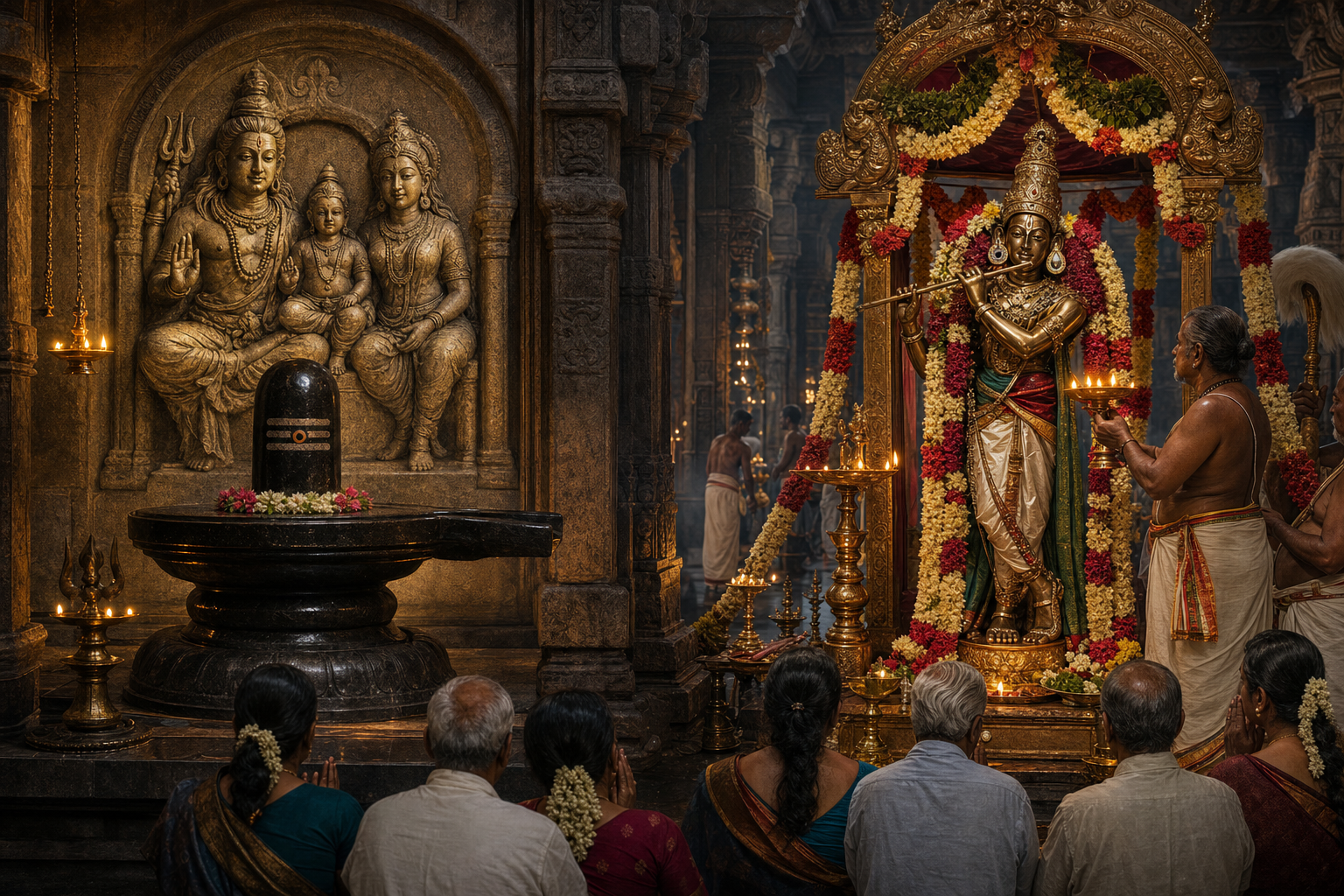
A divine family carved behind a Shiva linga and a pair of unequal earrings worn by Krishna may appear to belong to different worlds. Read together, however, the Somaskanda imagery associated with Pallava and Chola traditions and the Rajagopala legend of Mannargudi reveal a shared feature of Tamil temple culture: iconography becomes meaningful through an ongoing relationship between form, ritual, story, and devotee.
This comparison offers a way to look beyond the surface of a murti without treating it as a code to be mechanically decoded. Composition, placement, ornament, procession, and local memory each disclose a different aspect of how a temple community understands divine presence.
Two visual paths from divinity to relationship
The DharmaRenaissance account of Somaskanda describes Shiva seated with Uma and their son Skanda. It explains the name through the joining of Sa, meaning with, Uma, and Skanda. The central idea is therefore relational from the beginning: Shiva is shown neither solely as an ascetic nor only through the aniconic linga, but within a composed divine household.
The article reports a generally stable arrangement in which Shiva and Uma sit beside one another while the child Skanda occupies the space between them. Shiva may have four arms, with upper hands bearing such attributes as an axe and deer; Uma is usually shown with two arms; and Skanda may stand or dance. According to the source’s interpretation, the axe evokes the cutting of bondage, the deer suggests mastery of the restless mind, and the child’s central position turns three figures into a visual teaching about relationship, continuity, and power arising from harmony.
The Mannargudi account takes a different route. Its focus is not the overall composition of Rajagopala but a small irregularity: Krishna’s two different earrings. The local explanation reported by the article says that Krishna appeared in such haste to answer devotion that he did not pause to achieve the matching adornment expected of a royal deity. In this reading, visual asymmetry communicates compassionate urgency.
One image establishes intimacy through an ordered family composition; the other locates it in an affectionate departure from ornamental order. Read together, they suggest that closeness to the divine can be expressed through both balance and irregularity. Somaskanda makes relationship the structure of the image, while Mannargudi makes relationship the reason for its memorable exception.
Form, placement, and ornament carry theology
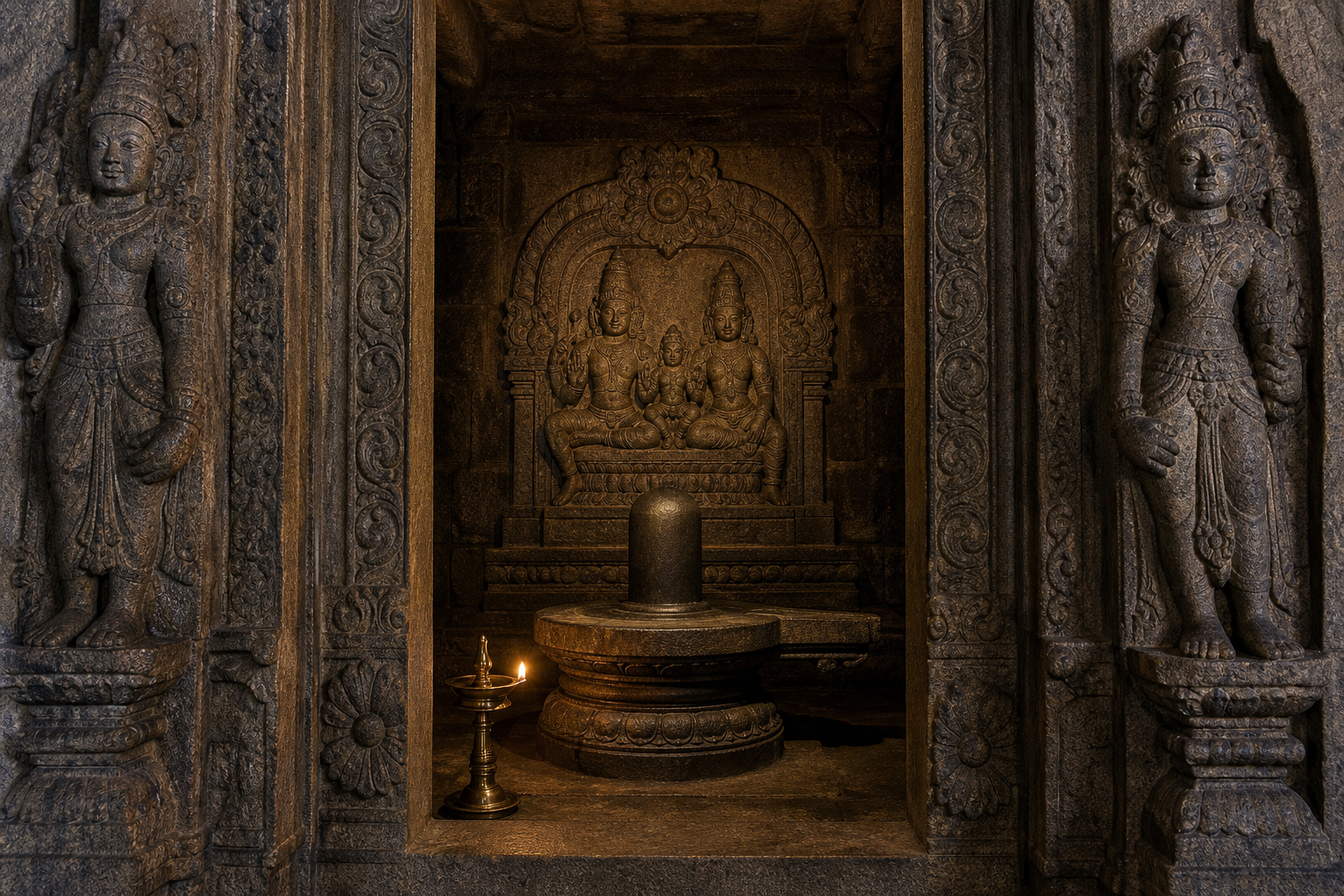
The Somaskanda article associates the form especially with Pallava temple culture of the seventh and eighth centuries CE. It reports repeated Somaskanda panels at the Kailasanathar Temple in Kanchipuram and reliefs on the rear walls of Shiva sanctums at the Shore Temple in Mamallapuram. The source treats this recurring placement as deliberate rather than incidental.
Of particular importance is the reported relationship between a Somaskanda panel and the Shiva linga before it. The linga directs contemplation toward an unbounded, aniconic reality; the family image presents that reality through recognizable persons and bonds. The movement is not from a supposedly primitive symbol to a more complete human form. It is between complementary modes of attention: the formless and the embodied, transcendence and intimacy.
At Mannargudi, theology is carried by adornment rather than architectural placement. The source identifies the deity as Sri Vidhya Rajagopalaswamy, or Rajagopala, a form in which the sovereignty of a royal lord meets the accessibility of Krishna as cowherd. The unmatched earrings sharpen that conjunction. Ceremonial splendour establishes kingship, while the irregular pair draws the devotee’s attention to nearness and responsiveness.
The Mannargudi article also cautions against interpreting the legend as a dismissal of ritual discipline. It reports an elaborate devotional setting of puja, alankaram, food offering, recitation, procession, and festival observance. The exception has force because it appears within a culture of careful service. Love is not placed against order; the story presents love as the purpose that animates order.
Ritual turns an image into a public presence
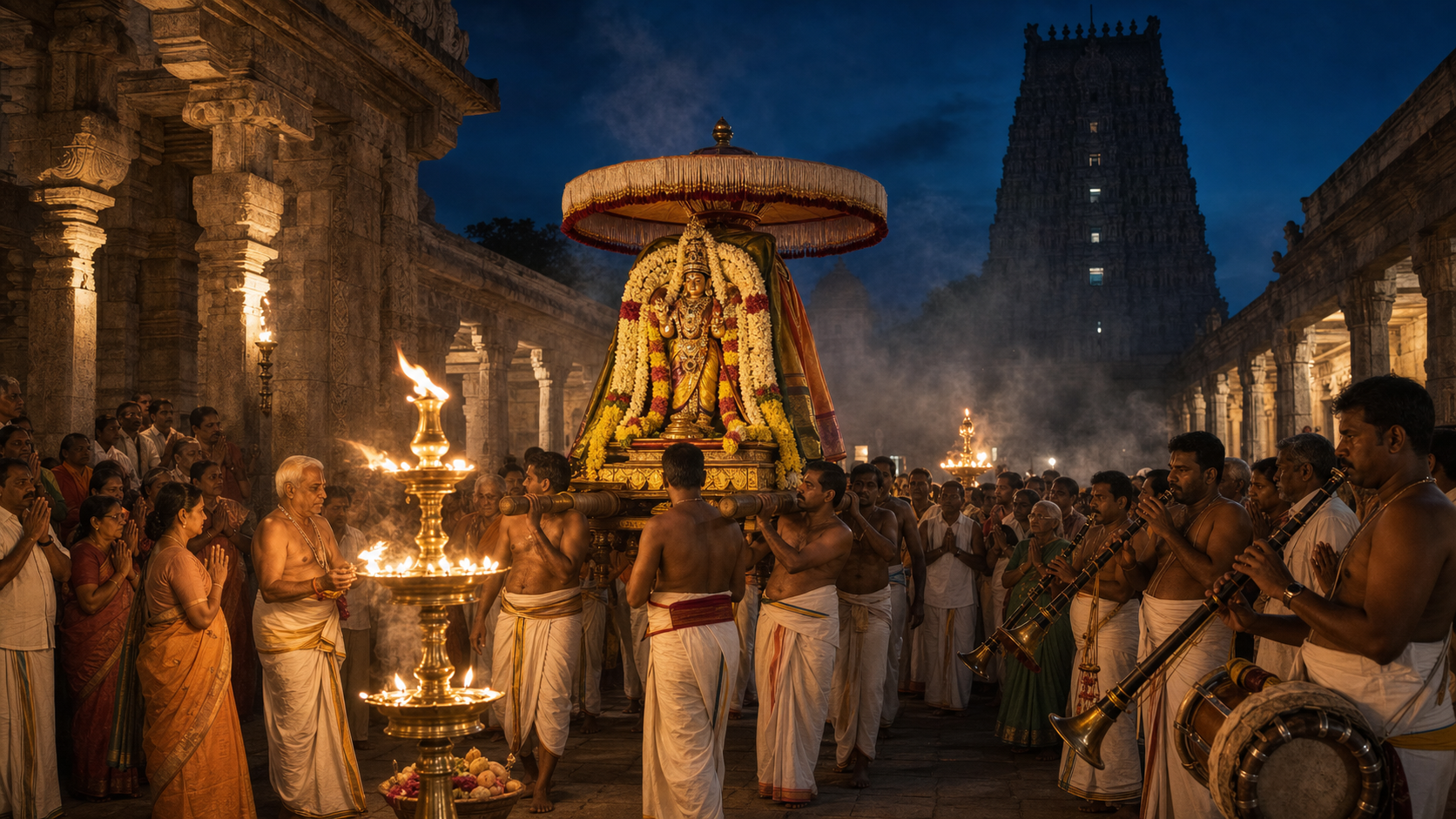
Both source articles describe a murti as more than a passive artwork. The Somaskanda account notes that Chola metal icons were made to receive worship, adornment, song, and procession. The Mannargudi account similarly describes the deity as awakened, bathed, dressed, fed, praised, and carried before the community. Across their Shaiva and Vaishnava settings, the shared emphasis is repeated service.
This ritual dimension changes how iconography should be read. Stone establishes a durable sacred arrangement within the temple, while a processional metal image brings divine presence into collective space. Clothing and ornaments may change according to liturgical practice, yet the identity of the deity remains recognizable. Story, meanwhile, teaches devotees where to direct their gaze: toward the child between Shiva and Uma, the relationship between panel and linga, or the earrings on Krishna’s face.
The sources also place these images within institutions larger than any single visual detail. The Somaskanda article links early examples with Pallava sites and the later development of bronze icons under the Cholas. The Mannargudi article describes a major temple in the Cauvery delta, associates its history with the Chola period and later Nayak expansion, and reports a complex of enclosures, towers, halls, shrines, festival routes, and the Haridra Nadhi temple tank. Monumental scale and intimate storytelling are not competing features here. The institution preserves the ritual world in which the detail can remain alive, while the detail gives a human point of entry into the institution.
Key takeaways
- Somaskanda communicates divine relationship through the balanced placement of Shiva, Uma, and Skanda; Mannargudi’s Rajagopala communicates responsiveness through deliberately remembered asymmetry.
- A murti’s meaning can reside in composition, attributes, sanctum placement, ornament, local legend, and ritual use rather than in appearance alone.
- The reported pairing of linga and Somaskanda holds aniconic transcendence and personal form together instead of forcing a choice between them.
- Mannargudi’s earring tradition makes sense within disciplined worship: its irregularity highlights loving urgency without rejecting ceremonial care.
- Procession, adornment, offering, and communal remembrance keep temple iconography active across generations.
How to read a living temple icon with care
Begin with what is visibly stable
The first question concerns form: who is present, where each figure stands or sits, what attributes appear, and how the image relates to the surrounding shrine. This approach makes the centrality of Skanda or the proximity of a Somaskanda panel to a linga visible before an interpretation is imposed.
Notice what ritual activates or changes
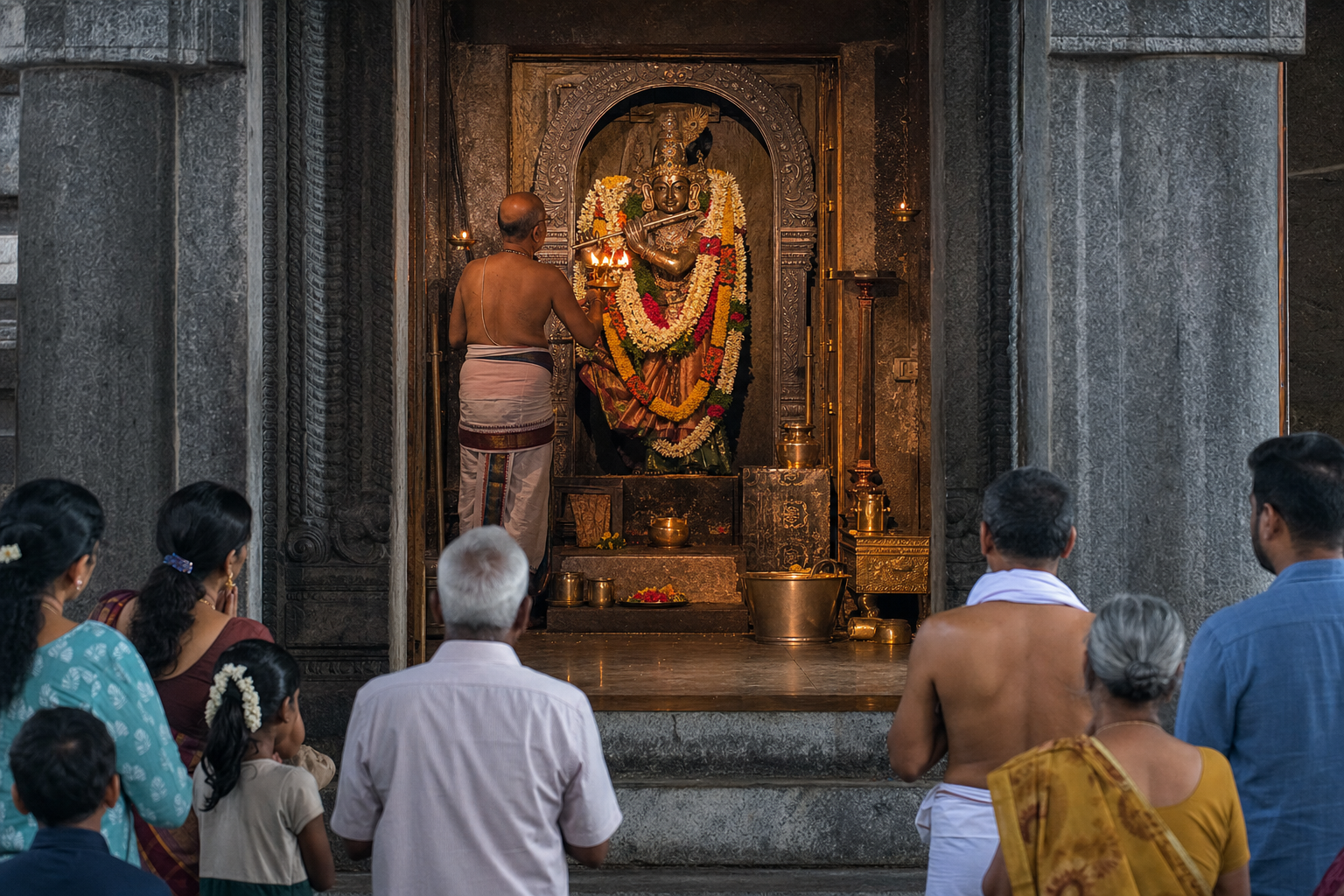
Bathing, clothing, alankaram, food offerings, song, and procession show how a community serves the deity over time. Such practices can also determine which visual features become prominent on a particular occasion. The image should therefore be considered both as an enduring form and as the center of recurring action.
Treat local narrative as interpretation, not decoration
The Mannargudi story does not merely explain why two ornaments differ. It tells devotees what the difference means within that community’s devotional imagination. Likewise, the Somaskanda account interprets the divine household through Shaiva ideas of consciousness and energy while also connecting Skanda with the importance of Muruga in Tamil religious memory. These narratives may not function like inscriptions or ritual manuals, but they preserve how a sacred form is emotionally and theologically received.
Future engagement with Tamil temple art can become more attentive by holding these modes of evidence together. Architecture and art history establish context; ritual shows continuing use; and local memory reveals why a particular detail still matters to those who worship before it.
References
- DharmaRenaissance Blog — Somaskanda Murti: Powerful Shiva Family Iconography and Sacred Temple Wisdom
- DharmaRenaissance Blog — Mannargudi’s Mismatched Earrings: A Powerful Krishna Legend of Living Devotion