

Two reported inquiries in Maharashtra approach religious property from opposite directions. One concerns temple-linked land that may have passed out of its intended institutional control; the other concerns a government building allegedly put to religious use without authorisation. Together, they reveal a common governance question: is an entrusted asset still being used for the purpose for which it was assigned?
Answering that question requires more than defending one community or condemning another. It requires reliable records, equal rules, transparent decisions and remedies that follow evidence. Those safeguards protect sacred endowments, public property, religious freedom and communal trust at the same time.
Different forms of ownership, the same duty of stewardship
The Tuljabhavani land report states that the Maharashtra government ordered a detailed inquiry into the alleged illegal transfer and sale of more than 4,121 acres of Inam land associated with Shri Tuljabhavani Devi Mandir. It attributes the action to a memorandum submitted by Maharashtra Mandir Mahasangh National Coordinator Sunil Ghanwat. The acreage, ownership and legality of any transactions remain matters for the inquiry rather than established findings.
The Solapur report describes a separate investigation into allegations that a government building in Bapuji Nagar was used as a church without proper authority. It says sustained representations by the Hindu Janajagruti Samiti and Hindu Rashtra Sena preceded the probe. The investigation was also expected to examine distinct allegations involving a municipal health department clerk, including misuse of public property and reservation fraud. These, too, were reported as allegations requiring documentary examination.
The assets are legally and institutionally different. Temple-linked Inam land may have been dedicated to sustain worship, services or other defined purposes, while a government building is held for an authorised public function. Yet the governing principle is similar: neither asset should be treated as unencumbered private property. A manager, employee, occupant or official may exercise limited control, but that does not necessarily include authority to sell, transfer or repurpose the asset.
The comparison also suggests a useful symmetry. Public accountability should examine both the possible diversion of property away from a religious endowment and the possible diversion of state property into religious use. Applying the same evidence-based standard in both directions makes the principle credible.
An inquiry must reconstruct the asset’s administrative history
Property controversies often appear to ask a simple question: who owns the land or building? In practice, an adequate inquiry must distinguish ownership, custody, possession, authorised use and authority to make a transaction. These statuses may overlap, but they are not interchangeable.
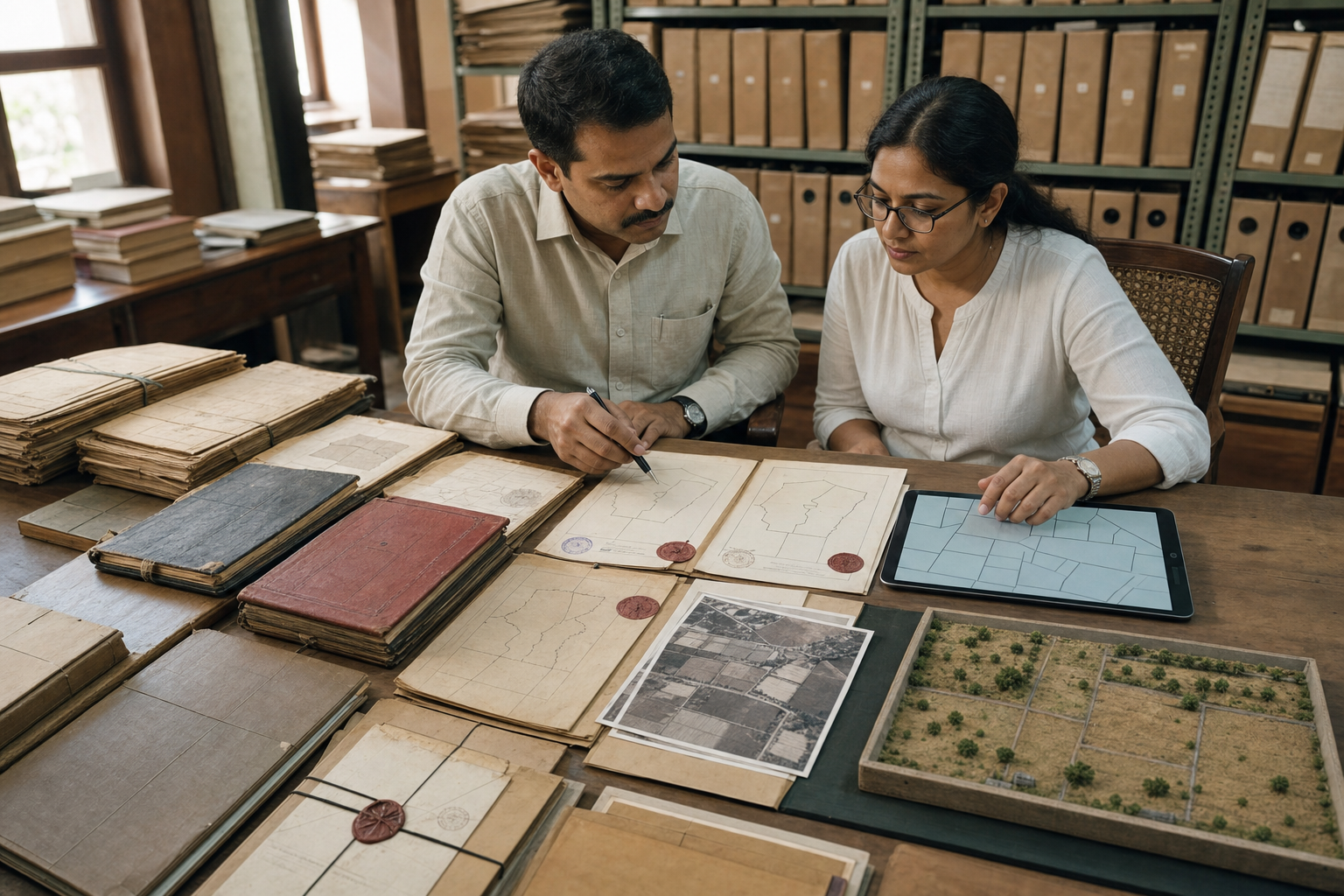
In the Tuljabhavani matter, the source identifies a potentially complex evidence trail involving original grants, revenue extracts, mutation entries, tenancy documents, sale deeds, trust registers, government permissions and court orders. The central task is to connect each disputed parcel to its original status and then establish how every later entry or transfer occurred. An old revenue entry may be important evidence, but it should be reconciled with the endowment’s records and the legal authority behind subsequent changes.
The Solapur inquiry requires a shorter but conceptually similar chain. Investigators would need to establish who owns or controls the building, its sanctioned purpose, the department responsible for it, whether religious use was formally requested or approved, and who knew of or facilitated any change. Repeated use alone would not answer whether that use was authorised.
Both cases therefore expose the cost of fragmented administration. When property registers, land records, trust files and departmental permissions are maintained separately, an irregular use or transfer can remain obscured between institutions. Accountability depends on reconstructing the complete chain rather than examining each record in isolation.
Due process must separate allegations, actors and remedies
Public attention can help bring neglected records under scrutiny, but a memorandum or complaint is a trigger for verification, not proof of wrongdoing. The two source articles expressly frame the matters as inquiries into allegations. That distinction protects individuals from premature condemnation and helps ensure that any eventual administrative action can withstand legal review.
The Tuljabhavani inquiry may encounter historical ambiguity as well as possible misconduct. The source notes that Inam land disputes can involve changing land laws, tenancy rights, hereditary service arrangements, missing records and inconsistent entries. Investigators should therefore distinguish intentional alienation from clerical error, lawful occupancy, procedural failure and unresolved title questions. A single label applied to every parcel would obscure those differences.
The Solapur probe similarly contains several questions that should not be collapsed into one accusation. The status and use of the building form one evidentiary track. The municipal employee’s role forms another. The reported reservation-fraud allegation requires its own eligibility records and competent verification process. Religious identity, property use and employment eligibility may intersect in public debate, but each requires separate findings.
Remedies should be equally specific. An unauthorised property use may call for restoration of the sanctioned purpose and clearer custody controls. A defective record may require correction. A transaction made without authority may require legal proceedings concerning the property. Proven employee misconduct may require proportionate disciplinary action. Unsupported allegations should be expressly closed rather than left hanging over people or communities.
Equal rules protect devotion and religious freedom
Temple property carries meaning beyond its market value because devotees understand an endowment as supporting worship, festivals, maintenance, pilgrimage services and continuity across generations. That significance strengthens the case for careful stewardship, but it does not reduce the need for documentation, lawful permissions and financial scrutiny.
Religious freedom is likewise compatible with firm public-property rules. Protecting private worship and voluntary religious association does not require allowing a government asset to be repurposed without authority. Conversely, investigating the alleged use of one building should not become a judgment on ordinary Christians or Christianity generally. The object of scrutiny is the asset and the conduct connected to it, not an entire faith community.
This distinction is particularly important when disputes may affect communal confidence. Neutral questions are less inflammatory and more useful: What was the asset’s documented purpose? Who had decision-making authority? What approval was given? Was the same procedure available to others? What evidence supports the proposed remedy? An administration that answers those questions openly gives citizens fewer reasons to replace missing facts with competing narratives.
Key takeaways
- Temple endowments and government buildings have different legal foundations, but both must remain tied to their authorised purposes.
- A credible inquiry should trace title, custody, possession, use, permission and every relevant transfer rather than rely on a single record.
- Property questions, employee-conduct allegations and eligibility claims should receive separate findings and evidence-based remedies.
- Complainants perform a legitimate civic function by seeking scrutiny, but their allegations do not substitute for official verification.
- Equal enforcement protects sacred institutions, public assets, religious freedom and communal trust more effectively than selective enforcement.
From episodic investigations to preventive governance
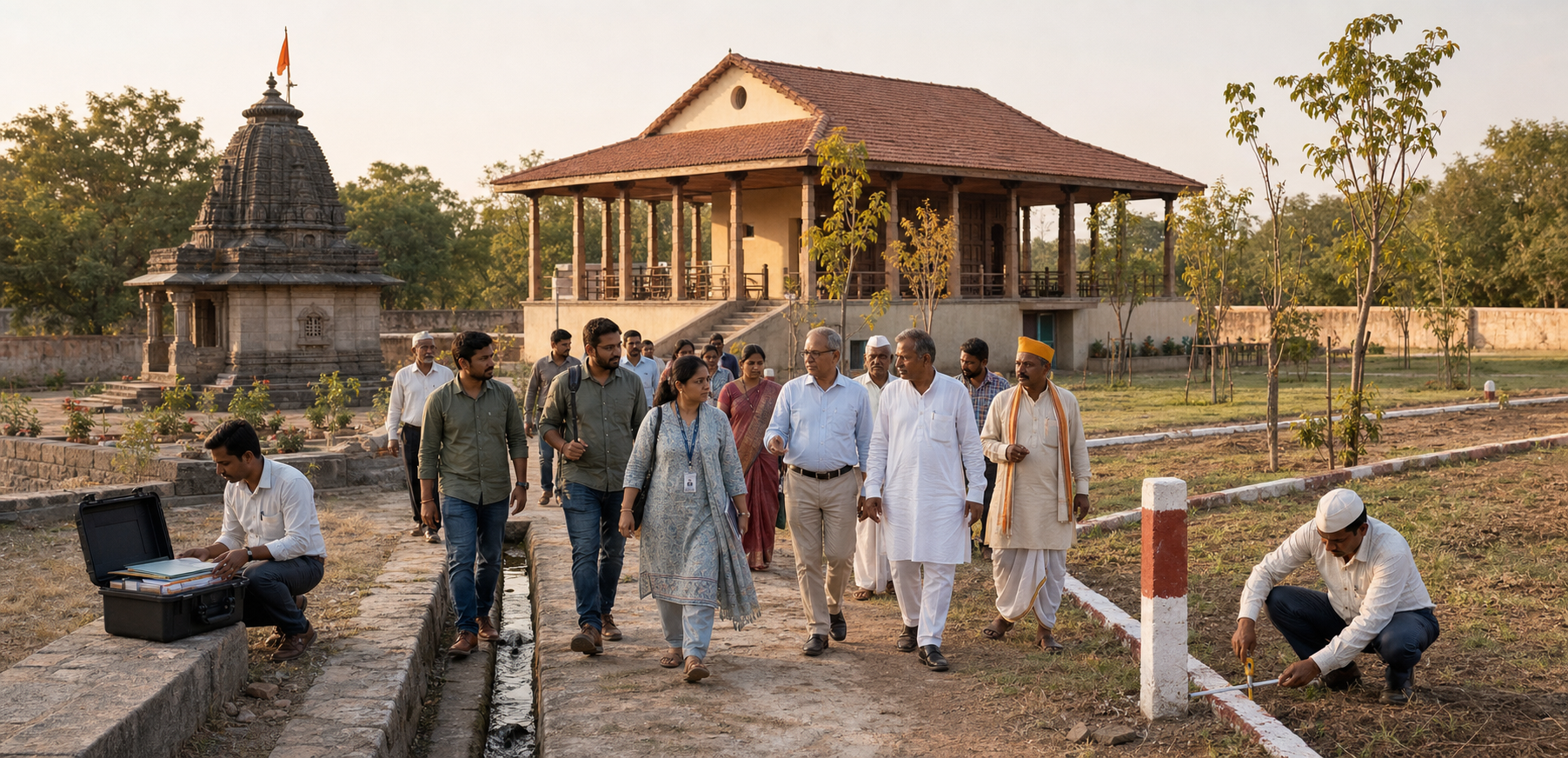
The source on Tuljabhavani proposes digitised records, geo-tagging, reconciliation of revenue and trust entries, review of valuations and a chronological account of transfers. The Solapur source calls for updated public-property registers, periodic inspections, clear identification of government buildings and accessible complaint mechanisms. Combined, these proposals point toward a shared preventive model: know what each institution holds, record why it holds it, identify who is responsible and preserve an auditable history of every change.
Non-sensitive findings should also be disclosed in a form that explains the evidence, the authority applied and the status of each issue. Transparency should include correction of unsupported claims as well as identification of established failures.
If these inquiries produce verified asset maps, reasoned findings and durable controls, their value will extend beyond the two disputes. They can help shift religious-property governance from crisis-driven intervention toward routine, even-handed stewardship.

References
- DharmaRenaissance Blog – High-Stakes Tuljabhavani Land Inquiry: Why 4,121 Acres Matter to Devotees
- DharmaRenaissance Blog – Solapur Probe: Powerful Test of Public Property, Fairness and Communal Trust