

You arrive at a temple and hear an account of why the deity is worshipped at this precise place. Part of it sounds theological, part historical, and part inseparable from the landscape around you. Should you receive it as faith, investigate it as history, or treat it as symbolism?
You do not need to force that choice. A Sthala Purana becomes clearer when you identify the kind of truth each passage is carrying. That approach lets you honor a temple’s sacred memory without turning every devotional detail into a dated claim, or dismissing the whole tradition because it does not read like a modern chronicle.
Begin with the work a Sthala Purana performs
In temple usage, a Sthala Purana connects the holiness of a place with the temple’s origin, development, maintenance, repairs, and renovation. It is therefore wider than either a foundation story or a construction record.
This breadth matters. A chronological history asks when something happened and what evidence supports the sequence. Sacred history also asks why this place matters, why worship belongs here, and how a community understands its relationship with the deity. An account of repairs asks yet another question: how was the temple carried through change?
Before deciding whether a Sthala Purana is historically reliable, ask four narrower questions:
- What makes this location sacred rather than interchangeable with another location?
- What event or relationship establishes the temple’s sacred beginning?
- Which details concern later growth, patronage, administration, or custodianship?
- Which statements concern physical maintenance, repair, or renovation?
Those questions stop one category from swallowing all the others. A sacred beginning does not automatically date the surviving structure. A renovation record does not automatically identify the temple’s first foundation. A modern building can still stand within a much older continuity of worship, while an old-looking structure does not by itself prove every claim made about its beginnings.
Separate four layers without tearing them apart

A useful reading begins by sorting the material into four layers. The layers may overlap within a single episode, but naming them prevents confusion.
- Sacred geography: This explains why the location itself is holy. Pay attention to the relationship between the narrative and the actual place, not merely to the sequence of events.
- Sacred origin: This explains how worship is understood to have begun. Its primary purpose may be theological even when it also contains historical names or claims.
- Temple development: This concerns the shrine’s growth and changing institutional life. Here, questions about sequence, patrons, records, and surviving structures become especially relevant.
- Material continuity: This concerns maintenance, repair, rebuilding, and renovation. These details show how people accepted responsibility for carrying the temple forward.
Do not assume that each Sthala Purana gives equal space to every layer. One may dwell on the sanctity of the site, while another preserves more information about later development. The right question is not whether the account resembles a standardized history book. It is which functions the particular account is performing.
This also changes how you read descriptions of renovation. Repair is not merely an interruption between an ancient past and the present. It can be evidence that a community regarded the temple as worth sustaining. At the same time, continuity of care is not identical to continuity of masonry. Record the two separately: what continued in worship and memory, and what continued in physical form.
Use the right test for each kind of claim
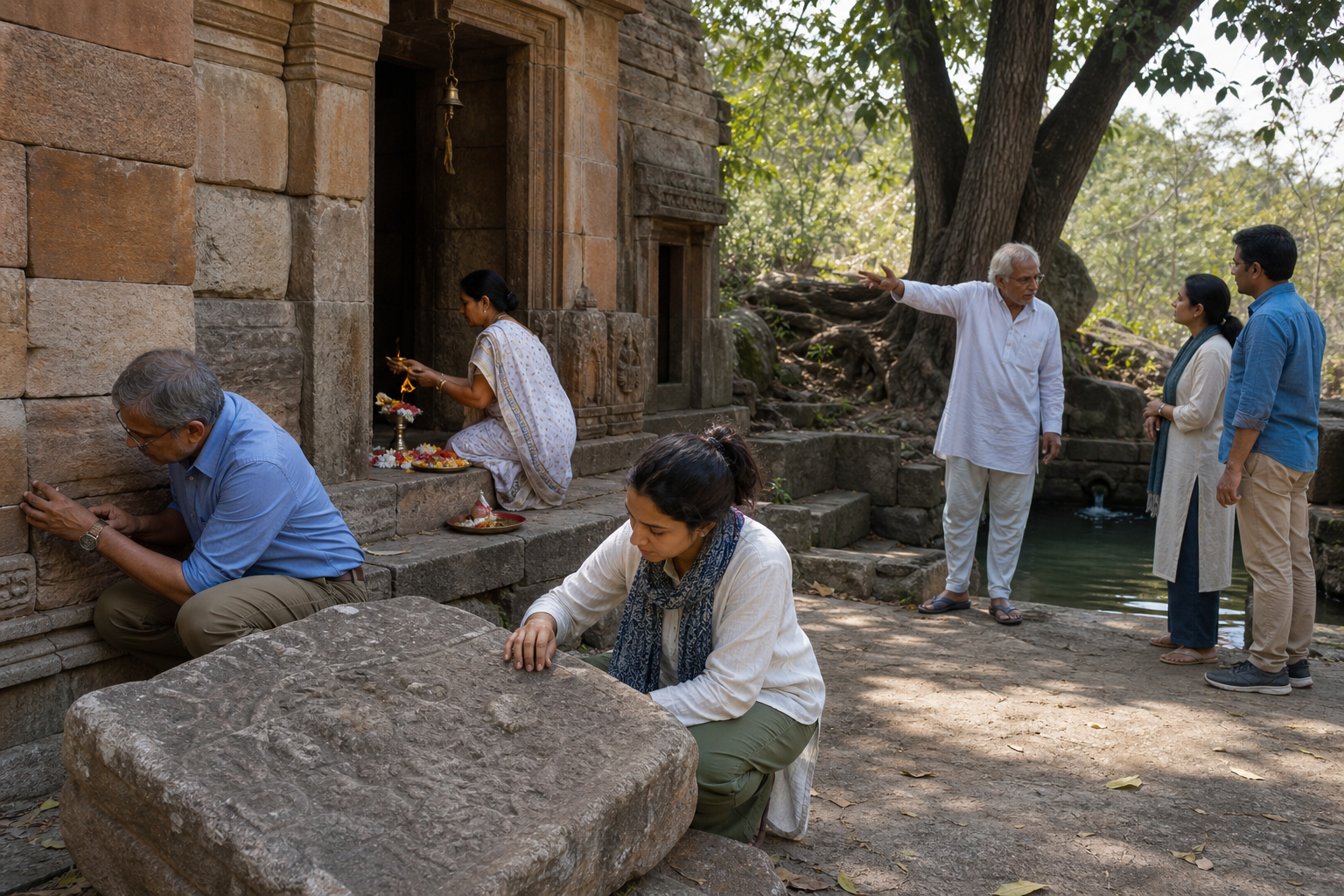
The argument over whether a Sthala Purana is ‘history or legend’ usually begins too early. First classify the statement. Then apply the appropriate test.
| Kind of statement | Question to ask | How to handle it |
|---|---|---|
| Sanctity of the place | What does this disclose about why the location is revered? | Read it within the temple’s worship, community memory, and physical setting. |
| Sacred origin | Is this a theological beginning, a datable foundation claim, or both? | Preserve its sacred meaning; seek separate support before assigning a historical date. |
| Temple development | What changed, and can the proposed sequence be checked? | Compare internal records with inscriptions, physical phases, and other historical material when available. |
| Repair or renovation | What was renewed, and what was retained? | Treat it as evidence of work and continuity at that point, not automatic proof of the original foundation. |
This method avoids two opposite errors. The first is careless literalism: treating every element as though it were written to answer a modern historian’s questions. The second is careless dismissal: assuming that anything expressed through sacred narrative has no historical or cultural value.
Absence of independent confirmation does not by itself prove that a tradition is false. It means the historical claim remains unverified. Conversely, repetition within a devotional setting does not by itself establish an exact chronology. You can state both points without insulting the tradition or lowering the standard of evidence.
Your wording should show that distinction. Use ‘tradition remembers’ or ‘the Sthala Purana relates’ for sacred narration. Use ‘temple records state’ when the claim rests on the institution’s own records. Reserve firmer historical language for details supported by evidence appropriate to the claim. This is especially important when you publish temple history online, where a missing qualifier can turn a respected tradition into an assertion it was never meant to carry alone.
Use this method on your next temple visit

You do not need to conduct a full academic investigation to read carefully. A notebook and a disciplined sequence of questions are enough to prevent the most common misunderstandings.
- Receive the account before judging it. Read or hear the whole narrative once. Notice its devotional movement and the importance it gives to the place.
- Mark each passage by function. Use four simple labels in your notes: place, origin, development, and care. If a passage performs two functions, give it two labels.
- Connect the narrative to the site. Note which visible locations or temple features the account treats as significant. Do not assume that every present feature belongs to the earliest phase.
- Separate sacred time from calendar time. When a passage explains divine significance, preserve that meaning. When it supplies a date, named patron, construction phase, or repair claim, note that it can be checked independently.
- Ask a precise question. Instead of asking whether the entire account is ‘true,’ ask which details are preserved as sacred tradition and which are supported by records, inscriptions, or surviving material evidence.
- Record where each detail came from. Distinguish the temple’s written account, an oral explanation, a notice at the site, and your own observation. This makes later verification possible and prevents one retelling from silently becoming another.
- Return to the purpose of the visit. After analysis, look again at what the narrative asks you to notice about the temple, the deity, the land, and the duty of preservation. Critical reading should deepen attention, not reduce a living sacred place to a list of disputed claims.
If two local tellings differ, write down the difference instead of immediately choosing one. Variation can reveal which details a community emphasizes, but it does not prove that every version is equally old or equally well supported. Preserve the versions first; assess their historical claims second.
If you are preparing a temple page, family record, pilgrimage note, or social-media thread, keep sacred narration and historical verification visibly distinct. Readers should be able to tell what the tradition holds, what the temple institution records, what physical evidence indicates, and what remains uncertain. That clarity protects both faith and credibility.
Key takeaways
- A Sthala Purana may preserve the holiness of a place, the temple’s sacred origin, its development, and its history of care.
- Classify a statement before evaluating it; theological meaning, historical chronology, and renovation history require different questions.
- Do not use the date of a repair or rebuilding as the temple’s foundation date unless separate evidence supports that conclusion.
- Respectful language should preserve what tradition holds while clearly identifying what has and has not been independently verified.
- During a temple visit, connect the narrative to the site, label the type of each claim, and record where each detail came from.
The next time you encounter a Sthala Purana, resist the urge to issue one verdict on the whole account. Ask what each passage is doing, what kind of evidence could bear on it, and how it shapes your attention to the sacred place before you. You will be better equipped to receive the tradition, investigate its historical dimensions, and pass it on without confusing reverence with overstatement.
References
