
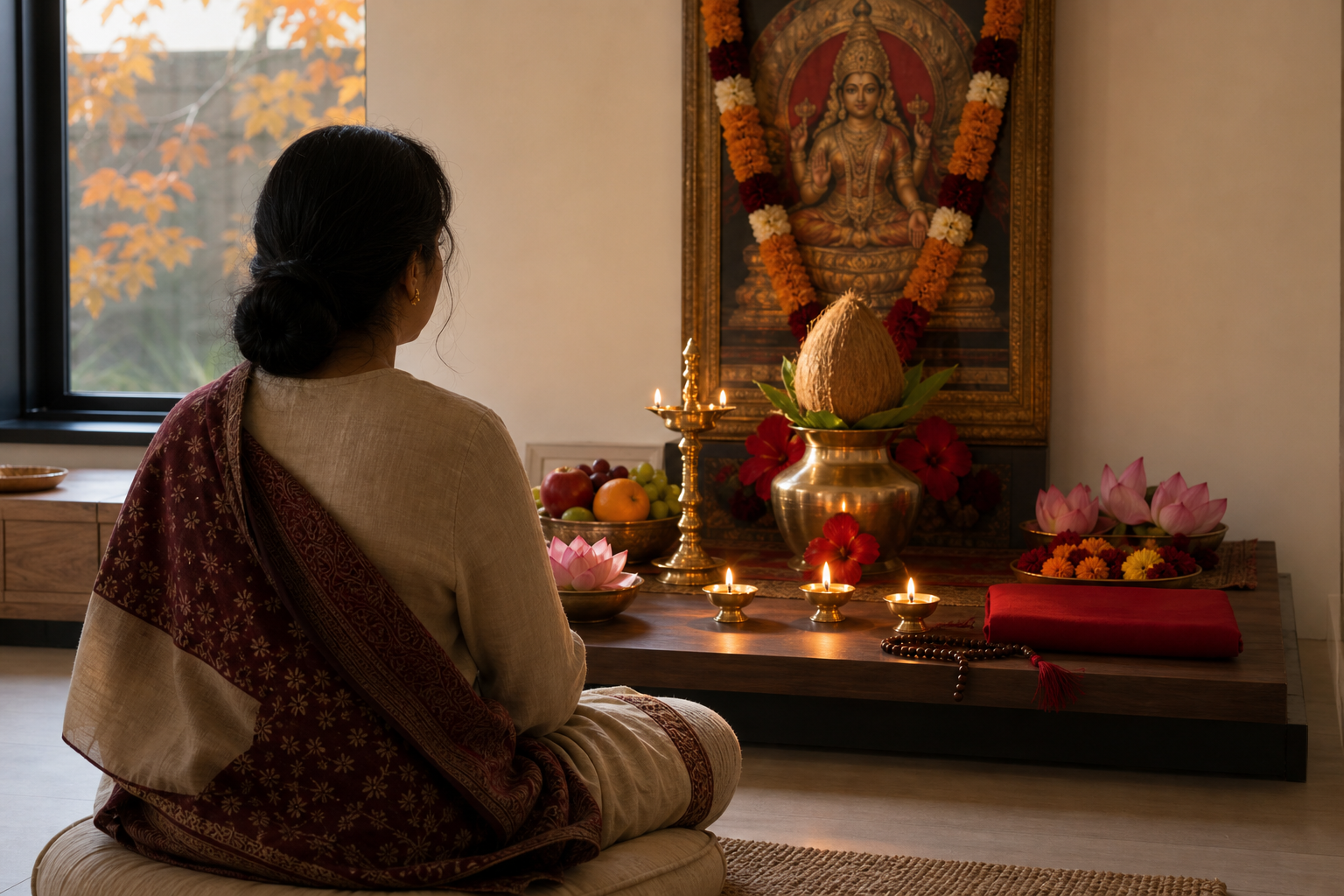
You want to observe the autumn Shakti festivals seriously, but the calendar can quickly become a burden: a long vrata, a Jayanti inside it, and Navratri preparations close behind. The answer is not to perform the largest possible puja on every date. It is to build one sustainable devotional rhythm and let each observance give that rhythm a distinct focus.
This guide helps you decide what to do daily, what to add on a festival day, and how to approach Devi Mahatmyam without improvising a ritual procedure you have not learned.
Build one autumn sankalpa around three observances

The traditional 16-day Mahalakshmi Vrata is observed in Bhadrapada and is listed for 2026 from September 19 through October 3. Bhuvaneshwari Jayanti falls on September 23, placing it within that vrata period. Navratri then begins in October 2026.
| Observance | 2026 timing | Useful devotional focus | What to plan |
|---|---|---|---|
| Mahalakshmi Vrata | September 19-October 3 | Steadiness, gratitude, responsible use of what you receive | A daily practice small enough to maintain throughout the vrata |
| Bhuvaneshwari Jayanti | September 23 | Devi as the sovereign presence encompassing the cosmos | A focused addition to the existing vrata, not a competing routine |
| Navratri and Devi Mahatmyam practice | Begins in October; confirm the exact local observance | Worship of Shakti through disciplined recitation, prayer, and community celebration | Your text, reading method, schedule, pronunciation support, and temple arrangements |
Use the dates as anchors, but confirm tithi and local timing with the panchang or temple you actually follow. Hindu observances are governed by the ritual calendar rather than by civil dates alone, and diaspora locations may not observe a tithi at the same clock time as Bharat. If your family, guru, or temple gives a different local instruction, follow that tradition consistently instead of combining several calendars.
Now write one sentence that defines your sankalpa. It should identify a practice you control, not an outcome you are trying to force from Devi. A sound sankalpa might be: During these observances, I will offer a clean, attentive period of worship each day and bring greater order, restraint, and generosity into the household. Avoid promises about wealth, success, or the removal of every difficulty. Bhakti is not a transaction in which the scale of the request must match the scale of the ritual.
Build the sankalpa in three layers:
- Daily foundation: the minimum prayer, reading, japa, or silent attention you can preserve even on a demanding day.
- Festival addition: the particular stotra, contemplation, offering, or temple visit associated with the observance.
- Community layer: shared aarti, kirtan, recitation, seva, or a family meal when your circumstances permit.
This structure prevents a common failure. Devotees sometimes begin with an elaborate routine, miss it when work or caregiving intervenes, and then abandon the whole vrata because the original plan can no longer be performed perfectly. Your daily foundation should be modest enough to survive an imperfect day. The more elaborate layer can expand and contract around it.
Keep Mahalakshmi Vrata steady from September 19 to October 3
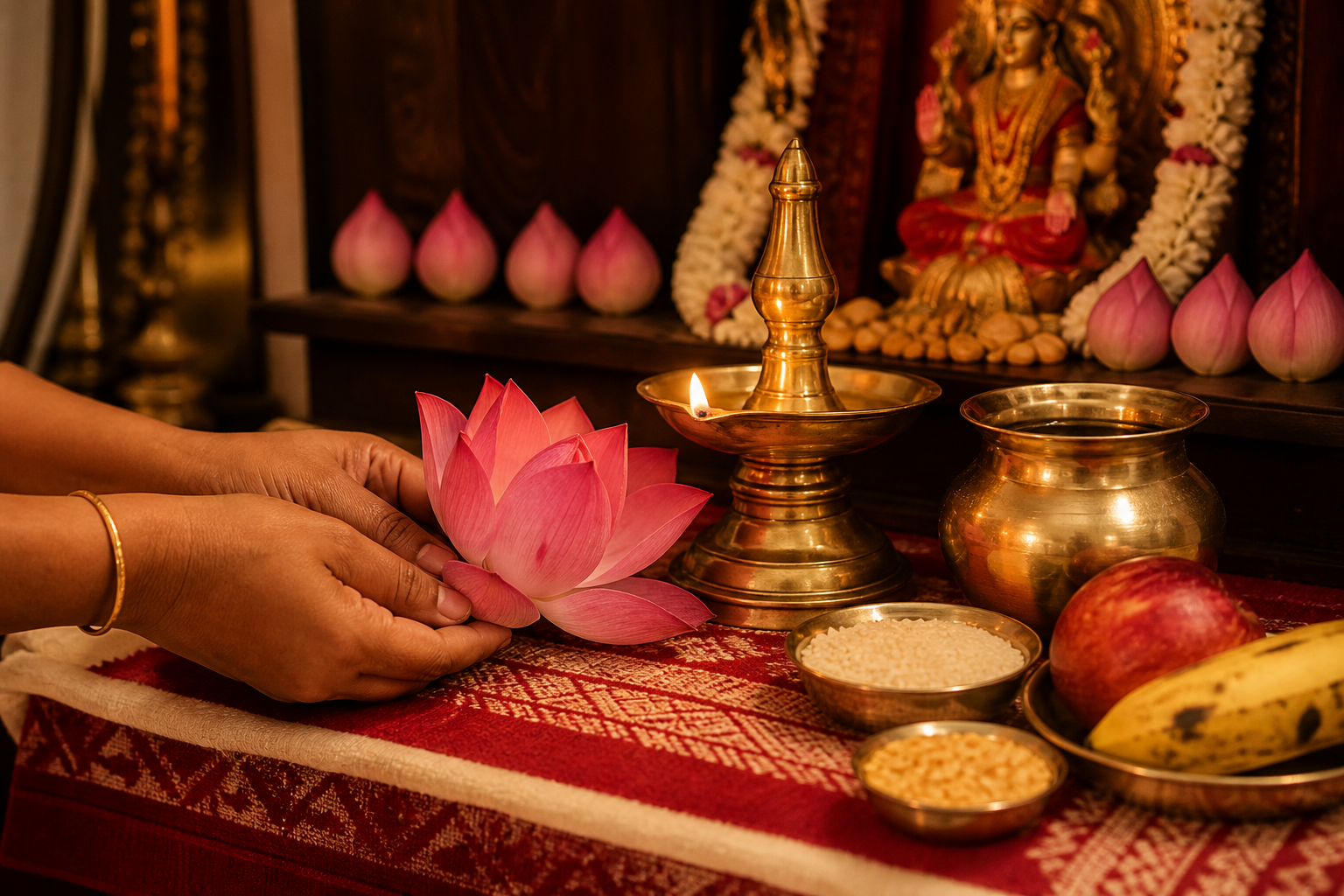
For this vrata, approach prosperity as something to receive with gratitude, maintain with care, and share without vanity. That turns Mahalakshmi worship into a discipline governing the household rather than a request confined to the altar. You can pair the puja with one concrete form of order: reduce avoidable waste, complete a neglected responsibility, repair a strained exchange, protect your speech from needless harshness, or set aside something appropriate for dana.
A workable home sequence is:
- Prepare the same clean worship space and gather the necessary items before beginning.
- Settle your breathing and state the sankalpa plainly.
- Invoke Mahalakshmi using the prayer, nama, or dhyana already accepted in your household tradition.
- Offer water, flowers, food, light, or another customary item without turning simplicity into embarrassment.
- Recite one known hymn, set of names, or passage with attention to meaning.
- Sit quietly and identify the practical act of order, gratitude, or generosity you will carry into the day.
- Close with aarti and distribute prasada if those belong to your practice.
Use the same core sequence throughout the vrata. Constantly changing the text, decoration, and offering may feel creative, but it also consumes the attention that repetition is meant to deepen. Abhyasa works because you return to the same act after novelty has worn away.
Do not copy another person’s dietary fast merely to make your vrata feel more serious. Where a family observance includes food restrictions, follow them only when they are safe for your health and compatible with unavoidable responsibilities. Regular worship, restraint in consumption, careful speech, dana, and seva can carry the discipline when a severe fast is inappropriate. Devotional practice should not be treated as a substitute for medical guidance.
If you miss the planned practice on one day, do not manufacture a harsher routine the next day as punishment. Acknowledge the break, make a simple prayer, and resume your foundation. If you have formally undertaken a lineage-specific vrata with prescribed rules, ask the priest or teacher connected to that lineage about any required correction. A generic online answer should not overrule a vrata you received through a living tradition.
Let Bhuvaneshwari Jayanti deepen the ongoing vrata

Bhuvaneshwari is one of the Dasa Mahavidyas. Her name presents her as ruler of the universe, and she is contemplated as the cosmos embodied as Devi; she is also understood as a saguna form of Parvati. That framing makes September 23 an opportunity to widen your attention beyond private needs. You do not need to suspend the Mahalakshmi Vrata or establish an unrelated second discipline.
Keep your normal daily foundation and add one Bhuvaneshwari-focused period. If your lineage provides a dhyana, nama, stotra, or puja procedure, use it. If it does not, stay with a simple prayer to Mata Bhuvaneshwari and contemplate the meaning of her name. Do not adopt an unfamiliar bija mantra because it appeared in a short video or image. A mantra traditionally transmitted through initiation should be learned from a qualified teacher, not reconstructed from fragments.
You can make the contemplation concrete by writing brief answers to these questions:
- Where have I reduced dharma to the protection of my own comfort?
- Which person or duty have I pushed outside the circle of my concern?
- What would become more truthful if I viewed the household, community, and natural world as held within Devi rather than as objects available for my use?
End with a prayer for loka-kalyana as well as your household intentions. The point is not to manufacture a dramatic mystical experience. It is to notice where your field of responsibility has become too narrow and then correct one action. That could mean giving patient attention to an elder, ending a wasteful habit, supporting a community need, or performing an overlooked duty without resentment.
Mahavidya traditions are not uniform in ritual method or interpretation. If your sampradaya gives Bhuvaneshwari worship a more specific form, let that form govern your practice. A broad household plan is useful only where it does not displace received instruction.
Prepare for Navratri and Devi Mahatmyam before October

Devi Mahatmyam is also known as Durga Saptashati or Chandi Path. It is a central Shakti text, but deciding to recite it is not the same as having a workable recitation plan. Devotees commonly need to determine which chapters are read on which day and what procedure their tradition expects. Resolve those questions before Navratri begins; the first recitation should not be the moment when you are still searching for instructions.
Choose the approach that honestly matches your preparation:
- You already received a procedure: follow the chapter plan and associated practice given by your guru, family, or temple. Do not add steps from unrelated methods merely because they appear more elaborate.
- You know the text but not a full ritual procedure: use a reliable edition and ask your temple or teacher which reading schedule is appropriate for your household. Arrange help with pronunciation before the festival.
- You are new to the text: begin by reading its meaning, learning the names of its divisions, and listening to a recitation from the tradition you intend to follow. You may also attend or sponsor a properly conducted community recitation instead of pretending fluency at home.
Before October, complete this preparation:
- Confirm the exact local Navratri timing through your temple or trusted panchang.
- Select one edition in a script and language you can actually follow.
- Decide whether you are undertaking a complete recitation, a tradition-approved multi-day schedule, a selected devotional reading, or attendance at a temple recitation.
- Verify the chapter division and any preliminary or concluding elements with the method you have chosen.
- Mark the reading periods in your calendar and account for work, travel, caregiving, and community events.
- Prepare the altar and ordinary puja materials in advance. Keep open flames attended at all times; use a safer alternative where that is not possible.
- Tell participating family members what has been decided so that different procedures are not introduced midway.
Pronunciation matters, but speed is not the cure for uncertainty. If you are still learning Sanskrit, work phrase by phrase and use a translation so that the recitation does not become a race through unfamiliar sound. A smaller, coherent practice performed attentively is more honest than claiming a full path that you cannot yet sustain.
Do not collapse Mahalakshmi, Bhuvaneshwari, and Durga into a catalogue of interchangeable benefits. The continuity lies in Shakti; the devotional relationship changes its emphasis. Mahalakshmi Vrata can train order and grateful stewardship. Bhuvaneshwari Jayanti can expand the field of concern. Navratri and Devi Mahatmyam can then gather that steadiness into sustained worship of Devi’s power against disorder and adharma. Continuity does not require sameness.
Key takeaways
- Mahalakshmi Vrata is listed for September 19 through October 3, 2026; make the daily foundation sustainable across the full observance.
- Bhuvaneshwari Jayanti falls on September 23, inside the vrata period, so add a focused contemplation rather than replacing your established routine.
- Use one sankalpa centred on your conduct. Do not frame the observances as transactions for guaranteed results.
- Confirm local tithi timing with the panchang or temple you follow, especially outside Bharat.
- Choose a Devi Mahatmyam approach that matches your actual preparation and verify its chapter schedule before Navratri.
- Received family, guru, and sampradaya instructions take priority over a generic combination of online practices.
Before September 19, put four things in writing: your one-sentence sankalpa, your minimum daily practice, the additional observance for September 23, and the person or temple from whom you will confirm your Navratri recitation method. Once those decisions are made, the calendar stops being a pile of obligations and becomes a continuous path of worship.
References
- Hindu Pad – Devi Mahatmyam Reading Procedure | How to read Devi Saptashati
- Hindu Pad – 16-Days Mahalakshmi Vrata 2026 | Maha Laxmi Puja
- Hindu Pad – Mata Bhuvaneshwari Jayanti 2026
