
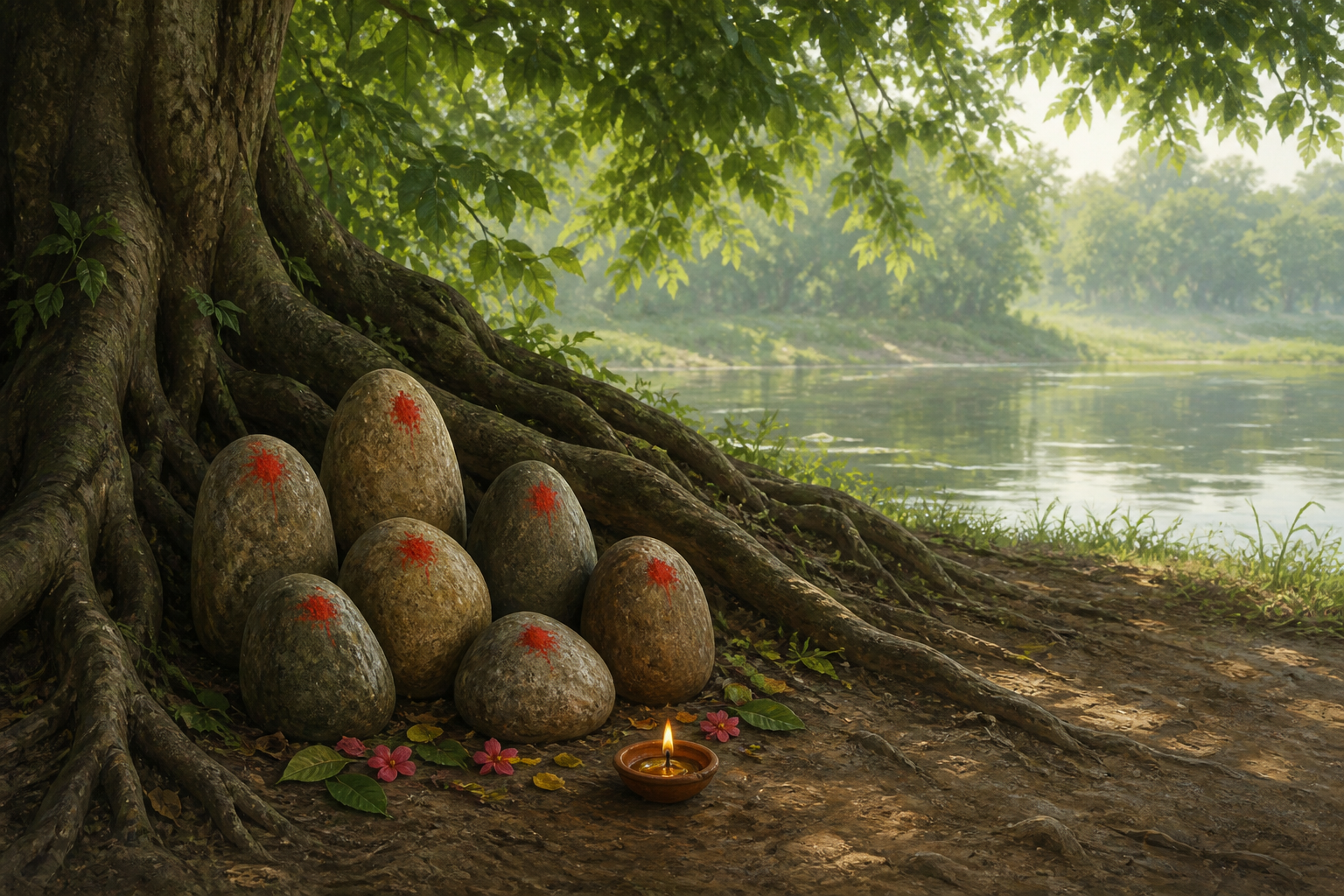
You come upon seven vermilion-marked stones beneath a tree, close to water. There is no sanctum, sculpted murti, signboard, or priest to tell you what you are seeing. It would be easy to mistake the place for an unfinished shrine, an abandoned one, or simply a cluster of rocks.
Pause before you name it. You may be standing before a living goddess tradition whose form is complete on its own terms. The right response begins with four things: notice the arrangement, ask how local worshippers understand it, respect the rules of the place, and never confuse reverence for a tradition with an obligation to enter physical danger.
Begin with the shrine that is present, not the temple that is absent
Across India, one recurring form of folk goddess worship consists of seven rocks of different sizes, marked with vermilion and placed near a river, pond, or lake under a neem, tamarind, or lemon tree. Worship can occur there without an enclosing temple or an officiating priest.
Each apparent absence can produce a wrong conclusion. An uncarved stone is not necessarily an unfinished image. An open-air shrine is not necessarily abandoned. A place without a priest is not necessarily a place without discipline, memory, or worship.
A temple-centered eye looks first for architecture, sculpture, inscriptions, and an institutional custodian. A stone-centered tradition asks you to notice a different set of signs: deliberate grouping, repeated marking, a stable place beneath a particular tree, proximity to water, offerings or other signs of attention, and the conduct of people who approach. No single sign proves that an ordinary rock is sacred. Their relationship to one another, sustained through practice, is what matters.
Do not treat the word folk as a polite synonym for primitive, superstitious, or theologically empty. It identifies a local form of religious life; it does not rank that life below worship conducted through monumental architecture. A village goddess does not become more real when someone builds walls around her.
You also do not need to settle, from a distance, whether worshippers understand the stones as the goddess herself, her seat, her manifestation, or a material focus for her presence. That distinction may matter within the community, but an outsider should not manufacture an answer. Until you are told otherwise, behave as you would before a sacred presence rather than as though you were examining loose archaeological material.
Use four questions before you identify or document the tradition
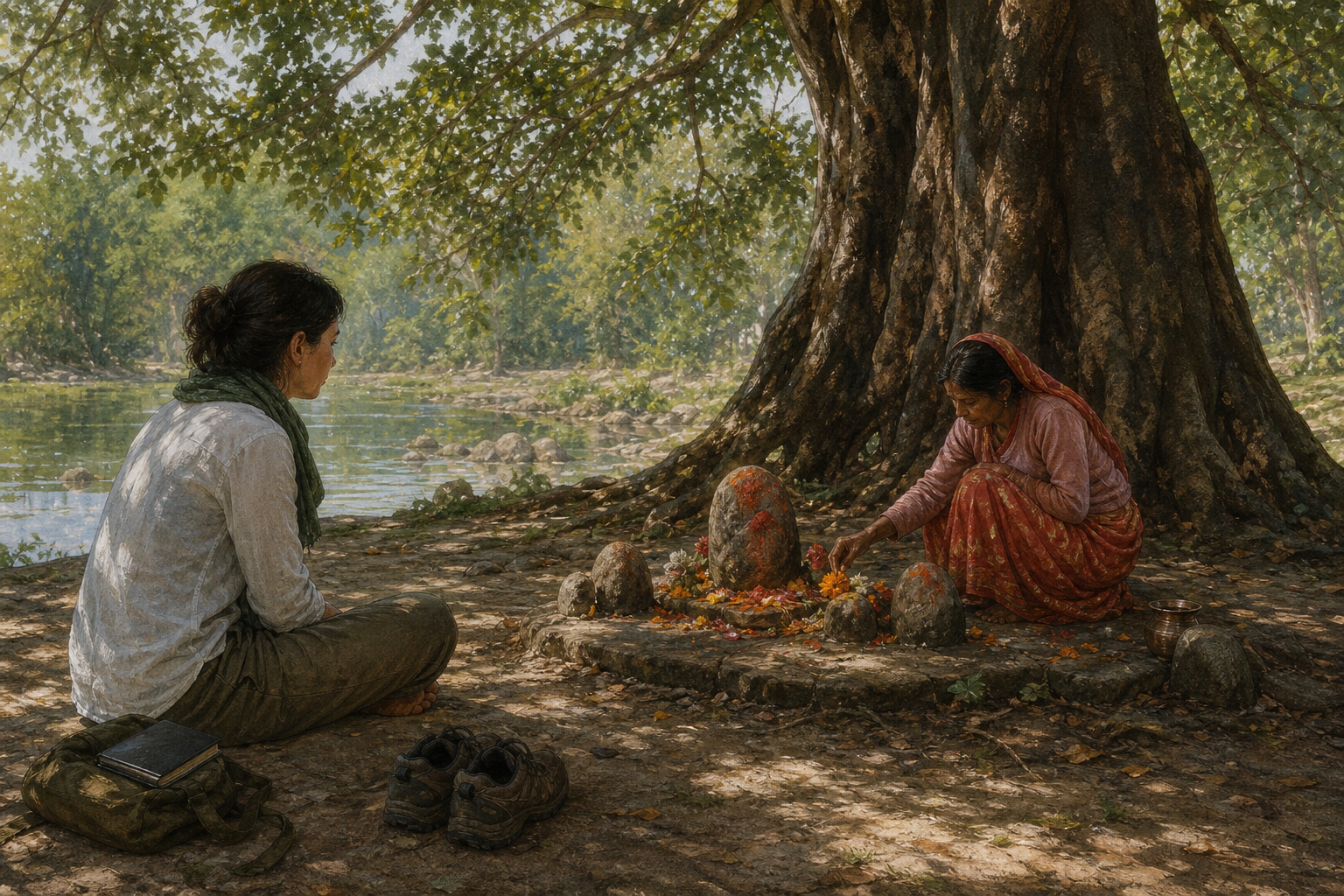
The fastest way to misunderstand a local shrine is to begin with a grand theory. Begin with questions that the place and its worshippers can actually answer.
- What is materially present? Note the number of stones, their relative sizes, markings, arrangement, tree, nearby water, and any visible boundary. Observe without moving anything. A rearranged shrine may give you a cleaner photograph while destroying the very relationship you hoped to understand.
- What name is used here? Ask, “What do people call Devi at this place?” Record the local name and pronunciation you are given. Do not replace it with the name of a better-known goddess merely because the stones remind you of another shrine.
- What do worshippers do here? Ask who may approach, what acts are customary, and whether particular times matter. The absence of a resident priest does not give a visitor permission to improvise an offering or ceremony.
- What are the limits for visitors? Ask where you may stand, whether you may photograph, what you may touch, and whether any part of the site should remain private. Consent to see a shrine is not automatically consent to publish its location or images.
Ask neutral questions. “Why do you worship rocks?” already assumes that the material object exhausts the meaning of the practice. “What is this place called?” and “How should a visitor behave here?” allow worshippers to describe it in their own categories.
If no knowledgeable person is available, leave uncertainty intact. You can accurately describe what you observed without declaring which goddess, theology, sect, or historical period it represents. A careful unknown is more respectful than a confident invention.
The same restraint applies when helping with maintenance. Do not scrub away vermilion, separate stones, trim the sheltering tree, add a platform, or relocate the cluster because the site appears untidy. If roadwork, landscaping, or construction threatens it, identify the people who worship there and let them determine what protection is appropriate. Preservation without community authority can become another form of erasure.
Seven visible stones do not give you seven automatic meanings
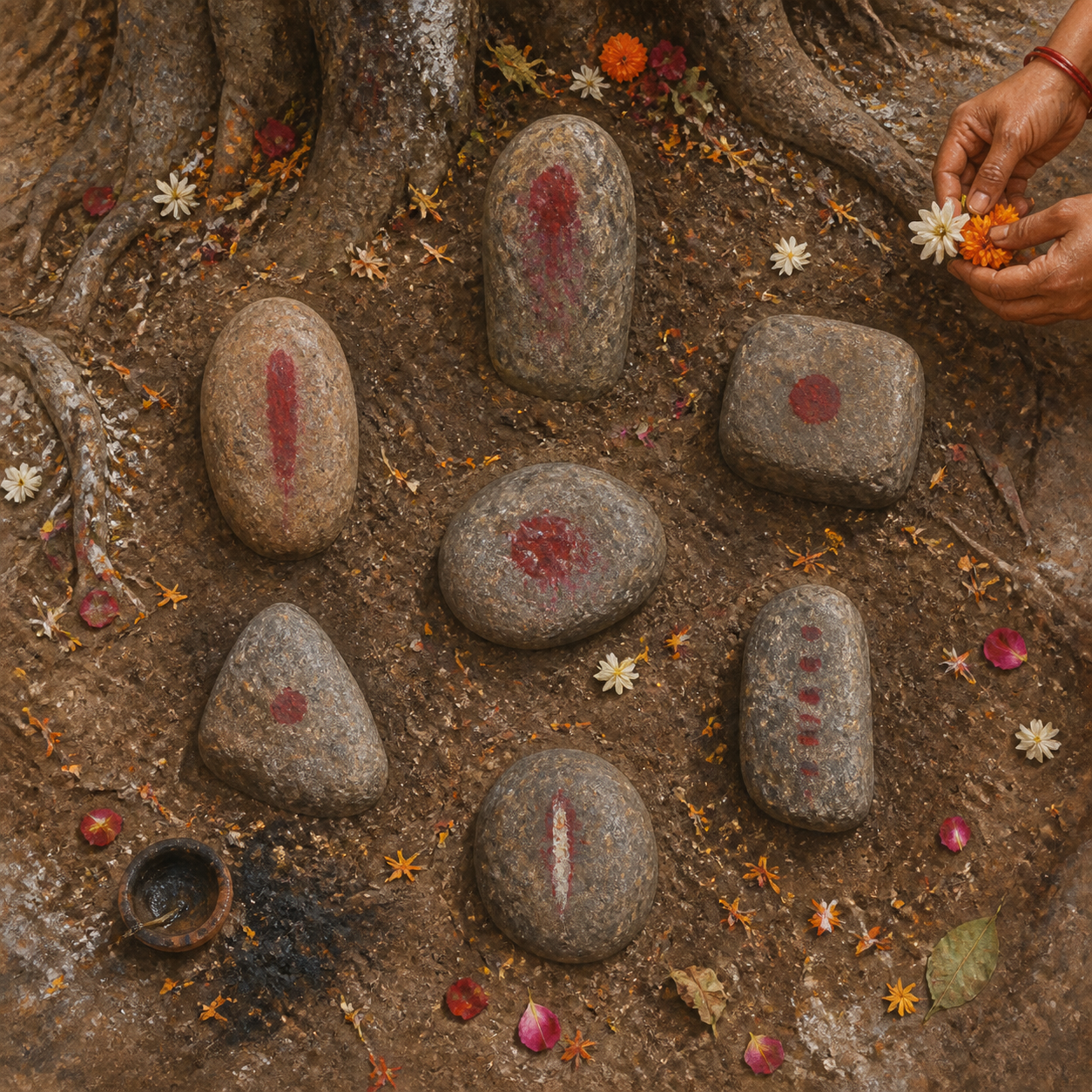
The number seven is an observation. Its meaning is a separate question. Hindu traditions contain many significant groupings, but resemblance is not evidence that every seven-stone shrine encodes the same idea. Do not decide that the stones must represent seven named goddesses, seven powers, seven ancestors, or any other fixed scheme unless the local tradition identifies them that way.
Keep three layers separate whenever you write a caption, family record, travel note, or heritage description:
- Observed: what you could directly see, such as seven stones of varying sizes, vermilion markings, a tree, and nearby water.
- Locally explained: the name, practices, relationships, and meanings that worshippers actually gave you.
- Unresolved: anything you were not able to verify, including the reason for the number, the age of the shrine, or the significance of its natural setting.
This separation keeps description honest. It also protects local knowledge from being overwritten by a pan-Indian explanation assembled elsewhere. Shared Dharmic patterns can help you ask better questions, but they cannot answer those questions in place of the community.
Visible simplicity cannot date a shrine either. A stone-centered form may preserve a long continuity, but the stones themselves do not provide a calendar. If no oral history, inscription, or other reliable evidence supplies an age, describe the tradition as living rather than assigning it an impressive but unsupported antiquity.
A responsible public caption might therefore say: “An open-air local goddess shrine centered on seven vermilion-marked stones near water.” Add the goddess’s name, antiquity, or interpretation only when you can identify who preserves that knowledge. This wording may sound modest, but it tells readers what is known without turning conjecture into heritage.
Distinguish a sacred focus from a stone used in a ritual contest
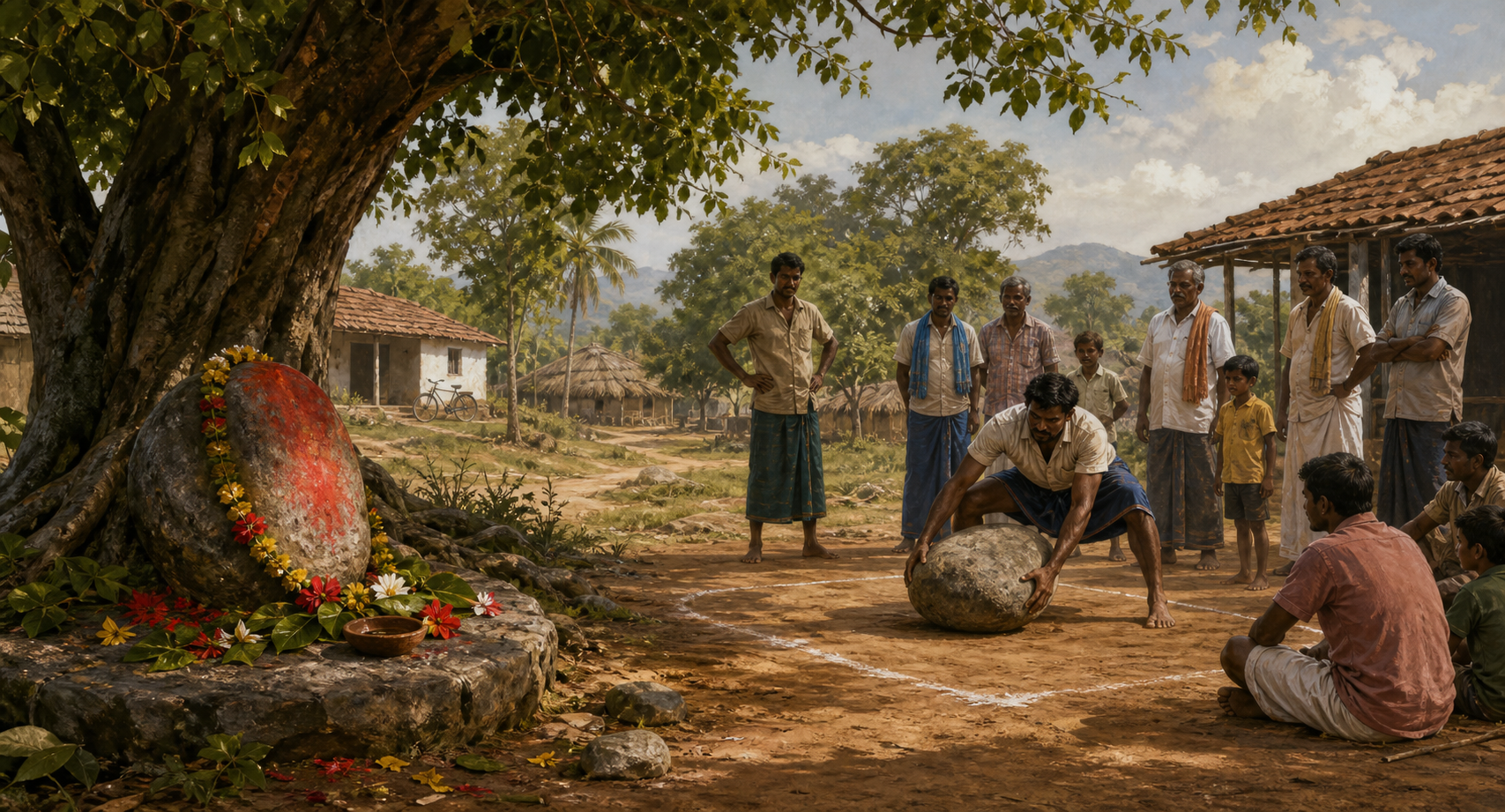
Stone does not perform one universal religious function. In one setting, stones remain arranged and receive devotional attention as a sacred focus. In another, rocks can become moving instruments within a ritual event. Treating every stone practice as the same phenomenon obscures both.
The annual Bagwal Mela at Maa Barahi Devi Temple in Uttarakhand provides the sharpest contrast. Thousands of worshippers divided into four groups and used rocks, sticks, and shields until their leaders stopped the contest after about eight minutes. Devotees understand the bloodshed as fulfilling a traditional offering to Maa Barahi.
The danger is not symbolic. More than 140 people were taken to hospital with injuries to the head, face, and legs. That figure describes one documented event, not a universal injury rate for folk goddess worship. It is still enough to establish that an active stone-throwing ritual can cause substantial bodily harm.
If you attend such an event, respect does not require you to enter the field or a projectile’s path. Learn where the active ground begins, follow the directions of recognized organizers, and remain in a designated spectator area if one exists. If no clearly controlled viewing place is available, withdraw from the active area. Do not assume that carrying a camera, being a pilgrim, or standing beside other observers makes your position safe.
Do not join a group, lift a stone, or copy participants without an explicit role and a full understanding of the event. The presence of shields and an internal stopping signal shows that the contest has its own structure; it is not an invitation for spectators to improvise. If you are struck, use available medical assistance rather than remaining in the ritual for the sake of appearance or politeness.
Heritage and safety are two distinct judgments. Explaining why devotees value a practice is necessary for understanding it. Pretending that documented injuries do not matter is not. A pro-Dharmic response can defend a community from caricature while still asking how preventable harm is addressed. Reverence needs discernment, especially when bodies bear the consequence.
Key takeaways
- An uncarved, open-air, priestless shrine can be a complete and active form of goddess worship, not a deficient version of a built temple.
- Read arrangement, markings, setting, local name, and living practice together; no isolated visual clue gives you the whole tradition.
- Never move stones, clean markings, add offerings, photograph, or publish a location until you know what the worshipping community permits.
- Treat the number seven as an observed fact until local knowledge establishes what it means.
- Separate stones that serve as a stable sacred focus from rocks used as instruments in a ritual contest.
- Respect for tradition does not oblige you to enter an active stone-throwing area or minimize the risk of injury.
The next time you encounter vermilion-marked stones beneath a tree, slow down before reaching for a label or a camera. Find the people who know the place, ask how you should approach, and let the shrine disclose its own scale of meaning. That small discipline is how a visitor becomes a respectful witness rather than an accidental editor of someone else’s living tradition.
References
- Hindu Blog – Seven Stones, Sacred Presence: The Living Folk Worship Of Goddess In Hinduism
- Hindu Human Rights Blog – Video: Over 140 ‘Hindoos’ Get Injured During Stone Pelting Each Other During Festival
