
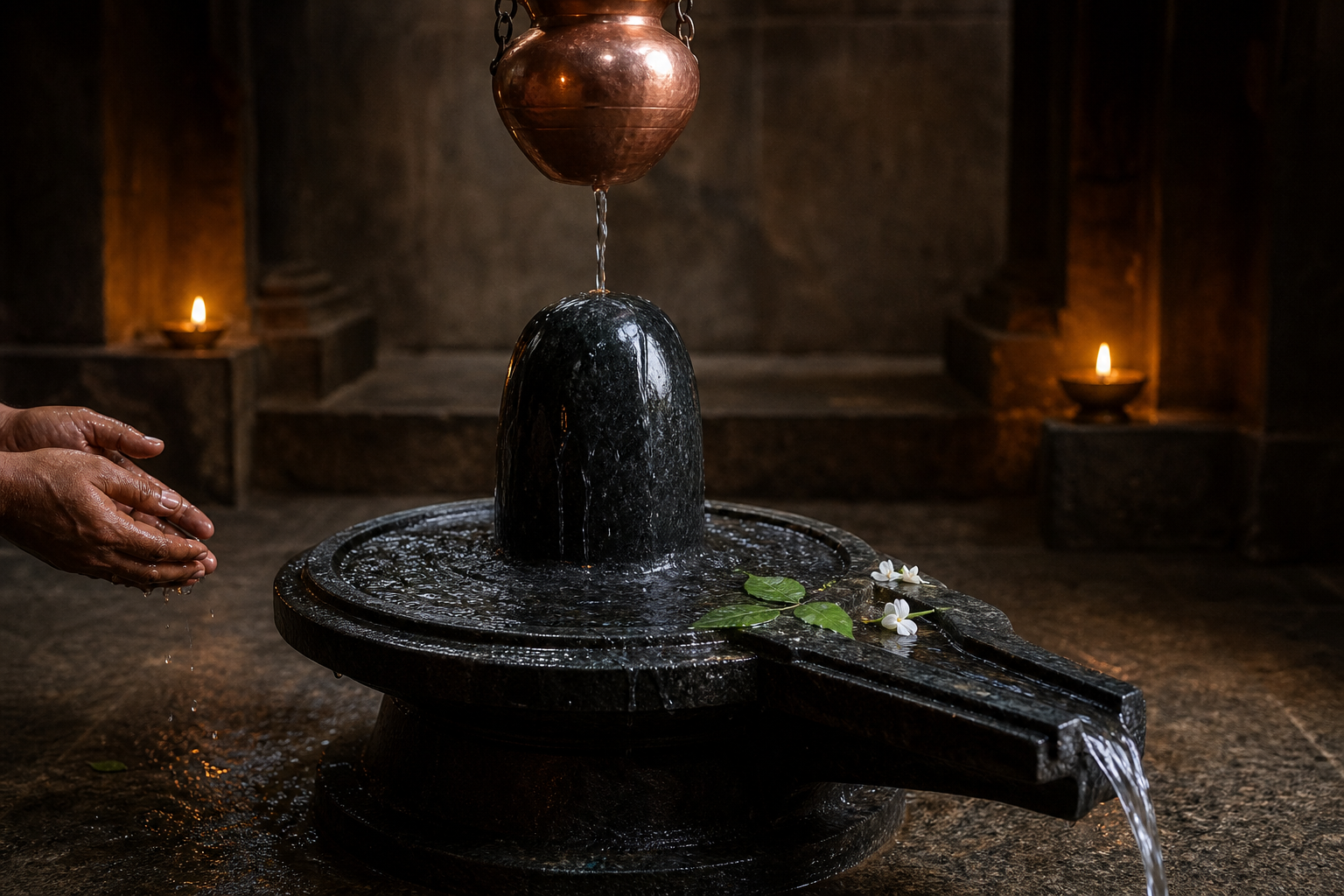
If you watch abhishekam only as an offering being poured, you can miss what the Shivalinga itself is doing. The liquid meets a carefully formed summit, spreads over the visible shaft, enters the pedestal, and leaves through a dedicated channel. That entire path joins worship, sacred geometry, and practical temple engineering.
This matters whether you are a devotee seeking a more attentive darshan, a volunteer responsible for cleaning, or a trustee looking at uneven drainage. Once you can identify the crown correctly, you can distinguish a legitimate regional form from damage, follow the inner meaning of the ritual, and notice when maintenance needs qualified attention.
First identify what the Shivalinga crown actually is
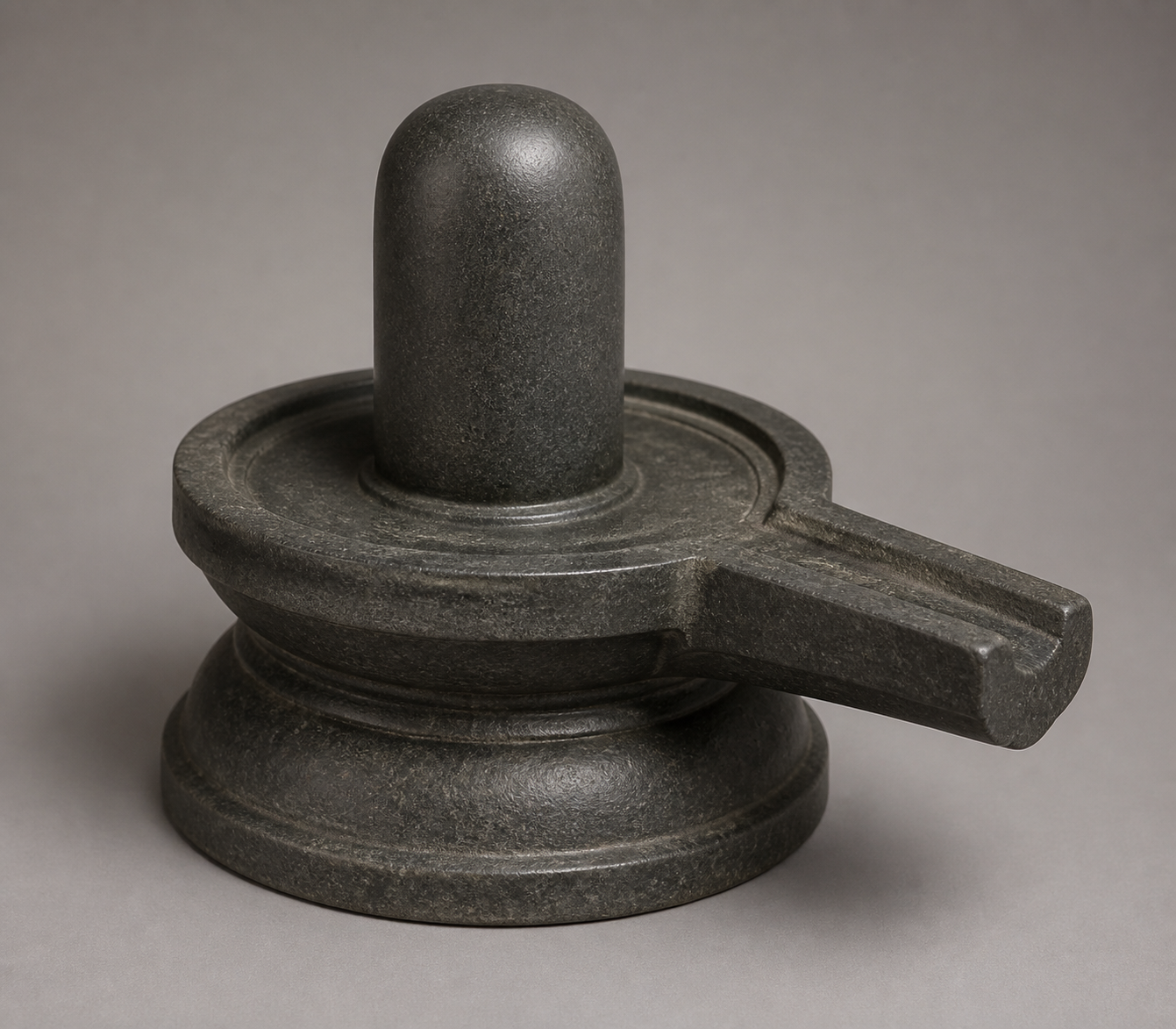
The architectural crown is the Shirovaratna, literally the “head-jewel.” It is the shaped summit of the Shivalinga itself, not necessarily a separate jewel, headdress, or detachable metal ornament. A kavaca or naga-bhushana may cover or adorn the summit during alankara, but the Shirovaratna remains the underlying sacred geometry.
This summit crowns the visible Rudra-bhaga. Beneath it are the Vishnu-bhaga and Brahma-bhaga, which continue downward into the pedestal. Together, the three divisions present creation, preservation, and reabsorption along one vertical axis. The arrangement is not merely a symbolic diagram laid over an object; its proportions determine how the installed form stands, receives worship, and conducts liquid.
| Member | Position | What you should notice |
|---|---|---|
| Shirovaratna | Summit of the visible Rudra-bhaga | The first point touched during abhishekam; normally convex, continuous, and smoothly finished |
| Rudra-bhaga | Visible upper section of the linga | The worship-facing portion over which the offering descends |
| Vishnu-bhaga | Middle division continuing into the pedestal | The sustaining middle of the threefold vertical body |
| Brahma-bhaga | Basal division within the foundation | The grounding portion of the installed axis |
| Yoni-pitha or adhara-shila | Pedestal surrounding and supporting the linga | A raked surface that receives the liquid and directs it toward the outlet |
| Nala or pranala | Spout leading away from the pedestal | The controlled exit into the extended soma-sutra drainage course |
The Kamikagama, Suprabhedagama, Mayamata, Manasara, and Shilparatna belong to the Agamic and shilpa-shastra setting in which the summit is treated as a calibrated architectural member. Within that tradition, the visible Rudra-bhaga is commonly described as roughly the upper third, ending in a resolved convex crown.
That proportion is a principle for trained design, not a licence to measure an established murti and declare it incorrect. Svayambhu forms, river-worn bana-lingas, mukhalingas, regional schools, and individual Agamic lineages do not all present the same silhouette. The practical question is whether the form belongs to its tradition and remains ritually and structurally sound.
The curve governs the entire abhishekam path
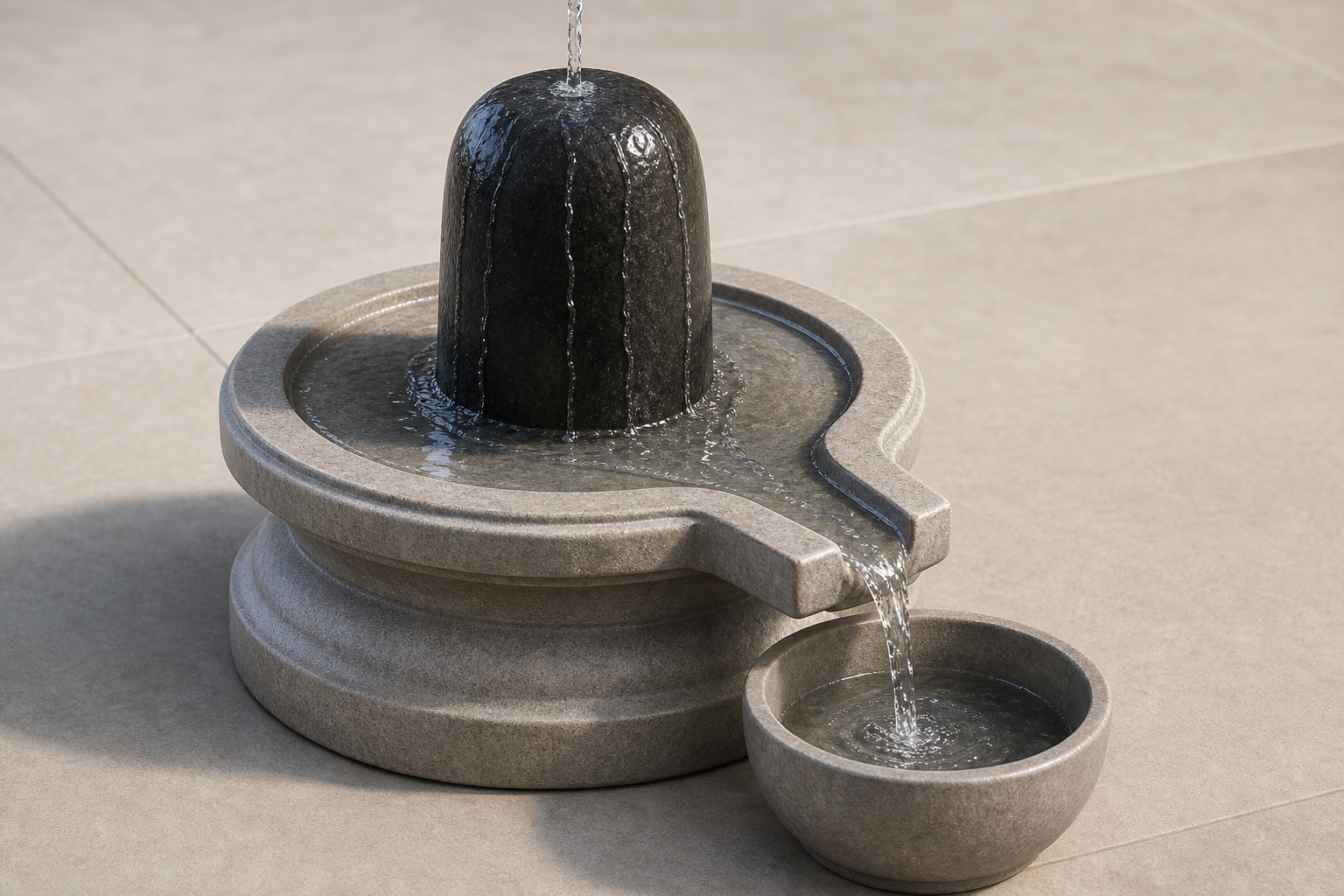
The crown is where ritual action becomes visible. Water, milk, or another authorized abhishekam offering first touches the summit. A properly resolved curve encourages the liquid to open into a smooth, continuous sheet instead of sitting on a flat top or breaking immediately into erratic streams. It then descends over the Rudra-bhaga, gathers at the neck and pedestal, and moves toward the pranala.
Three crown profiles can serve this purpose: a rounded golardha or hemispherical summit, a tighter ellipsoid such as that found in many bana-lingas, and a gently rising form that culminates toward a bindu-like point. Their shared feature is continuity. The transition should not become an arbitrary facet, shelf, or abrupt flat surface where liquid can stagnate.
Polish matters for the same reason. A well-dressed surface helps the stream travel as an even film and gives the wet crown a luminous appearance. The sheen is therefore neither cosmetic alone nor proof of sanctity by itself. It supports the hydraulics of worship while making the summit appear as a concentration of jyoti, or light.
During an ordinary abhishekam, follow the liquid in sequence rather than staring only at the point of pouring:
- At the summit, look for immediate outward movement rather than persistent pooling on the crown.
- Across the upper shaft, notice whether the offering forms a broadly continuous sheet or repeatedly breaks at one fixed rough point.
- At the neck, see whether the flow reaches the pedestal without being trapped in an unintended recess.
- Across the pitha, check whether the slope sends the liquid toward the pranala rather than onto the sanctum floor.
- At the outlet, notice whether discharge is controlled and reaches the intended collection or drainage course.
This sequence also prevents a common maintenance mistake: blaming every drainage problem on the linga. Pooling at the summit may involve crown wear or an obstruction placed during alankara. Standing liquid on the pitha points farther down the path. Wetness beyond the intended route may involve the pranala or soma-sutra. These are clues for an archaka, sthapati, or conservator, not permission for an untrained person to grind, scrape, or reshape the stone.
Orientation also needs local knowledge. The pranala may be aligned north or east according to the governing Agama and temple lineage. A generic plan cannot tell you that a long-established installation is “wrong.” Before changing an outlet or its drainage course, identify the temple’s own ritual authority and construction tradition.
Let the ritual reveal what the architecture means
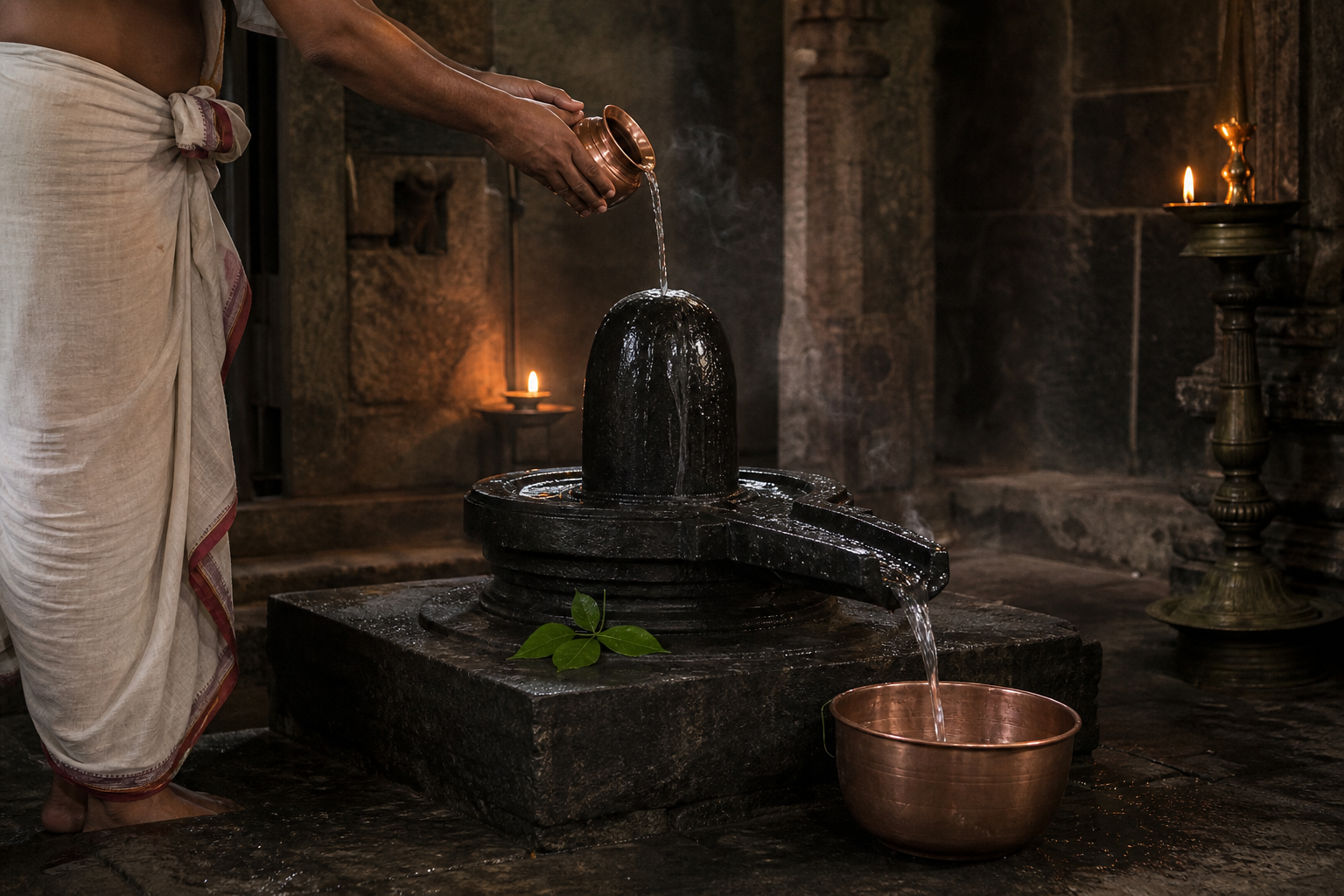
The summit deserves attention before decoration hides its outline. Begin with a steady view of the crown if the temple layout permits it. Notice the rise of the form, its unbroken surface, and the way the vertical axis comes to rest at one apex. This is a more useful darsana than searching for a literal face on an aniconic linga.
During abhishekam, the movement has a theological grammar. The summit concentrates bindu and nada, understood in Shaiva interpretation as seeds of manifestation. The downward stream can be contemplated as anugraha, grace descending through the body of the linga and returning to the world through the nala. The physical route does not compete with the spiritual meaning; it makes that meaning perceptible.
The three divisions deepen the same contemplation. Brahma-bhaga grounds the axis, Vishnu-bhaga sustains it, and Rudra-bhaga reveals itself above the pedestal. The Shirovaratna completes the ascent. Its symbolic correspondence with the sahasrara gives a yogic way to read the form: attention rises from the foundation toward the head-jewel, where finite awareness opens toward Shiva-tattva.
You can turn these ideas into a simple ritual discipline:
- Offer your first attentive gaze to the summit, acknowledging the head of the sacred axis.
- As abhishekam begins, follow one complete stream from crown to outlet instead of allowing attention to scatter among surrounding activity.
- Hold the descent and return together in mind: grace is received at the summit, passes through the manifested form, and moves outward again.
- If you are authorized to make an offering, place bilva-patra, vibhuti, or prescribed alankara with particular care at the crown. Do not press, scrape, or improvise.
- Follow the archaka’s directions and the temple’s own Agamic discipline. Public access to the murti and rules for touching or placing offerings vary.
Alankara should clarify rather than confuse the distinction between structure and adornment. A metal kavaca can sheath the form, and a naga ornament can frame it. Bilva leaves and vibhuti can direct devotional attention toward it. None of these additions turns the crown into a separate architectural object. When the ornament is removed, the shaped summit remains the Shirovaratna.
Respect variation before diagnosing damage or making repairs
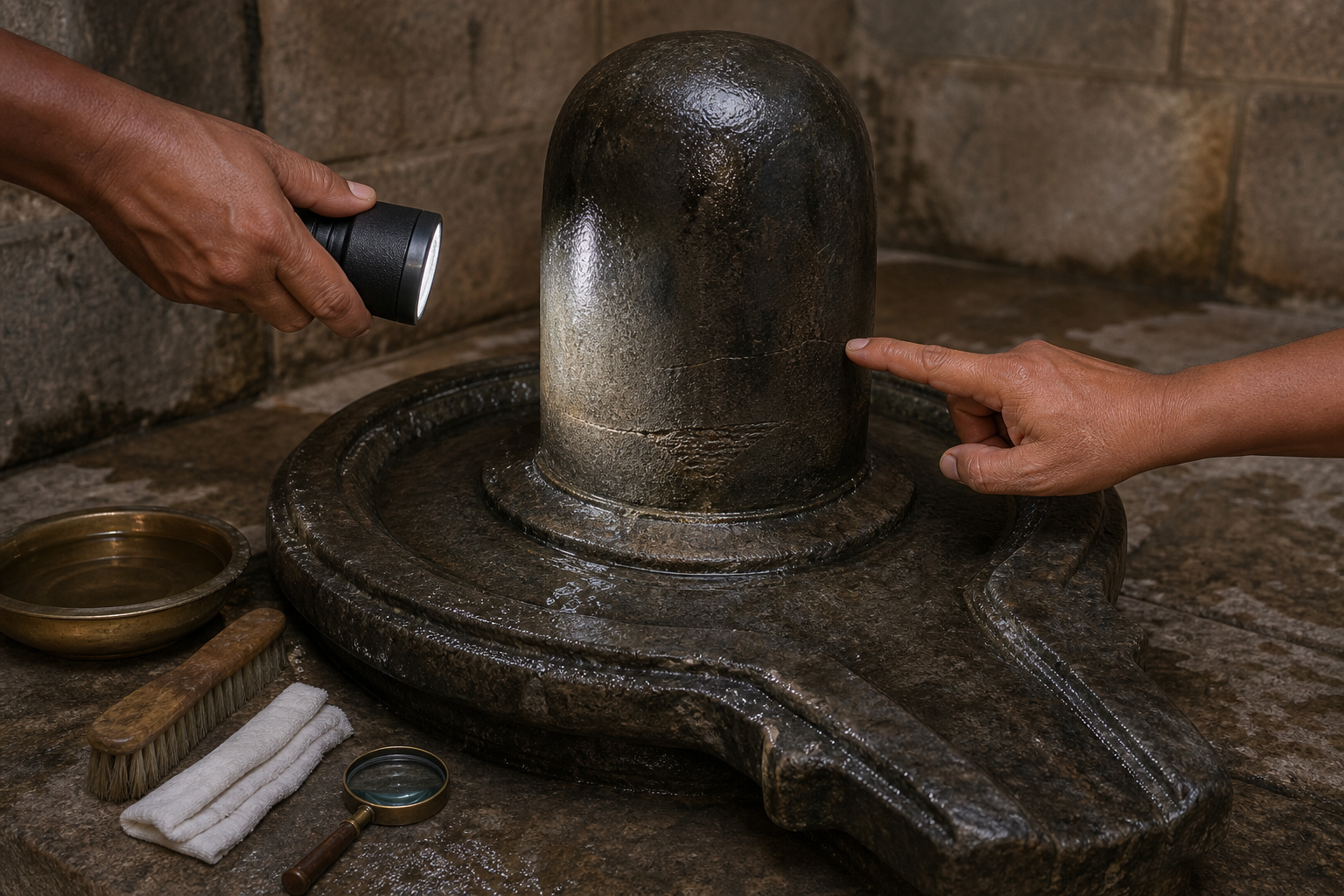
A full, rounded golardha crown with pronounced necking is associated with many Dravida workshops. Nagara workmanship may favour a somewhat tighter ellipsoid. Kerala traditions value highly polished granite and sphatika forms whose wet surfaces heighten the impression of gathered light. Granite and basalt provide durable crowns in southern temple settings, while marble appears in northern settings. These are tendencies, not a checklist for assigning every linga to a region.
The type of linga matters as much as the region. A bana-linga preserves the smooth ellipsoid given by the Narmada’s river action. A svayambhu linga retains its naturally emergent crown rather than being forced into a workshop-perfect profile. A mukhalinga may carry one, four, or five serene faces while still rising into a modest dome. An irregularity that belongs to a svayambhu form must not be “corrected” merely because it differs from a carved golardha.
That distinction becomes critical in conservation. Abrasive scrubbing can dull the finish and alter the surface that distributes abhishekam. Acidic cleansers can attack the material. Recutting the summit to make it look sharper can change the iconographic canon, disturb the designed flow, and introduce micro-fractures. Because reshaping consecrated stone is both physically irreversible and ritually consequential, it should never begin as a casual cleaning or beautification job.
A responsible care routine is narrower and more observant:
- Inspect the crown periodically for fresh abrasion, chips, persistent roughness, or a change in the way liquid leaves the summit.
- Observe the pitha and pranala during actual ritual flow; a dry visual inspection alone cannot reveal the complete drainage behaviour.
- Keep the pranala and extended soma-sutra course functioning so consecrated liquid does not remain in the pedestal or escape into the sanctum fabric.
- Use only the temple’s authorized, pH-neutral cleaning method. Do not substitute household acids, abrasive powders, or hard scraping tools.
- Where temple rules permit documentation, record the location of a recurring flow problem before any intervention. A consistent written or photographic record helps a qualified practitioner distinguish damage from temporary obstruction.
- Ask an Agama-aware archaka and a sthapati or suitable stone conservator to assess any proposed alteration. Ritual legitimacy, material condition, and hydraulic performance have to be considered together.
Flow is an especially useful condition indicator. If an uninterrupted sheet begins to split at the same bare section of the crown, note the point. If the crown drains well but the pedestal retains liquid, direct attention to the slope and outlet. If discharge leaves the pranala but moisture appears elsewhere, the continuing soma-sutra route needs inspection. This order of observation helps you report the problem precisely without pretending to know the repair in advance.
Key takeaways
- The Shirovaratna is the shaped summit of the Shivalinga, not merely a detachable crown or decorative covering.
- Its convex, continuous surface carries both sacred meaning and a practical duty: distributing abhishekam smoothly toward the pedestal and pranala.
- Rounded, ellipsoidal, gently pointed, river-worn, naturally emergent, and mukha-bearing forms can all be legitimate within their own traditions.
- The full ritual system includes the linga, yoni-pitha or adhara-shila, pranala, and extended soma-sutra drainage route.
- Northward or eastward outlet alignment depends on local Agamic practice; do not alter an installation from a generic rule.
- Abrasives, acidic cleansers, and casual recutting can harm the crown’s finish, geometry, flow, and ritual integrity.
At your next darshan, place yourself where you can observe without interrupting worship and follow one complete abhishekam cycle from summit to outlet. If you care for a temple, make the same observation before reaching for a cleaning tool. The crown will often show you where devotion, geometry, and stewardship must remain joined.