
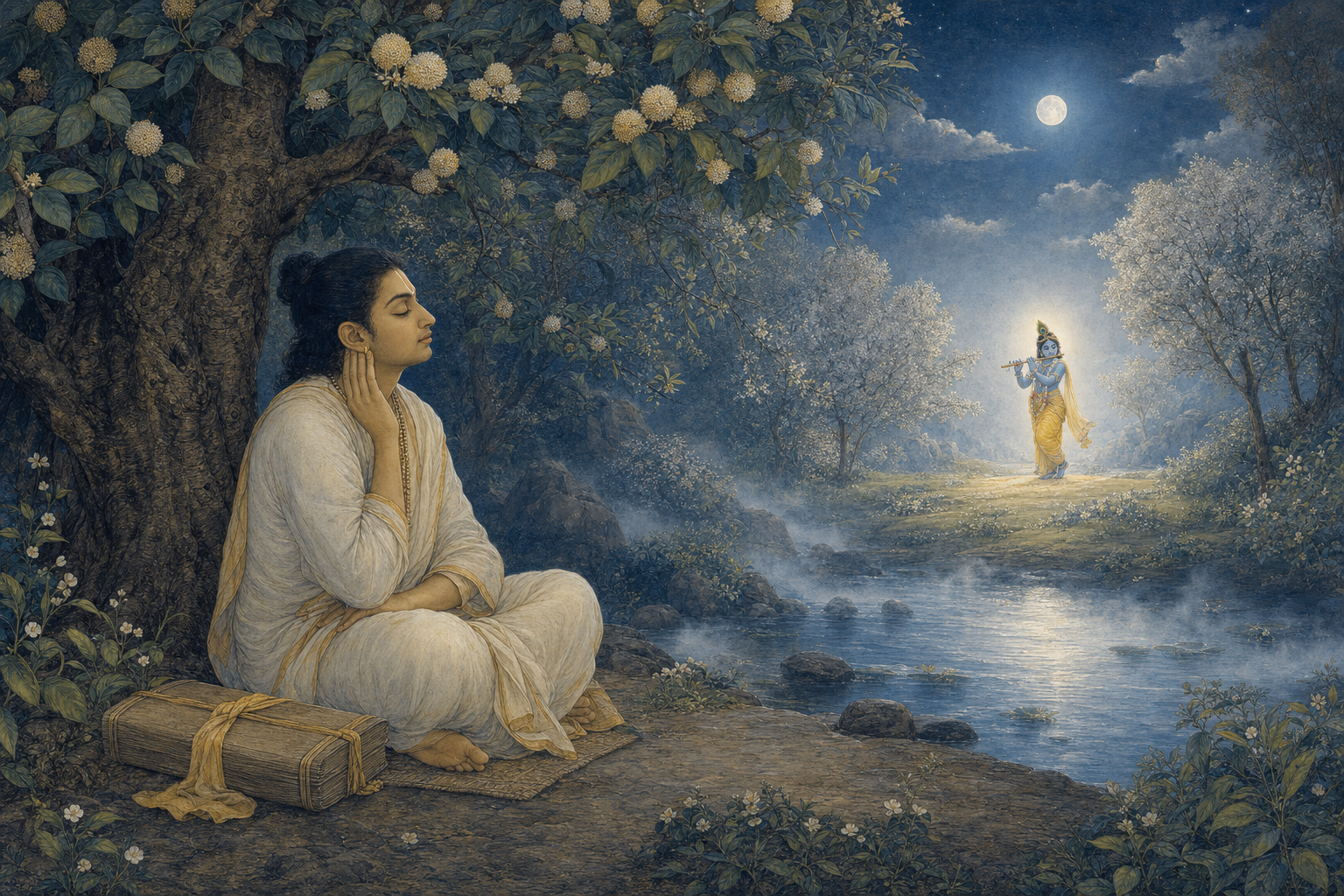
If you have opened Krishna Karnamrita and wondered whether to study it as Sanskrit poetry, receive it as Vaishnava devotion, or use it in daily sadhana, begin with the ear. Its theology is carried not only by ideas, but by cadence, image, pause, and longing.
That changes how you should read. A quick hunt for doctrine misses the music. A purely aesthetic reading misses the surrender. Treating every saintly legend as verified biography creates a certainty the historical record cannot support. The more fruitful approach is layered: hear the verse, see the Krishna it reveals, identify its devotional movement, and then let its meaning remain with you.
First understand what kind of work you are holding

Krishna Karnamrita is not a continuous account of Krishna’s life, a systematic philosophical treatise, or a biography of its poet. It is a compact body of Sanskrit devotional lyrics. A verse may give you Krishna’s flute, smile, peacock feather, the dust of Vrindavan, the speech of a gopi, or the ache of separation without narrating the full episode around it.
This compression is deliberate. The Bhagavata Purana supplies the broad narrative world, especially through its Tenth Skandha. Lilasuka turns selected moments from that world into concentrated experiences of remembrance. You are therefore better served by dwelling on a small passage than by racing through the collection to discover what happens next.
Keep the historical poet and the devotional saint distinct
Lilasuka is widely identified with Bilvamangala, also known as Bilvamangala Thakura. Beyond that identification, firm historical conclusions become difficult. Traditions associate him with Kerala and other places, while proposed dates range roughly from the eleventh through the thirteenth centuries.
The best-known account presents a sensually driven young man whose life is overturned by the rebuke of a courtesan named Cintamani. He renounces his former attachments, undertakes pilgrimage, and eventually reaches Vrindavan. Another strand preserves his reverence for the guru Somagiri. These memories disclose how Vaishnava tradition understands his transformation: powerful desire is not merely suppressed but redirected until it becomes unwavering love of Krishna.
You need not choose between dismissing that account and treating it as a modern archival biography. Read it as hagiography with spiritual purpose while keeping its chronology qualified. It illuminates the inner trajectory associated with the poet – compulsion, awakening, surrender, and loving vision – even where external details remain uncertain.
The honorific Lilasuka captures the identity that matters most to the work. It is commonly understood as the swan-poet of Krishna’s lila. The hamsa evokes discernment: the contemplative ability to draw essence from a mixed field of experience. Lilasuka is remembered, accordingly, as a kavi-yogi whose poetic mastery and devotional perception cannot be pulled apart.
Expect different verse counts and numbering
Many recensions arrange Krishna Karnamrita in three satakas, or groups of approximately one hundred verses, but surviving and printed forms are not uniform. Depending on the recension, a reader may encounter roughly 250-330 verses distributed across three parts. South Indian palm-leaf lines of transmission and Eastern manuscript traditions sometimes preserve different readings, enumerations, and additional verses.
This variation is evidence of a work copied, recited, and cherished in several communities. It also has a practical consequence: a verse number by itself may not identify the same text in every edition. When you copy, teach, or share a verse, record the edition or translator, its sataka or section, its verse number, and, where possible, its opening Sanskrit words. If a study group uses several translations, choose one base edition before discussing discrepancies.
Hear Krishna before trying to explain him

The title Krishna Karnamrita is commonly rendered as ‘nectar for the ears’ associated with Krishna. That is more than an attractive title. It tells you that sound is one of the work’s ways of knowing. A verse is meant to enter through attentive hearing before it is reduced to a proposition.
Lilasuka works with the resources of classical Sanskrit poetics. Alongside the prevalent anustubh, he employs meters such as mandakranta, sardulavikridita, and sragdhara. Alliteration, internal rhyme, carefully placed pauses, alankara, and slesa give the language several layers of movement and meaning. Ornament here is not decorative excess. It directs attention, delays premature closure, and lets an image continue resonating after its grammatical meaning is understood.
You do not need advanced training in Sanskrit metrics to respond to that craft. Read a verse silently for its basic sense, then aloud for its sound. Once the meaning is clearer, read it aloud again and notice where the voice naturally slows, gathers force, or falls quiet. If you have access to the Sanskrit, keep it beside the translation. If you do not, favor a translation that preserves line breaks, repetitions, changes of address, and concrete imagery rather than converting the verse into explanatory prose.
Listen and look for several kinds of movement:
The sensory center: Is the verse organized around a sound, a color, a facial expression, a gesture, or the atmosphere of Vrindavan?
The turn: Does description become longing, praise become petition, or absence suddenly feel like presence?
The pause: Where does the verse make you wait? A caesura can allow one image to settle before another changes its meaning.
The double sense: Does a word appear to operate at both a physical and a theological level? Do not rush to choose only one.
The after-image: What remains when the recitation ends – the flute, the smile, Krishna’s childlike immediacy, or the pain of not seeing him?
This is why reading aloud matters even when your main interest is philosophy. In Krishna Karnamrita, thought is not delivered separately from beauty. Sound, image, and doctrine arrive together, each preparing the mind to receive the others.
Turn one verse into a practice of remembrance
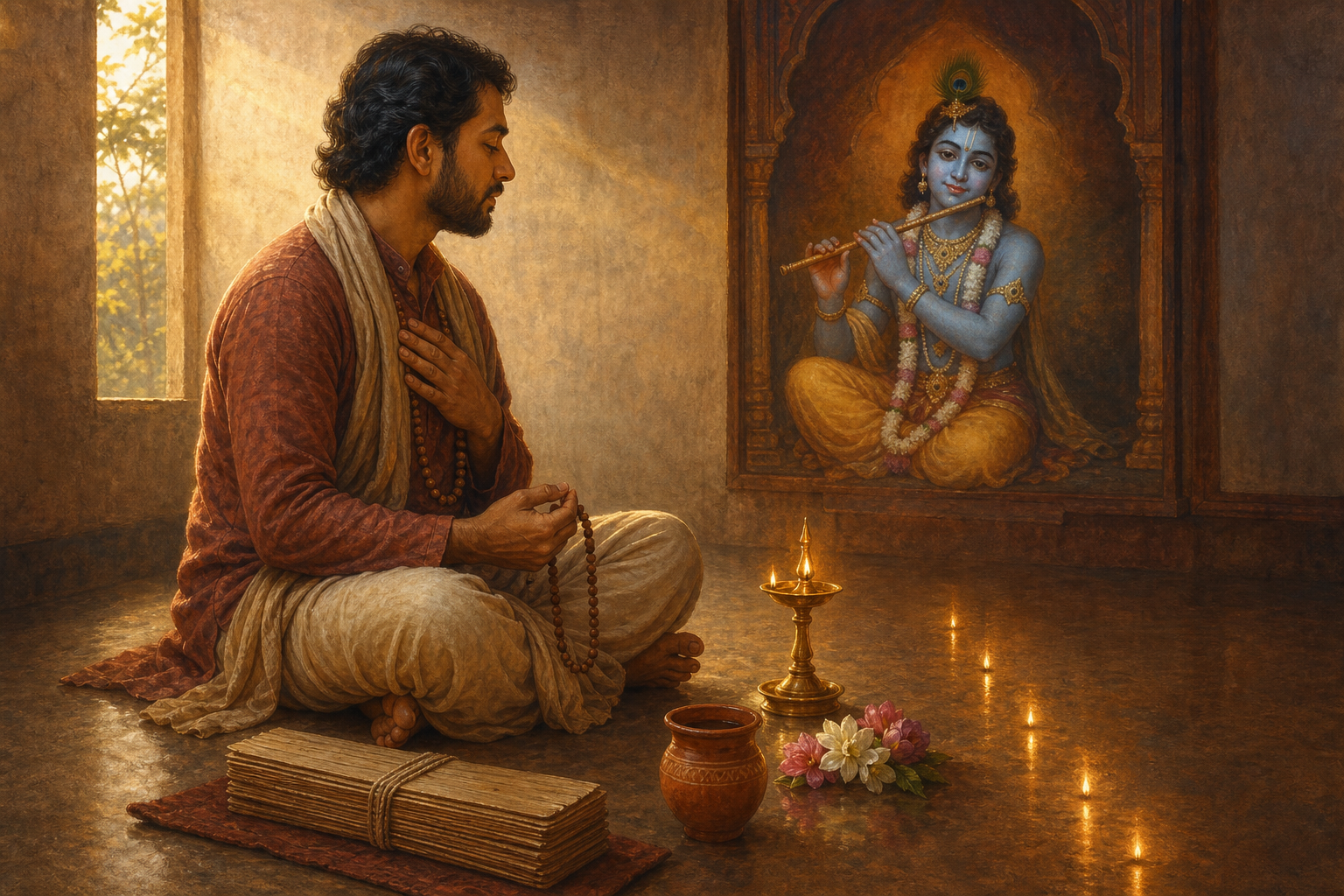
A verse of Krishna Karnamrita can be studied closely without being trapped in analysis. Its images are designed to move from the senses into memory. The practical aim is not to manufacture a dramatic feeling, but to refine attention until Krishna’s form, qualities, and lila become easier to remember without prompting.
Use this sequence with a verse that draws you:
Locate it accurately. Note the edition, sataka, verse number, and opening words. This prevents confusion when recensions differ.
Establish the visible scene. Before interpreting anything, state what is present: Krishna as cowherd, child, flautist, companion, or beloved; the figures around him; and the sensory detail carrying the scene.
Read it into the ear. Recite slowly enough to hear repeated sounds and pauses. If pronunciation is still developing, attentive steadiness is more useful than rushing to sound impressive.
Name the devotional movement. Ask whether the verse moves toward intimacy, wonder, vulnerability, playful affection, separation, or the sudden nearness of Krishna. This identifies the inner action of the lyric.
Ask the theological question. What kind of divinity can be the Absolute and yet appear as a child with dust on his body, a cowherd holding a flute, or a beloved whose absence overwhelms the devotee?
Carry one image rather than the whole commentary. Return to the same verse at a natural daily transition. Dawn and dusk are traditional occasions, and some teachers recommend remaining with one verse for several days. Let a single phrase, sound, or image accompany ordinary activity.
A simple notebook can keep study and devotion connected. Give each entry the headings ‘Image’, ‘Movement’, and ‘Remembrance’. Under the first, write only what the verse makes perceptible. Under the second, describe how its emotional direction changes. Under the third, record the phrase or image you intend to recall. This prevents commentary from burying the encounter that made the verse worth studying.
If a verse leaves you cold
Do not imitate an emotion you do not feel. Return to observable craft. Identify the central image, speak the verse slowly, and ask why that image rather than another has been chosen. Devotional receptivity is not theatrical intensity. Honest attention is already a discipline.
It may also be the wrong verse for your present attention. Move to one whose imagery is more immediate, but keep the abandoned verse marked. A lyric that seemed closed can become intelligible after you have learned how Lilasuka handles longing, sound, and sudden changes of address elsewhere.
Read madhurya as theology, not decorative romance
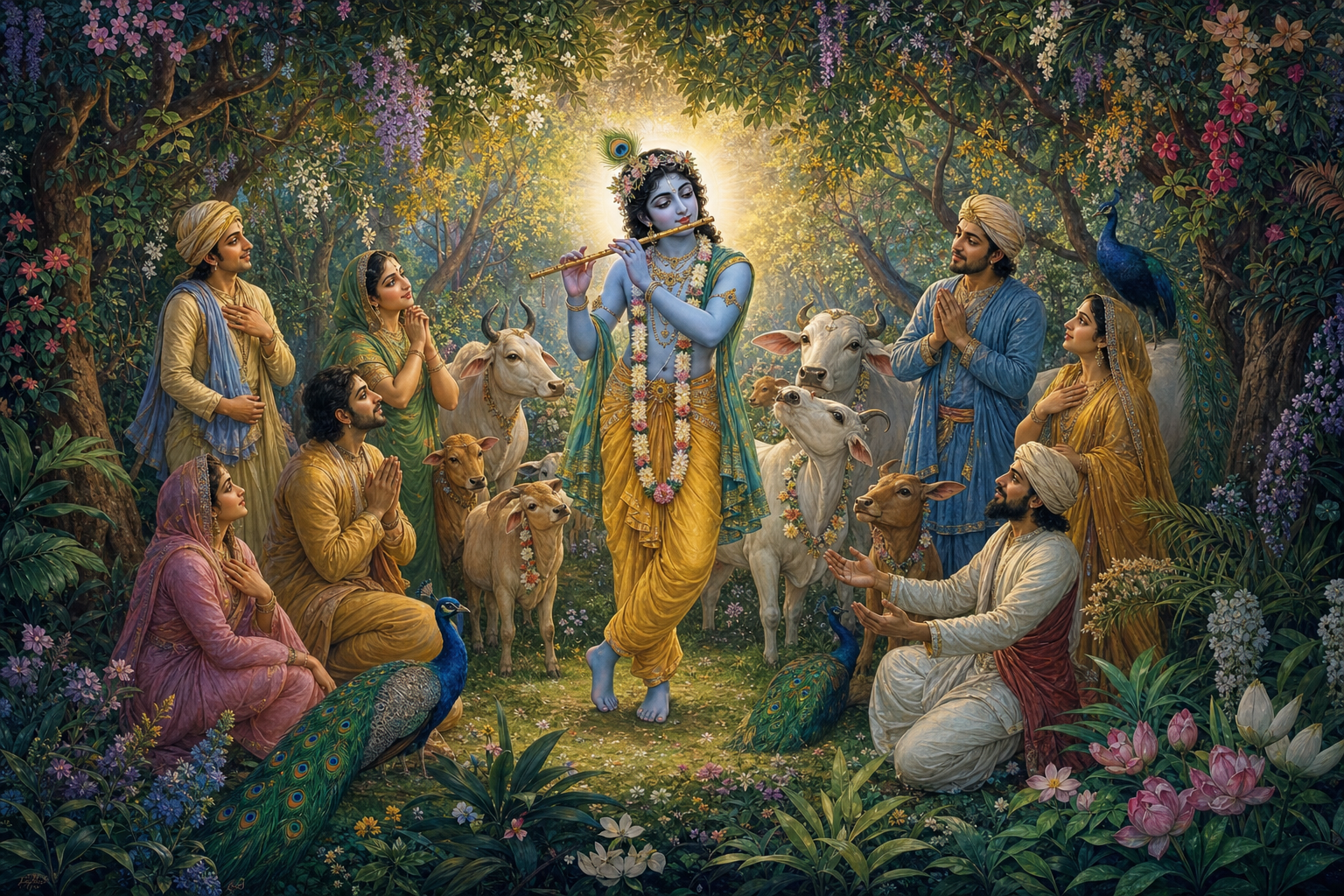
The governing mood of Krishna Karnamrita is madhurya-bhakti, the sweet and intimate mode of devotion associated with the Krishna lila of the Bhagavata Purana’s Tenth Skandha. Krishna’s flute, the responses of the gopis, the play of the cowherd companions, and the immediacy of his beauty do not merely embellish an abstract deity. They reveal how the supreme can be approached through intimacy without ceasing to be supreme.
That is the theological pressure within the poetry. Krishna is at once the innermost reality and the beloved who is addressed, sought, seen, and missed. Complete identity would erase the relationship through which love moves. Complete separation would make union impossible. The lyrics preserve both nearness and distinction, allowing devotion to taste union without dissolving the one who loves or the one who is loved.
A Gaudiya Vaishnava reader may hear an anticipation of the later language of acintya-bhedabheda, inconceivable oneness and difference. That resonance is illuminating, but it should not be turned into a claim that Lilasuka formally taught every element of a later theological system. The poem gives the experience its lyrical form; subsequent traditions supply more systematic vocabulary.
Use these guardrails against common misreadings:
Do not reduce divine longing to the poet’s sensual biography. The Cintamani narrative helps explain redirected desire, but it is not an interpretive key that turns every intimate image into autobiography.
Do not bleach the intimacy out of the poetry. Calling every image a mere symbol can protect you from discomfort while also removing the bhakti. Madhurya requires Krishna to be encountered as personally lovable, not merely decoded as an abstraction.
Do not confuse viraha with devotional failure. Separation intensifies remembrance. The absent beloved can occupy attention more completely than an object casually present before the senses.
Do not stop at sweetness. Krishna’s beauty disarms the self-centered habits of perception. The practical question is not simply whether the verse feels beautiful, but what it teaches your attention to seek.
The connection with the Bhagavata Purana can sharpen this reading. When a verse evokes the flute, rasa-lila, or a playful exchange involving the gopas or gopis, revisit the corresponding narrative setting in the Tenth Skandha. Then return to Lilasuka and notice what has been removed. The missing plot is often the point: narrative space has been compressed so that one devotional mood fills the field.
This concentrated quality also helps explain the work’s later reception. Gaudiya Vaishnava tradition remembers Sri Chaitanya Mahaprabhu encountering Krishna Karnamrita in South India and treasuring it. Its verses subsequently circulated through recitation, commentary, kirtan culture, and personal devotion in Bengal, Odisha, and beyond. The tradition did not preserve the work as a literary artifact alone; it treated poetic hearing as a form of spiritual cultivation.
Readers from other Dharmic paths can recognize that discipline without pretending all traditions teach the same theology. Buddhist chanting and mindfulness, Jain stavan, and Sikh kirtan each refine hearing, memory, and attention within their own doctrinal worlds. The responsible comparison lies in the disciplined transformation of perception, not in erasing differences between Krishna-bhakti, Buddhist practice, Jain devotion, and remembrance of the Divine Name in Sikh tradition.
Key takeaways
Approach Krishna Karnamrita as a collection of concentrated devotional moments, not as a continuous life of Krishna.
Keep historical uncertainty visible: Lilasuka is widely identified with Bilvamangala, but his date, location, and complete biography remain unsettled.
Name your edition when citing a verse because recensions differ in numbering, readings, additions, and total length.
Read in layers: establish the image, hear the sound, identify the devotional movement, and only then formulate the theology.
Understand madhurya as a mode in which intimacy reveals divine supremacy rather than replacing it.
Stay with one verse long enough for its image to enter ordinary memory. Repetition becomes fruitful when attention grows more exact, not merely more frequent.
Your next step can be modest. Choose one verse, note exactly where it comes from, read it aloud at the same daily transition for several days, and carry one image from it into the rest of the day. Move on when that image begins to return without being forced. That is where Krishna Karnamrita starts becoming what its title promises: not information about devotion, but something received through the ear and retained by the heart.