
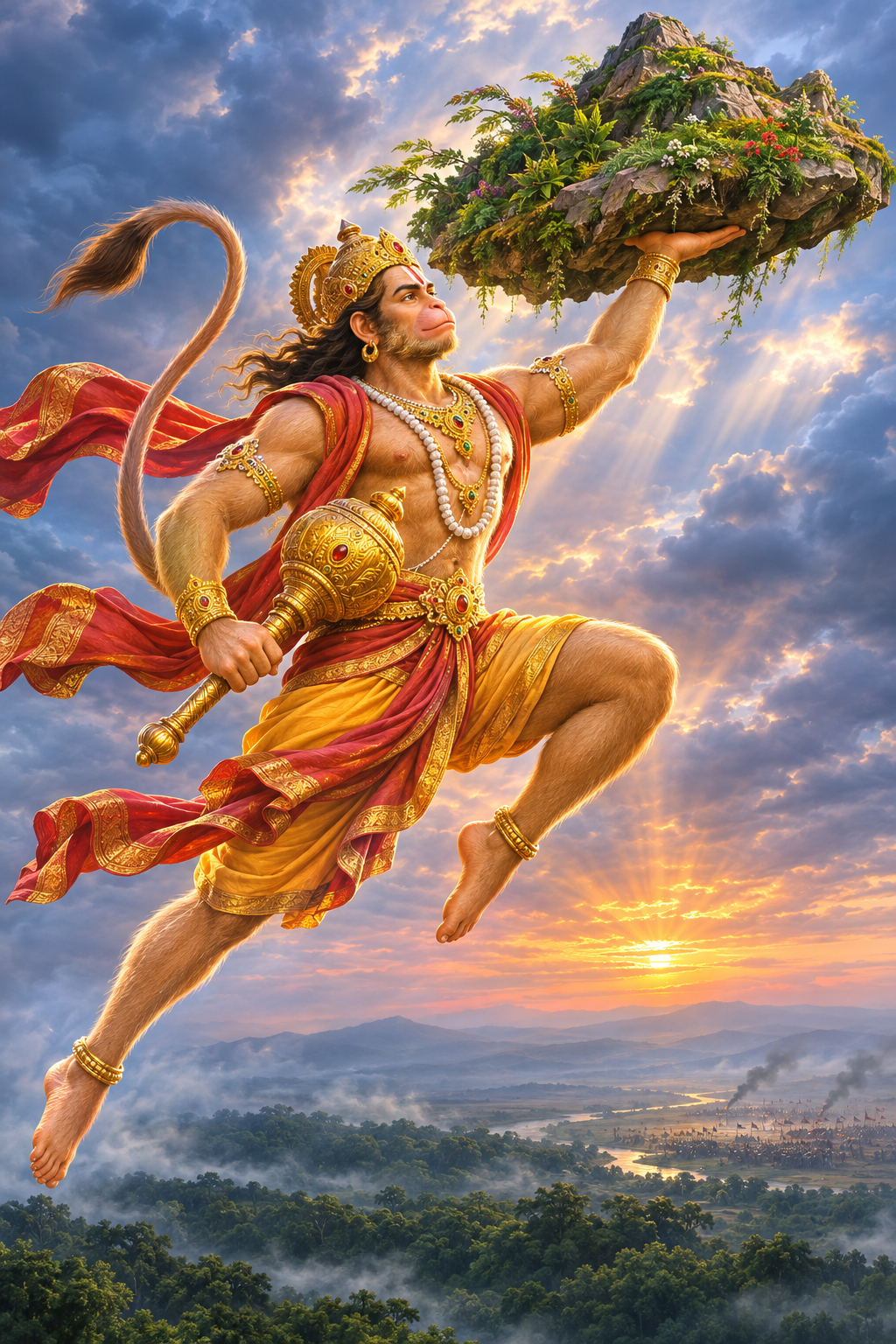
You have seen the image: Hanuman bears a mountain while moving with unmistakable urgency. Perhaps you are trying to identify a temple sculpture, choose a murti for your home, or understand why this form feels different from a quiet image of Hanuman in prayer.
The answer lies in the relationship between three elements: the mountain, the movement, and the purpose. Read them together and Sanjeevani Hanuman becomes more than a familiar figure carrying an unusual object. He becomes an image of bhakti acting decisively when another life depends on it.
The mountain is the form’s decisive identifier
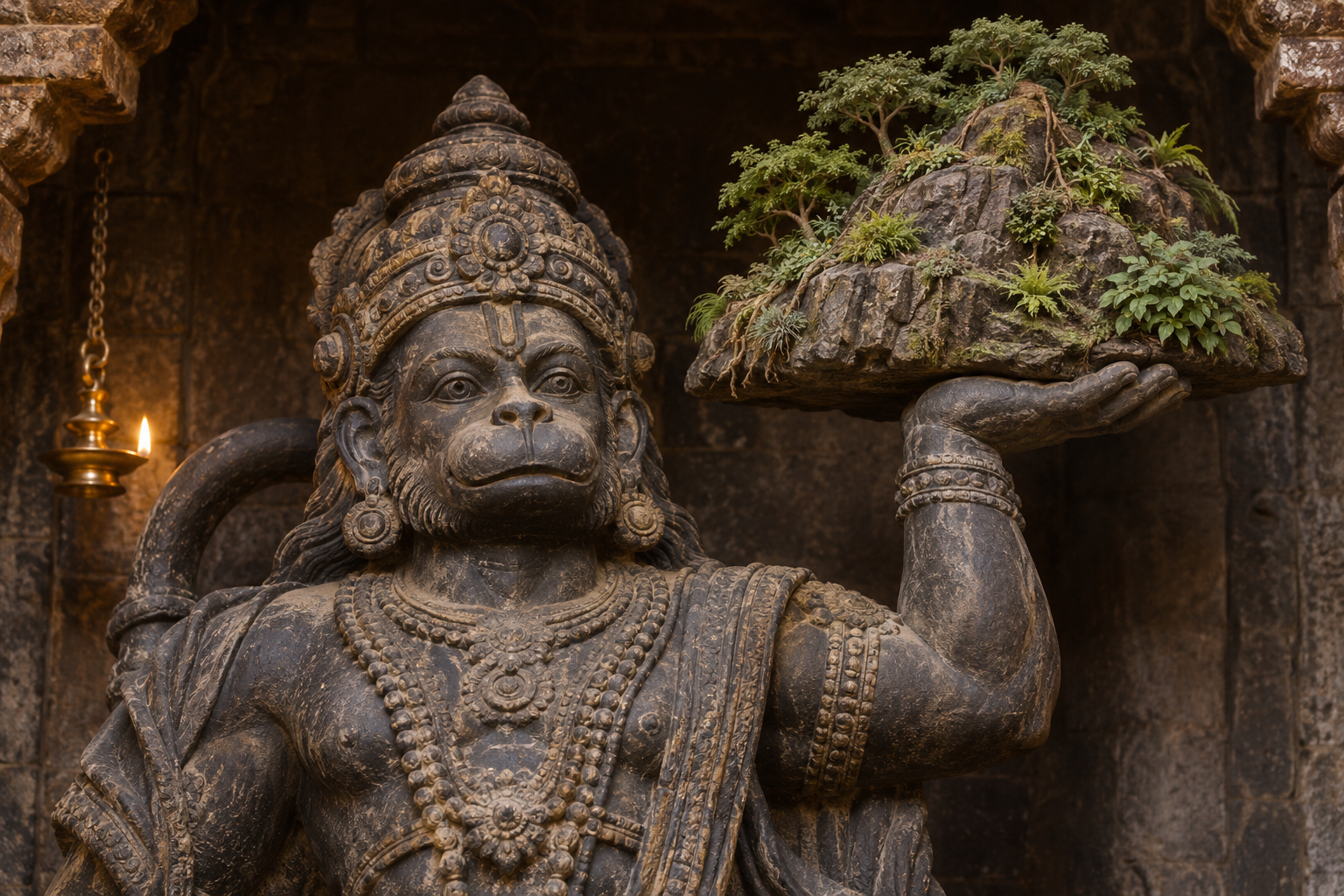
The most reliable way to recognise Sanjeevani Hanuman is not by colour, clothing, ornament, or the position of a secondary object. It is by the mountain he carries. This form captures Hanuman racing through the sky with the mountain that bears the life-restoring Sanjeevani herb.
That distinction matters because artists do not represent every sacred form in exactly the same way. A painted calendar image, a large roadside statue, a weathered temple relief, and a small household murti may differ sharply in proportion and detail. The mountain is the narrative attribute that holds the identity together across those changes.
When examining an unfamiliar image, ask a simple question first: is the rocky or vegetation-bearing mass merely part of the landscape, or is Hanuman visibly carrying it? If it is borne by him, the image points specifically to the Sanjeevani episode. If no mountain is present, devotion to Hanuman may still be clear, but this particular identity cannot be established from that attribute alone.
Do not make the opposite mistake and demand botanical precision. The image does not need to isolate one recognisable plant for its meaning to work. The whole mountain is the identifying object. Leaves, trees, peaks, and other surface details can help an artist make it legible, but they are not more important than the relationship between bearer and burden.
Read the image through object, action, and purpose
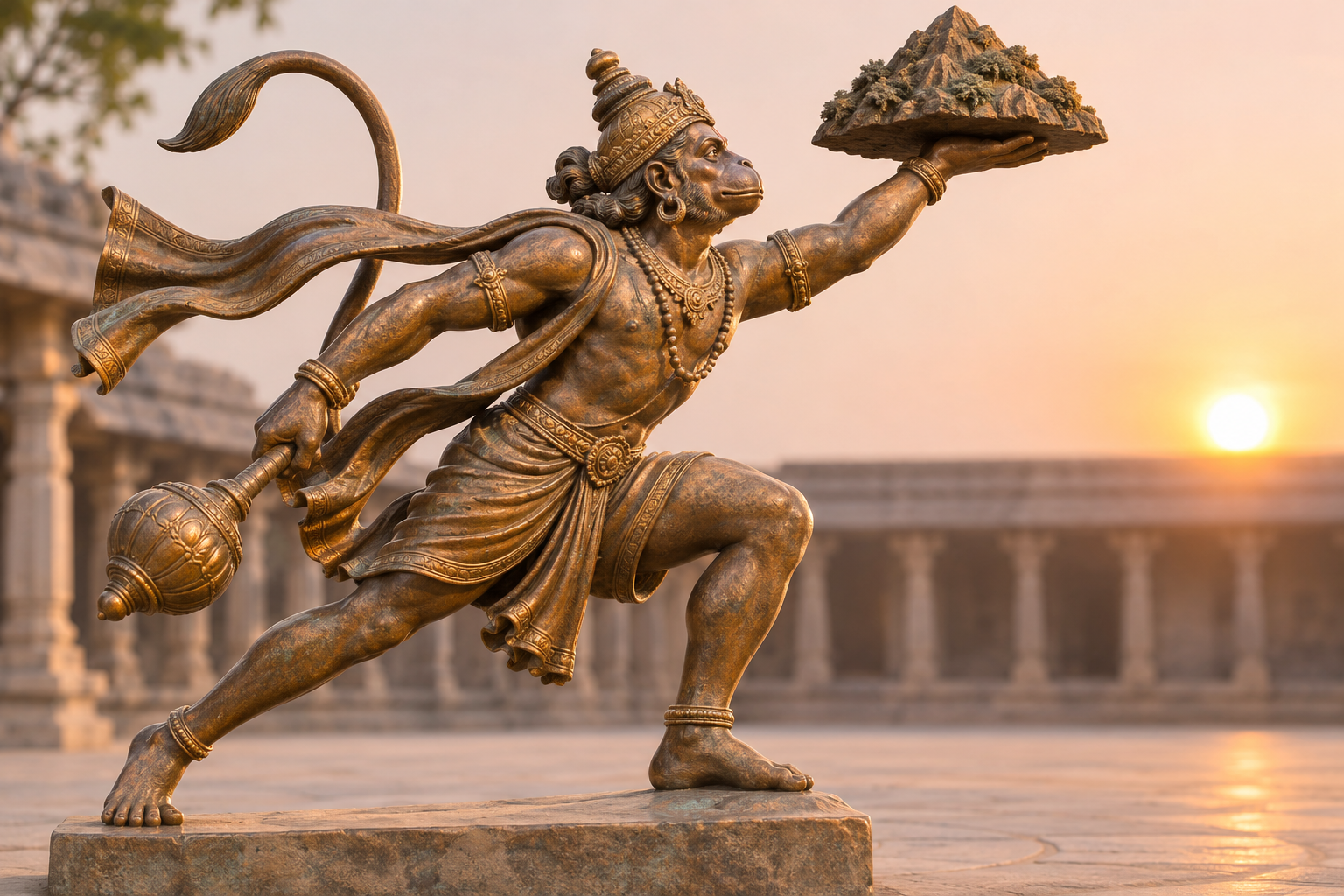
Iconography is a visual language. Sacred identity is communicated through attributes, posture, gesture, and narrative context. With Sanjeevani Hanuman, you can read that language in three layers.
First, identify the object
The object is a mountain bearing the Sanjeevani herb. It is not a throne, weapon, architectural canopy, or decorative background. Its scale is part of the visual statement: Hanuman is carrying something that would ordinarily be immovable.
This gives you a practical test when a sculpture is damaged or viewed from a distance. Look for the outline of a substantial rocky mass associated directly with Hanuman. Small carved plants may have eroded, but the larger silhouette can still preserve the identity of the form.
Second, notice the action
Sanjeevani Hanuman is an active form. The episode is not centred on possession of the mountain but on transporting it urgently. Artists may communicate that action through a forward-driving body, extended limbs, wind-swept details, a lifted posture, or another visual sign of flight and speed.
Not every murti will display the same degree of motion. The limits of stone, scale, regional style, and placement can make one image appear airborne and another more firmly planted. Judge the form by the complete composition. The mountain establishes the narrative identity; movement reveals its urgency.
Third, recover the purpose
The action is directed toward saving life. That purpose prevents a shallow reading of the image as a display of extraordinary strength. Strength is present, but it is placed in service. Speed is present, but it is not aggression. The burden is immense, but Hanuman does not carry it for status or conquest.
This is the interpretive centre of the form. If you see only a powerful being lifting a mountain, you have recognised the spectacle but missed the dharmic structure of the image. Power receives its meaning from the duty it fulfils.
The icon joins bhakti to practical intelligence
Sanjeevani Hanuman is especially valuable because the form refuses to separate devotion from effective action. His devotion is not represented as emotion alone. It becomes movement, burden-bearing, urgency, and a concrete response to another’s need.
You can read several connected lessons in that composition without turning them into rigid claims about every tradition or every temple.
- Service gives strength its direction. The mountain matters because it is being carried for a life-saving purpose.
- Urgency need not destroy focus. The figure is in motion, but the action remains directed toward one necessary task.
- Devotion is compatible with decisive effort. Bhakti does not excuse passivity when help is required.
- A burden can become an offering. What would normally appear overwhelming is accepted because the purpose is greater than personal comfort.
- Capability carries responsibility. The image invites you to ask not merely what strength you possess, but where it is needed.
These are devotional readings, not substitutes for the Ramayana narrative or for a temple’s own teaching. Their usefulness lies in directing attention back to what the murti actually presents: a devotee using all available power in service of a duty beyond himself.
How to assess a murti, print, or temple sculpture
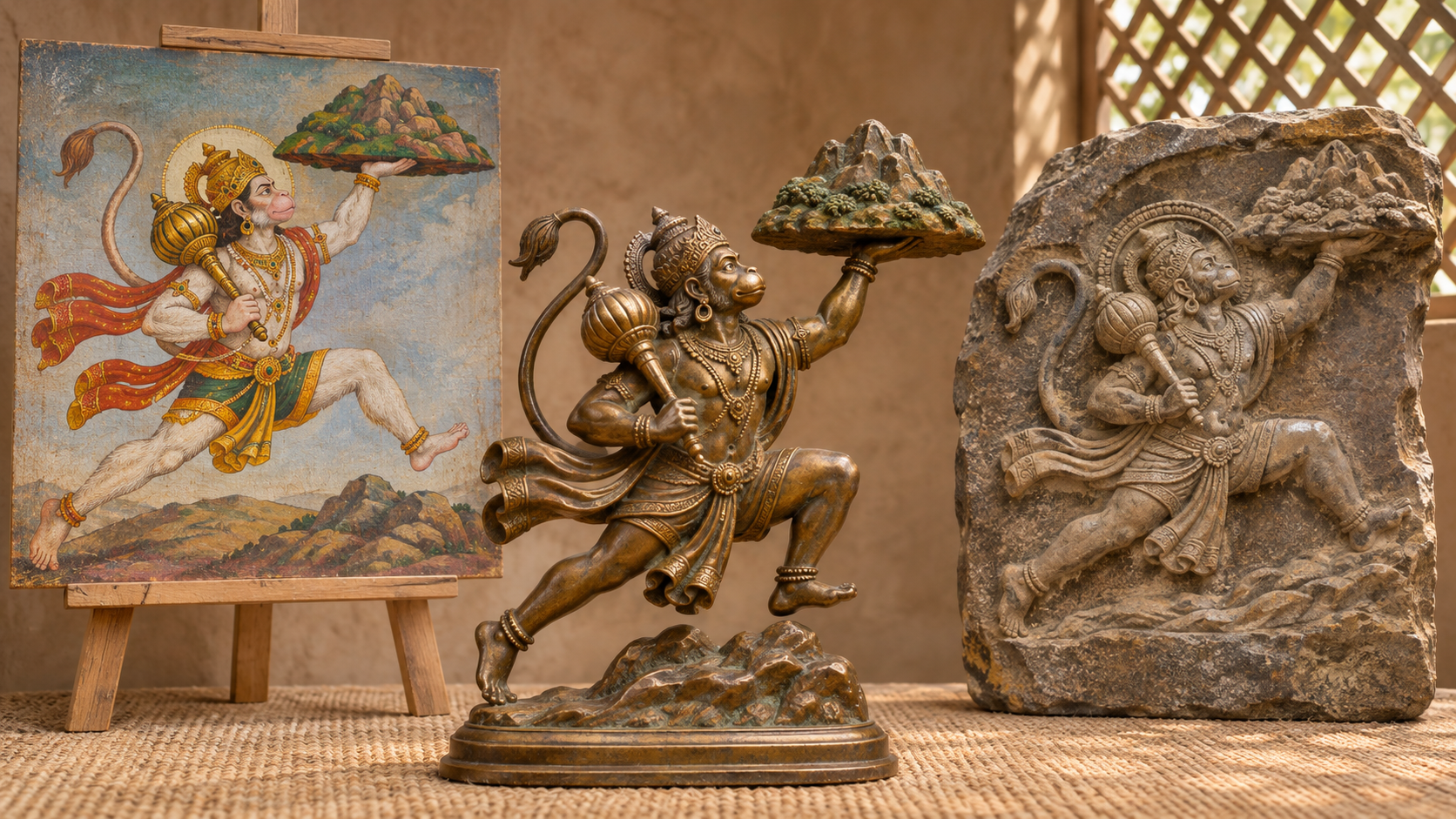
If you are choosing an image or trying to identify one, avoid judging it by a single decorative convention. Use a short sequence that separates essential iconography from artistic variation.
- Confirm Hanuman’s identity. Begin with the figure as a whole and the devotional context in which it appears.
- Locate the mountain. Make sure the rocky or vegetation-bearing form is carried by Hanuman rather than merely placed near him.
- Look for purposeful motion. Read the stance, limbs, balance, and overall direction of the composition. The form should communicate a mission, even when the treatment is restrained.
- Read the burden and bearer together. A clear composition should make Hanuman’s relationship to the mountain intelligible at the image’s intended viewing distance.
- Check the local identification. In a temple, the name used by the temple and its worshipping community matters. Do not replace a living tradition with a checklist assembled from images elsewhere.
- Separate variation from error. Differences in scale, ornament, facial expression, and exact pose do not automatically change the identity of the form.
For a household murti or print, choose a representation in which the central relationship is immediately readable: Hanuman bears the mountain and advances with purpose. Fine workmanship can deepen appreciation, but decorative abundance should not obscure the action that makes this Sanjeevani Hanuman.
Be cautious with claims that one hand, one direction, one colour, or one room placement is universally mandatory. Customs can differ among families, temples, lineages, and regions. If the image will be installed for formal worship rather than kept as devotional art, follow the practice of the temple, priest, guru, or family tradition responsible for the worship.
The same restraint applies when reading an old sculpture. Weathering may erase small details. Later repairs may alter a contour. A museum label may use a broad name where a temple community uses a more specific one. Start with the surviving iconographic evidence, then consider the place and tradition in which the image belongs.
Key takeaways
- The carried mountain is the clearest attribute identifying Sanjeevani Hanuman.
- Movement distinguishes the form as a mission in progress, not a static display of strength.
- The life-saving purpose turns physical power into seva, or service.
- Pose, ornament, scale, and artistic style may vary without changing the form’s basic identity.
- When choosing or interpreting an image, prioritise the mountain-bearer relationship and the sense of purposeful action.
- For formal worship, respect the established practice of the relevant temple, lineage, or family.
The next time you stand before Sanjeevani Hanuman, do not stop at the marvel of a mountain in his grasp. Follow the image from burden to movement and from movement to purpose. Then let it pose a practical question: when service requires more of your strength than expected, what part of the burden can you carry now?
References

Leave a Reply
You must be logged in to post a comment.