

You can read scripture, visit temples, meditate, and still wonder whether you are actually growing. The problem is usually not a lack of spiritual activity. It is the absence of a clear way to connect practice with conduct, attention, and the identity from which you live.
Hindu philosophy becomes practical when you stop treating spiritual evolution as a collection of elevated experiences and start using it to examine ordinary choices. The question is not only what you believe. It is whether your practice is making you less governed by compulsion, more faithful to dharma, and more capable of acting without being possessed by the result.
What spiritual evolution is meant to change
Spiritual evolution is not the construction of a more impressive personality. It is a gradual correction in how you see yourself, how you interpret experience, and how you act. One of the great strengths of Hindu thought is its ability to hold reality, consciousness, human growth, and the ultimate purpose of life within one framework.
That does not mean every Hindu darshana gives the same account of the self, Ishvara, the world, or liberation. Hindu traditions contain real philosophical differences. You do not need to erase those differences to begin. Their practical disciplines repeatedly turn your attention toward several recognizable changes:
- Conduct becomes less impulsive. You notice desire, anger, fear, or pride before it takes command of speech and action.
- Attention becomes steadier. The mind still moves, but every thought no longer receives equal authority.
- Motivation becomes cleaner. Duty, truth, devotion, and service begin to matter more than praise, status, or immediate gratification.
- Identity becomes less cramped. You no longer reduce yourself entirely to a role, possession, success, failure, emotion, or opinion.
- Freedom becomes more important than stimulation. You begin to recognize that endlessly satisfying a compulsion is not the same as becoming free of it.
This gives you a first diagnostic. If a practice produces unusual experiences but leaves you equally dishonest, reactive, vain, or careless toward your duties, the experience has not yet matured into spiritual growth. Conversely, quiet progress may be present when your life has become more truthful and less self-centred even if you have had no dramatic vision.
Use dharma, karma, samsara, and moksha as coordinates

These terms are often discussed as doctrines. They become far more useful when you treat them as coordinates for examining a real decision.
- Dharma asks: What is the right action here? Look at your actual responsibilities, the truth of the situation, the welfare of those affected, and the values you are unwilling to betray. Dharma is not whatever feels pleasant, nor is it a licence to imitate someone else’s duty.
- Karma asks: What am I reinforcing through this action? Every repeated response strengthens a way of thinking and acting. When you answer criticism with reflexive hostility, for example, you are not only handling one conversation; you are training hostility to become your default.
- Samsara asks: What pattern keeps repeating? Samsara includes the larger cycle of conditioned existence, but you can also observe its mechanism in daily life: desire promises completion, possession gives temporary relief, fear of loss follows, and the search begins again.
- Moksha asks: What would freedom from this bondage require? The answer may involve clearer knowledge, non-attachment, devotion, disciplined attention, selfless action, or a combination suited to your tradition.
Suppose you are deciding whether to pursue recognition at work. Dharma does not automatically tell you to reject ambition. It asks whether the pursuit is compatible with honest work and your responsibilities. Karma asks what habits the pursuit is creating. Samsara reveals whether recognition has become an endlessly receding condition for self-worth. Moksha shifts the deepest question: can you act wholeheartedly without making your inner stability dependent on applause?
This method prevents two common errors. The first is using spirituality to escape responsibilities. The second is allowing responsibilities to become an excuse for never examining attachment. A Dharmic life asks you to perform what is yours to perform while steadily loosening the ego’s demand to own the action, the credit, and the result.
Choose the form of yoga that meets your actual obstacle
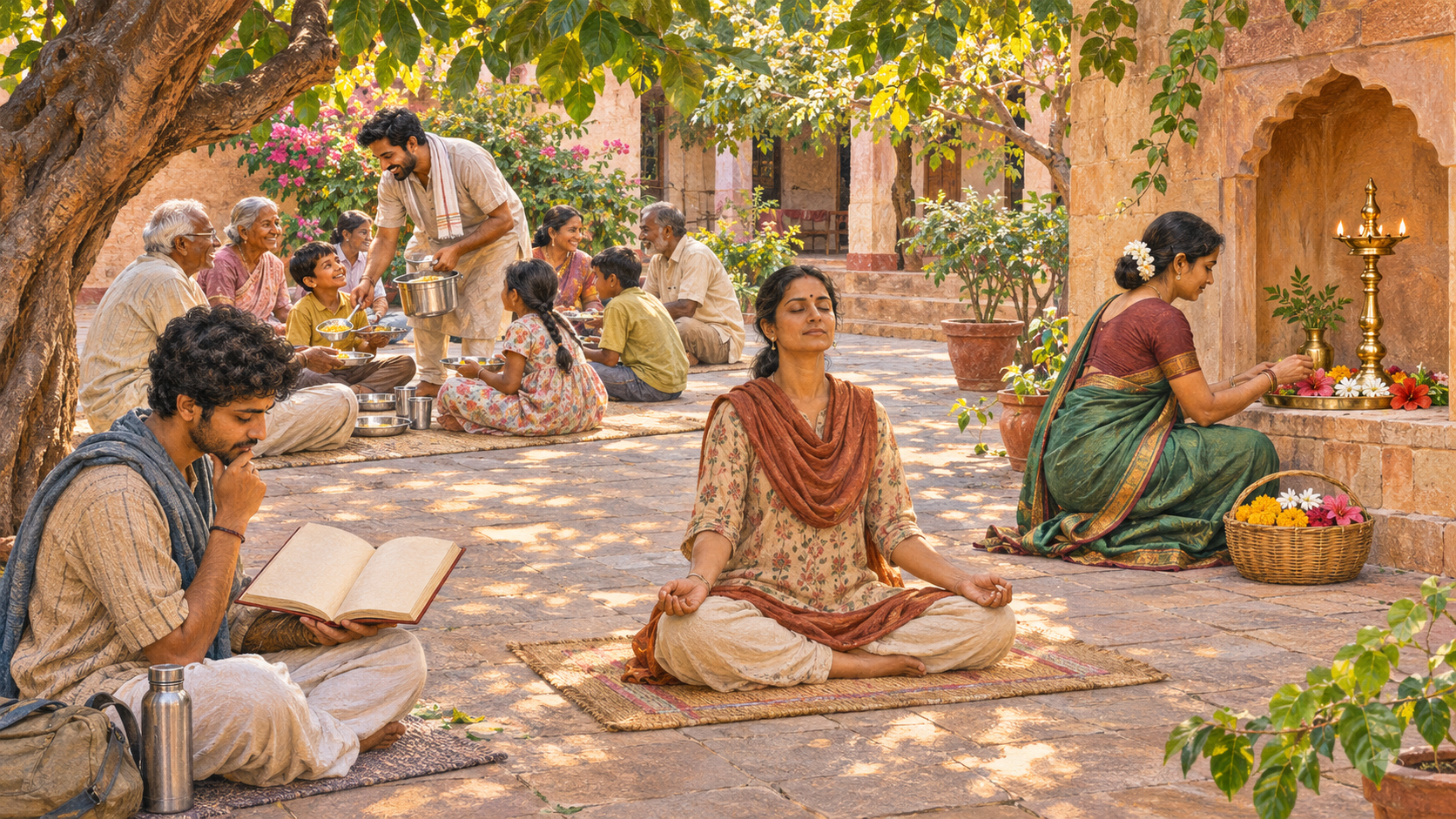
The familiar yogic paths are not competing lifestyle brands. They are disciplines aimed at different forms of bondage. Most people draw from more than one, but your practice becomes clearer when you know which obstacle you are addressing.
- Karma Yoga is especially relevant when attachment to results dominates you. Perform the work carefully, accept responsibility for the quality of your action, and relinquish the fantasy that you can control every consequence. This is not passivity. It is complete effort without psychological ownership of everything that follows.
- Bhakti Yoga is especially relevant when self-sufficiency has hardened the heart. Prayer, worship, remembrance, mantra, and offering redirect attention from the isolated ego toward the Divine. The practical test is not emotional intensity alone. Devotion should deepen humility, gratitude, fidelity, and care.
- Jnana Yoga is especially relevant when confusion about identity is central. Inquiry and discrimination help you distinguish the changing contents of experience from what you take to be the knower of experience. Because Hindu schools answer the final metaphysical question differently, serious study should follow a coherent teaching rather than a random mixture of quotations.
- Meditative discipline is especially relevant when attention is scattered. Posture, breath awareness, concentration, and meditation train the mind to remain present long enough for deeper inquiry or devotion. Mental quiet is valuable, but temporary quiet should not be mistaken automatically for liberation.
Choose a primary emphasis according to the friction you repeatedly meet. If you work well only when praised, begin with Karma Yoga. If your practice is intellectually sharp but emotionally dry, make room for bhakti. If you keep confusing every passing state with your deepest identity, pursue disciplined inquiry. If you cannot remain with a prayer, question, or duty because attention constantly breaks apart, strengthen concentration.
Do not switch paths every time practice becomes uncomfortable. Discomfort can expose the very attachment the discipline is meant to reveal. At the same time, do not assume that every difficulty proves a method is right for you. Study within a trustworthy sampradaya or lineage where possible, observe whether the teaching produces ethical clarity, and distinguish qualified guidance from charismatic certainty.
Turn philosophy into a daily sadhana

Sadhana is where a worldview becomes a way of living. Abhyasa, sustained practice, matters because insight that appears only under ideal conditions has not yet become stable. Your routine does not need to be elaborate. It needs a dependable cue, a coherent purpose, and a connection to the duties that follow it.
Build a repeatable daily rhythm
- Begin before outside demands take possession of your attention. Use a stable cue such as waking, bathing, lighting a lamp, or entering your place of practice. A cue is more dependable than waiting to feel spiritual.
- Settle the body and attention. Sit in a sustainable posture and let agitation decrease. The purpose is not to manufacture a special mood but to become available for the practice you have chosen.
- Remember what is sacred. This may take the form of prayer, mantra, puja, contemplation of your ishta-devata, or silent recollection, according to your tradition.
- Study a small, coherent portion of teaching. Stay with one text and a reliable explanation long enough to understand its argument. Collecting isolated sayings from incompatible systems often creates the appearance of breadth without the discipline of understanding.
- Name the day’s field of practice. Identify a duty you must perform and the attachment most likely to distort it. Examples include wanting credit, avoiding an uncomfortable truth, controlling another person’s response, or abandoning a task when enthusiasm fades.
- Close with an offering. Dedicate the work ahead rather than imagining that spiritual life ends when you leave the place of worship or meditation.
Carry the practice into pressure
Your most revealing spiritual material usually appears when preference meets obstruction. Use ordinary pressure as a bell of mindfulness:
- When someone disagrees with you, notice whether you are defending truth or merely defending an image of yourself as correct.
- When a result is delayed, separate the work still available to you from the outcome that is no longer in your control.
- When success arrives, receive it with gratitude and examine the impulse to convert it into superiority.
- When you fail, make the necessary correction without turning self-condemnation into another form of self-absorption.
- When desire appears, ask what it is promising: relief, recognition, control, belonging, or genuine need. Naming the promise weakens its ability to operate invisibly.
- When duty feels ordinary, remember that constancy in unglamorous responsibilities can reveal attachment more clearly than rare spiritual intensity.
Review the fruit, not the performance
At a regular review, do not ask only whether you completed the ritual. Ask what the practice is doing to the person who performs it:
- Where did I know my dharma but choose convenience instead?
- Which reaction repeated itself, and what expectation fed it?
- Did I perform any action mainly to secure admiration or avoid disapproval?
- Where was I able to act fully and release the result?
- Did devotion make me more humble and attentive to others?
- Did study correct my assumptions, or did I use it to confirm what I already wanted to believe?
- What is the smallest honest correction I can carry into the next day?
This review should be exact without becoming punitive. Guilt that merely circles around the ego is not transformation. Name the action, acknowledge its consequence, make amends where appropriate, and change the condition that made repetition easy.
Be equally careful with false signs of progress. Spiritual vocabulary, ritual visibility, meditative sensations, social recognition, and proximity to a respected teacher can all coexist with strong attachment. Even apparent detachment can be avoidance if it makes you indifferent to truth, family duties, injustice, or the effects of your behaviour. Vairagya is freedom from possessiveness, not freedom from responsibility.
Key takeaways
- Measure spiritual growth by changes in conduct, attention, motivation, and attachment, not by dramatic experiences alone.
- Use dharma to identify right action, karma to inspect what your action reinforces, samsara to detect repeating bondage, and moksha to keep freedom in view.
- Match your main practice to your actual obstacle: attachment to results, spiritual dryness, confusion about identity, or scattered attention.
- Give sadhana a stable daily cue and connect it to a real duty that will test the teaching.
- Review the fruit of practice honestly. Greater humility, steadiness, truthfulness, and non-attachment matter more than spiritual display.
- Follow a coherent tradition deeply enough to understand its terms instead of flattening distinct Hindu philosophies into interchangeable slogans.
Begin with the next duty already in front of you. Write down what dharma requires, identify the result you are trying to possess, and choose the yogic discipline that directly addresses that attachment. Then perform the duty as carefully as you can.
That ordinary moment is not outside the spiritual path. It is where philosophy becomes character, where practice becomes discernment, and where the movement from compulsion toward freedom can actually begin.
References

Leave a Reply
You must be logged in to post a comment.