
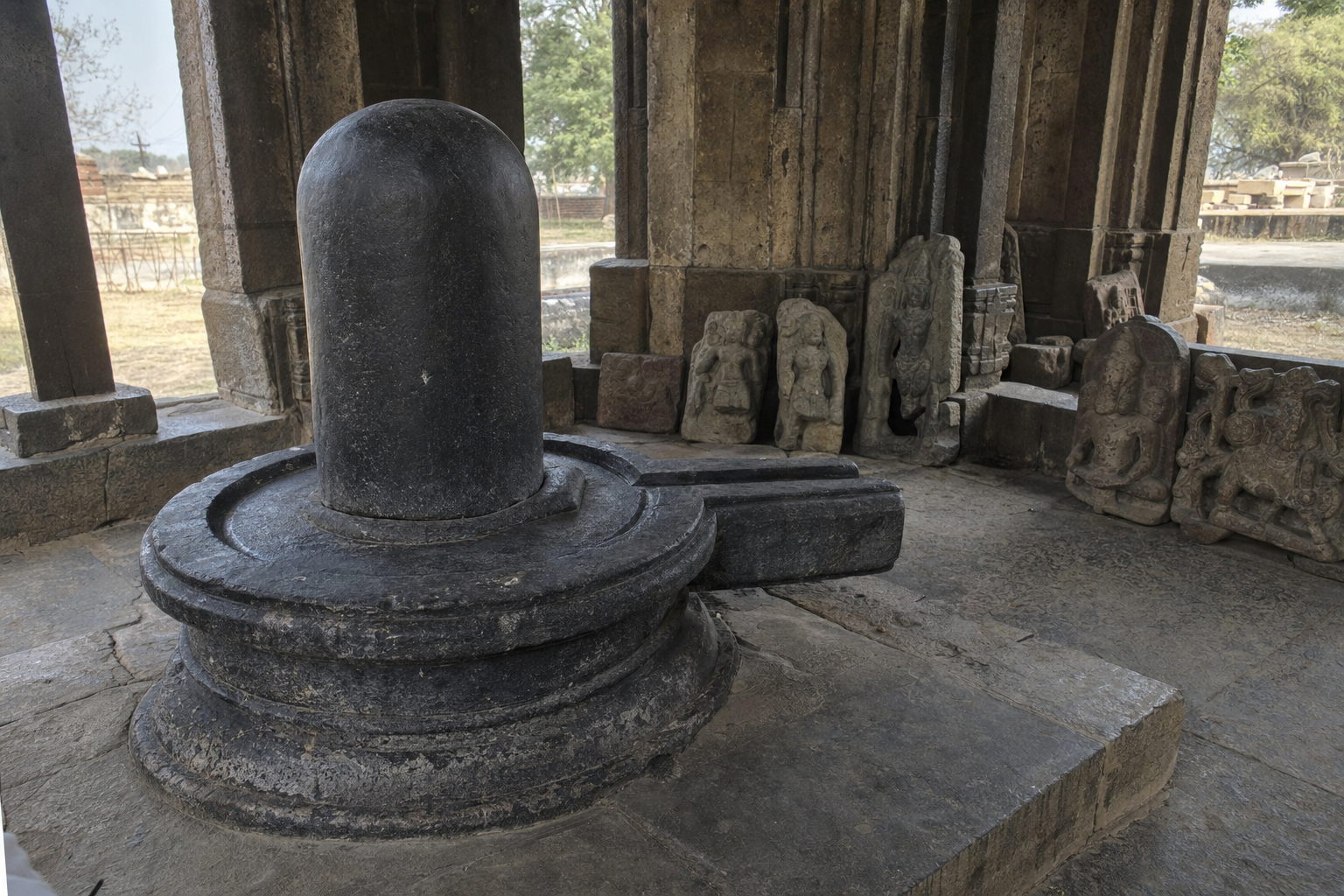
Prithvinath Temple in the Khargupur region of Gonda is usually approached through its immense Shivling and the local tradition associating it with Bhima. Yet a source article on the temple draws attention to another inheritance: a small group of weathered sculptures placed around or within the outer structure.
These fragments matter because they may preserve evidence of the site’s artistic, religious and institutional history. They also present a practical challenge. Their identities and dates remain uncertain, while exposure, handling and devotional offerings may be erasing the very details needed to understand them.
A celebrated Linga and a vulnerable sculptural collection
The available report estimates that approximately seven or eight sculptural pieces are visible near the temple’s outer structure. According to local accounts cited in that article, the objects emerged from the same area in which the temple developed around the Linga. They were subsequently regarded as temple property and kept where worshippers and visitors could encounter them.
This arrangement expresses continuity: objects recovered from sacred ground remain within the sacred landscape rather than being separated from it. At the same time, the central Shivling and the peripheral fragments occupy very different positions. The Linga receives concentrated worship, while the sculptures appear to lack the documentation and physical protection expected for fragile historical material.
The contrast should not be reduced to devotion versus scholarship. Prithvinath is a living Shaiva shrine, not simply an archaeological display. Its sculptural heritage therefore has at least three overlapping kinds of value: sacred value for the community, historical value as material evidence, and artistic value embodied in carved forms. Responsible care must address all three.
What the damaged images may reveal—and what they do not yet prove
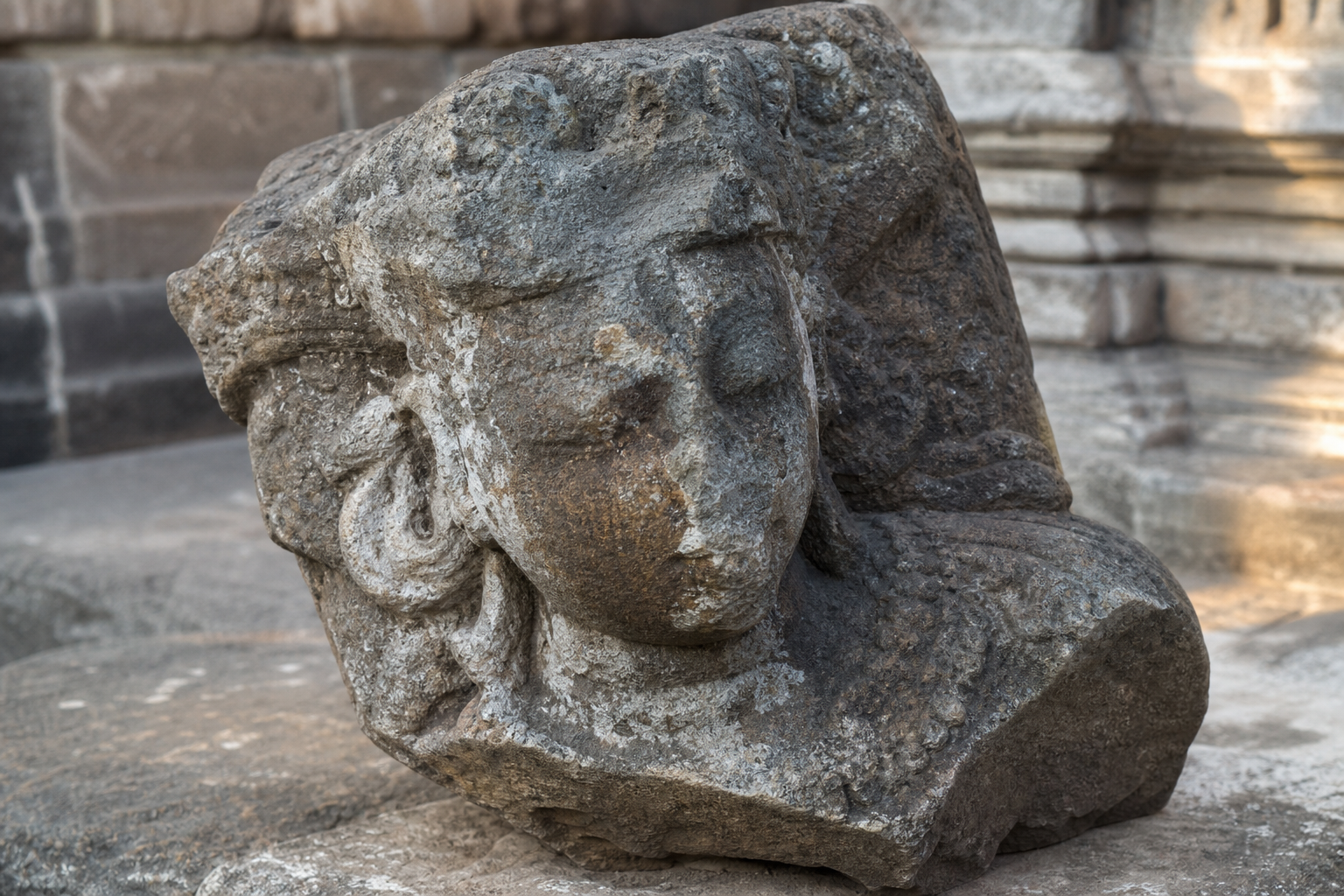
The source article discusses several provisional readings of the fragments. One image has been interpreted as possibly representing Pashupati or another Shaiva form because it appears to combine a meditative figure with surrounding animals. Another standing figure has been tentatively read as Vishnu, perhaps accompanied by figures identified as Ganesh and Lakshmi. If supported by closer study, such identifications could indicate that the site contained imagery associated with more than one devotional tradition or more than one phase of sacred activity.
None of those identities is established by the report. Erosion can remove attributes that distinguish one deity or figure from another, while ritual coverings and accumulated deposits can conceal surviving details. A posture alone is rarely decisive. Identification ordinarily depends on a combination of attributes, hand gestures, ornaments, attendant figures, mounts, compositional conventions and archaeological context.
The possibility of Shaiva and Vaishnava imagery in the same setting is nevertheless worth investigating. Dharmic sites often acquire multiple images and ritual associations over time. Coexistence need not imply that every sculpture belonged to one building, one period or one original programme. The pieces could represent a complex with subsidiary shrines, successive construction phases, relocated images or objects gathered after their recovery nearby. At present, these are research possibilities rather than conclusions.
Stylistic resemblance is a clue, not a date
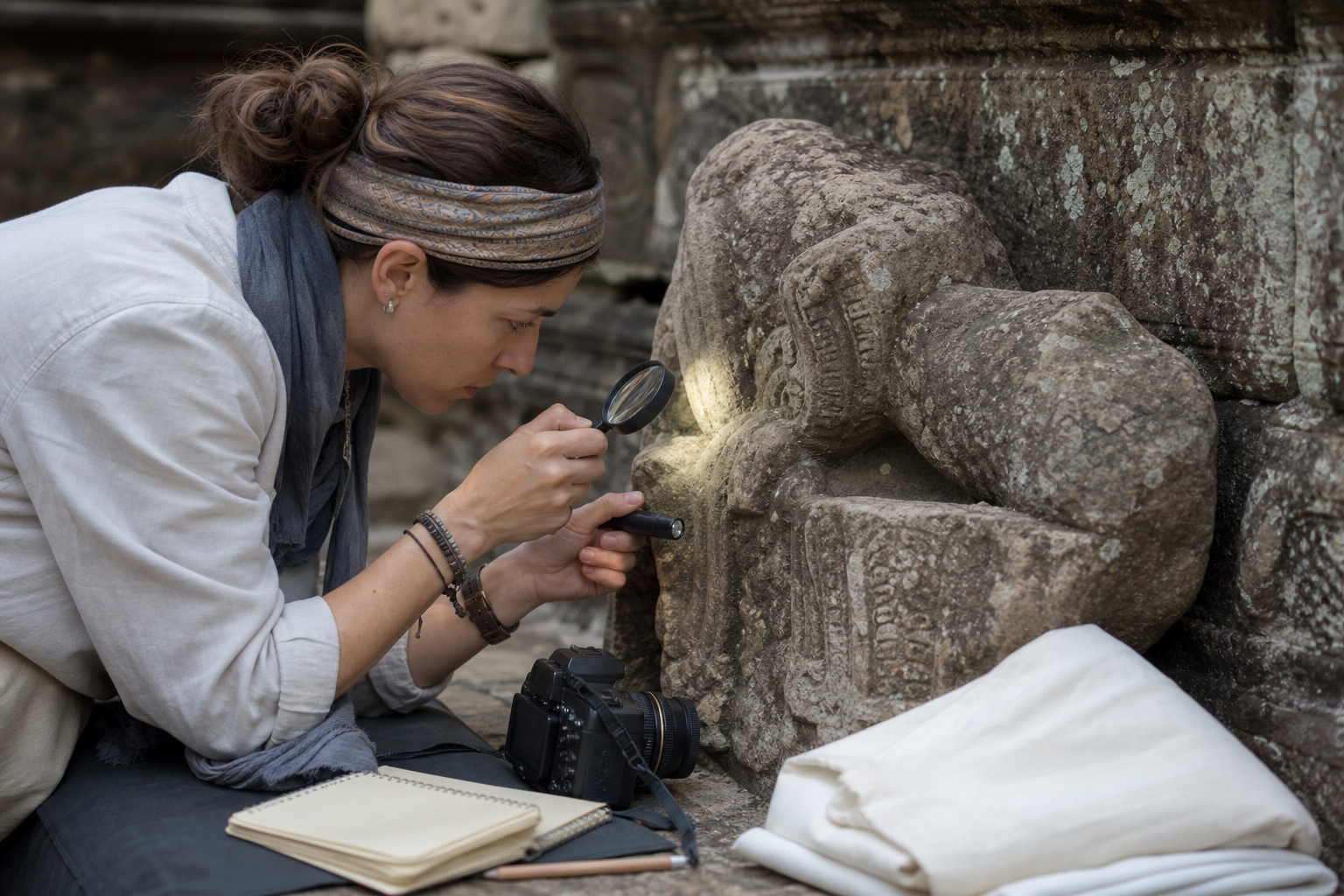
The report notes comparisons between the Prithvinath sculptures and the Mathura school of art, whose sculptural language is associated with robust figures, broad chests, expressive faces, light drapery and Hindu, Buddhist and Jain subjects. It presents this comparison cautiously, as a starting point requiring professional examination.
That distinction is essential. Similarity to a recognised artistic tradition does not by itself establish where an object was carved or when it was made. Artistic conventions can travel, persist and be adapted by regional workshops. Weathering can also make unrelated works appear more alike by obscuring the features that once differentiated them.
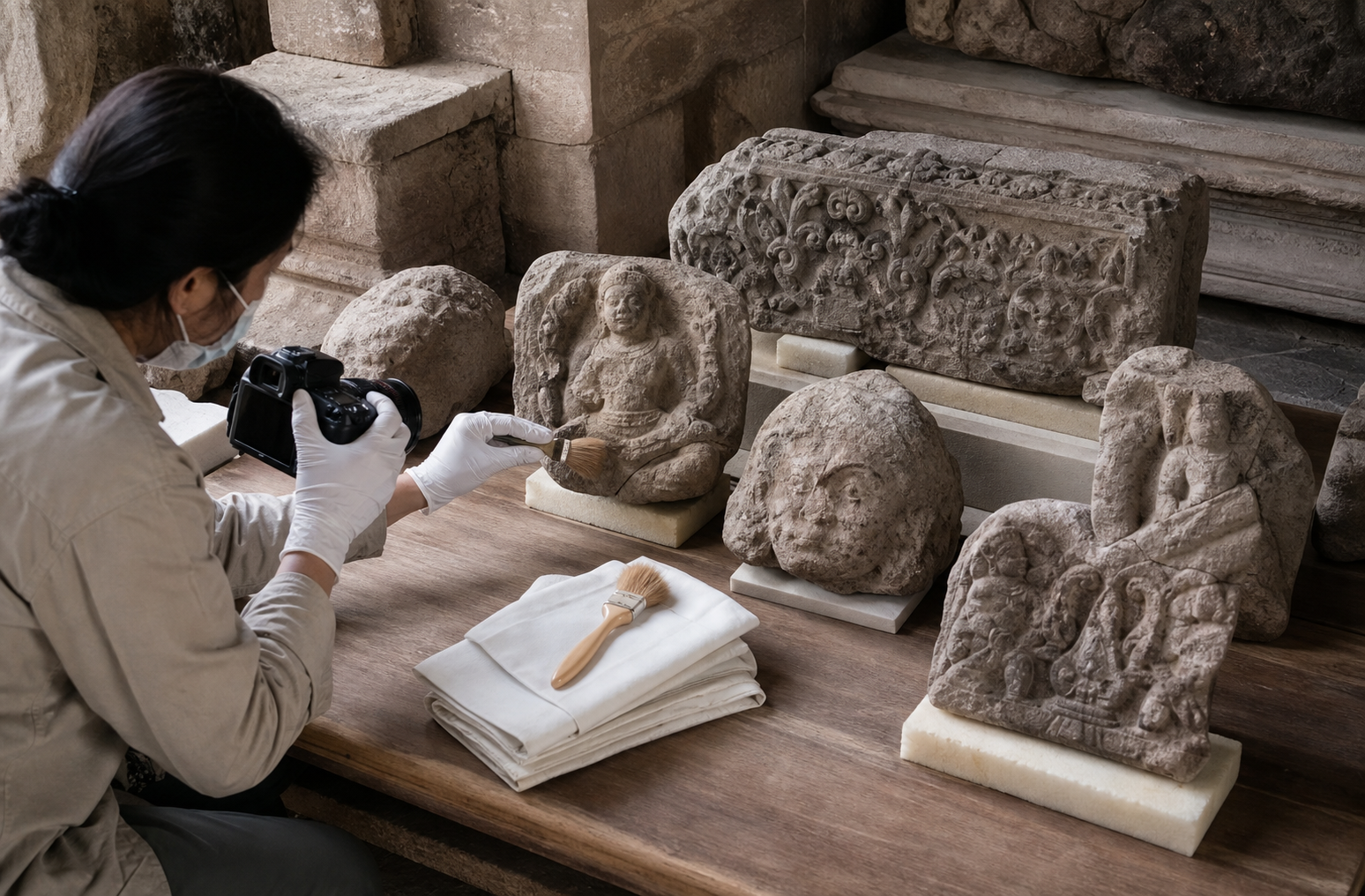
A stronger assessment would begin with systematic photography, measurements, condition mapping and records of each object’s present location. Specialists could then compare carving technique, body proportions, dress, ornament, iconographic attributes and stone characteristics with securely documented works. The circumstances of discovery would be equally important, although information lost during an undocumented recovery may be impossible to reconstruct fully.
The article places the temple within a wider landscape shaped by routes connecting the Gangetic plains, Ayodhya and regions farther east. It also mentions Ashokan and Gupta-period inscriptions in the broader region. These observations make regional mapping worthwhile, but, as the article itself acknowledges, nearby inscriptions cannot be used to date the Prithvinath fragments. Geographic context can frame an inquiry; it cannot substitute for evidence attached to the objects.
Conservation must work with living worship
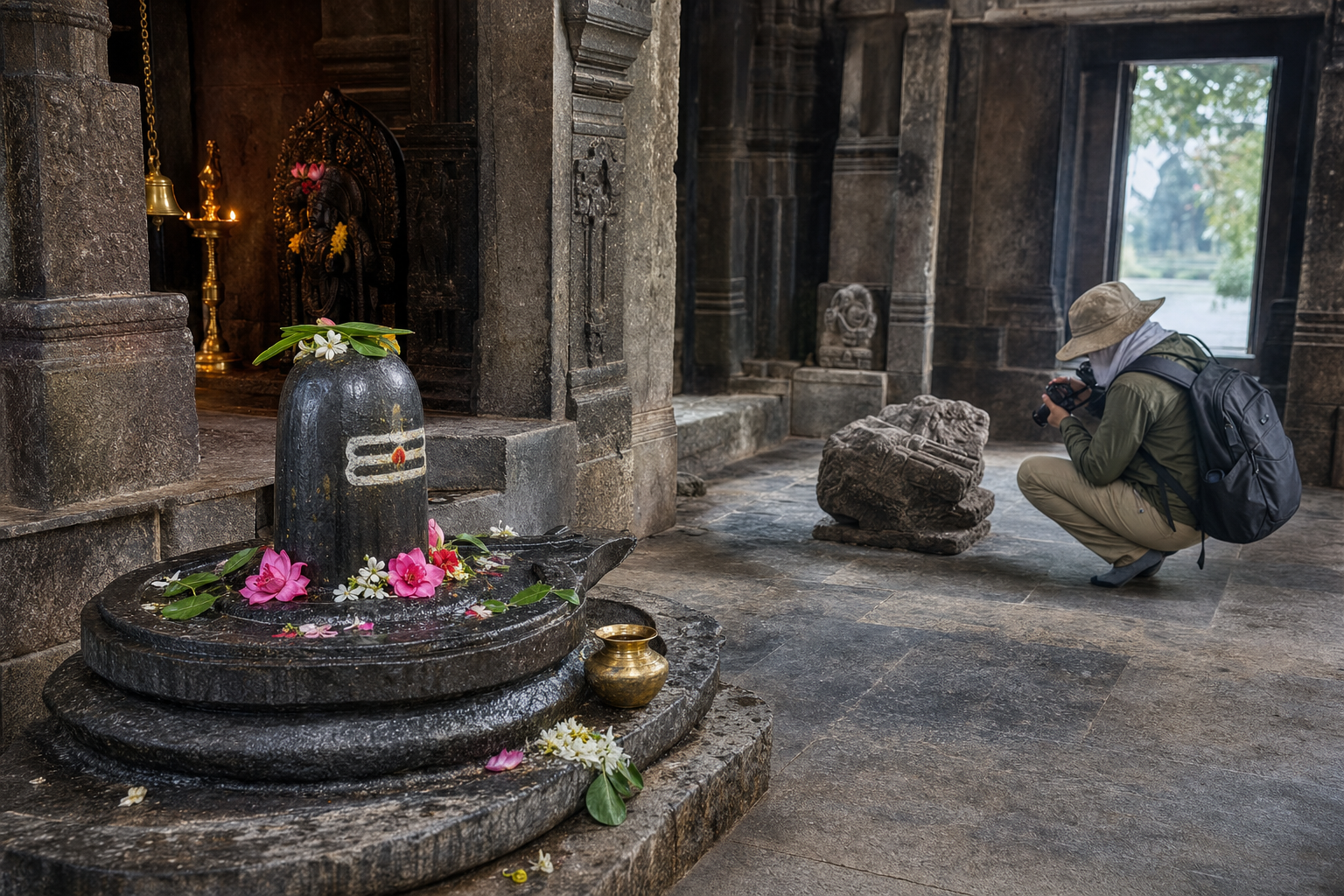
The source describes erosion associated with environmental exposure, touch and the repeated application of substances used in worship, including chandan, flowers, milk and rice-mixed water. Devotees use such materials as expressions of reverence, not with an intention to damage. The difficulty is that a practice suitable for a robust object in active ritual use may be unsuitable for a fragile fragment bearing faint historical details.
As a general conservation principle, repeated wetting, residue and physical contact can alter vulnerable stone surfaces, although the precise effect depends on the material, its condition and its environment. Once a facial feature, ornament or identifying attribute disappears, both artistic detail and historical information are lost. Cleaning without expert guidance can create further damage, so intervention should follow a condition assessment rather than assumptions about what the stone can withstand.
The report says that temple authorities have placed notices asking visitors not to make offerings on the sculptures. That is a constructive beginning because it recognises a distinct conservation need without denying the objects’ sacred setting. Notices, however, are most effective when accompanied by an explanation of why restraint is itself a form of care.
The same source proposes practical measures such as suitable plinths, rain protection, non-invasive lighting, cataloguing, condition reports, protective barriers and periodic specialist inspection. These measures should be designed so that the sculptures remain visible and respectfully situated. Consultation with priests and devotees would help identify acceptable alternatives for reverence, such as making offerings at a designated ritual object rather than on the fragile fragments.
Key takeaways: a practical path from fragments to evidence
- Protect before interpreting: Stabilise the sculptures’ immediate environment and discourage touching or direct offerings while their condition is assessed.
- Record every object consistently: Assign an identifier and document dimensions, visible features, damage, present placement and any known discovery history.
- Keep proposed identities provisional: Pashupati, Vishnu, Ganesh, Lakshmi and Mathura-related readings should remain hypotheses until iconographic and stylistic examination supports them.
- Study the wider sacred landscape carefully: Regional routes, inscriptions and proximity to Ayodhya can guide research questions but cannot independently date or identify the sculptures.
- Make the community part of conservation: Clear interpretation, designated offering practices and collaboration with temple stakeholders can connect preservation with bhakti.
The immediate priority is not to attach a dramatic date or identity to every fragment. It is to preserve enough material evidence for those questions to be answered responsibly. With documentation, specialist assessment and community-supported safeguards, Prithvinath’s sculptures can remain part of a living temple while becoming more legible as records of its layered past.