
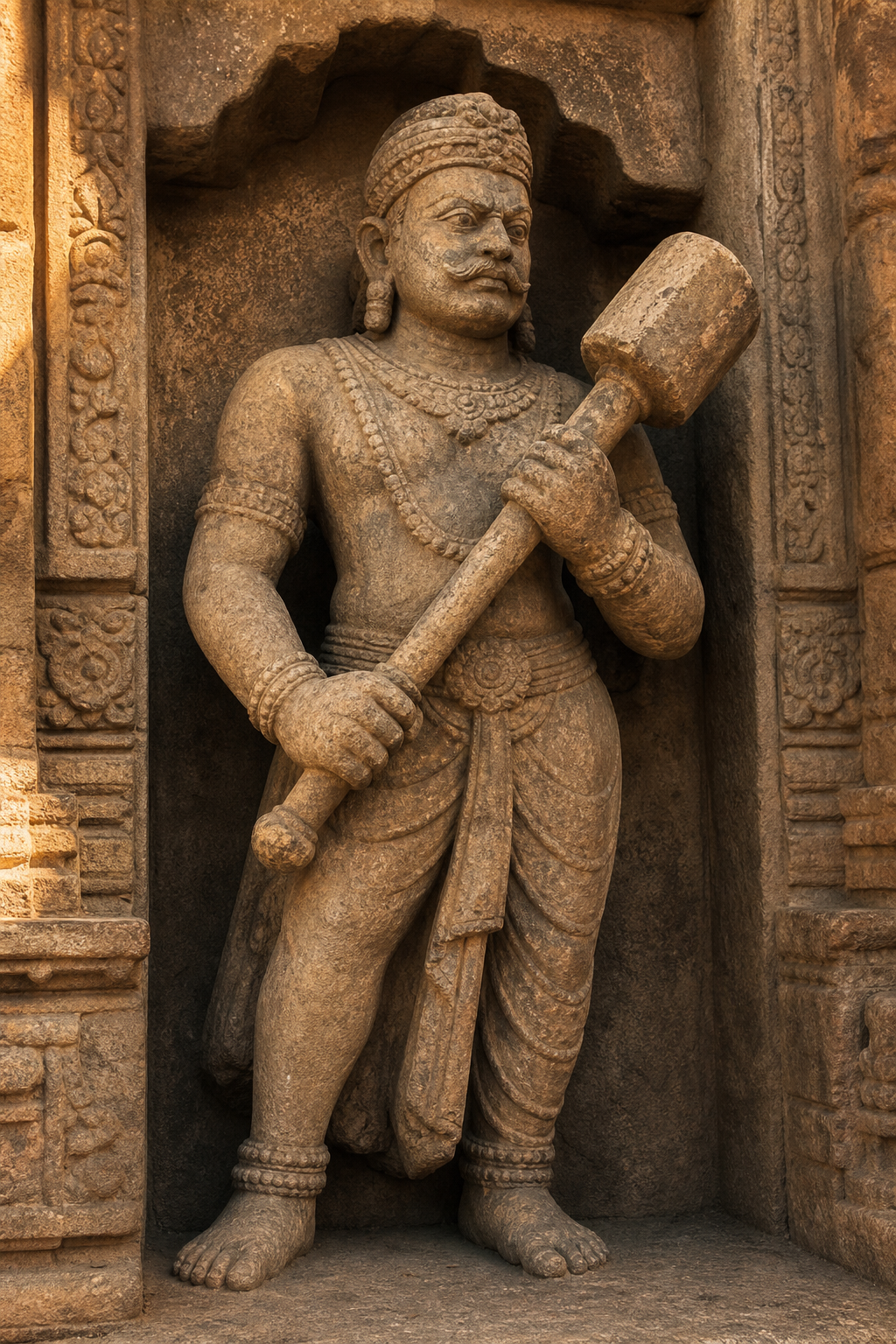
You are looking at a temple guardian, artisan-deity, or many-armed divine figure holding a short, heavy implement. Is it a gada, a damaged staff, or a mudgara? Do not begin with the figure’s name alone. Begin with the geometry of the object, then ask who carries it and where the figure stands.
That distinction matters because the mudgara is more than a generic club. Its hammer-like form joins three ideas that belong together in Hindu sacred art: protecting an ordered space, breaking an obstruction, and repairing what must endure. Learning to recognize those layers will help you read a sculpture rather than merely label its weapon.
Begin with the object: head, shaft, grip, and posture
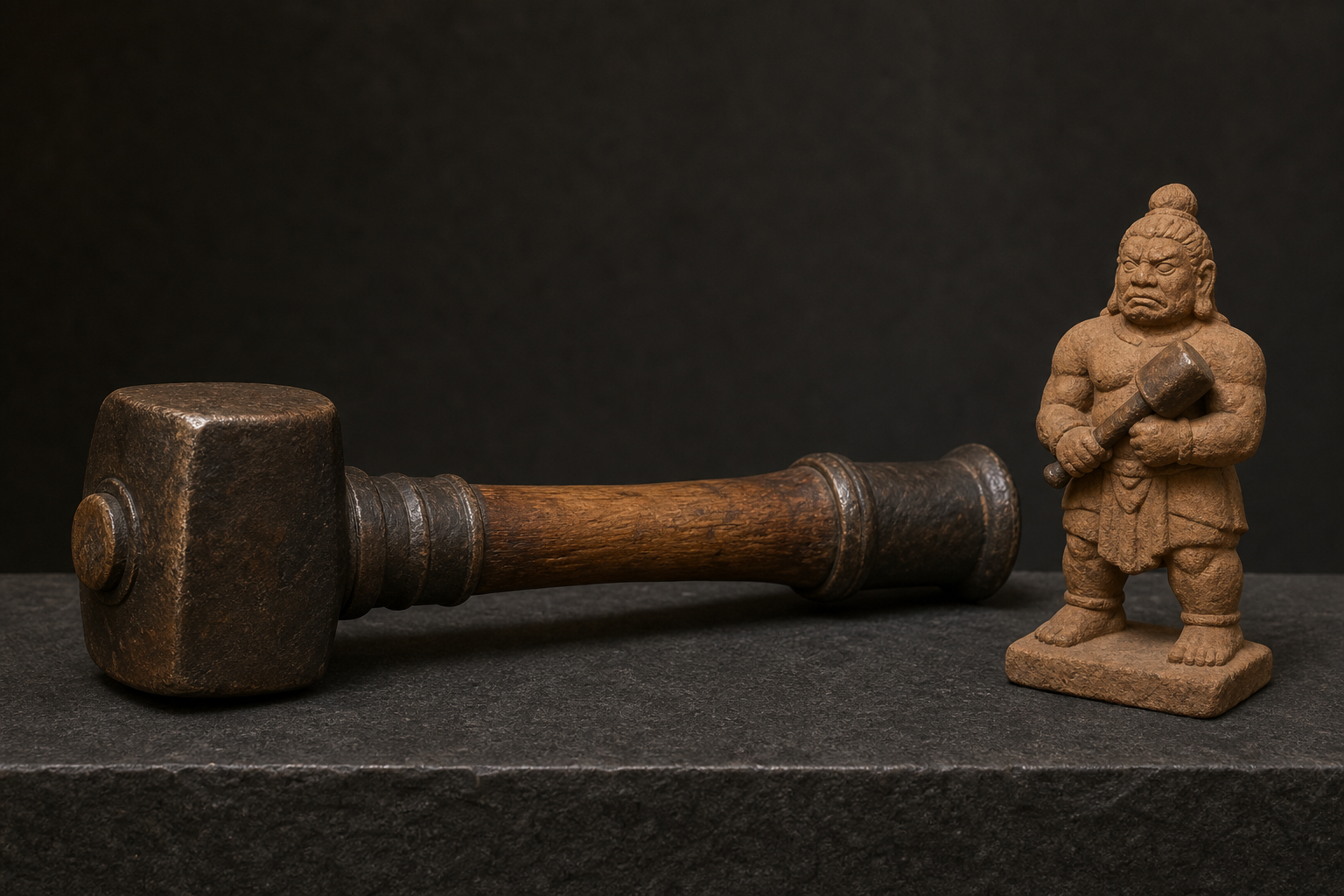
Mudgara is a Sanskrit term for a hammer or mallet. Its clearest visual signature is a broad striking head attached to a relatively short or medium-length shaft. The head may appear rectangular, barrel-shaped, or drum-like. Its striking face is usually flat or gently rounded rather than pointed, hooked, or elaborately pronged.
Use this four-part inspection when you encounter an unfamiliar implement:
- Trace the head. Look for a block, compact barrel, or thick drum with an identifiable impact face. A swelling ball or pear shape points more readily toward a gada.
- Estimate the shaft. The mudgara is a controlled striking tool, so its haft generally looks stockier and shorter than a spear, staff, or pestle.
- Notice the transition into the hand. A collar, wrapped grip, or clear junction between head and haft supports a hammer identification.
- Observe how it is carried. A guardian may hold it ready at close range or rest its heavy head on the ground. That grounded posture can be more informative than the surviving length of the shaft.
The mudgara often looks deliberately workmanlike. That lack of ornament is evidence, not an artistic failure. A plain impact head advertises function: this is an implement made to strike accurately, set something firmly, or break something resistant.
Do not decide from the outline of the head alone when the sculpture is damaged. Stone hafts break easily, and restoration can shorten an implement until a mace resembles a mallet. Bronze examples can preserve subtler evidence, such as a flattened face, an undercut head, or a collar near the grip. In stone, beveled edges around a rectangular head may be the best surviving clue. Treat any identification based on one damaged feature as provisional.
Let the bearer determine which meaning comes forward
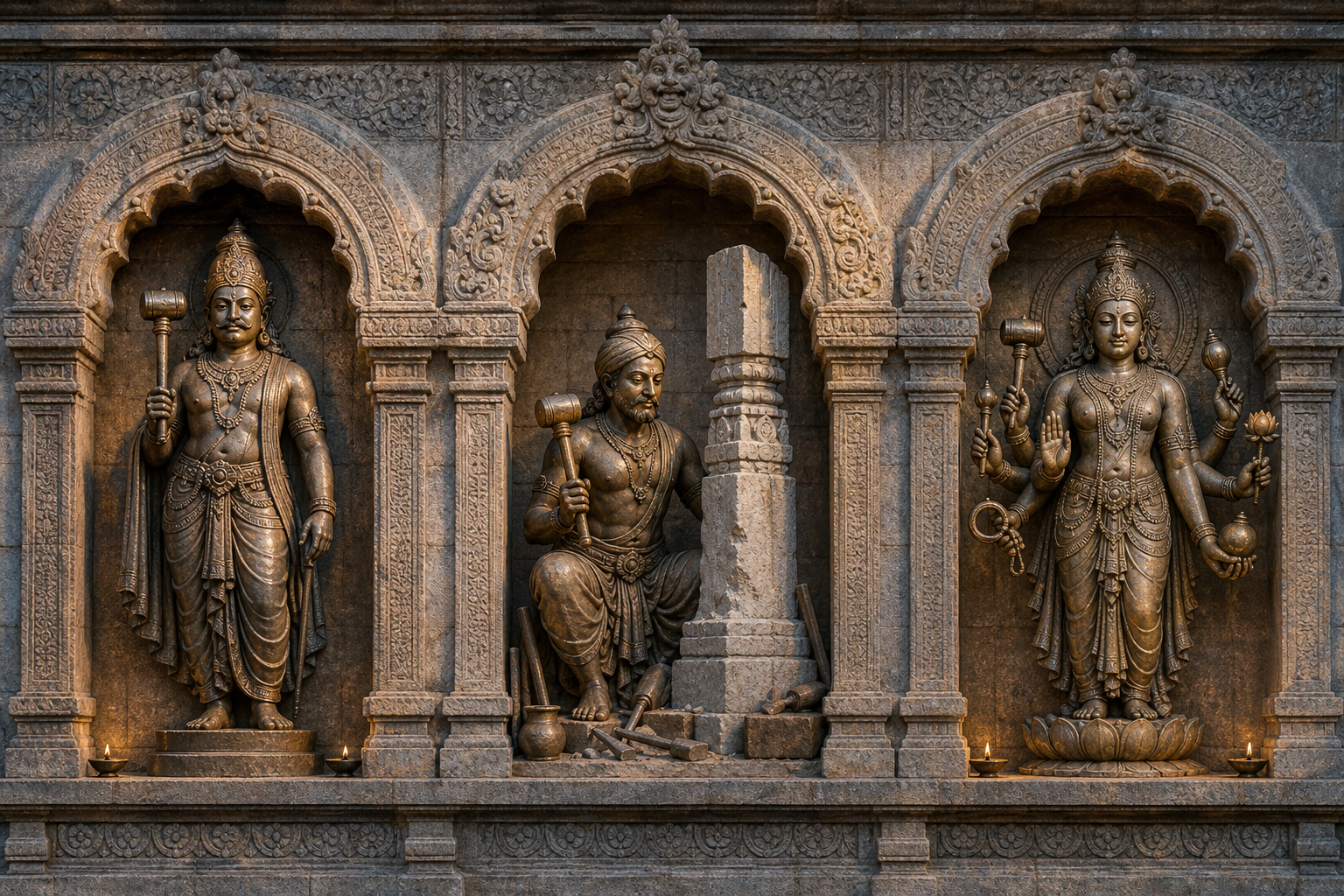
The same physical object does not carry exactly the same emphasis in every sculptural program. The mudgara’s immediate meaning comes from the bearer, the figure’s position, and the neighboring attributes. Read those before moving to a broad philosophical interpretation.
At a doorway, it is an instrument of custodianship
A mudgara held by a dvarapala or yaksha attendant tells you that a boundary is being actively maintained. The figure is not simply displaying martial strength. The guardian stands between ordinary movement and consecrated space, responsible for stopping disorder before it enters.
The weapon’s short reach strengthens that reading. It is suited to close, accountable action rather than distant destruction. When you see it beside an entrance, ask what the doorway separates: exterior and interior, unprepared movement and ritual attention, or disorder and a space governed by dharma. The iconography makes the threshold morally significant, not merely architectural.
With Vishvakarma, it becomes a tool of cosmic maintenance
In the hands of Vishvakarma, the hammer belongs to the workshop as much as the armory. It can shape material, correct a faulty fit, close a joint, or remove a defective part so sound construction can continue. Nearby measuring cords, craft implements, or workshop-like attributes reinforce this identification.
This context changes how you should understand force. A craftsman’s blow is judged by proportion, placement, and result. Too little force fails to set the work; too much ruins it. Vishvakarma’s hammer therefore represents intelligence governing power. It is force applied to make the world fit for its purpose.
The connection is especially natural in a temple. Sacred images and structures reach canonical form through the disciplined labor of shilpins working with stone and metal. The hammer that helps create an icon can itself enter iconography as a sign of shaping, calibration, and repair.
With a fierce attendant, it makes divine authority effective
In Shaiva or Shakta settings, a mallet-bearing attendant can operationalize the presiding deity’s power. The mudgara does not replace defining attributes such as the trident, drum, or sword. It shows how a mandate is carried out: an obstruction is struck, loosened, and rendered workable.
That distinction can keep you from mistaking every fierce figure for an image of uncontrolled anger. First identify the principal deity and the attendant’s place within the composition. Then ask what disorder the attendant is assigned to contain or remove. Fierceness may serve the precinct rather than dominate its meaning.
In a many-armed form, geometry must outrank expectation
Vaishnava and Ganapatya images can include extensive sets of attributes, some of which resemble hammers after damage or erosion. Do not identify an object merely because a familiar list of weapons leads you to expect it. Follow the surviving form: a broad impact face favors the mudgara, a rounded swelling favors the gada, and a hook identifies the ankusa.
Sacred destruction means rectification, not rage
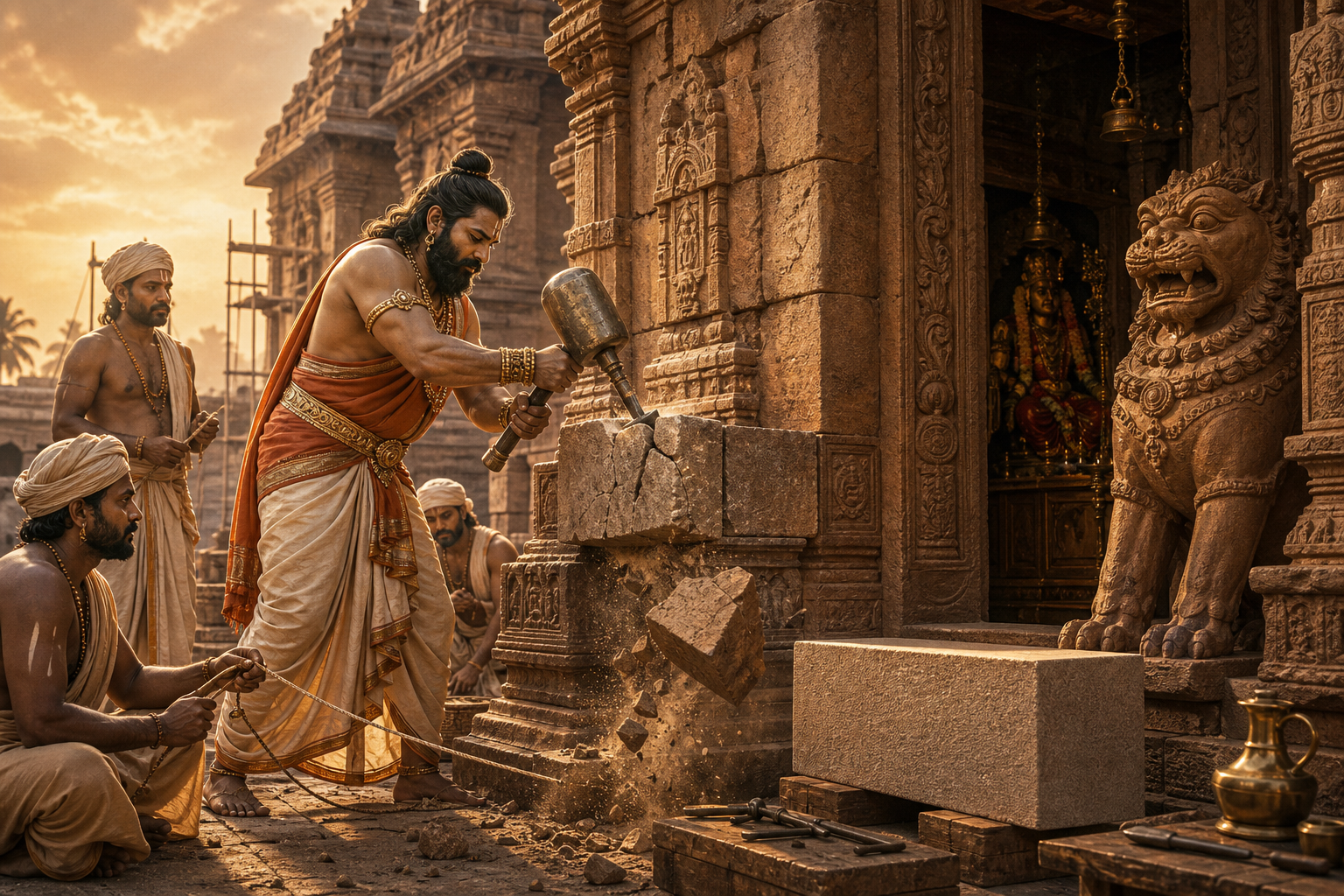
A hammer can destroy, but destruction is only half of its logic. The same tool that breaks a defective joint can set a sound one. The mudgara therefore expresses a tightly bounded kind of sacred force: something resistant is undone because order, safety, or renewed creation requires it.
Hindu philosophical language gives this symbolism an inward dimension. The hard material struck by the mudgara can be read as avidya, ignorance that distorts perception; granthi, a binding knot; or vighna, an obstruction that prevents right movement. In fierce settings, it can also suggest the breaking up of tamas when inertia has become a barrier.
This is not a license to call every blunt weapon a symbol of enlightenment. The figure’s immediate iconographic role still comes first. Once that role is established, the mudgara offers three connected questions for reflection:
- What is being protected? A sacred boundary, a vulnerable community, a ritual order, or the conditions needed for disciplined work.
- What must be broken? Not life indiscriminately, but the obstruction, false fit, hardened habit, or disorder that prevents dharmic action.
- What must be built afterward? The hammer’s symbolism is incomplete if nothing sound replaces what has been removed.
These questions prevent a shallow reading in which sacred weapons merely celebrate domination. The mudgara’s power is purposeful, measured, and answerable to what it protects. Its strongest lesson is not that force is glorious, but that necessary force must remain governed by discernment.
The honoring of implements during Ayudha Puja brings the same principle into lived practice. A tool of work or defense participates in dharma through right purpose, careful use, and respect for the responsibility it carries. Sacredness does not erase utility; it disciplines utility.
A Dharmic family resemblance does not make every emblem identical
Related Dharmic traditions also link power with the removal of ignorance or the defense of an ordered moral space, but their emblems should not be collapsed into the mudgara. In Buddhist iconography, the vajra represents an indestructible force that overcomes ignorance and can be paired with the ghanta to hold power and wisdom together. It is not a hammer, even when the spiritual analogy is close.
Jain Tirthankaras remain non-violent and free of weapon attributes, while guardian yakshas and yakshinis may carry clubs or mallet-like objects as signs of wardship. Sikh tradition centers other weapons, especially the khanda and kirpan, within the ethical responsibility to defend justice expressed by the saint-soldier ideal. The shared principle is strength made accountable to dharma, wisdom, non-violent sacred space, or justice. The iconographic forms remain distinct.
Separate the mudgara from four neighboring ayudhas
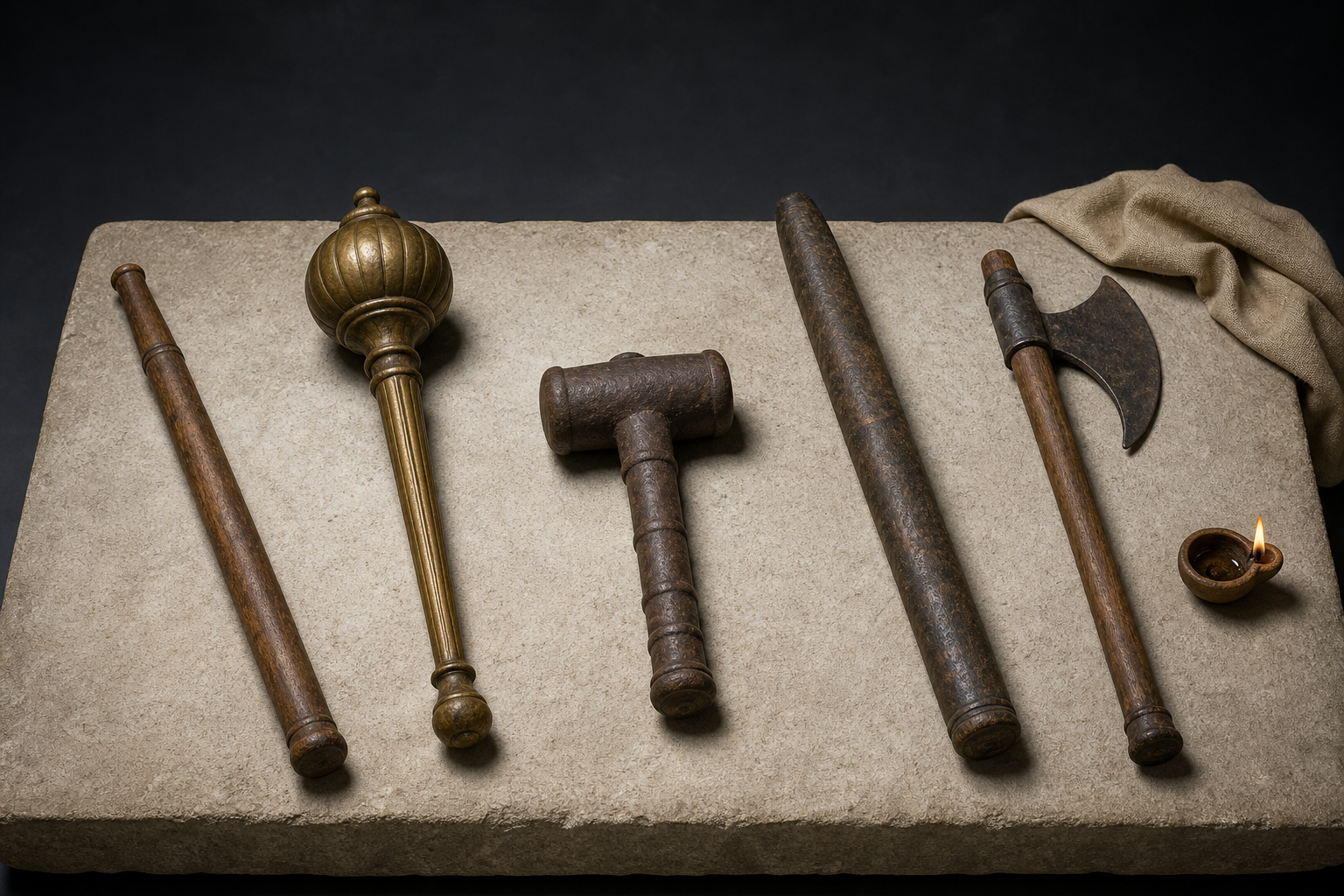
Most misidentifications become manageable when you compare the object’s working geometry rather than relying on a general impression of heaviness. Use this table as a diagnostic aid, not as a substitute for the sculpture’s context.
| Implement | Typical visual profile | Fastest separating clue |
|---|---|---|
| Mudgara | Broad block, barrel, or drum-like head on a stocky shaft | Visible blunt impact face and practical hammer construction |
| Gada | Globular, rounded, or pear-shaped head, often ornamented | The head swells rather than presenting a broad hammer face |
| Musala | Long, comparatively uniform pestle-like body | Rod-like length without a distinct compact hammer head |
| Vajra | Axially balanced form with symmetric or pronged ends | Symmetry around the center rather than a head-and-haft tool structure |
| Ankusa | Compact goad ending in a hook and knob | The hook remains the defining working element |
When preservation is poor, apply a three-part test: geometry, bearer, and setting. A block-like head supplies geometric evidence. A dvarapala or Vishvakarma supplies contextual evidence. A threshold or craft-related group supplies compositional evidence. Two or three agreeing signals justify a stronger identification; one surviving signal calls for caution.
Scale can also deceive. A small relief may compress a gada into a crude lump, while a damaged mudgara may lose the corners that once marked its striking face. Record what is actually visible before naming it. Broad head, short haft, ground-resting posture, and a guardian or artisan context form a much stronger case than resemblance alone.
Key takeaways: a field checklist for your next viewing
If you are examining a temple photograph, catalogue image, or sculpture in person, work from the whole composition inward. A tightly cropped weapon can hide the very clues that identify it.
- Record the location first. Note whether the figure stands at an entrance, accompanies a principal deity, or appears in a craft-related setting.
- Name the bearer before the object. Distinguish a guardian, yaksha attendant, artisan-deity, fierce subsidiary figure, and principal many-armed deity where the image allows it.
- Sketch the surviving profile. Mark the head, impact face, shaft, grip, and any collar. This forces you to separate visible evidence from expectation.
- Compare working shapes. Block or barrel suggests mudgara; globe suggests gada; long rod suggests musala; symmetric prongs suggest vajra; hook suggests ankusa.
- Allow for breakage. A missing haft or restored end can alter the apparent class of the implement. Use a provisional identification when context and geometry disagree.
- Interpret in the correct order. Establish the object and the figure’s role first. Then read the mudgara as protection, obstruction-breaking, craft, repair, or a combination of these.
You do not need to identify every deity in a crowded program before the mudgara begins to speak. Its blunt form already directs your attention toward work that must be done close at hand: a boundary held, a defect removed, a structure secured, or an obstruction broken so right action can resume.
On your next temple visit, pause before calling every heavy implement a mace. Note the head, haft, bearer, and setting. That small discipline can reveal a precise Hindu theology of power: strength becomes sacred when it protects, corrects, and leaves the world better fitted to dharma.