
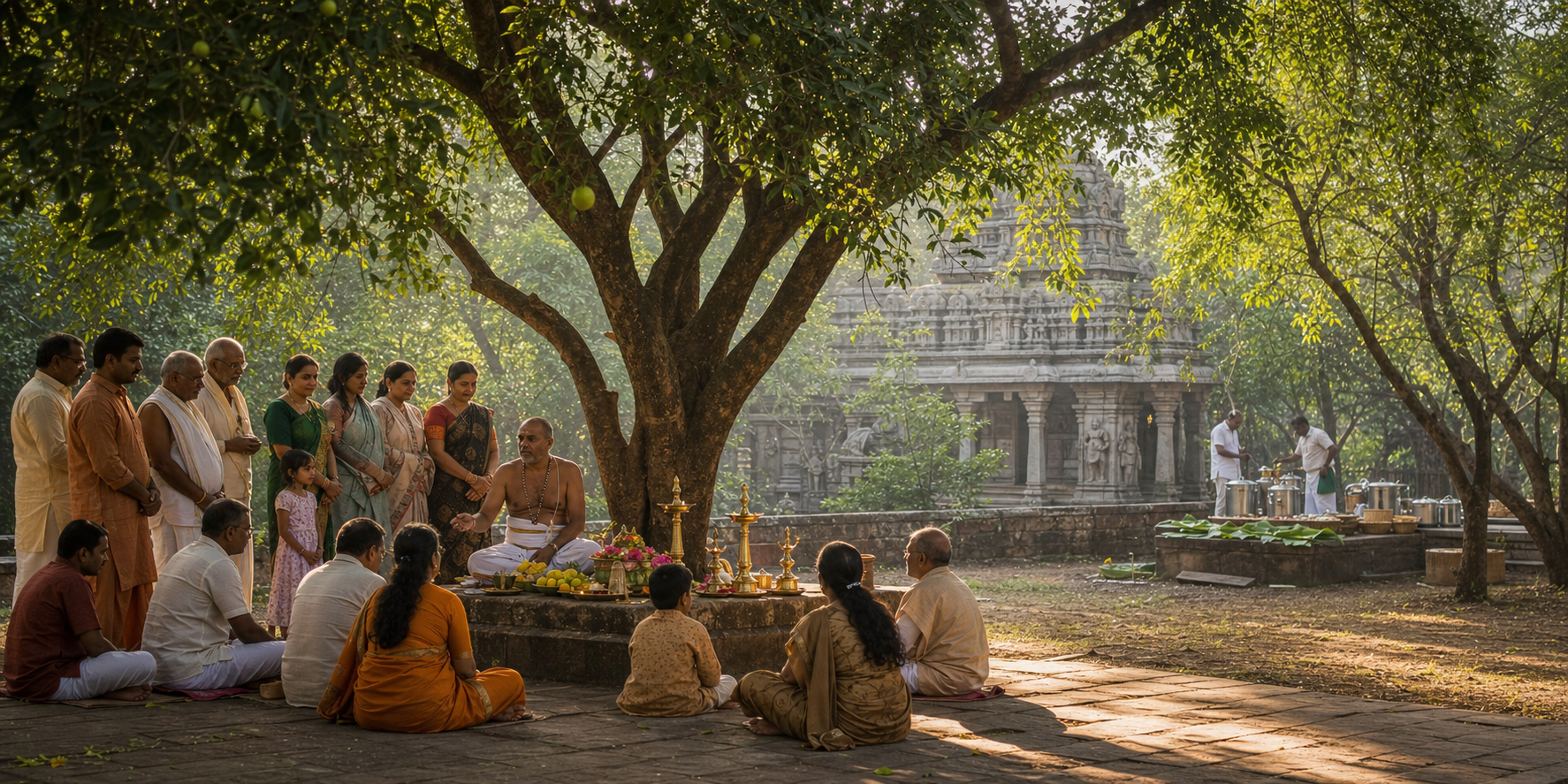
You may have been invited to a Kartika Vanabhojanam and wondered how it differs from an ordinary picnic. Or perhaps your temple association wants to organize one without reducing a sacred observance to lunch in a park. The distinction lies in the relationship among Kartika worship, a natural setting, shared food, and seva.
There is no single script that every family and temple must copy. The safest rule is simple: preserve the devotional purpose, and let the host temple determine the ritual form. A family custom can enrich the gathering, but it should not override temple instructions or be presented as universal practice.
Recognize the sacred form before planning the details
Kartika Vanabhojanam is especially associated with Andhra Pradesh, where families, temples, and cultural associations gather outdoors during Kartika masam. The setting may be a grove, temple courtyard, garden, or park. The month falls roughly in October-November, although the applicable dates follow the religious calendar rather than a fixed civil date. Related forms are also found elsewhere in South India, and the observance is sometimes called Kartika Masa Vana Mahotsavam.
The recognizable pattern is an outdoor devotional gathering followed by a collectively prepared or served sattvic meal. Prayer, songs, storytelling, gratitude toward sacred plant life, and care for the gathering place distinguish it from a recreational outing. These elements place the shared meal within Kartika’s disciplines of devotion, simplicity, and ecological mindfulness.
Key takeaways
- Kartika Vanabhojanam is a devotional gathering in nature, not merely a picnic with religious decorations.
- At a temple event, worship determines the order of the day; the meal follows that sacred framework.
- A simple sattvic meal, shared service, and responsible cleanup carry more meaning than an elaborate menu.
- Tulasi, Usiri, Bilva, and Durva have distinct ritual associations. They should not be treated as interchangeable decorations.
- Local variations are normal. Ask what the host temple observes instead of assembling rites from unrelated family customs.
This distinction gives organizers room to adapt without emptying the practice of meaning. A city park can replace a village grove when necessary. It cannot replace permission, reverence, worship, or responsibility for the land. In the same way, a catered meal can solve practical problems, but convenience should still serve the devotional sequence rather than become the main attraction.
Let temple worship determine the order of the meal
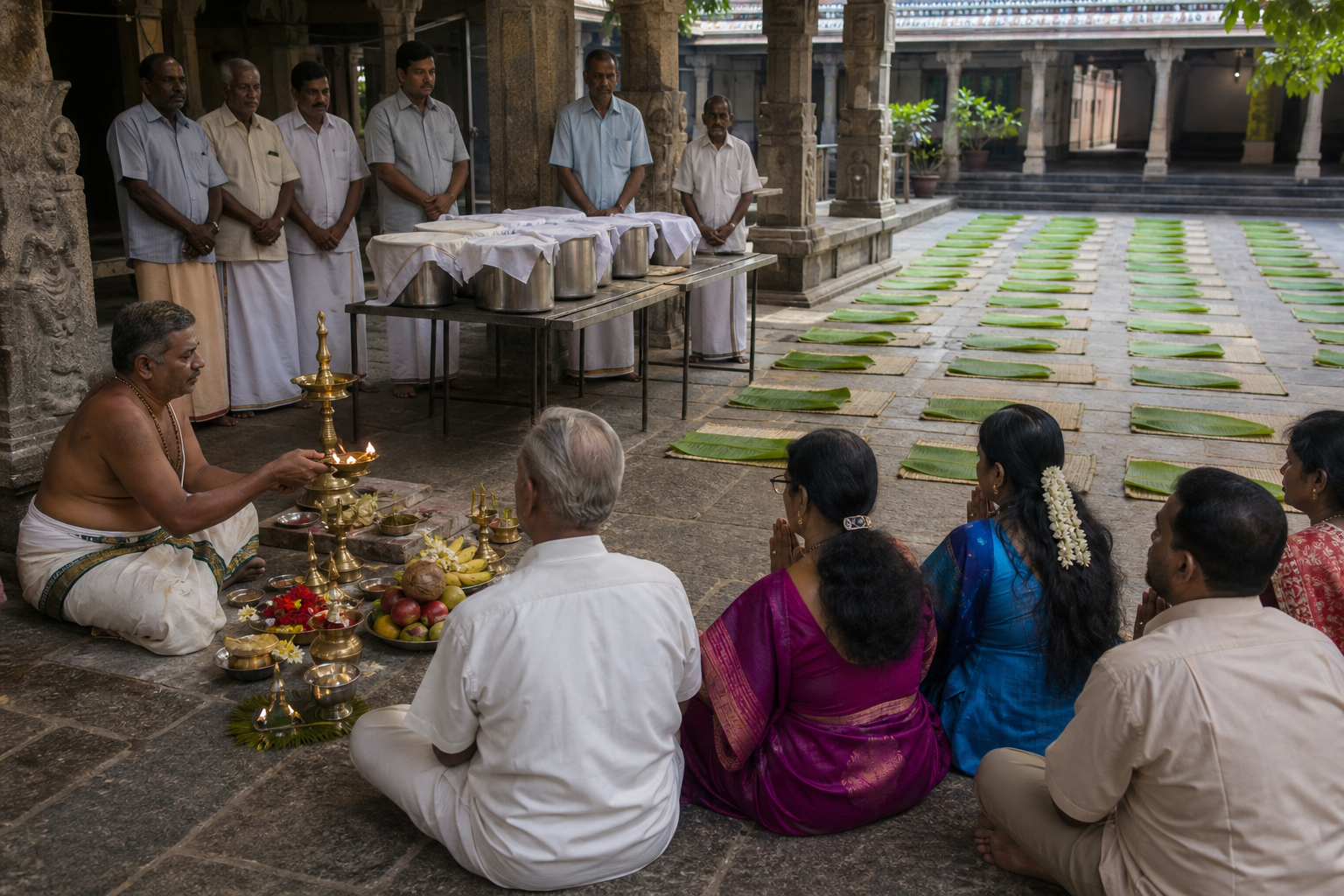
A temple-run Vanabhojanam differs from a private family gathering because ritual authority remains with the temple. Priests and administrators decide which deities are brought in procession, whether an abhishekam is performed, which offerings are appropriate, where devotees may assemble, and how prasadam is distributed. Participants support that order; they do not create a parallel ceremony beside it.
Tirumala provides a clear example of this worship-to-fellowship sequence. On 9 November 2025, the scheduled observance at Paruveta Mandapam near Gogarbham placed Snapana Tirumanjanam for the Utsava Murtis between 11:00 a.m. and noon, with Karthika Vana Bhojanam afterward. Snapana Tirumanjanam is a ceremonial bathing and adornment of the festival deities. The meal therefore did not interrupt the worship; it flowed from it.
The transferable lesson is the sequence, not the old clock time. Do not reuse a previous year’s schedule for a future visit. Confirm the current temple notice, because the date, location, access arrangements, and ritual timing may differ.
- Identify the organizer. Determine whether the event is conducted by the temple, a cultural association working with the temple, or a private group using nearby grounds. That tells you whose instructions govern the gathering.
- Confirm the complete sequence. Ask when worship begins, when the meal is expected to start, and whether participants must be present before a procession, abhishekam, or offering.
- Arrive for worship, not only for lunch. Joining only when food is served misses the movement from puja to prasadam and weakens the communal character of the observance.
- Distinguish food from prasadam. Food becomes part of temple distribution according to the temple’s procedure. Do not independently label every picnic dish as prasadam or place it before a deity without permission.
- Follow the service flow. Use the designated seating, serving, and cleanup arrangements. If you want to volunteer, ask where help is needed instead of assuming that the most visible ritual role is the most valuable one.
This approach also resolves a common uncertainty for first-time visitors: respectful participation does not require you to know every mantra or ritual gesture. You can arrive on time, observe the priest and volunteers, receive prasadam as directed, help others without obstructing the ceremony, and leave the grounds orderly.
Plan a community Vanabhojanam through six clear decisions
If your family or association is organizing the gathering, settle its religious and practical structure before announcing the menu. Six decisions prevent most confusion.
- Who holds ritual responsibility? Name one liaison who will obtain instructions from the priest or temple administration. Participants should receive one consistent answer about offerings, timings, and permitted spaces.
- Which outdoor place is approved? Use a temple courtyard, grove, garden, or park only with the relevant permission. Check where cooking, serving, seating, devotional singing, and waste collection are allowed. A beautiful tree does not automatically make the surrounding ground available for an event.
- What is the devotional opening? Ask the temple whether it will conduct worship. In a family gathering outside temple grounds, follow a known household or community custom without advertising it as the only correct form of Vanabhojanam.
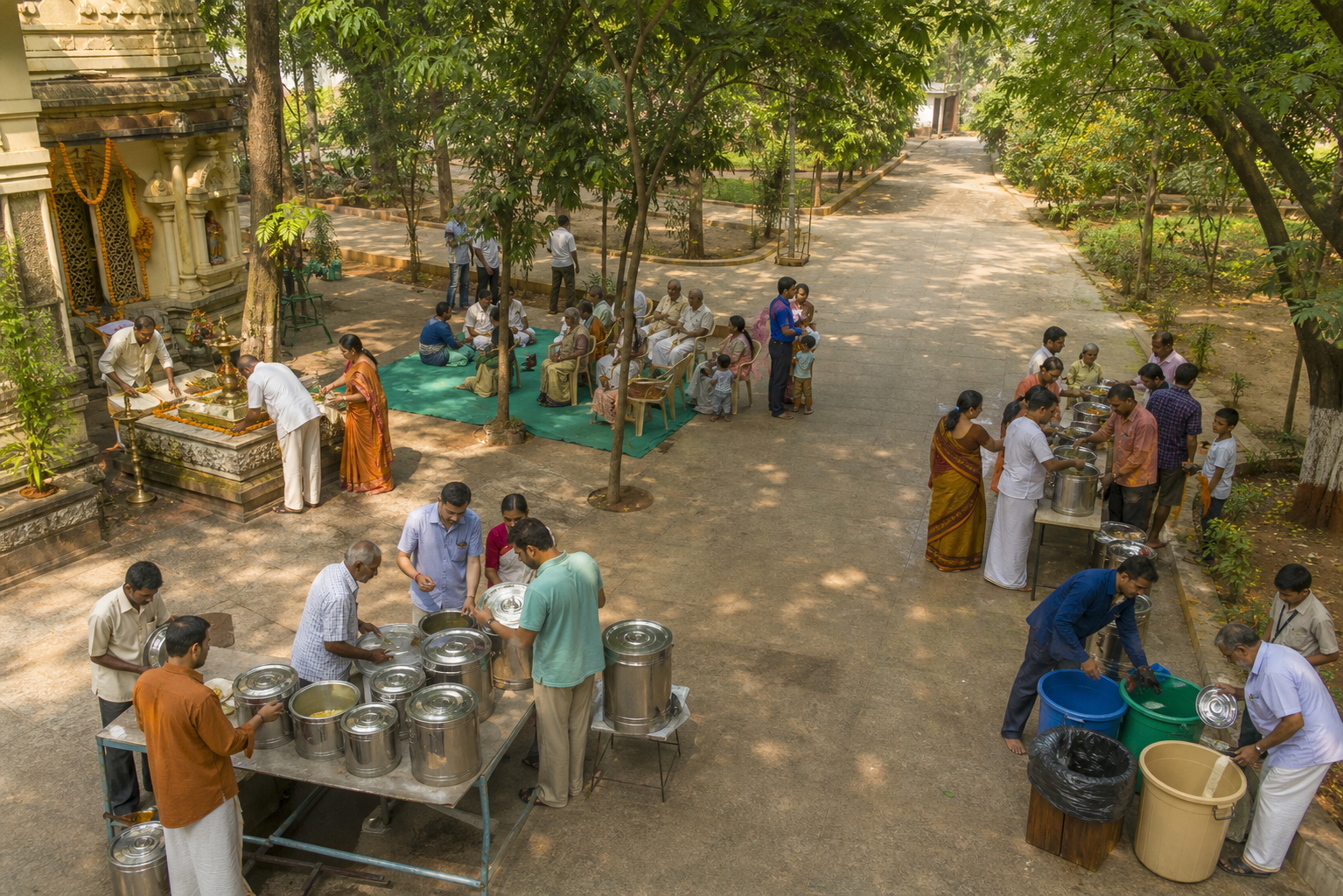
- How will food be prepared and shared? Plan a simple sattvic meal and confirm any temple-specific dietary rules. Assign responsibility for preparation, transport, serving utensils, drinking water, and the return of reusable vessels. Label dishes clearly so participants are not forced to guess what they contain.
- How will everyone participate? Give people defined roles in devotional singing, storytelling, seating assistance, serving, water distribution, or cleanup. Participation should not be measured only by who performs a visible ritual action.
- Who restores the site? Assign a cleanup team before the gathering begins. Remove food, plates, packaging, flowers, and other materials according to the site’s rules. Do not leave an object behind merely because it was used in a devotional setting.
Keep the meal proportional to the purpose. Kartika Vanabhojanam traditionally emphasizes shared, simple food rather than private display. A long menu can create avoidable work, delay the meal after worship, and divide participants into hosts and spectators. A smaller menu served calmly often supports seva and fellowship more effectively.
Also decide what happens if the intended outdoor plan cannot proceed. A change of place should remain under the organizer’s or temple’s authority. Moving unannounced to another corner of temple land can interfere with worship, pilgrim movement, or maintenance even when the group’s intention is devotional.
Honour sacred plants without inventing new rites
The vana in Vanabhojanam is not decorative scenery. Plant life belongs to the sacred grammar of the gathering. Tulasi, Usiri or Amla, Bilva, and Durva are revered within Hindu ritual life, but their roles are not identical. The presence of several sacred plants does not require an organizer to use all of them.
- Tulasi: Some gatherings pause near Tulasi to offer gratitude or worship. Follow the household or temple custom governing that act; do not assume leaves may be plucked because the plant is sacred.
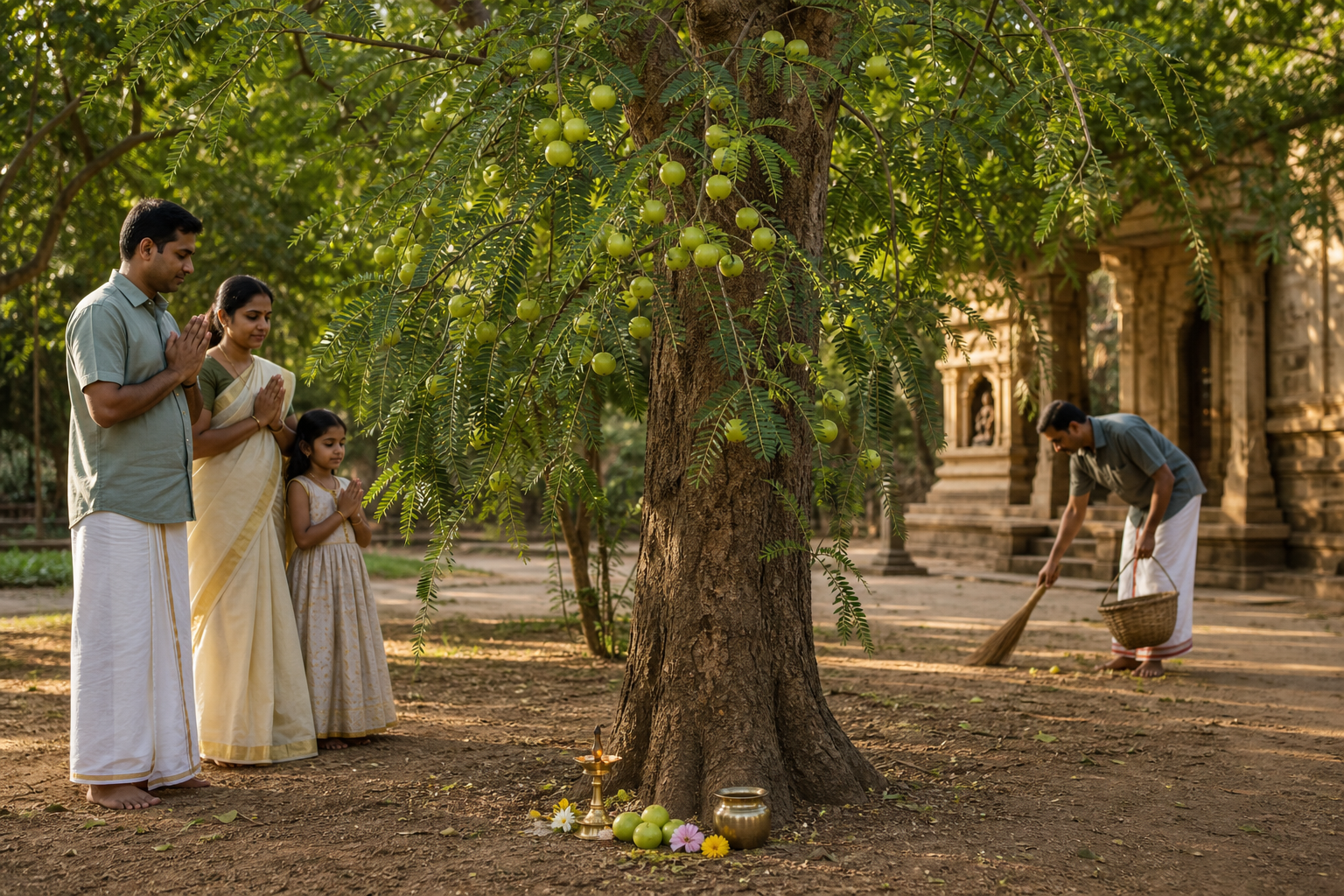
- Usiri or Amla: Vanabhojanam may be associated with gathering or dining in the presence of the Usiri tree. Treat the living tree and its root area as part of the place being honoured, not as infrastructure for bags, signs, or discarded plates.
- Bilva: Bilva leaves have an established place in Hindu worship, including practices connected with Kartika. Let the priest or established family procedure determine whether and how they are offered.
- Durva: Durva grass also carries ritual significance. Its sacred status is not permission to uproot it from temple or park land. Use only what the authorized worship procedure provides or permits.
A practical test helps here: if an action damages the plant, compacts its root area, creates litter, or treats a living presence as a disposable prop, it contradicts the gathering’s ecological meaning. Ask before touching, cutting, tying, hanging, or placing anything on a sacred plant. Reverence is visible in restraint.
This care also clarifies the relationship with other Dharmic paths. Ahimsa, compassion, dana, community, self-discipline, and mindful use of the natural world resonate across Hindu, Buddhist, Jain, and Sikh traditions. That ethical kinship should not be turned into a claim that all four traditions perform the same Kartika rite. Nature reverence and communal care provide the shared moral horizon; the particular worship remains rooted in its own tradition and locality.
Give younger participants one story, one song, and one service
A gathering transmits tradition when younger participants can understand what they are doing. Simply bringing children to the venue may give them a pleasant memory, but it does not automatically explain why worship comes before the meal or why a tree is being honoured.
Use a simple three-part structure. Ask an elder to tell one brief family or village memory, while clearly identifying it as a local experience rather than a universal rule. Include one devotional song that the group can follow. Then give each child or young adult one concrete act of seva, such as helping an elder find a seat, distributing water under supervision, collecting reusable vessels, or checking the area for litter.
Storytelling should explain a relationship, not merely list ritual objects. A useful explanation might connect the month of Kartika with simplicity, the tree with gratitude toward life-supporting nature, the meal with community, and cleanup with dharmic responsibility. That gives a child a framework that can travel from an Andhra village to a city temple or a diaspora park.
Urban and diaspora communities do not need to manufacture a village atmosphere. The tradition already has room to adapt to temple gardens and public parks while retaining its core of devotion, intergenerational learning, shared food, and care for nature. What matters is that adaptation remains transparent: explain which elements come from the host temple, which belong to a particular family or region, and which are practical arrangements for the present venue.
Before you publish the invitation, write down four things in plain language: the approved location, the worship schedule, the food rules, and who is responsible for restoring the site. Once those are settled, the gathering can remain joyful without becoming casual about its purpose.
References
- DharmaRenaissance Blog – Kartika Vanabhojanam: Sacred Picnics, Community Bonding, and Nature Reverence in Andhra Pradesh
- DharmaRenaissance Blog – Tirumala’s Karthika Vana Bhojanam by TTD: Sacred Feast and Snapana Tirumanjanam on 9 Nov 2025
