If you are asking whether a stone-by-stone rebuild will undo the destruction of Warangal’s Kakatiya shrine, the honest answer is: only partly. A new structure can restore form and public presence. It cannot automatically restore the archaeological relationships erased when stones, foundations and soil layers are disturbed.
The immediate task is therefore larger than construction. The roughly eight-century-old Shiva temple in Ashok Nagar, Khanapur Mandal, was demolished for a government Integrated School. Telangana’s commitment to rebuild it creates an opportunity, but the result should be judged by the evidence preserved, not merely by whether a temple-shaped building eventually appears.
Key takeaways before anyone moves another stone
- A temple does not lose its historical value because it has no deity, no current worship or a damaged roof. Ritual status and archaeological significance are different questions.
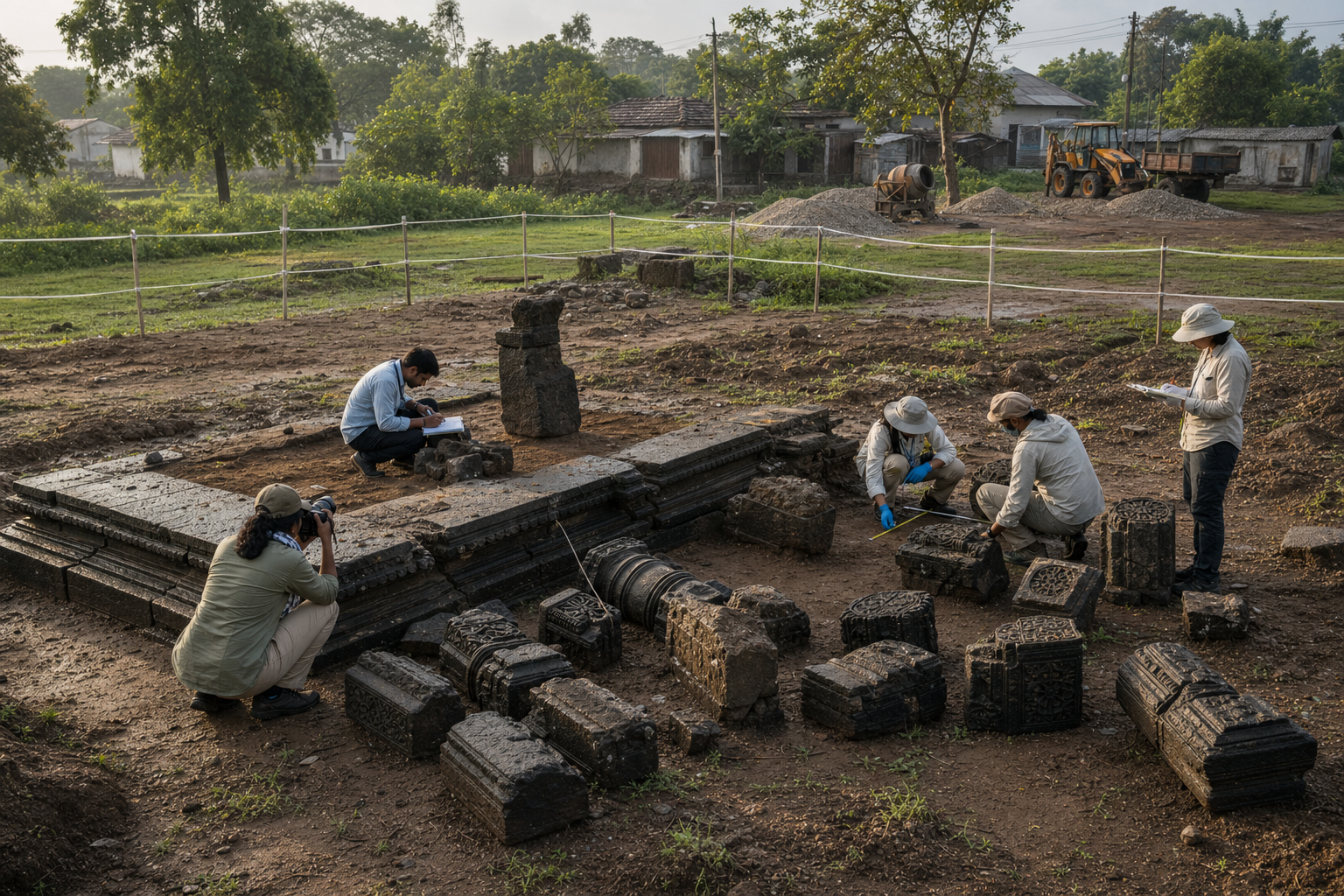
- The first step after demolition is not reassembly. It is securing the footprint and debris so that fragments are not discarded, cleaned, mixed, stolen or reused as fill.
- Stone-by-stone reconstruction is credible only when every recoverable element is documented, numbered and matched to evidence of its original position.
- The seven-line Telugu inscription needs a separate conservation plan. Treating its pillar as ordinary building stone risks losing information that no replacement carving can recover.
- The school and shrine need not be framed as rivals. A mapped heritage zone, an evidence-based setback and a revised site plan can allow education and preservation to share the land.
- If you know an unprotected shrine near a proposed road, school or public building, intervene when surveying and site clearance begin. By the time a bulldozer arrives, the most useful archaeological context may already be at risk.
Why an inactive shrine still carries living history
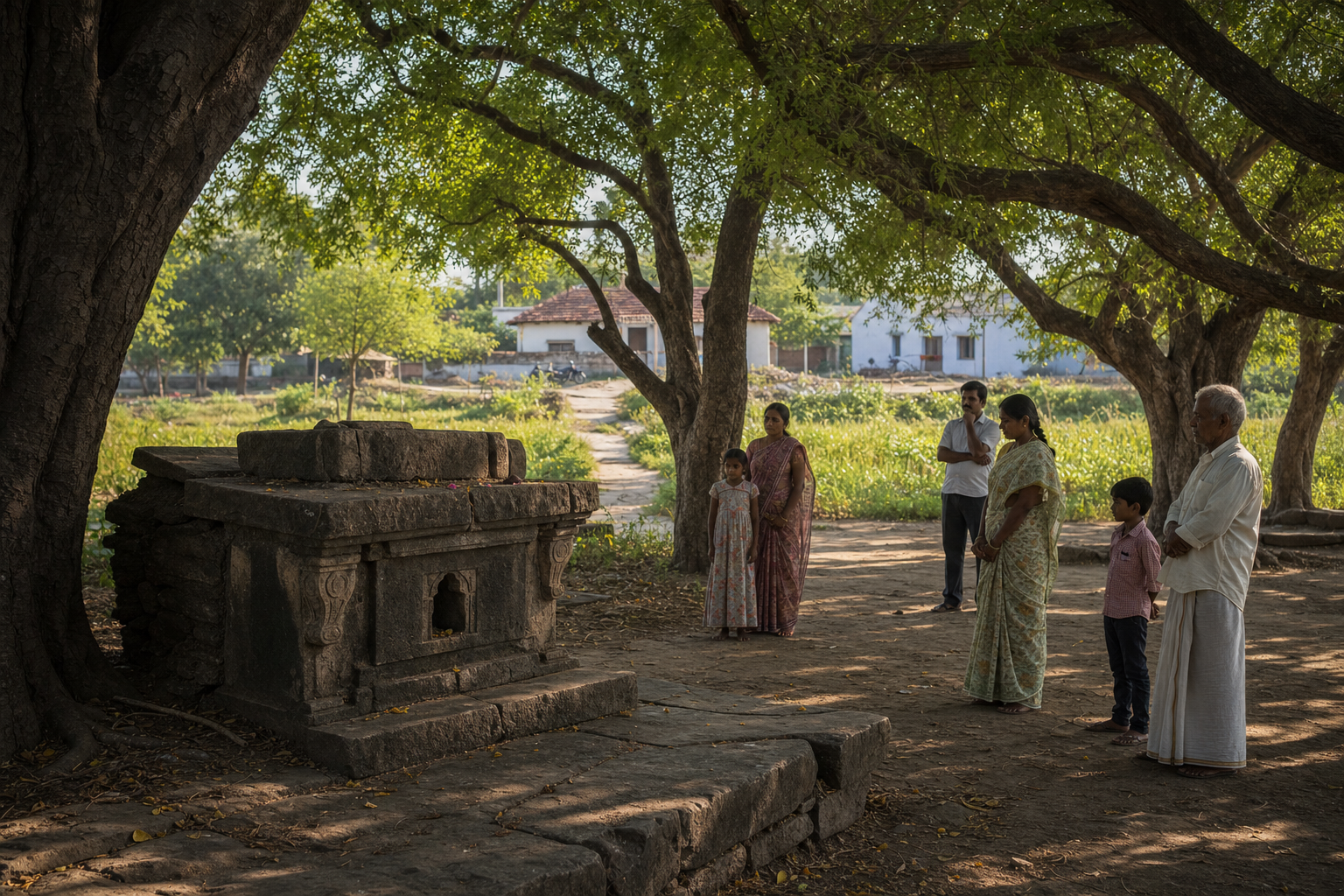
The Ashok Nagar temple was reportedly dilapidated, without a deity and no longer used for worship. Those conditions made it vulnerable, but they did not make it empty. A Hindu shrine can fall out of ritual use while its masonry continues to preserve evidence about patronage, language, landholding, craft and the settlement around it.
Here, the clearest evidence was a seven-line Telugu inscription dated February 1231 A.D. It referred to the Kakatiya ruler Ganapatideva with the titles Maharaja and Rajadhirajulu and recorded the donation of land near a toddy plantation. That combination matters. The royal titles anchor the shrine in Kakatiya political history, while the land donation opens a small window onto the economic landscape in which ordinary people lived.
The inscription was not an unknown discovery made after the damage. A state heritage record had documented an inscription at the temple in 1965. That prior documentation should now be located, digitised and compared with the surviving pillar. Earlier photographs, measurements or transcriptions could help establish what changed during demolition and guide conservation of damaged characters.
The visible shrine was also part of a wider setting. The temple stood between Shikargarh Fort and an old mud fort locally called Kota Katta. The associated landscape included earthworks and ponds, with the shrine near one of those water features. Precisely finished pillars, beams and door jambs were therefore not isolated antiques. They were elements in a connected sacred, defensive and water-managed landscape.
This is the distinction you should carry to any threatened site: abandonment is a condition, not a verdict. A broken shrine may still contain the only surviving inscription for a local grant, the only visible edge of an older settlement or the only reliable clue to how a historic route connected water, worship and fortification. Clearing it as debris can erase evidence before anyone has asked the right questions.
The wider Kakatiya tradition already has international recognition through the UNESCO-listed Kakatiya Rudreshwara, or Ramappa, Temple. That does not mean every modest Kakatiya shrine must be treated as a miniature Ramappa. It means small structures deserve examination on their own evidence rather than dismissal on the grounds that they are neither monumental nor active.
What a credible stone-by-stone reconstruction requires
Officials have promised to rebuild the temple stone by stone. That phrase sounds reassuring, but it is a method only when backed by documentation. Otherwise, old fragments can be placed into a largely new building without preserving their original relationships.
Reconstruction makes a structure stand again. Conservation protects authentic material and the information attached to it. Anastylosis connects the two: surviving original elements are reassembled in positions supported by evidence, while necessary modern additions remain limited and identifiable. For Ashok Nagar, a defensible process should follow this order:
- Secure the footprint and debris. Mark a protected working boundary and prevent fragments from being removed, reused or shuffled between piles. No historic surface should be scraped, pressure-washed, painted, chalked or chemically cleaned by untrained hands.
- Conduct salvage archaeology before construction resumes across the affected area. Archaeologists should examine exposed foundations, soil relationships and the locations where displaced pieces were recovered. Even after demolition, the ground may retain evidence that the standing structure no longer can.
- Create a georeferenced site survey. Record the temple footprint, surviving foundations, debris locations, nearby earthworks, water features and the school works. Coordinates should connect every later photograph, drawing and catalogue entry to a real place.
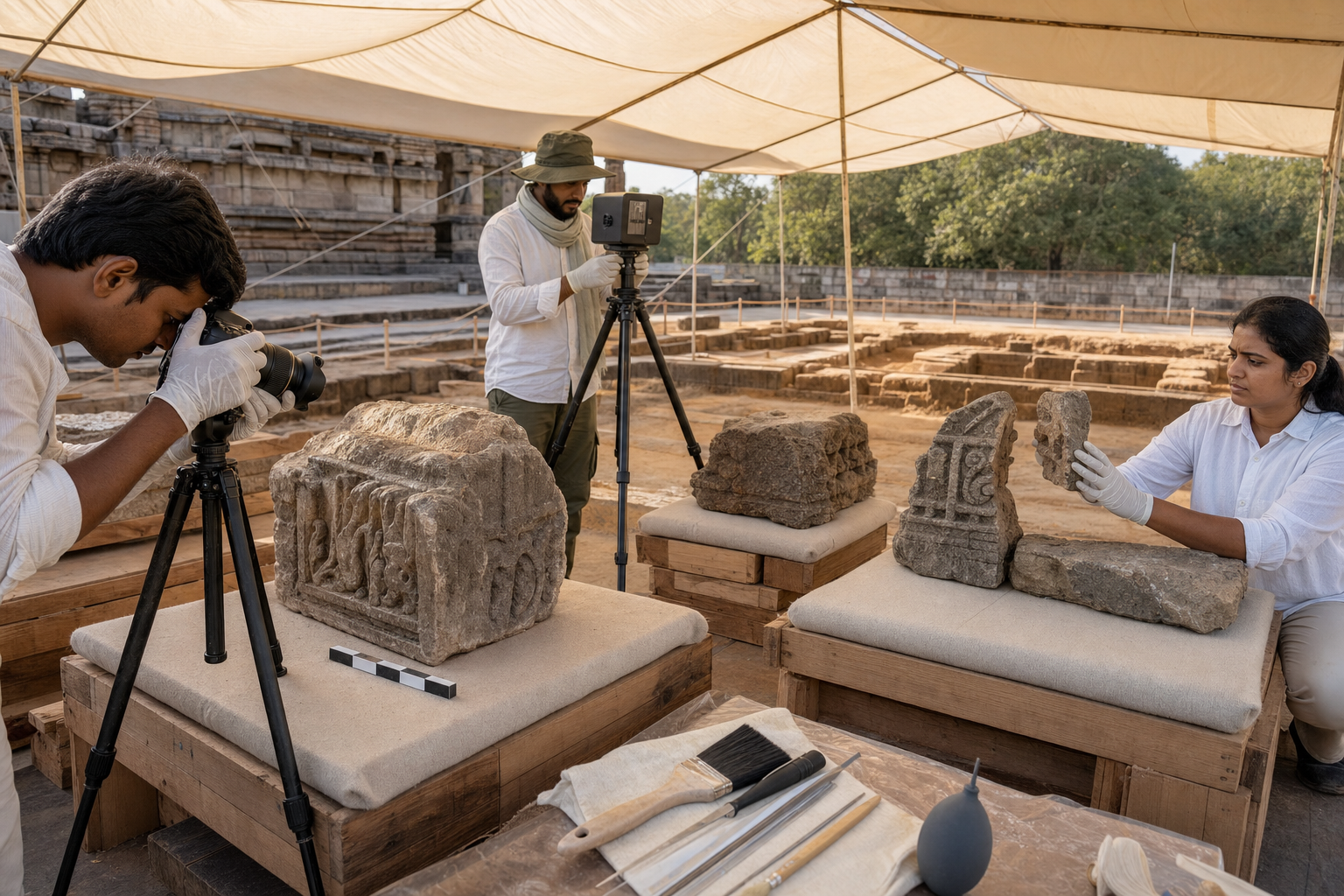
- Document the remains in three dimensions. High-resolution photography, photogrammetry and 3D laser scanning serve different but complementary purposes: visible condition, measurable surface models and precise geometry. Documentation must happen before stones are rearranged for convenience.
- Catalogue every recoverable component. Each pillar, beam, jamb and fragment needs a unique identifier, scaled photographs, dimensions, stone type, condition description and proposed original location. Identification marks must not damage historic faces.
- Give inscribed surfaces specialist treatment. Use high-resolution directional photography and Reflectance Transformation Imaging to reveal shallow characters. Physical rubbings should be attempted only by qualified specialists after the surface has been assessed as stable.
- Analyse materials and structure before assembly. Stone, mortar traces, finishes, foundation conditions and load paths should guide the engineering design. Modern replacement pieces may be necessary for stability, but they should be documented and distinguishable from Kakatiya fabric on close inspection.
- Reassemble through evidence, not aesthetic guesswork. Original components should return to supported positions wherever possible. Missing portions should not be imaginatively completed merely to produce a symmetrical or newly polished result.
- Publish the method and the inventory. An independent technical review involving Department of Heritage Telangana specialists, appropriate ASI expertise and civil-society conservation bodies such as INTACH Warangal would make the process easier to verify. The final record should identify original stones, modern insertions, unresolved placements and any departures from the approved plan.
The sequence matters. If reassembly begins before surveying and cataloguing, the project may produce a presentable shrine while permanently confusing original placement, later repairs and new work. Ask for the documentation package before accepting photographs of fresh masonry as proof of conservation.
Protect the inscription, the landscape and the school
Treat the pillar as a fragile historical archive
The inscribed pillar is not simply one more element to fit back into the mandapa. Its shallow cut letters, weathered surface and position all carry information. Cleaning intended to make the stone look new could remove precisely the traces an epigraphist needs.
The conservation team should record the pillar’s condition before intervention, use controlled cleaning only where necessary, and apply non-invasive consolidation if specialists find unstable material. Any relocation, repair or change in orientation should be recorded. After reassembly, the surface needs periodic condition checks so that water, salts, handling or poorly placed lighting do not create a second cycle of damage.
A Telugu-and-English panel should explain the February 1231 date, Ganapatideva’s titles, the land donation and the method used to conserve the inscription. The panel should also distinguish the surviving text from later interpretation. Visitors deserve to know what the stone actually records, what scholars infer from it and which portions remain uncertain.
Design a micro-heritage zone within the school site
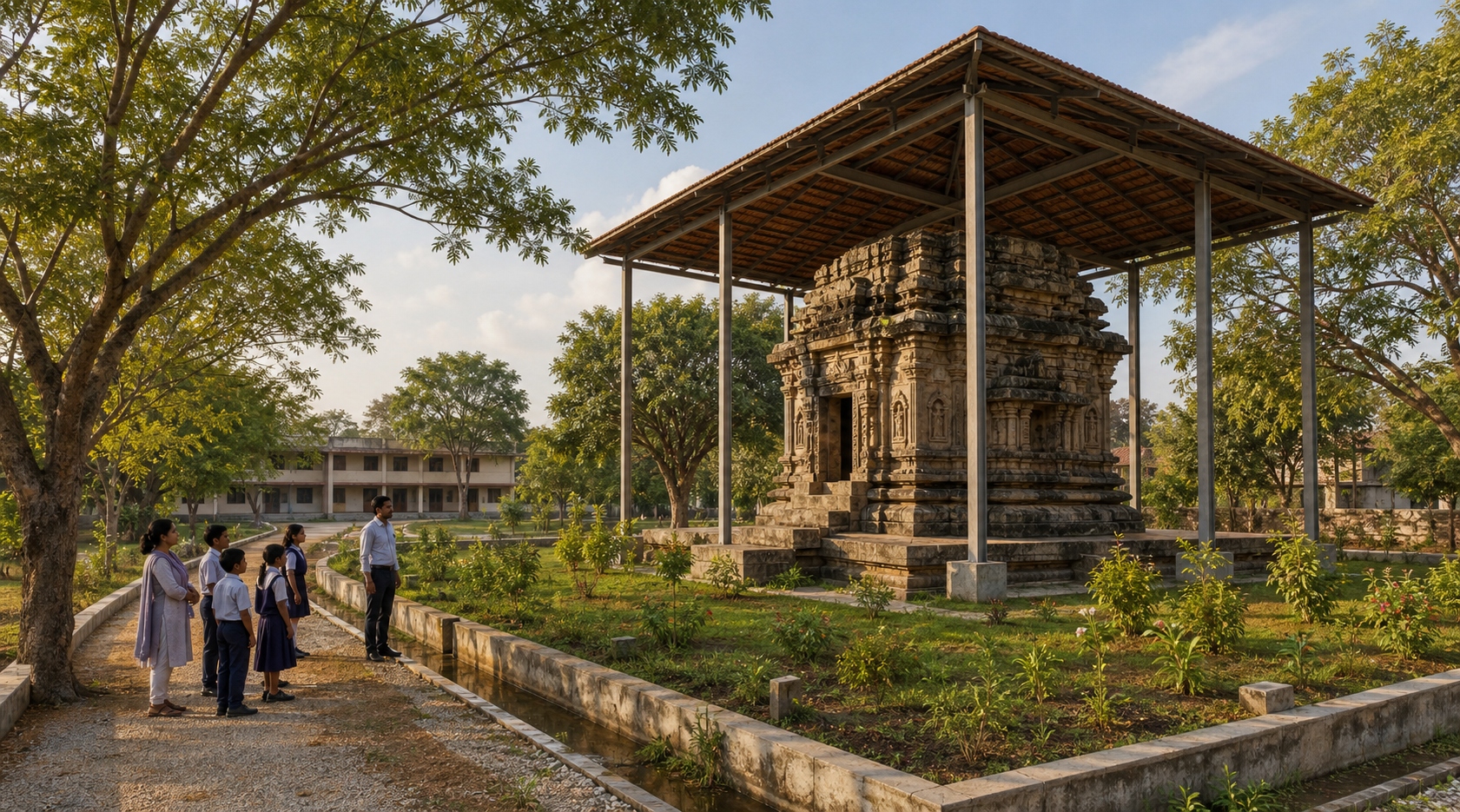
The school is not an argument for pushing the shrine elsewhere. It is a reason to improve the site plan. A Heritage Impact Assessment should now examine the temple footprint and surviving context alongside the school’s buildings, foundations, drainage, utilities, access routes and construction movement.
- Map the verified historic footprint and any archaeologically sensitive ground before finalising nearby construction.
- Set the temple-school separation through archaeological and structural review, not by leaving whatever narrow strip remains after the buildings are placed.
- Keep new foundations, trenches, drains, utility lines and routine heavy-vehicle routes outside the protected zone.
- Use low, visible boundary markers and clear wayfinding so that staff, pupils and maintenance crews understand where ordinary campus work must stop.
- Provide a safe visitor path and lighting that does not require drilling fixtures into historic stone.
- Name the public body responsible for inspection, vegetation control, drainage and repairs. A protected boundary without assigned maintenance soon becomes an unattended margin.
- Place the temple, inscription and Kota Katta landscape in the school’s local-history curriculum. Students can learn how epigraphy, archaeology, architecture and public decision-making meet on their own campus.
- Keep open-access copies of scans, photographs, catalogue entries and translations in a digital repository. Digital records cannot replace the shrine, but they can preserve knowledge and make future changes detectable.
This approach turns coexistence into a design requirement. It also rejects a damaging assumption that a public school and a Hindu heritage site compete for legitimacy. Education becomes stronger when the campus teaches pupils to recognise and care for the history beneath their feet.
What you can do when a local heritage site is threatened
The most effective intervention usually begins before site clearance, when a road alignment, school boundary or foundation trench can still be changed. You do not need to decide the site’s age or legal status yourself. You need to preserve observable facts and put the relevant departments on notice that an expert inspection is required.
If the structure is still standing
- Create a dated visual record from a safe and lawful position. Take wide photographs showing the setting, middle-distance views showing the structure and close views of carvings or inscriptions. Preserve original files rather than relying only on compressed social-media copies.
- Record the precise location and nearby landmarks. Share exact coordinates with heritage professionals and responsible officials; avoid broadcasting the location of loose or unguarded inscribed stones if that could increase theft or vandalism.
- Do not clean, chalk, trace, wet or move a carving to make it easier to photograph. A well-intentioned intervention can destroy surface evidence.
- Ask Department of Heritage Telangana whether the site appears in an inventory, whether an inscription was previously recorded and which office has responsibility. Request the identifier and available documentation in writing.
- Send one factual representation to the district administration, the state heritage department and the agency implementing the public project. Include the location, photographs, visible risk and a specific request for a joint inspection before work crosses the historic footprint.
- Request a Heritage Impact Assessment while the layout can still be changed. Ask it to cover the structure and its surrounding archaeological context, not merely the walls visible above ground.
- Invite qualified historians, epigraphists, conservation architects, local educators and temple-community representatives to one documented site meeting. A district-level Dharmic heritage forum can keep this contact network ready for the next vulnerable shrine instead of rebuilding it after every emergency.
If demolition has already occurred
- Focus first on preventing further loss. Ask that debris remain on site, under controlled custody, until specialists have inventoried it. Do not encourage volunteers to collect stones for safekeeping; separating a fragment from its recovery location can destroy evidence and create ownership disputes.
- Record the condition of the footprint and debris piles without disturbing them. Note the date, visible machinery, active works and any movement of material. Keep fact, inference and allegation separate in public statements.
- Request an independent technical inspection and a published fragment inventory. The public should be able to see which inscribed and carved pieces survived, which are missing and who holds custody.
- Ask who is leading the reconstruction and what conservation qualifications are represented. A general building contractor may be necessary for site work, but archaeological recovery, epigraphy and anastylosis require specialised oversight.
- Demand a written method before assembly begins. It should cover documentation, stone numbering, inscription stabilisation, original-versus-new material, foundation design, school setbacks and long-term maintenance.
- Pursue accountability and recovery as parallel tasks. An inquiry can establish how clearances and decisions were handled, while a conservation team secures perishable evidence. Waiting for one process to finish before starting the other can allow preventable losses to continue.
- Keep public communication peaceful, specific and verifiable. Anger may attract attention, but dates, maps, inventory gaps and unanswered technical questions are what officials and conservation professionals can act upon.
For Ashok Nagar, the practical test is now visible: secure the remains, publish the inventory, conserve the 1231 inscription, assess the entire Kota Katta setting and redesign the school around a protected footprint. A ceremonial reopening without those safeguards would close the controversy without repairing the institutional failure behind it.
If an unattended shrine in your area sits beside fresh survey markers or construction fencing, do not wait for demolition photographs. Make the dated record, send the precise inspection request and bring heritage specialists into the conversation while the plan can still move. That is how lawful Dharmic stewardship turns memory into protection.