You may be preparing a Dharmic gathering, answering an online argument, or trying to explain to your family why Hindu, Buddhist, Jain, and Sikh traditions can cooperate without being declared identical. The difficulty is real: emphasize difference too sharply and dialogue becomes rivalry; emphasize unity carelessly and living traditions are reduced to interchangeable labels.
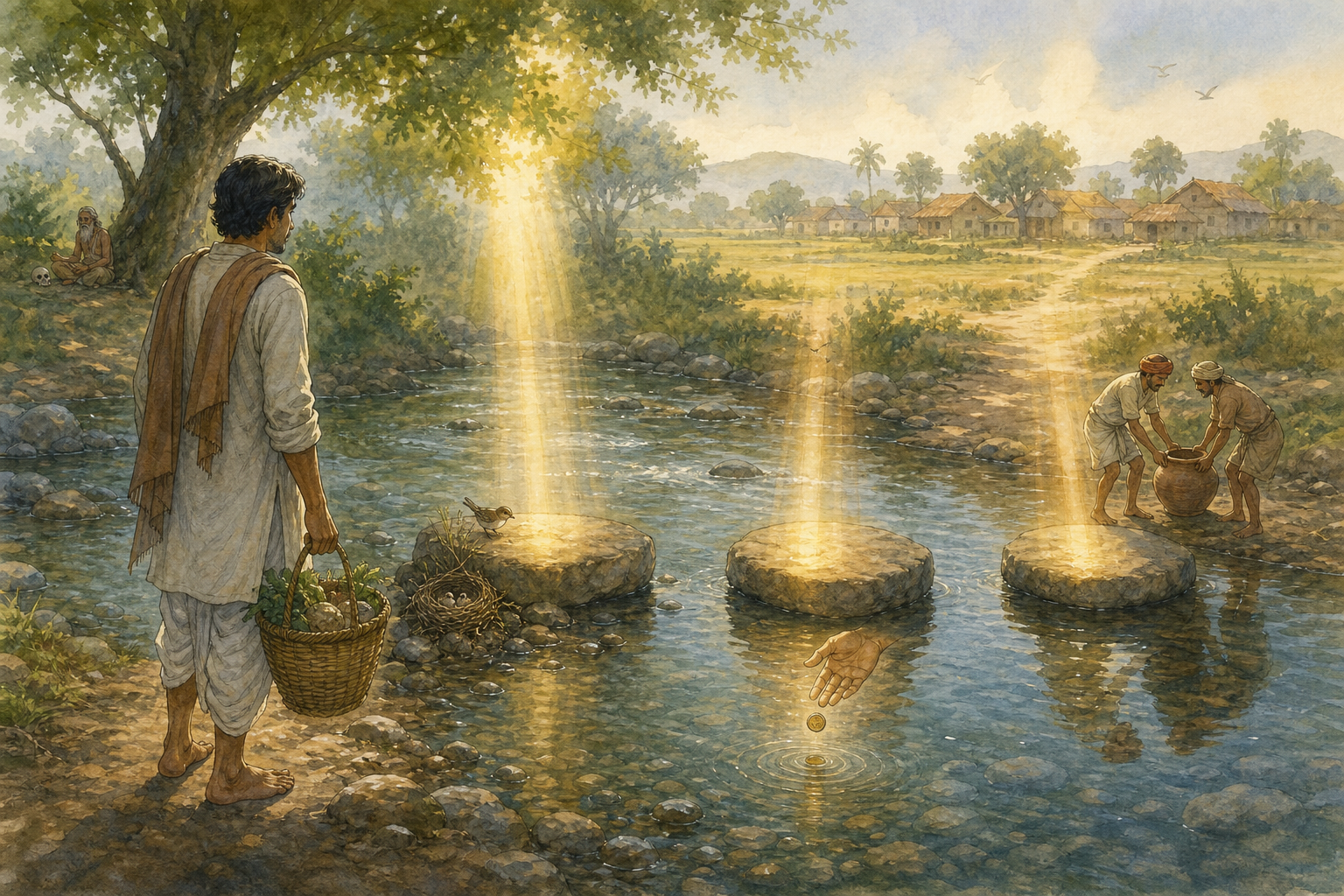
Kapal-Muni offers a better test. The skull-bearing ascetic is most useful here not as a mascot for religious unity, but as a question directed at everyone involved: has your spiritual identity loosened ego, reduced harm, and produced compassionate conduct? That question reveals common ethical ground while leaving doctrine, discipline, and sacred vocabulary intact.
Build common ground without manufacturing common theology
Dharmic unity does not require you to say that every tradition makes the same claims about the Divine, the self, liberation, grace, karma, or ultimate reality. Ethical convergence and doctrinal identity are different propositions. The first can support honest cooperation. The second often asks participants to misdescribe their own paths.
Keep three layers separate whenever you organize or join an interfaith conversation:
- Doctrine: What does each tradition actually hold to be true? Let its own vocabulary remain visible, including points that do not fit another tradition’s framework.
- Discipline: What practice is supposed to transform the practitioner? Nama-simarana, prema-bhakti, insight meditation, and anitya-bhavana should not be presented as different names for one technique.
- Cooperation: What can people do together without pretending that doctrinal differences have disappeared? Truthful speech, non-harm, generosity, restraint, compassion, and service provide substantial ground for action.
This separation prevents two common mistakes. One is exclusivist pride: only our language can produce virtue. The other is sentimental flattening: because several traditions value compassion, their teachings must be identical. You can refuse both. A Sikh can explain seva through the Guru’s path, a Jain can ground restraint in ahimsa and aparigraha, a Buddhist can speak from compassion and freedom from self-clinging, and a Hindu can understand service through bhakti or another Hindu discipline. Cooperation does not become weaker when the reasons remain distinct. It becomes more truthful.
Before an event or shared project begins, establish a simple covenant: each tradition will be represented in terms its adherents recognize; disagreements will be named without ridicule; no participant will seize another tradition’s symbol as proof of sameness; and the encounter will point toward conduct that benefits someone beyond the speakers.
Read Kapal-Muni carefully before building an argument around him
If you came looking for one securely documented biography shared by four religions, do not make that claim. The name Bhagat Maalaa covers a family of saint lists and concentrated teaching narratives, transmitted through manuscripts, later recensions, and oral retellings. In the Vaishnava stream, Nabhadas’s late-sixteenth-century Bhaktamal became an influential model for remembering devotees. Sikh manuscript traditions also preserve titles such as Bhagat Mala or Bhagat Ratnavali, with variations in attribution, order, and emphasis.
This is hagiographic teaching, not a modern historical dossier. An encounter may be compressed so that a striking ascetic, a humble devotee, and a decisive moral turn can expose the listener’s assumptions. Variation does not make the narrative worthless, but it changes what you may responsibly claim. Use Kapal-Muni as a didactic figure unless a particular edition, recension, and identity have been established.
The name itself requires care. The Sanskrit kapāla means skull or bowl, while muni denotes a sage or silent seer. Kapila is a different word, associated with a tawny color and with Kapila Muni of Sāṃkhya. Regional pronunciation, oral transmission, and scribal variation can blur Kapal and Kapila, but similarity of sound does not establish identity.
When you encounter a Kapal-Muni story, check four things before repeating it:
- The wording: Does the telling actually say Kapal, Kapila, Kapālika, or something else?
- The setting: Is the figure situated in a Śaiva, Vaishnava, Sikh, Buddhist, Jain, or later comparative setting?
- The narrative function: Is the ascetic being remembered as a person, used as a sectarian contrast, or presented as a symbol of mortality and renunciation?
- The ethical result: Does the scene lead toward humility and compassion, or does its dramatic imagery merely attract attention?
The skull does not prove sanctity. It confronts the bearer and the observer with bodily impermanence. The decisive question is what happens next. Fearlessness can become compassion, or it can become another identity to display. Renunciation can dissolve pride, or pride can simply acquire ashes and a skull-bowl.
Recognize the distinct routes to a shared ethical horizon
The comparison becomes sound when you locate convergence at the level of ethical transformation rather than treating symbols and doctrines as interchangeable. Each tradition contributes a different route, a different safeguard, and a different vocabulary.
Hindu traditions: test austerity by humility and devotion
Two Hindu trajectories should be distinguished. Kapālika and related Śaiva ascetic currents employ charnel-ground and skull-cup imagery to face mortality, fear, and attachment directly. The transgressive appearance is not the ethical endpoint. Its value depends on whether fear is transformed and self-importance relinquished.
The Vaishnava bhakti horizon applies another test. External austerity remains incomplete without prema-bhakti, surrender, humility, and service to Bhagavān’s beings. A spectacular ascetic can therefore function as a contrast to the devotee whose ordinary conduct reveals a transformed heart.
When discussing Kapal-Muni, do not call the skull-cup simply a Hindu symbol. Name the Śaiva ascetic context when that is the context, and then distinguish the bhakti evaluation of outward renunciation. This protects the diversity within Hindu Dharma instead of using Hinduism as an undifferentiated container.
Buddhist traditions: cut self-clinging rather than imitate an image
In Buddhist Vajrayāna, the kapāla has a specific iconographic and ritual life. It may appear with ḍākinīs and wrathful deities, while charnel-ground imagery is used to confront aversion, attachment, and the constructed habits surrounding fear and self. Chöd expresses a related logic through the ritual offering of the body, directing generosity against egoic fixation.
That does not make every skull-bearing figure Buddhist, nor does it make the kapāla representative of Buddhism as a whole. In dialogue, identify the Vajrayāna setting and discuss the ethical function: loosening self-clinging so compassion can expand. Do not turn a lineage practice into an aesthetic accessory or imitate it merely because the image appears dramatic.
Jain Dharma: approach impermanence through uncompromising non-harm
Jain Dharma reaches the ethical issue without adopting skull symbolism. Anitya-bhavana, one of the 12 bhāvanās, directs attention to impermanence. Ahimsa disciplines action, speech, and intention, while aparigraha challenges attachment and accumulation. The absence of a skull-cup is important: traditions can recognize a related human problem without borrowing one another’s imagery or method.
Anekantavada gives the interfaith participant a particularly useful discipline. Many-sidedness does not require you to claim that every statement is equally complete or that contradictions do not matter. It asks you to state the standpoint and limits of your claim. Replace a totalizing sentence such as all Dharmic traditions teach exactly the same thing with a precise one: these traditions can converge in their opposition to attachment and cruelty while explaining bondage and liberation differently.
Sikh Dharma: verify remembrance through truthful living and seva
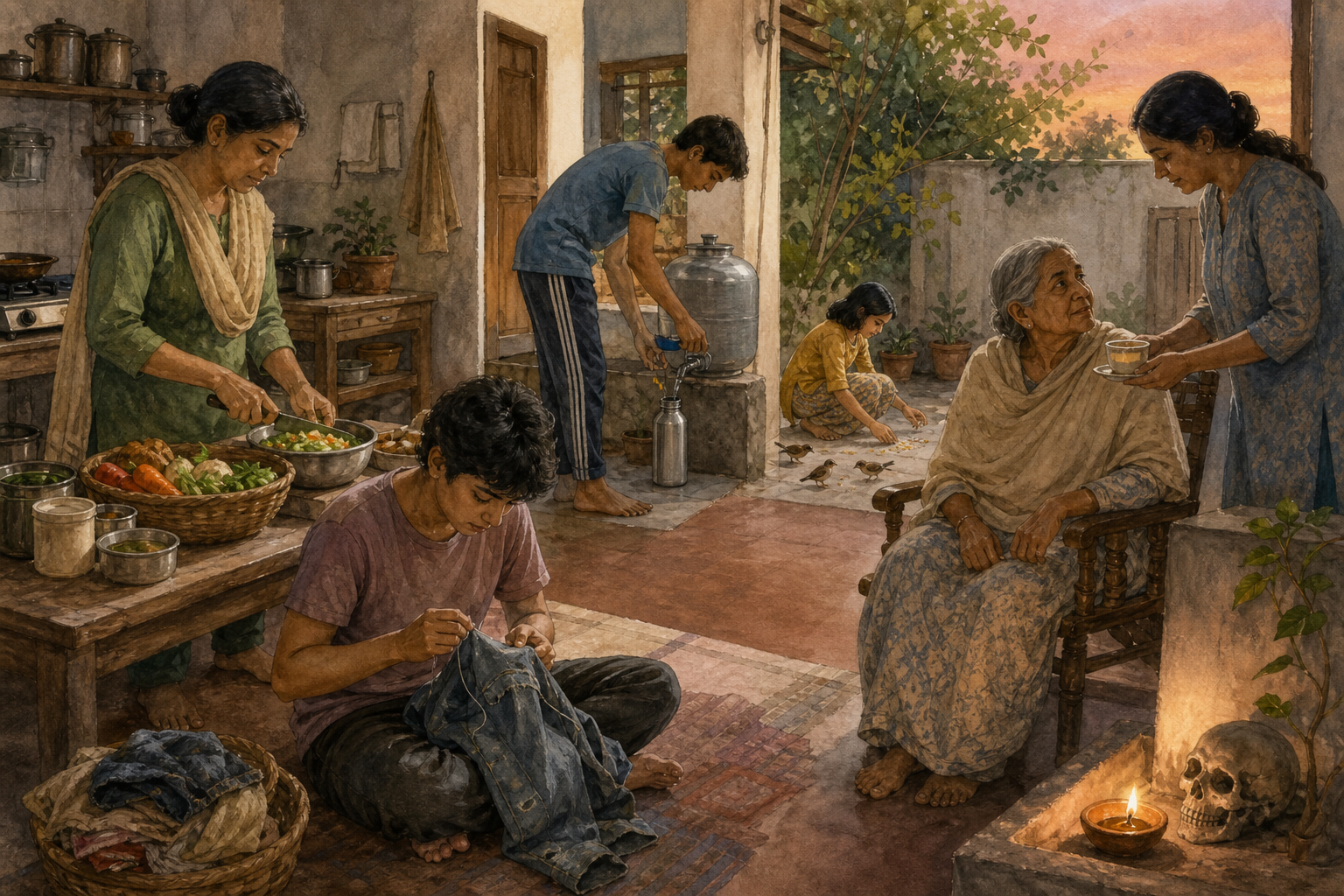
Sikh teaching redirects attention from spiritual display to sach, remembrance of nāmu, seva, humility, and just conduct. The householder’s path is not a diluted substitute for serious renunciation. Family, labor, community responsibility, and the response to injustice are where interior discipline becomes visible.
This comparison should never be used to sneer at religious form. A form may carry discipline, memory, and commitment. The narrower claim is that form by itself cannot certify liberation. Ask what remembrance changes: Does it make speech more truthful? Does it make service less self-congratulatory? Does it produce courage in the face of injustice? If not, the emblem has outrun its ethical purpose.
Apply the skull-bowl test to a real disagreement
The Kapal-Muni motif yields a compact test you can use at a temple-gurdwara dialogue, in a classroom, around a family table, or before replying to an online claim. It turns comparison away from symbol collecting and toward accountable conduct.
- Ask what the symbol or practice means here. Let the relevant tradition define it. Is the subject mortality, devotion, non-attachment, generosity, remembrance, or something more specific? Do not begin with an assumed equivalence.
- Ask who benefits. If the encounter only raises the speakers’ status, displays their learning, or proves that one framework can absorb all the others, ego remains in charge. Name the person, community, or form of life that the resulting action should serve.
- Ask where the insight will be tested. Move from the ceremonial setting to ordinary responsibility. Identify the truthful statement that must be made, the avoidable harm that must stop, the attachment that can be loosened, or the act of service that will follow.
A reliable sentence pattern for difficult conversations is: We do not hold the same doctrine about this point. We do recognize a shared duty toward this ethical aim. We can cooperate on this action without asking anyone to misstate their tradition.
If someone insists that all four traditions are simply the same, preserve the relationship while correcting the claim. Name the ethical convergence, then name the doctrinal boundary. If someone insists that doctrinal difference makes cooperation impossible, reverse the sequence: acknowledge the difference, then ask whether it prevents truthful speech, non-harm, compassion, restraint, or service in the situation at hand.
Notice when dialogue is becoming another performance of ego
Pause the conversation when any of these patterns appears:
- One participant explains another tradition while its own adherents are expected only to agree.
- A shared value is treated as proof that metaphysical differences are unreal or unimportant.
- A skull, mantra, icon, or sacred term is admired for its atmosphere while its discipline is ignored.
- Polite disagreement is condemned as hostility, making honest speech impossible.
- The gathering produces photographs and declarations but no identifiable service, restraint, generosity, or repair.
When this happens, return to one tradition-specific term and one concrete ethical consequence. Ask the Sikh participant what seva requires in this case, the Jain participant what ahimsa forbids, the Buddhist participant how compassion is obstructed by clinging, or the Hindu participant how bhakti or viveka changes the response. The aim is not to force uniform answers. It is to make every answer answerable to conduct.
Keep the skull-bowl symbolic unless you are working within an established tradition that authorizes a specific practice. The lesson does not require obtaining human remains, imitating transgressive asceticism, or borrowing ritual objects. For most readers, mortality is already present in grief, aging, illness, and the knowledge that every possession will eventually leave its holder. That recognition is sufficient material for ethical self-examination.
Key takeaways
- Kapal-Muni is safest treated as a teaching motif unless a particular textual identity and recension have been established.
- Kapal and Kapila are not interchangeable names; check the wording and context before drawing conclusions.
- Shared Dharmic ethics does not require shared theology. Preserve differences in doctrine, discipline, and sacred vocabulary.
- Hindu bhakti and Śaiva ascetic symbolism, Buddhist Vajrayāna, Jain non-harm, and Sikh remembrance and seva approach transformation through distinct paths.
- The common ethical test is demanding: truthfulness, ahimsa, non-attachment, compassion, humility, and service must become visible in ordinary conduct.
- A dialogue that increases pride, appropriates symbols, or benefits no one has failed the very lesson the skull-bowl is meant to teach.
Before your next Dharmic encounter, write down the real doctrinal difference, the ethical restraint you are willing to accept, and the action you can share. Bring those into the room. If the exchange makes everyone more truthful and someone beyond the speakers is served, the bridge is carrying weight. If it merely gives ego a more sacred costume, set the costume aside and begin again with conduct.