
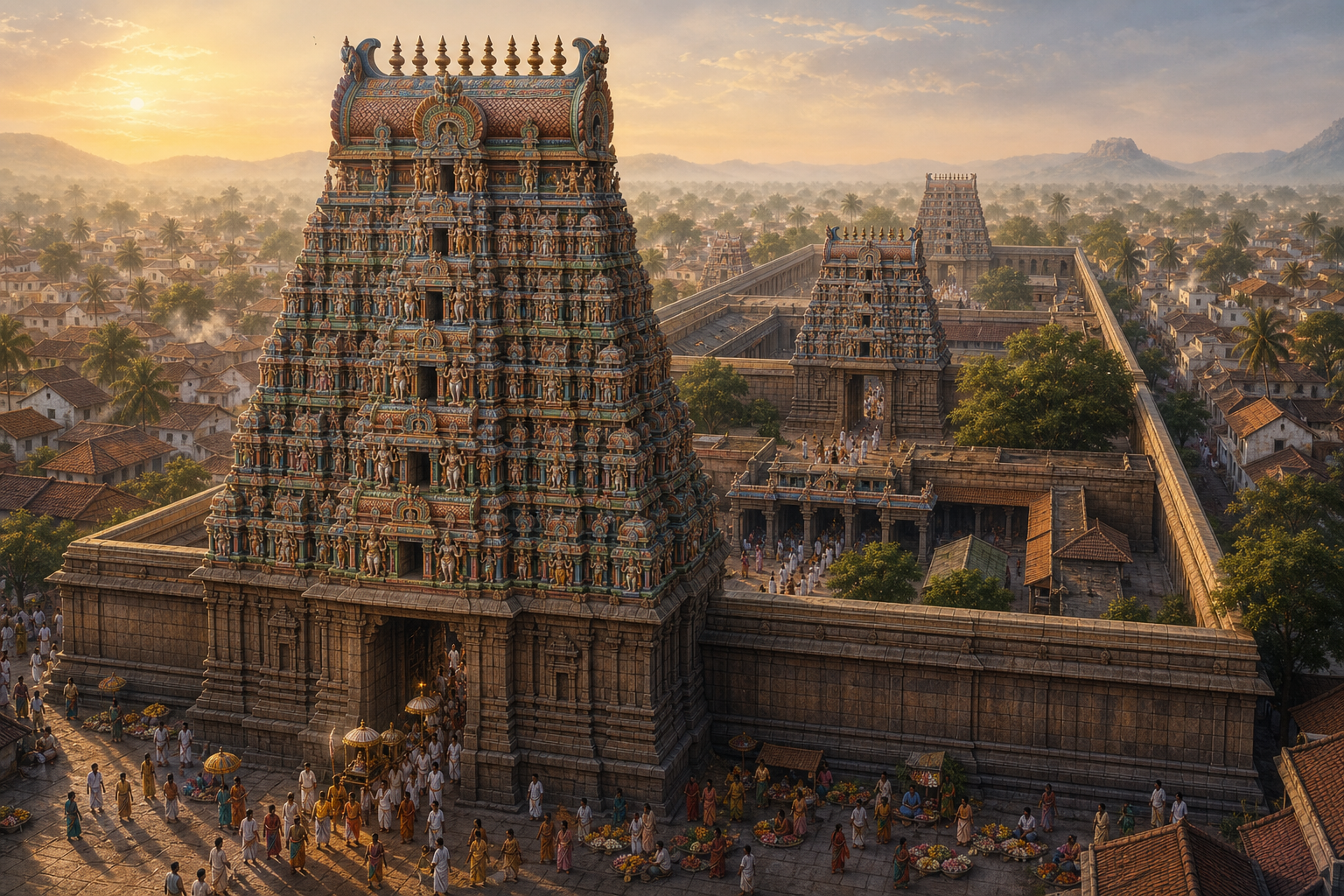
You can stand beneath a South Indian temple gateway, photograph hundreds of sculpted figures, and still miss what the architecture is telling you. The decisive clue is not the brightest colour or the largest deity. It is the gateway’s place in the temple plan.
Once you learn to check position, scale, construction, imagery, and ritual movement in that order, a gopuram becomes legible. You can distinguish an outer civic landmark from a processional gateway and an intimate threshold near the sanctum without reducing all three to variations of a tall, decorated tower.
Begin with the enclosure, not the sculpture
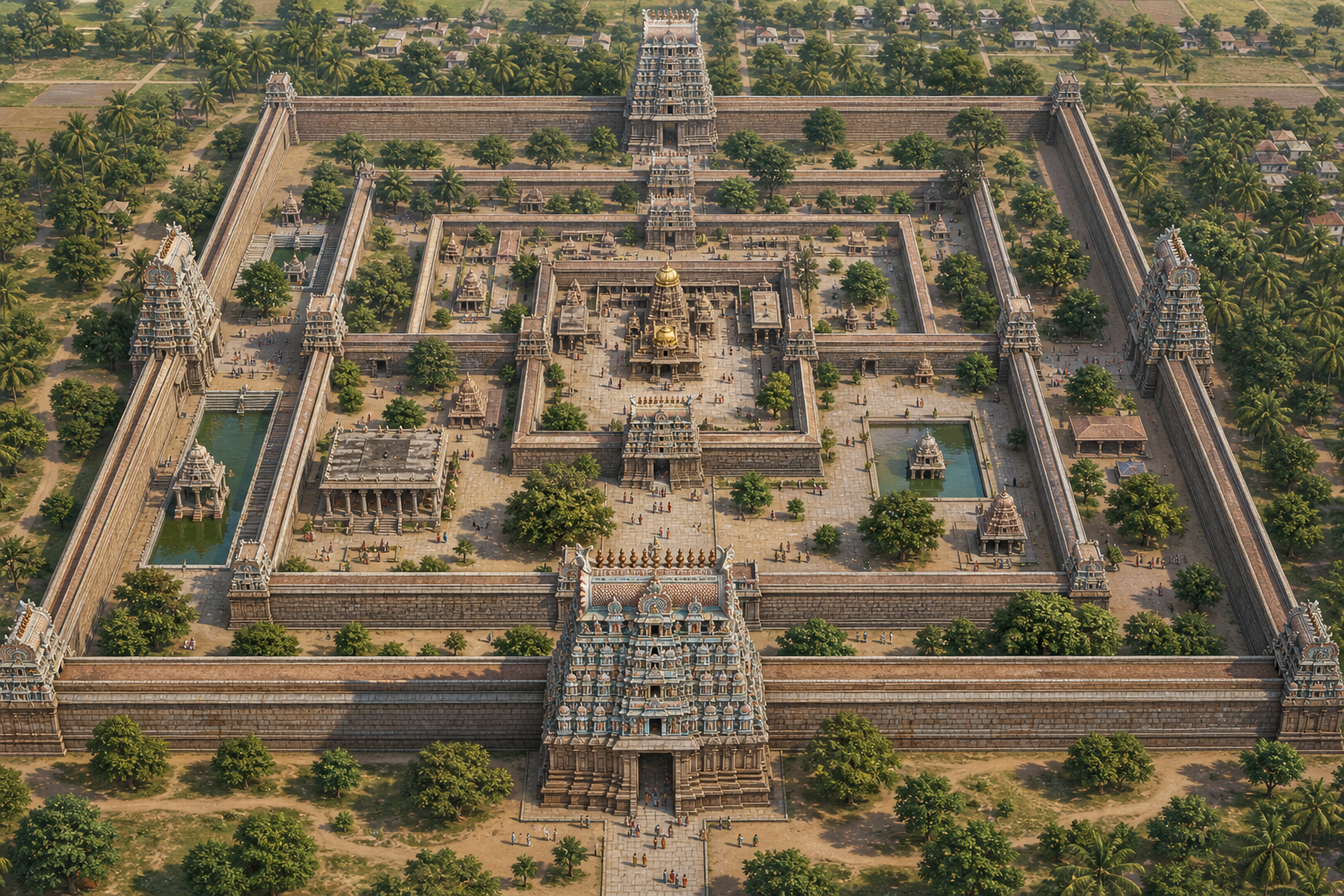
A gopuram, also written gopura, is a monumental gateway associated especially with the Dravida temple tradition. It pierces the wall of a prakara, or sacred enclosure. In a temple with several concentric prakaras, its position tells you which kind of threshold you are approaching.
Before looking upward, locate the sanctum and the enclosure wall through which the gateway passes. Then use the three principal positional types as your first reading key.
| Gateway type | Position | Typical architectural character | What it does |
|---|---|---|---|
| Inner gopuram | Near the sanctum | Modest height, fewer talas, restrained imagery | Concentrates attention before deeper entry |
| Intermediate gopuram | Between inner and outer enclosures | Taller profile and denser sculptural registers | Supports gathering, processional movement, and ritual pauses |
| Raja gopuram | At the outermost boundary | The tallest and most publicly commanding gateway | Announces the temple to the town and joins civic space to sacred space |
This classification is relational. A tower is not a raja gopuram merely because it looks grand in a tightly framed photograph. It must occupy the outermost threshold and perform the public role associated with that boundary. Likewise, a smaller inner gateway is not architecturally incomplete. Its restraint suits a different stage of the devotee’s approach.
The sequence also corrects a common visual assumption. Monumentality does not simply increase as you approach the sanctum. In many large complexes, you first encounter the most conspicuous gateway from the street. The architecture then becomes more intimate as your movement turns from public arrival toward focused worship.
Read the elevation from its stone base to its sacred crown
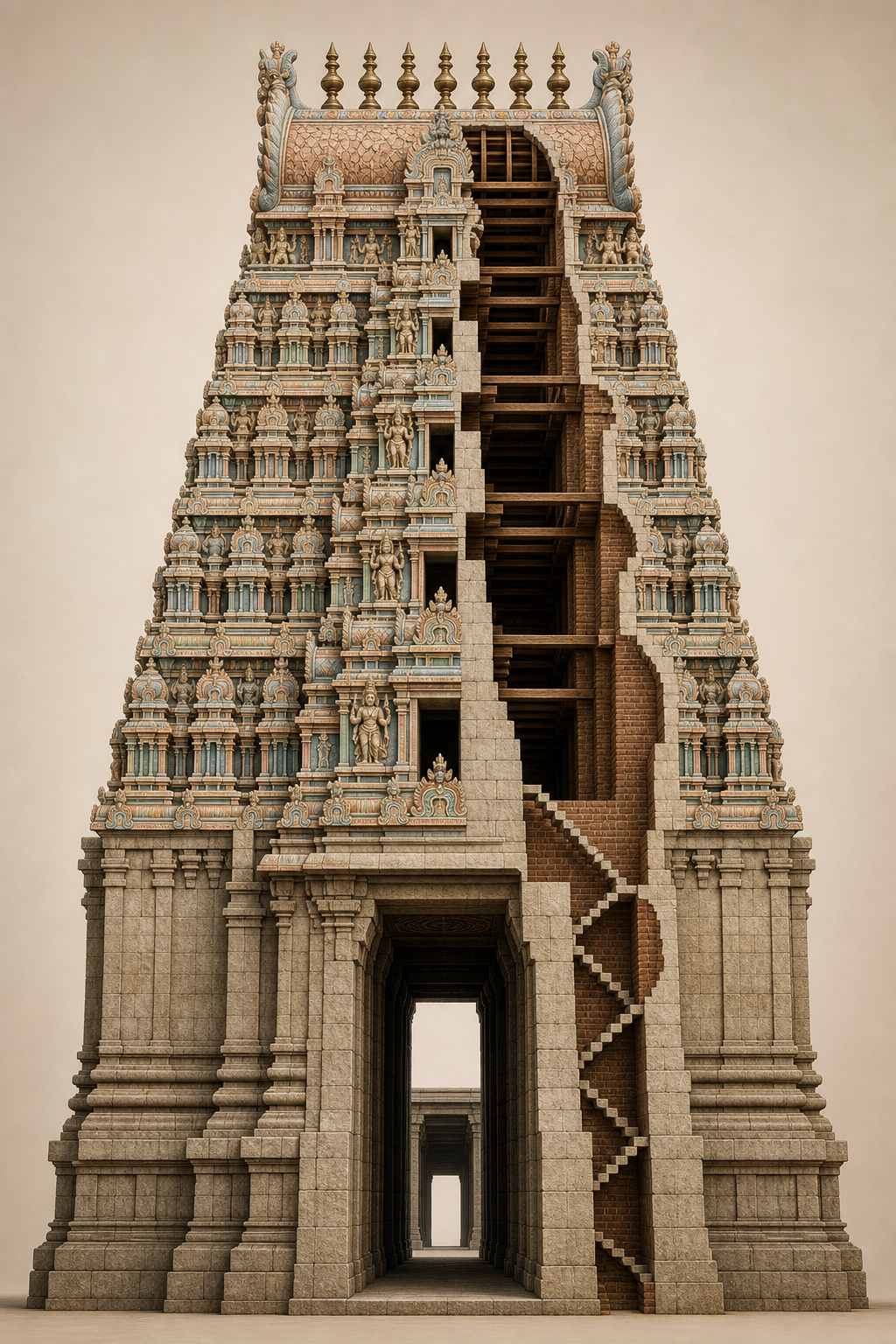
After establishing the gateway’s position, read its elevation from bottom to top. This keeps sculptural abundance from obscuring the underlying architecture. A useful five-pass method works both on site and when examining a clear frontal photograph.
- Find the base. Look for the heavy lower courses and the opening through the enclosure wall. Granite commonly gives this zone its visual weight.
- Examine the threshold imagery. Dvarapalas, lotus bands, and makara-toranas often emphasize protection and auspicious passage, particularly in more restrained inner gateways.
- Follow the talas. These rising tiers establish the stepped rhythm of the superstructure. Read their repetition before trying to identify individual figures.
- Notice the architectural modules. Kuta and sala motifs, together with pilasters, kapotas, bhadras, and panjaras, organize the surface. They prevent the facade from becoming an undifferentiated mass of sculpture.
- Locate the crown. Kalasa finials complete the upward movement and make the summit legible against the sky.
The contrast between a substantial stone base and a brick-and-stucco superstructure is especially important. It explains how a gateway can feel firmly rooted below while becoming progressively lighter, more repetitive, and more image-filled above. Rather than seeing structure and ornament as competing elements, notice how the structural divisions give every sculptural register a place.
If you are making a visual record, take one permitted view from far enough away to preserve the complete silhouette. Then trace one vertical line from base to finial and one horizontal tala across the facade. Those two readings usually reveal more architectural order than a collection of isolated close-ups.
Let ritual movement explain the differences in scale
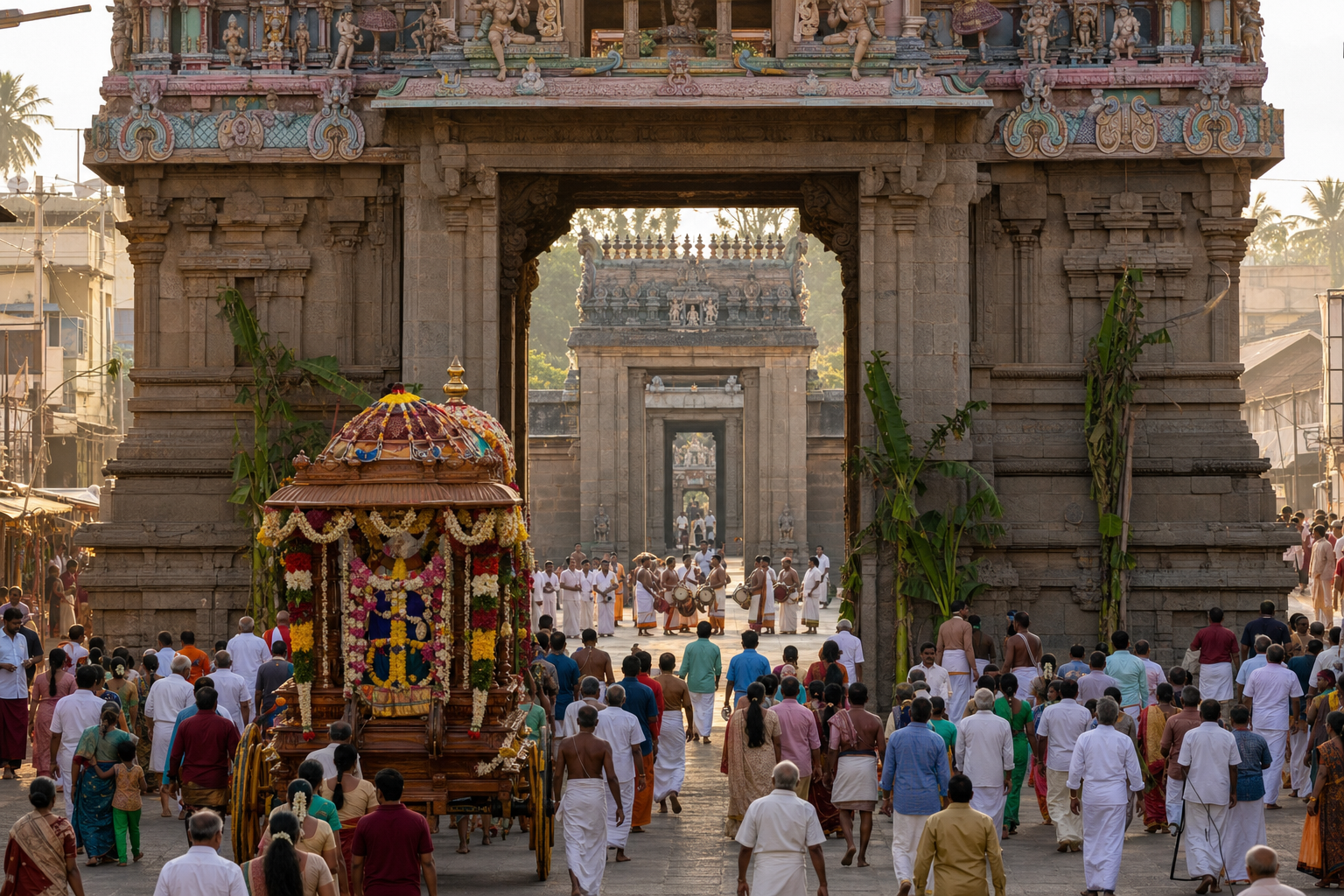
A gopuram is not only an object to be viewed. It is an opening through which people gather, pass, pause, chant, and move in procession. Its meaning therefore becomes clearer when you study the spaces on both sides of it.
At a raja gopuram, turn toward the town before turning toward the temple. Ask whether a street, market route, or public axis meets the gateway. The great outer towers of Srirangam, Madurai, Chidambaram, and Srivilliputhur demonstrate how a raja gopuram can anchor both the skyline and the surrounding civic geography. Its scale speaks beyond the enclosure because its audience includes the wider community.
At an intermediate gopuram, look for the relationship between passage and open space. Its greater height, multiplied narrative panels, ganas, and celestial motifs suit the communal rhythm of festivals and processional circulation. The gateway does not merely mark where a wall has been opened; it helps arrange movement and creates a recognizable place for collective ritual.
At an inner gopuram, resist expecting a smaller version of the outer spectacle. A modest profile and a more selective iconographic program can redirect the eye and mind. Guardians establish the seriousness of entry, while auspicious motifs frame the transition toward the sanctum. The reduction in scale is part of the instruction: public proclamation gives way to inward attention.
You can test this reading by walking the main axis without rushing. At each gateway, pause where local practice permits, face outward once, and then face inward. Notice who can see the tower, how many people the adjacent space can hold, and whether the imagery feels proclamatory, narrative, or protective. During worship or a procession, observation must yield to ritual movement; do not occupy the passage to obtain a better view.
This threshold logic also offers a careful way to compare Dharmic traditions. Some Jain temples in South India use comparable gateway fronts, while Buddhist toranas express a related idea of meaningful passage through a formally different structure. The useful comparison lies in what crossing the threshold asks of the participant: attention, ethical orientation, and readiness to enter sacred space. It should not be used to pretend that the architectural forms or religious traditions are identical.
Use historical style as a clue, not a date stamp
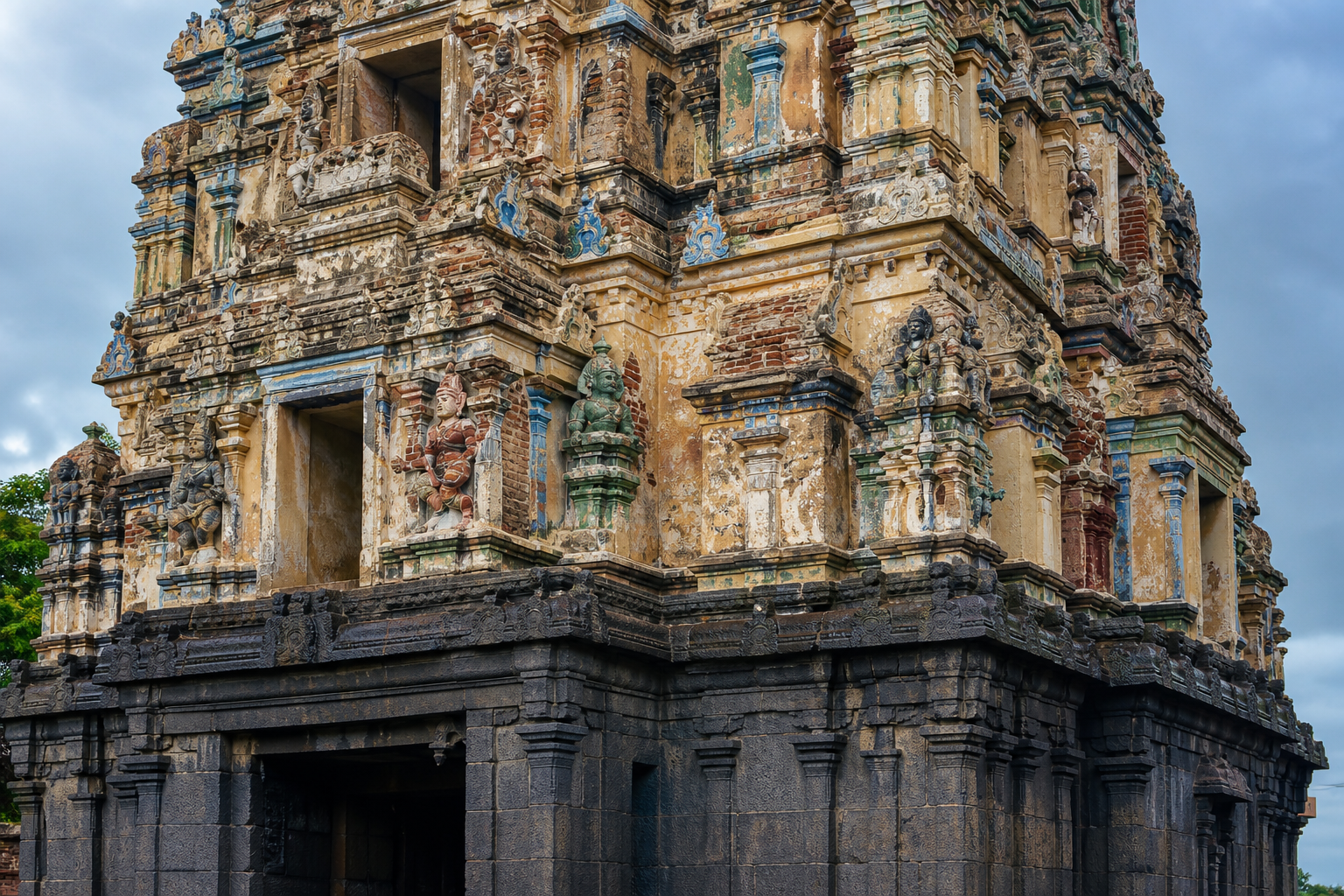
Height alone will not tell you when a gateway was built. The historical pattern is broader: early Chola gateways tended toward disciplined profiles and structural clarity, while Pandya, Vijayanagara, and Nayaka patronage increasingly amplified scale, surface narrative, and the public presence of the raja gopuram.
Brihadeeshwara Temple and Gangaikondacholeesvarar Temple help you recognize the Chola preference for architectural order. In the later trajectory, colossal brick-and-stucco superstructures become increasingly prominent, with repeated tiers and extensive sculptural fields turning the outer gateway into a dominant landmark. This change in architectural emphasis accompanied the temple’s widening communal role in education, art, service, and festival life.
When you are trying to place a gateway historically, record four observations separately: its position in the prakara system, the relationship between stone base and superstructure, the discipline or abundance of its profile, and the density of its narrative program. Only then compare the combination with the broad period tendencies. This prevents the easy but unreliable conclusion that the biggest or most crowded-looking tower must be the oldest, the holiest, or the most architecturally important.
The same caution applies to colour and surface detail. They may dominate your first impression, but the gateway’s deeper grammar survives in its tiers, modules, threshold, and placement. Start with those durable relationships before interpreting individual images.
Key takeaways for your next temple visit
- Locate the prakara first. Gateway type depends primarily on where the structure stands in relation to the sanctum and outer boundary.
- Do not equate size with sacred importance. The raja gopuram is tallest because it addresses the temple town as well as the enclosed precinct.
- Read from structure to sculpture. Begin with the base, talas, architectural modules, and finials before identifying narrative figures.
- Treat movement as evidence. Streets clarify the role of the outer gateway; gathering and processional space clarify the intermediate gateway; concentrated entry clarifies the inner gateway.
- Expect restraint near the sanctum. A smaller inner gopuram can express deliberate intimacy rather than diminished significance.
- Use period labels carefully. Chola clarity and later Pandya, Vijayanagara, and Nayaka amplification are useful tendencies, not a substitute for examining the whole structure.
On your next visit, stop before you pass beneath the first tower. Identify the wall it opens, read the elevation from stone base to kalasa, and notice how the surrounding space expects you to move. Crossing the gateway will then become more than arrival: you will be following an architectural progression from the life of the town toward the stillness of the sanctum.
References
