

If you serve on a temple committee, manage prasad, coordinate volunteers, or donate to a temple-linked institution, the difficult question is not whether security matters. It is how to strengthen security without making worship feel hostile, turning volunteers into amateur investigators, or treating an allegation as permission for collective blame.
You need two protections at once: controls that make harm harder, and conduct that keeps institutional trust intact. The practical answer is to secure processes, assign responsibility, train people to report observable conduct, and communicate only what has been verified.
Protect the entire chain, not only the temple gate

An alleged plan to contaminate prasad at major temples across India was disrupted by Gujarat ATS, leading to three arrests while investigation and inter-state coordination continued. The allegation is disturbing because prasad depends on a form of trust more intimate than ordinary food service. A devotee receives it as a consecrated offering, often shares it with children and elders, and normally has no reason to question its custody.
A visible guard at the entrance cannot protect that trust by himself. Prasad passes through a chain: supplies arrive, ingredients are stored, preparation takes place, vessels move between spaces, the offering is held, and distribution begins. Every handoff can be well controlled or left ambiguous. Your first security task is therefore to map the actual chain used in your temple, including festival days, outside catering, donated ingredients, and overflow distribution points.
- Write down each custody point. Record where ingredients or prepared offerings are received, stored, prepared, transferred, held, and distributed. Do not rely on a routine that exists only in the memory of experienced volunteers.
- Name the responsible role at every point. Use a role such as kitchen supervisor, store custodian, transfer volunteer, or distribution lead. A shared duty with no named owner becomes nobody’s duty when an anomaly appears.
- Define who may enter or handle. Preparation areas, storage rooms, vessels, and waiting trays should not be open merely because someone is familiar to the temple. Access should follow an assigned function.
- Create an explicit release check. Before distribution, the designated person should confirm that the expected batch followed the expected route and that no unexplained substitution, damaged container, or unattended interval has been reported.
- Give every handler a stop-and-report route. A volunteer who notices something unusual must know whom to contact and must have authority to pause distribution without being pressured to avoid embarrassment or delay.
This does not require turning a sacred space into a fortress. It requires consistency. Standardized handling, trained volunteers, discreet surveillance near appropriate distribution points, and a clear escalation path can make the chain harder to compromise while preserving the temple’s welcoming character.
Surveillance should support custody, not replace it. Position it only where there is a legitimate safety need, tell responsible office-bearers which areas are covered, limit access to recordings, and preserve relevant footage when an incident is reported. Cameras should not intrude into spaces where privacy, ritual dignity, or confidential pastoral interaction is reasonably expected.
Train volunteers to report conduct, not identities

Poorly framed vigilance produces two failures. It overlooks routine-looking process violations, and it encourages suspicion based on a person’s name, clothing, language, caste, sect, or community. Neither makes a temple safer. A useful briefing gives volunteers observable triggers and a fixed response.
Ask volunteers to report conditions such as these:
- A person enters a restricted preparation, storage, or distribution area without an assigned role.
- A vessel, package, seal, label, or batch appears changed, damaged, replaced, or inconsistent with the normal handoff.
- Food or a ritual item is left unattended and then returned to the distribution flow without verification.
- Someone asks a handler to bypass the established route, skip the release check, or keep an irregularity quiet.
- A threat, coercive message, unexplained illness, or direct claim of tampering is reported.
The instruction that follows should be equally simple: do not confront unless immediate protection of life requires it; do not taste, smell, open, or conduct an improvised test on a suspicious item; prevent further use or distribution; notify the designated supervisor; and record what was directly observed. If anyone may be ill or exposed, contact emergency medical services and the appropriate authorities rather than attempting an internal diagnosis.
Give public-facing volunteers neutral language they can use under pressure: “This batch needs supervisor verification before distribution.” That sentence protects people without announcing an accusation. It also prevents a volunteer from improvising a communal explanation for an event that may have an ordinary cause.
Training should include a boundary as well as a duty. A report concerns an action, access failure, object, message, or inconsistency. It is not a licence to search people arbitrarily, circulate their photographs, question their patriotism, or infer guilt from religious identity. Attempts to harm devotees can also seek to provoke social fracture. Refusing collective blame is therefore part of security discipline, not an optional gesture after the danger has passed.
Handle a live concern in a fixed sequence
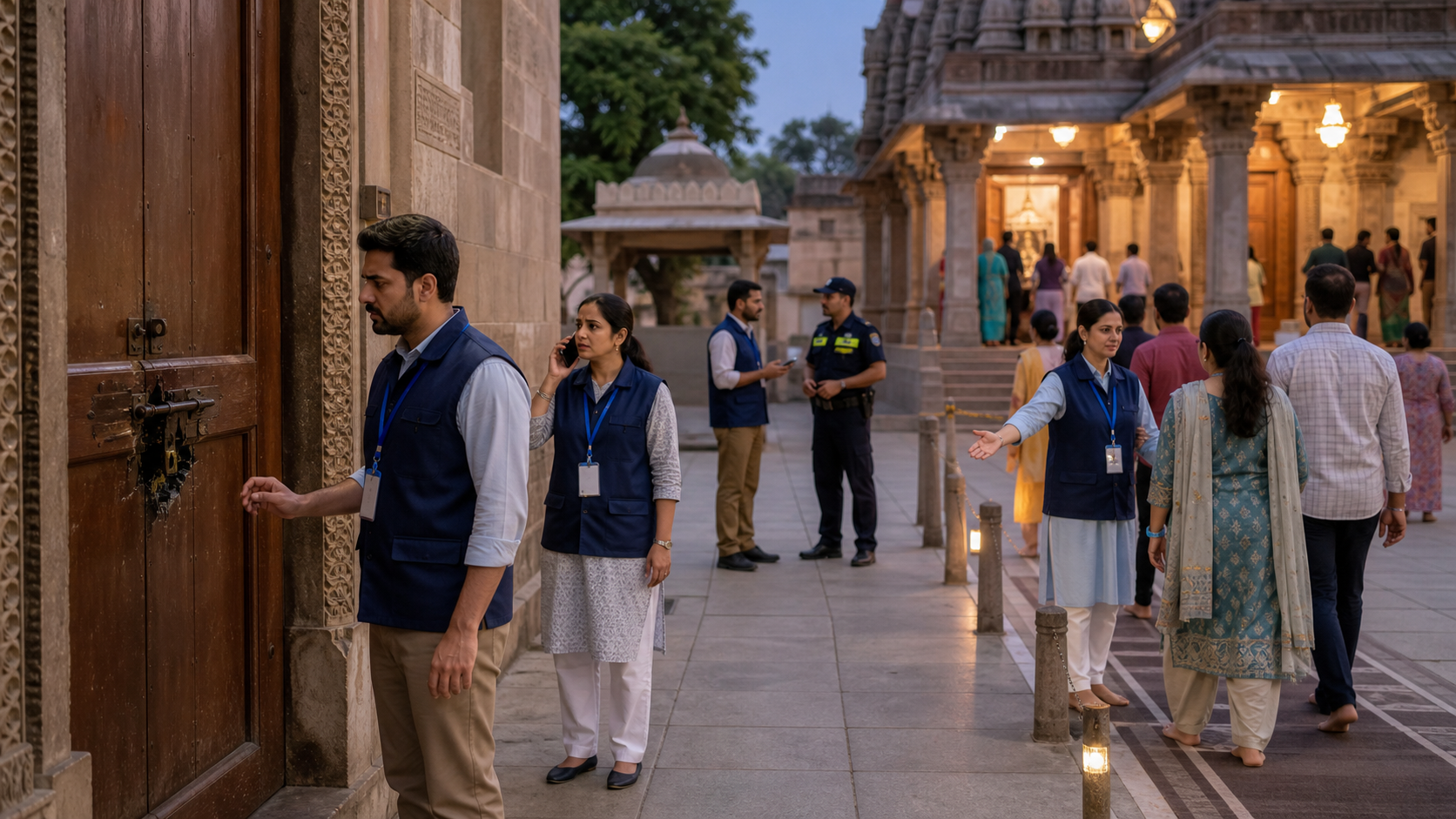
The first minutes of a concern are vulnerable to two opposite mistakes: carrying on because the committee fears panic, or making a public accusation before the facts are known. A written sequence keeps safety ahead of reputation management while preserving evidence and due process.
- Stop the affected activity. Pause distribution or access to the item, location, batch, or service in question. Do not shut unrelated temple functions unless the nature of the concern requires it.
- Protect people. Move devotees away from the affected area without creating a stampede or turning an unverified concern into a public spectacle. Obtain medical help immediately if exposure or illness is possible.
- Preserve the scene and records. Restrict further handling. Retain containers, packaging, access records, handoff notes, and relevant surveillance footage. Do not clean, discard, transfer, or publicly display possible evidence unless authorities direct otherwise.
- Escalate through the named route. Inform the temple’s incident lead and the appropriate local authority. A credible threat, suspected contamination, violent act, or medical emergency is not a matter for a committee to investigate privately.
- Separate facts from inferences. Record who observed what, where it occurred, what action was taken, and which authority was contacted. Keep assumptions about motive, identity, or affiliation out of the factual log.
- Issue a controlled public update. Tell devotees what has been confirmed, what precaution is in place, and where the next verified information will appear. Correct material errors openly when better information becomes available.
A useful initial notice might state that distribution from a particular area has been paused after a safety concern, that the relevant authorities have been informed, and that devotees should rely on updates from the temple’s designated channel. It should not speculate about a substance, suspect, motive, or community. Nor should it reveal details that could compromise an investigation or expose a security weakness.
One spokesperson should coordinate with investigators, medical responders, and temple leadership. Other office-bearers and volunteers should be asked not to provide unofficial accounts. This is not secrecy. It is a way to prevent contradictory messages, protect due process, and keep rumours from becoming a second incident.
After the immediate danger has been addressed, review the process rather than searching for a symbolic culprit. Ask where custody became unclear, whether a volunteer knew how to stop distribution, whether the escalation route worked, what evidence was preserved, and what public statement caused confusion. Someone independent of the failed control should participate in that review. Publish the corrective action at a level that demonstrates accountability without advertising exploitable operational details.
Trust does not require a claim that nothing went wrong. It requires visible proof that the institution can detect a problem, protect people, cooperate with lawful investigation, correct its procedures, and distinguish an allegation from a verdict.
Make temple-funded service auditable without making it sectarian

Physical security is only one layer of temple-linked trust. Donations may also support education, healthcare, scholarships, and social services. Allegations that medical professionals reportedly educated through donations from Mata Vaishno Devi devotees were later implicated in the Delhi blasts caused anguish because the controversy appeared to reverse the purpose for which devotees had given. The allegations still require investigation and due process; moral outrage cannot substitute for an adjudicated finding.
A temple cannot guarantee every future decision made by every beneficiary. It can control how recipients are selected, what obligations are disclosed, how conflicts are managed, how professional ethics are reinforced, what service is documented, and how credible misconduct allegations are handled. That is the proper boundary between accountability and impossible promises.
| Trust question | Institutional control | Evidence the committee should retain |
|---|---|---|
| Why was this person or institution funded? | Published eligibility and selection criteria, conflict-of-interest disclosure, and review by more than one decision-maker | Application, assessment record, declared conflicts, approval, and reasons |
| What was the donation meant to achieve? | A written purpose, permitted use of funds, and clearly disclosed conditions | Grant or scholarship terms, accepted budget, and acknowledgement by the recipient |
| How is dharmic service expressed? | Ethics formation, mentorship, professional duty of care, and any lawful service commitment agreed before funding | Training completion, mentor record, and service reporting appropriate to the programme |
| How can concerns be raised safely? | A confidential reporting route with protection from retaliation and a defined escalation owner | Complaint log, preservation record, referral decision, and access-controlled case file |
| What happens after a serious allegation? | Proportionate interim safeguards, cooperation with authorities, independent review, and a reasoned outcome | Chronology, evidence received, actions taken, review findings, and correction notice where appropriate |
Rigorous vetting should examine eligibility, credentials, conflicts, prior conduct relevant to the role, and the recipient’s ability to meet the programme’s stated obligations. It should not pretend to predict private belief or treat community identity as evidence of future wrongdoing. Screening that abandons fairness will create grievance without creating reliable security.
Service commitments also need care. If a scholarship includes a period of work in a temple town, pilgrim-support programme, charitable hospital, or other defined service, the commitment should be written clearly before funds are accepted. Any repayment term, restriction, or sanction should be reviewed by qualified local counsel for legality and fairness. A committee should never invent a penalty after an allegation arises or apply one retrospectively.
The ethical centre must remain universal. A doctor supported by Hindu devotees does not owe care only to Hindu patients. Professional duty extends to every person. The dharmic force of the arrangement lies in seva, ahimsa, compassion, and responsibility, not in sectarian preference. The same principle is recognisable across Hindu, Buddhist, Jain, and Sikh institutions.
When misconduct is alleged, separate the beneficiary, the programme, and the wider community. Investigate the individual claim. Audit whether the programme’s controls operated. Repair any institutional failure. Do not convert one person’s alleged conduct into a judgment on every student, doctor, donor, religious group, or educational institution connected by association. Justice becomes weaker, not stronger, when the circle of blame expands beyond the evidence.
Key takeaways
- Map the complete prasad chain, assign a responsible role at each handoff, and give handlers authority to stop distribution when custody becomes uncertain.
- Train volunteers to recognise access violations, unexplained substitutions, damaged containers, unattended items, threats, and reports of illness. Do not train them to profile communities.
- When a concern arises, protect people, preserve evidence, notify the proper authorities, and separate confirmed observations from assumptions about motive.
- Communicate the precaution being taken without naming an unconfirmed substance, suspect, affiliation, or community.
- For temple-funded education and service, document selection, purpose, ethics formation, mentorship, reporting, complaints, and the response to serious allegations.
- Apply due process to individuals and accountability to institutions. Collective blame satisfies neither security nor dharma.
At your next committee meeting, choose one public-facing process and walk it from beginning to end. For each handoff, name the custodian, the condition that stops the process, the person who receives the report, and the message devotees will hear. Then apply the same discipline to one scholarship, hospital partnership, or grant programme.
A secure temple is not one in which everyone is treated as a threat. It is one in which responsibility is clear enough that a devotee can receive prasad without fear, a volunteer can report an anomaly without prejudice, and a donor can see that sacred resources are governed with both vigilance and dharma.
References
- DharmaRenaissance Blog – Gujarat ATS Foils Temple Prasad Poisoning Plot, Safeguarding Devotees and Dharmic Unity
- DharmaRenaissance Blog – Shocking Allegations: Temple-Funded Doctors and Delhi Blasts – Lessons for Ethics and Unity
