
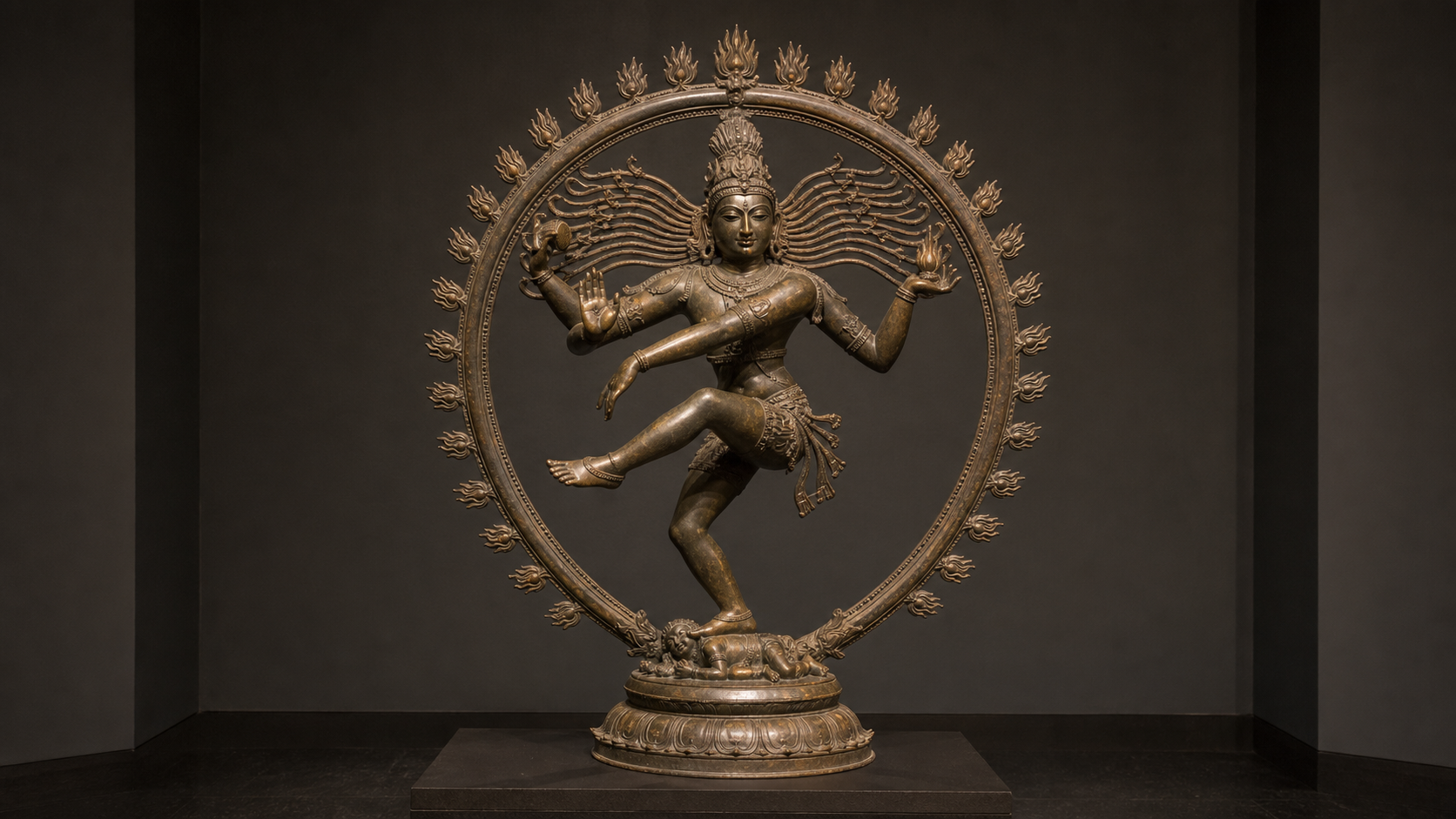
You recognize the deity on the museum label, but the image still feels unreadable. Why is one hand open while another holds a weapon? Is the figure blessing, fighting, dancing, or doing all three at once? If an object has broken away, can the remaining posture still tell you what was there?
You can answer most of those questions without memorizing an encyclopedia of mudras. Read the sculpture as a coordinated body: stance, gaze, hands, attributes, companions, and setting work together. The hand matters, but its meaning emerges from the whole composition.
Begin with four questions before naming the deity
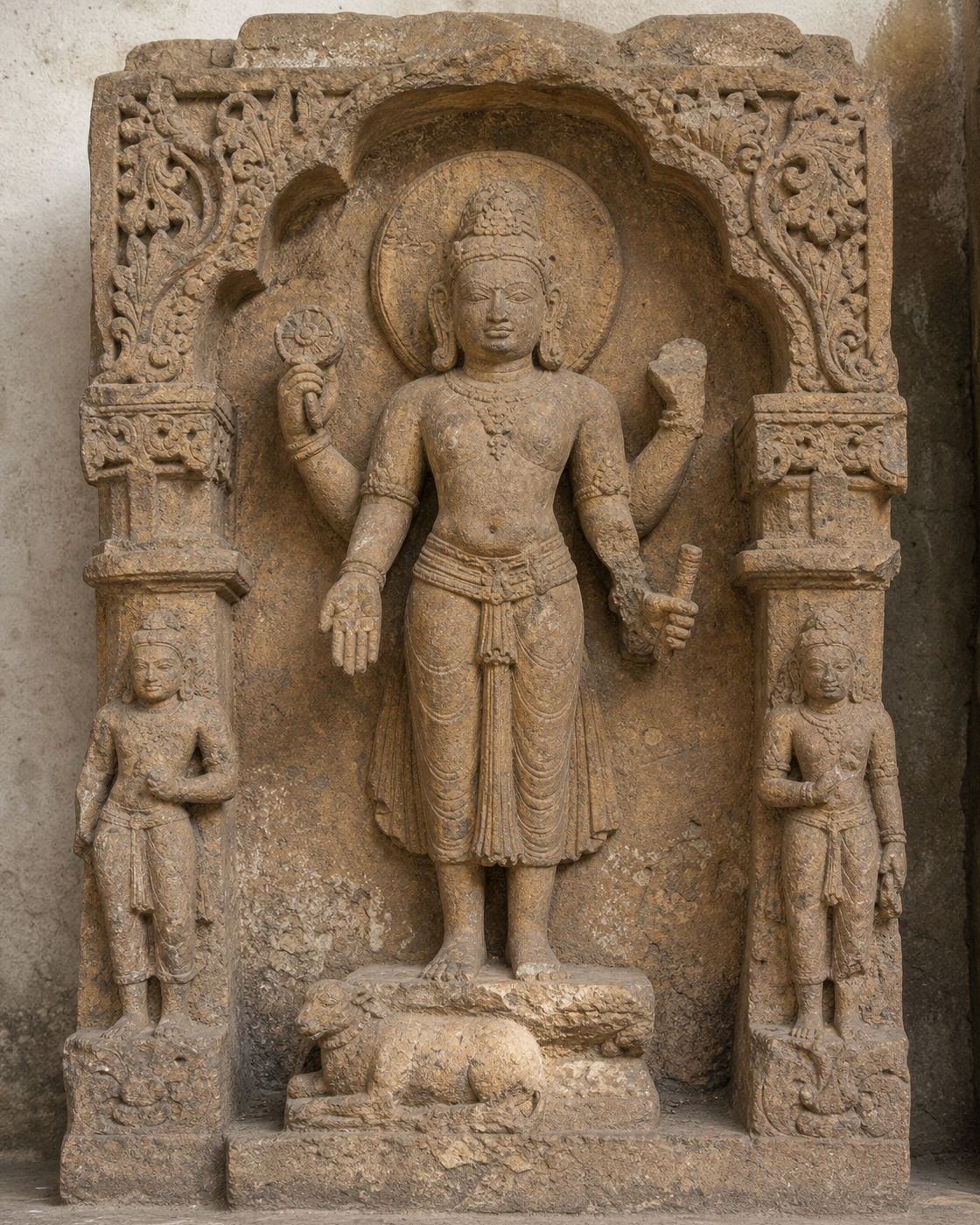
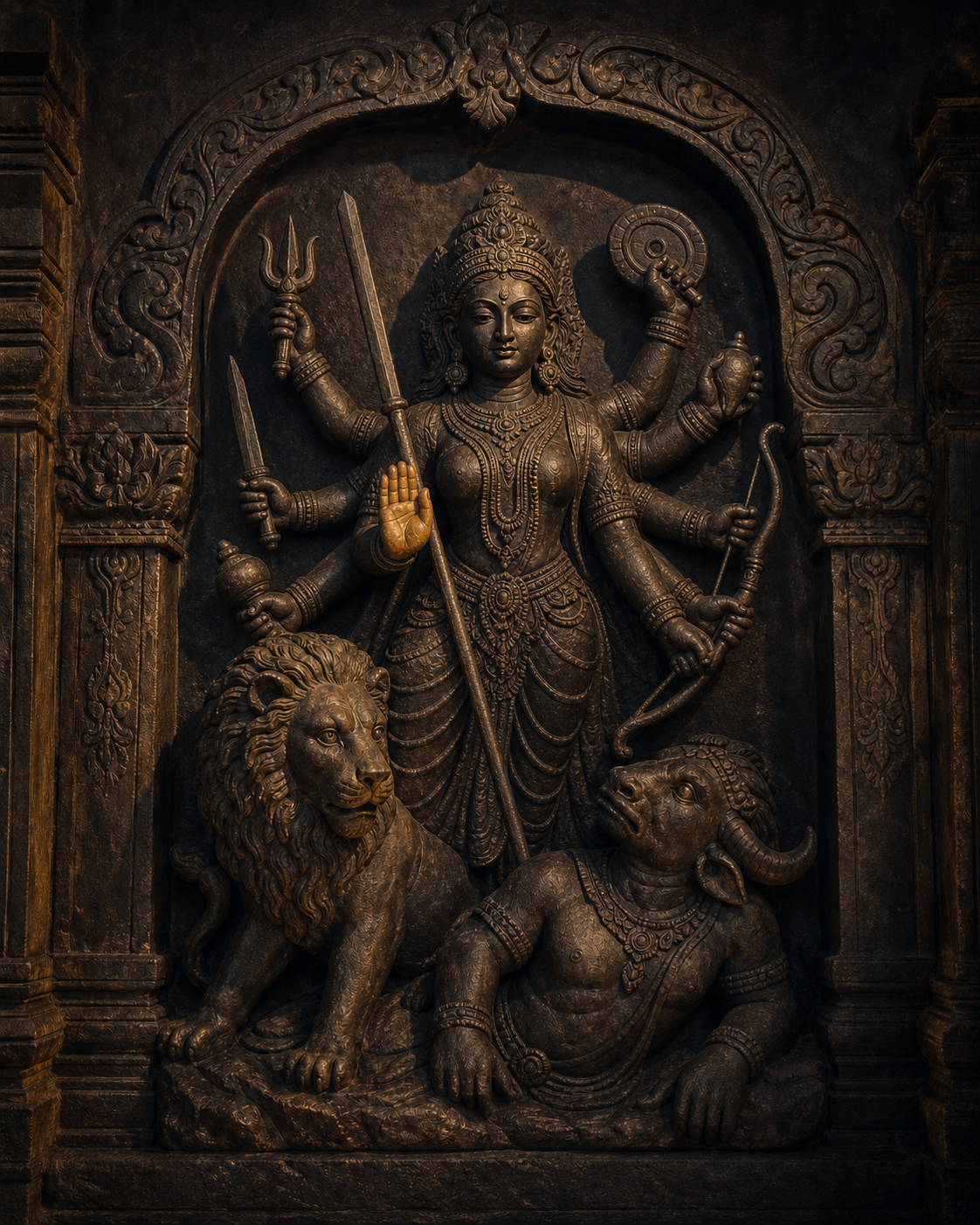
A common mistake is to identify a familiar object or hand shape and stop looking. A trident may narrow the field, an open palm may suggest reassurance, and a bow may point toward an archer. None of these clues should be interpreted alone. Hindu sculptural iconography works through clusters of signs.
| Layer | What to inspect | What it can establish |
|---|---|---|
| Body | Weight, stance, torso rotation, head angle, and gaze | Whether the figure is resting, dancing, aiming, guarding, or confronting |
| Hands | Palm direction, finger arrangement, arm level, and relation to the torso | Whether a hand reassures, grants, commands, grips an object, or completes an action |
| Attributes | Weapons, ritual implements, ornaments, crown, clothing, and number of arms | The deity’s identity, power, theological function, or narrative episode |
| Surroundings | Vehicle, attendants, pedestal, aureole, architecture, and neighboring figures | The ritual role, location, mood, and larger story to which the image belongs |
Start by describing what is physically visible. Write or say: the upper hand is open with its palm facing outward; the lower hand grips a damaged shaft; the torso turns toward that shaft; the eyes follow the same direction. This keeps observation separate from interpretation. Only after that should you propose abhaya, a weapon, or an archery scene.
Be precise about right and left. Catalogues normally describe the figure’s right and left, not yours as you face it. A reversed description can make an otherwise careful identification useless, especially in a many-armed image.
Read from the whole body toward the fingertips
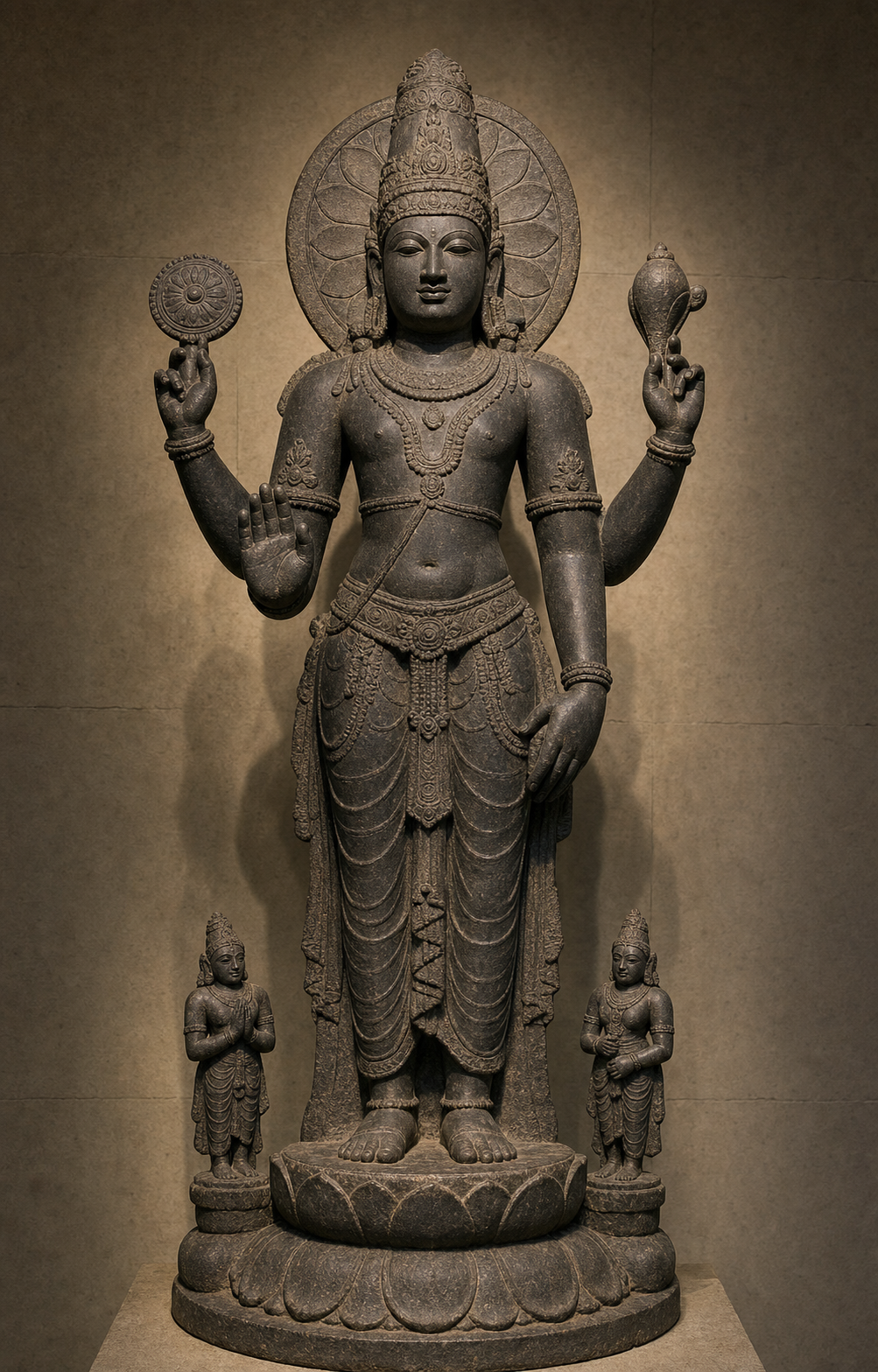
The most dependable reading order moves from large, durable forms to small, vulnerable details. Fingers, bowstrings, flames, and projecting weapons are easily damaged. The hips, shoulders, gaze, pedestal, and major arm positions often survive.
- Check orientation and condition. Decide whether you are seeing an independent icon, a figure from a narrative relief, or a fragment removed from a larger composition. Look for broken edges and deliberate sockets. In archery images, empty grips, attachment holes, mortises, and remnants of a quiver can preserve the logic of a lost bow or string. Do not treat every empty hand as an intentional mudra.
- Find the body’s axis. A quiet frontal body communicates differently from a figure whose hips and shoulders turn against one another. The dynamic ālīḍha and pratyālīḍha stances ground martial action, while utkutikāsana places the figure in a powerful squat. A dancing figure distributes force differently again. Ask where the weight lands and which direction the body could move next.
- Follow the gaze. The eyes may connect a deity to an opponent, devotee, weapon, attendant, or destination outside the surviving frame. In Akarṇa, the face and gaze follow the arrow’s intended line of flight. That alignment can remain readable after the arrow disappears.
- Trace each arm from shoulder to hand. Begin with the lowest or clearest arm, then proceed systematically. Note whether the elbow is relaxed, raised, drawn backward, or extended. A hand near the ear means something very different when the opposite arm pushes forward and the chest is under tension.
- Inventory attributes before interpreting them. Record the bow, sword, trident, drum, skull-cup, noose, goad, bell, fire, or other implement. Then ask how it is being used. A held object identifies capacity; an object integrated with posture identifies action. Named bows such as Śiva’s Pināka, Viṣṇu’s Śārṅga, Rāma’s Kodaṇḍa, and Arjuna’s Gāṇḍīva can turn a general archer into a particular divine or epic figure, but only when the rest of the image supports the identification.
- Inspect the vehicle, attendants, base, and backplate. A dog at the feet of Bhairava is not incidental decoration. Cremation-ground imagery, skull motifs, jackals, flames, and attendant beings can establish a fierce, liminal setting that the central hands alone cannot explain.
- Assign mood last. Heroic energy, fierce intervention, and tranquil resolve can use related bodily mechanics. A drawn bow may convey vīra, raudra, or śānta depending on the figure, target, expression, and narrative. Meaning comes from the relationship among the signs, not from the pose in isolation.
This order prevents a particularly damaging misreading. Suppose a figure carries a sword and skull-cup but also raises an open palm. If you stop at the weapons, you may call the image violent. If you notice the reassuring hand, alert vehicle, flame aureole, and shrine position, a protective function becomes visible. Fierce Bhairava imagery can place refuge and corrective force in the same body.
Decide whether the hand is a mudra, a grip, or an action
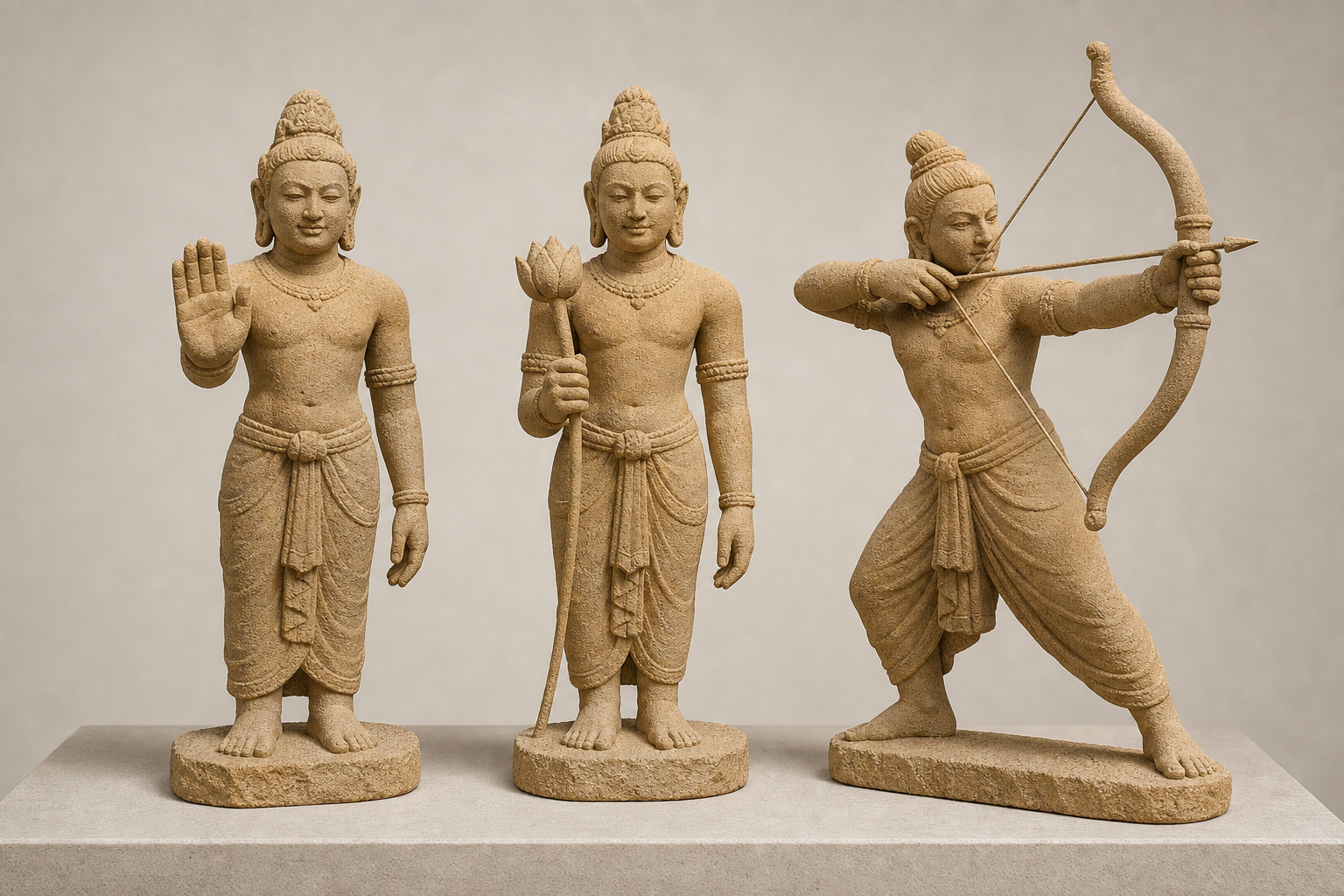
The word mudra is often used too loosely. It may refer to a codified hand sign, but viewers also apply it to any memorable hand position. For sculpture, it is more useful to distinguish three possibilities: a semantic gesture that communicates directly, an instrumental grip shaped by an object, and a full-body action in which the hand is only one component.
Abhaya and varada qualify the entire image
Abhaya communicates freedom from fear, protection, or refuge through an open hand presented toward the viewer. Varada communicates granting, giving, or the offering of a boon, usually through a lowered open hand. Their importance is not confined to the arm that performs them. Each gesture tells you how to receive the deity’s other attributes.
This becomes decisive in an ugra, or fierce, form. A weapon shows the ability to cut, pierce, bind, burn, or subdue. Abhaya tells you toward whom that power is protective. Varada indicates that severity has not displaced grace. Bhairava images may combine abhaya or varada with an array of formidable implements, so terror and reassurance should not be forced into separate readings.
Check the palm and fingers before naming either gesture. If the hand is damaged, state the uncertainty. An arm raised to the expected level may support an identification, but a missing palm cannot prove which gesture it completed.
Akarṇa is an archer’s event, not an isolated hand sign
Akarṇa literally points to the draw toward the ear. Calling it a mudra is convenient, but the sculptural code includes the bow arm, drawing arm, shoulders, chest, hips, legs, face, and imagined line of the arrow. You are looking for stored movement: the instant after aim has formed but before release.
- The forward hand stabilizes the bow rather than simply displaying it.
- The drawing hand retracts toward the ear, producing visible tension across the shoulder girdle.
- The torso rotates enough to connect the opposing forces of pushing and drawing.
- The gaze continues the arrow’s path beyond the sculpture.
- The lower body absorbs that tension through a grounded, often ālīḍha-like stance.
The alignment matters more than the survival of the bowstring. If the forward wrist, retracted elbow, clavicles, hips, planted foot, and gaze all participate in one line of force, the missing implement can be reconstructed conceptually without pretending that the material evidence is complete. By contrast, a figure merely carrying a bow may lack the torso tension and backward draw that define Akarṇa.
The instrument changes the theological register. A martial bow can frame cosmic rectification, protection, or dharma-yuddha. A sugarcane bow and floral arrows redirect the same geometry toward attraction or the transformation of consciousness. Lalitā Tripurasundarī and Kāmadeva can employ this subtler archery vocabulary. The pose tells you that power is being aimed; the object, deity, and setting tell you what kind of power it is.
A shared visual grammar does not erase theological difference
The archer’s draw traveled widely through Dharmic art and performance. A flower-bow appears with Kurukullā in Tibetan Buddhist imagery; Sikh artistic memory uses the poised archer to express disciplined strength; Jain tīrthaṅkaras remain non-weapon-bearing even where attendant figures or hero-stone traditions preserve martial postures. Related archery mechanics also appear across Indian temple traditions and the Ramayana reliefs of Angkor.
Use such comparisons in two stages. First compare the mechanics: stance, draw, gaze, and line of force. Then restore the specific doctrinal and narrative context. Similar geometry can reveal cultural transmission without making the figures interchangeable.
Read fierce imagery as a system of protection
Fierce Hindu images are frequently flattened into one of two mistakes. They are treated either as evidence of a malevolent deity or as spectacular decoration with no disciplined meaning. Krodha Bhairava offers a better test: move outward from face to setting and ask how each layer contributes to guardianship.
- Face and hair: a dark or deep indigo complexion, three intense eyes, arched brows, visible fangs, wild matted hair, and a flaming aureole produce wakefulness rather than passivity. The image confronts you before you have time to domesticate it.
- Body and ornaments: a skull garland, bone ornaments, serpents, ash, and a tiger-skin garment place mortality in full view. These are not signs that death has defeated the deity; they mark sovereignty in the field where ordinary status and concealment collapse.
- Posture and hands: warrior stances, dance, or a tense squat show readiness. The trident, sword, drum, skull-cup, noose, goad, bell, and fire distribute different capacities among the arms. Abhaya or varada can quietly establish the protective direction of all that force.
- Vehicle and terrain: the alert dog reinforces Bhairava’s role as guardian of the precinct. Cremation imagery, jackals, funerary motifs, and attendant beings place that guardianship at the boundaries people ordinarily fear to approach.
- Architecture and light: a shrine near a gateway, corner of an enclosure, or other threshold makes boundary-keeping spatial. A segmented ring of flames acquires movement when illuminated by oil lamps, allowing the surrounding ritual environment to complete the sculpture’s visual action.
Do not turn that description into a rigid checklist. Four-armed Krodha Bhairava images are frequent in stone, while eight- or ten-armed forms occur in Tantric bronze settings. Arm count therefore helps, but it does not decide the identity by itself. The same caution applies to direction: Krodha Bhairava is frequently connected with the southwest in some mappings, yet regional and liturgical lineages vary. Provenance matters more than a universal-looking diagram.
Style also changes what first catches your eye. Nepalese masks intensify the eyes and fiery surround, South Indian bronzes emphasize taut movement and rhythmic drapery, and eastern Indian stone traditions may use dense backgrounds. Do not mistake a regional visual accent for a different theological identity. Return to the relationship among gaze, posture, attributes, vehicle, and setting.
Sacred setting adds another layer that a photograph cannot fully preserve. Abhiṣeka changes the surface; lamps animate undercut details; offerings organize how devotees approach; and the shrine’s threshold position makes guardianship physically perceptible. Museum study can reveal workmanship and condition, but the ritual image also participates in a living pattern of attention and conduct. In many Bhairava communities, feeding and protecting dogs extends the guardian symbolism into ethical action.
If you are documenting an icon, capture more than a frontal portrait. Record the profile that shows torso rotation, a close view of every hand, the full pedestal and vehicle, the backplate, and the image’s relation to surrounding architecture. Those views preserve the evidence needed for interpretation when projecting objects, side-facing hands, or attachment points disappear in a flat photograph.
Key takeaways: use a repeatable field method
- Begin with condition, orientation, stance, and gaze. Small hand details are important, but they are also the easiest parts to damage or misread.
- Describe visible forms before assigning names. Separate what you can see from what you infer.
- Classify each hand as a semantic gesture, an object-shaped grip, or one part of a full-body action.
- Identify by clusters. Hands, attributes, ornaments, vehicle, attendants, base, and architectural setting should support one another.
- Read abhaya and varada as instructions for interpreting the deity’s other powers, especially in a fierce image.
- Recognize Akarṇa through opposing bodily forces and a continuous line of aim, not merely through a hand near the ear.
- Preserve uncertainty when an attribute is missing or a lineage varies. A careful partial reading is better than a confident but unsupported name.
The next time you meet a Hindu sculpture, resist the urge to ask who it is first. Ask what the body is doing, where its attention is directed, what each hand contributes, and how the surrounding figures complete the act. Write a sentence of observation, a sentence of interpretation, and a sentence naming what remains uncertain. That small discipline turns iconography from symbol spotting into sustained darśana: a way of seeing the image as an ordered presence rather than a collection of exotic parts.
References
- DharmaRenaissance Blog – Krodha Bhairava Unveiled: Iconography of the Fourth Circle of the Sixty-Four Bhairavas
- DharmaRenaissance Blog – Decoding Akarna Mudra in Hindu Sculptures: Archer’s Focus, Sacred Readiness, and Power