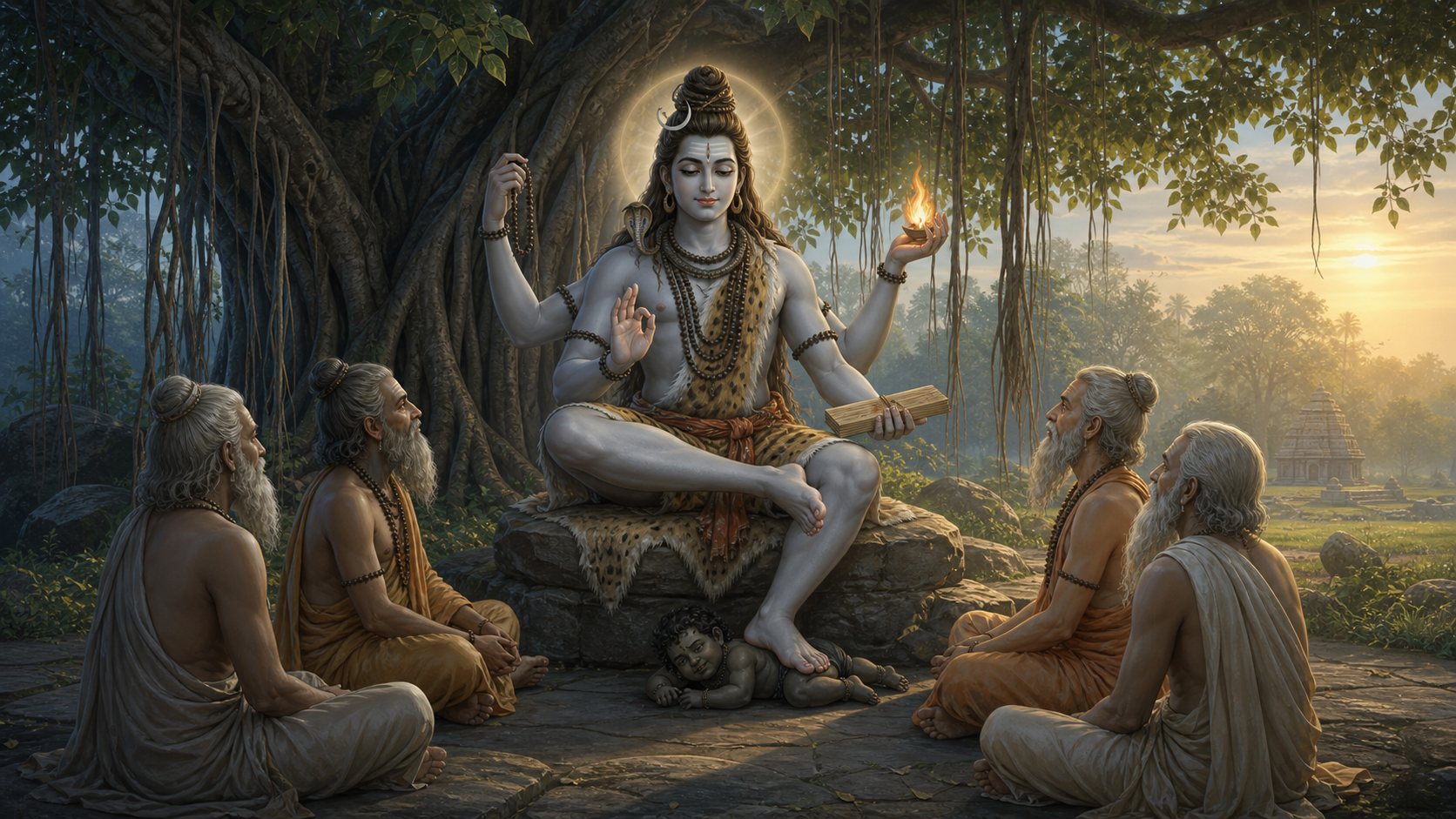
You recognize Shiva seated beneath a banyan, sages gathered at his feet and a small figure pinned beneath him. Yet one question remains: are you looking at the Guru who explains the teaching, or the Guru whose silence reveals its culmination?
The distinction matters because Jnana and Vyakhyana Dakshinamurti represent different moments in one discipline. One helps you listen, question and reason carefully. The other turns attention inward so that understood teaching can become stable knowledge. Learning to read both forms gives you a practical way to approach a temple image, select a murti for a study space, or organize your own movement from inquiry to contemplation.
First identify the complete teaching scene
Do not begin by staring at the thumb and forefinger. A damaged sculpture, an unfamiliar regional convention or an unusual viewing angle can make a single mudra misleading. Begin with the complete arrangement.
In a Shaiva temple, the southern niche is the first strong clue. Dakshinamurti characteristically faces south, the direction associated with Yama and mortality. The theological answer to that direction is the Guru’s knowledge of the Self as unborn and undying. Dakshina also carries associations of skill, right judgment and capable action. Murti, meanwhile, does not imply that the ultimate is confined to an object. Form makes an otherwise subtle teaching available to sight, worship and recollection.
After checking the location, look for a cluster of features:
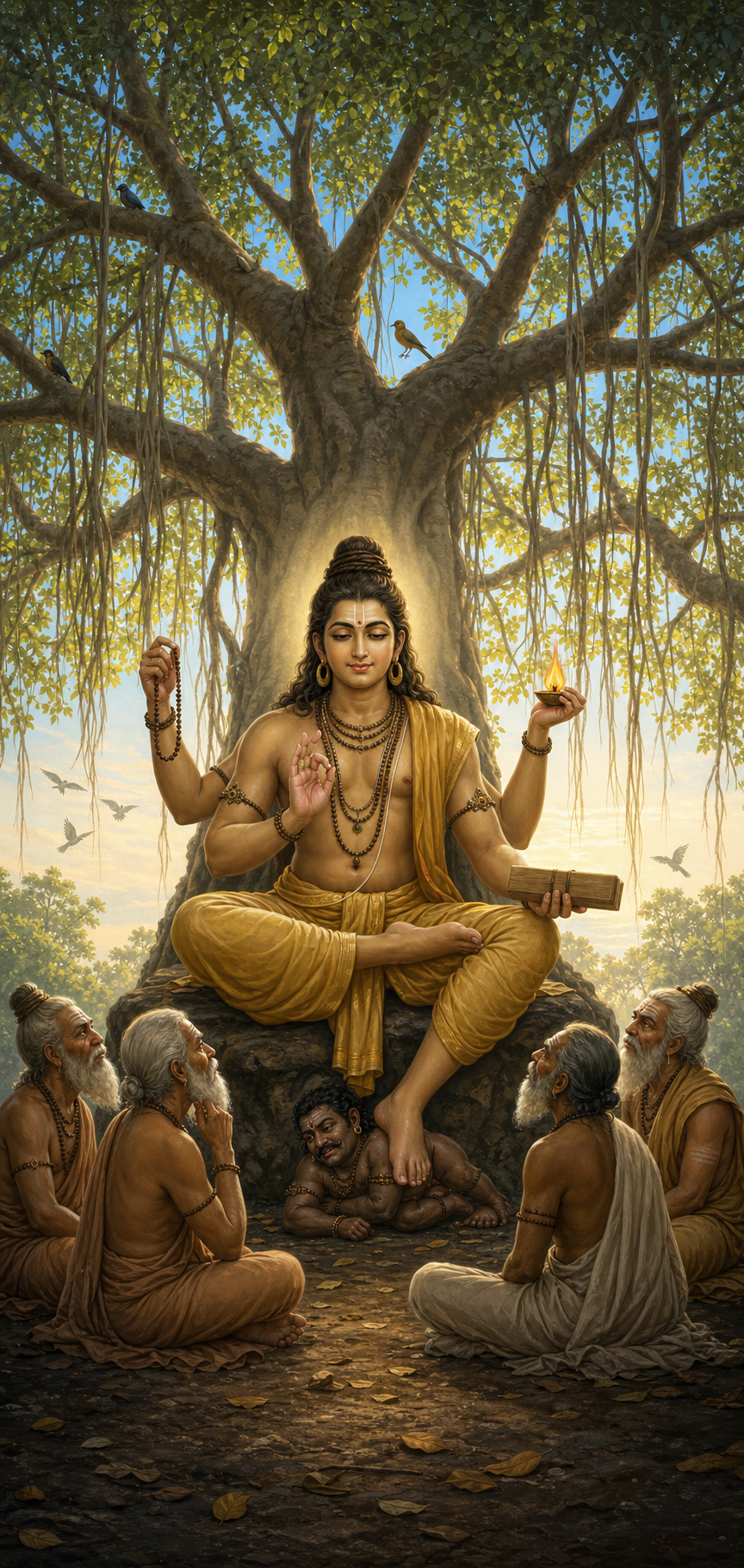
- A youthful yet ageless Shiva sits in composed authority, commonly in lalitasana or padmasana.
- The banyan rises above him as a sign of enduring life and the shelter provided by wisdom.
- Sanaka, Sanandana, Sanatana and Sanatkumara appear as the four sages receiving instruction.
- One foot restrains Apasmara, the dwarf associated with forgetfulness and avidya.
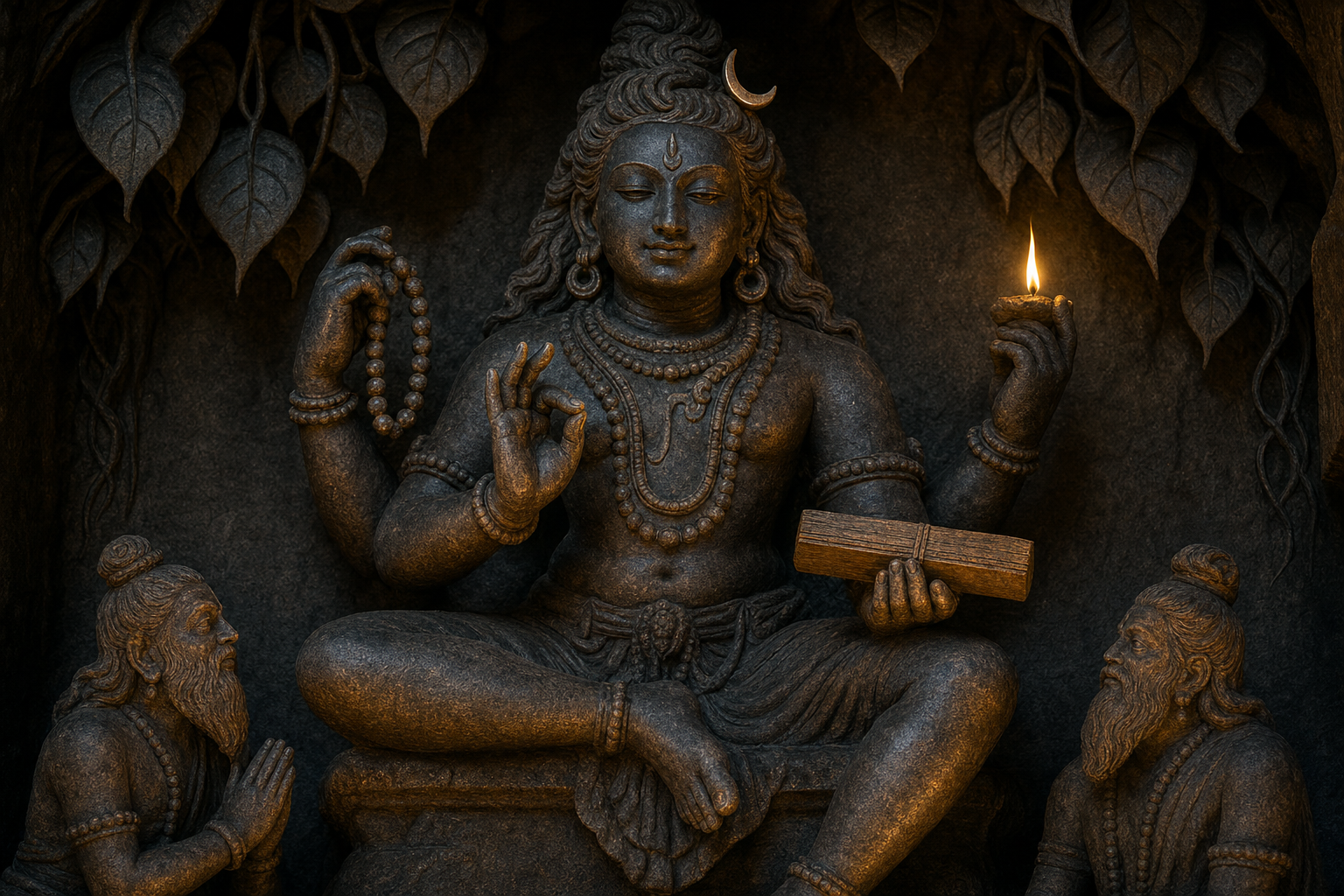
- Matted locks, the crescent moon and rudraksha ornaments identify the ascetic Lord as the teacher.
- A manuscript, rosary and teaching gesture show that this is not merely a scene of repose. It is a map of transmission.
Read the composition vertically. Wisdom shelters above. Students make themselves receptive before the Guru. Forgetfulness is kept beneath his foot. The arrangement tells you that ignorance is not overcome by collecting information while leaving attention undisciplined. Scripture, reasoning, remembrance and inner steadiness have to work together.
This whole-scene method is especially useful when a hand has eroded or an attribute has broken away. A missing manuscript should reduce your confidence about the subtype, but it need not prevent you from recognizing Dakshinamurti. Establish the identity from the ensemble; only then ask which teaching emphasis the sculptor intended.
The decisive distinction: exposition or realization?
Jnana Dakshinamurti and Vyakhyana Dakshinamurti are not rival deities or competing doctrines. They distinguish what the student presently needs. Vyakhyana concerns the disciplined unfolding of meaning. Jnana concerns direct, non-discursive recognition after confusion has been addressed.
Jnana Dakshinamurti turns knowledge inward
The clearest marker is usually the lower right hand in chinmudra or jnana mudra. Thumb and forefinger meet, signifying the identity of Atman and Brahman in the Advaita reading. The remaining fingers suggest the strands of conditioning that sustain the appearance of separateness. The palm often turns inward or downward, directing the meaning away from public discourse and toward recognition.
The upper hands may hold an akshamala and pustaka. The lower left hand may rest easily on the thigh or offer a boon-granting gesture. These attributes do not disturb the central stillness. They show that disciplined repetition and scripture have done their work; the student now has to assimilate what has been understood.
Jnana Dakshinamurti therefore corresponds most closely to nididhyasana, deep contemplation in which knowledge is made steady. When you encounter this form, do not spend the entire darshan cataloguing objects. Let the mudra pose its question: if awareness is the knower of every changing object, can it itself be reduced to one more object?
Vyakhyana Dakshinamurti makes room for inquiry
Vyakhyana Dakshinamurti commonly raises the lower right hand in vyakhyana or vitarka mudra. The palm tends to face outward at chest level, making the hand part of an active exposition. A manuscript may receive greater visual emphasis, and the lower left hand can participate in the discourse through a complementary gesture.
The associated disciplines are shravana and manana: receiving the teaching and then reflecting on it until apparent contradictions are resolved. The form dignifies questions, but not argument for its own sake. A useful question identifies exactly what has not been understood. Reason then tests the student’s interpretation while remaining answerable to shruti.
The practical differences can be read this way:
| Clue | Jnana Dakshinamurti | Vyakhyana Dakshinamurti |
|---|---|---|
| Lower right hand | Chinmudra or jnana mudra, often inward or downward | Vyakhyana or vitarka mudra, commonly outward at chest level |
| Teaching emphasis | Immediate recognition and inward abidance | Explanation, dialogue and analytical clarification |
| Stage of practice | Nididhyasana | Shravana and manana |
| Visual mood | Interiorized stillness | More outward engagement with the students |
| Manuscript and rosary | May be present | May be present, sometimes with a more prominent manuscript |
The final row prevents a common error. A pustaka does not automatically make the image Vyakhyana Dakshinamurti, and an akshamala does not automatically make it Jnana Dakshinamurti. Both forms can carry both objects. The orientation and level of the teaching hand, the posture of the other hand, the gaze and the Guru’s relationship to the sages provide the better reading.
The supporting symbols form a complete curriculum
Dakshinamurti’s attributes are easiest to understand when you stop treating them as independent emblems. Together they describe how knowledge is received, stabilized and finally owned.
- The pustaka represents the articulated wisdom of shruti. It establishes that silence is not an excuse to bypass texts, teachers or careful definitions.
- The akshamala represents contemplative continuity. Understanding must be revisited until habitual confusion no longer overrules it.
- The teaching mudra shows the present mode of transmission: outward clarification in Vyakhyana, inward identity-knowledge in Jnana.
- The sages embody receptive discipleship. Even knowledge of the highest reality appears within a relationship of teaching, listening and disciplined attention.
- Apasmara represents avidya and forgetfulness. His position beneath the Guru’s foot makes mastery of attention part of the lesson rather than a decorative afterthought.
- The banyan gives the teaching a setting of continuity and shelter. Wisdom is shown as a living canopy under which inquiry can mature.
- The jata, crescent and rudraksha keep the teacher unmistakably Shiva: ascetic stillness and illuminating knowledge belong to the same presence.
The sequence matters. You first receive a teaching in words. You return to it with disciplined recollection. You examine what it means and remove contrary assumptions. You then cease treating truth as an idea located outside yourself. The manuscript and rosary are therefore not competitors to the mudra. They prepare the mind to understand it.
This is the force of maunavyakhya, silent exposition. The Dakshinamurti Upanishad and the Dakshinamurti Stotra attributed to Adi Sankara place this paradox at the heart of the form. Silence is not blankness, refusal or hostility toward thought. It is what remains when explanation has removed the misconception that required explanation.
That point protects you from two opposite mistakes. Purely verbal study can become a collection of concepts that never alters how you see yourself. Premature silence can preserve confusion by giving it a spiritual appearance. Exposition prepares the mind for silence, and silence consummates exposition.
Regional variation calls for a hierarchy of clues
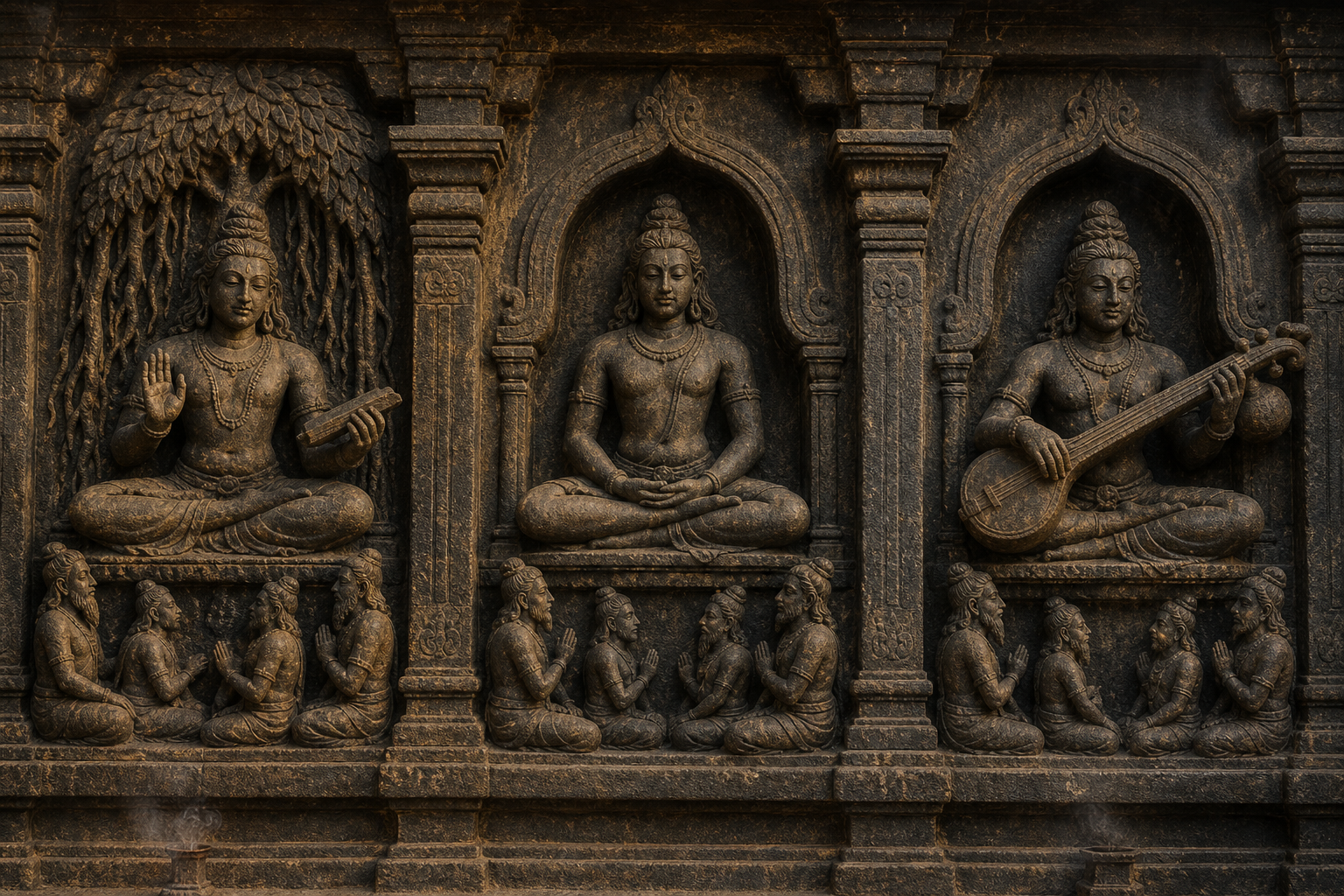
Temple sculpture is a living tradition, not a modern identification chart. The Kamikagama, Suprabhedagama, Shilparatna and related South Indian iconographic traditions establish recognizable postures and attributes, but regional workshops and historical periods permit variation. Some images combine an outward teaching gesture with an inward gaze. Others make the book, sages or banyan more prominent without changing the theological center.
Material also changes what you notice. The hard granites of Tamilakam encourage economy of line, often making the mudra and gaze especially important. The softer chloritic schist used in Karnataka allows denser ornament and can draw your eye toward manuscripts, jewelry and the students below. Metal icons use reflected light to animate the rosary, book and hands. These differences affect visual emphasis; they do not by themselves create a different doctrine.
Pallava and early Chola examples at Kanchipuram and the Brihadeeswara Temple at Thanjavur preserve refined teaching gestures and manuscript imagery. Vijayanagara and Nayaka depictions can feel more discursively animated, while Hoysala carving may surround the teaching with elaborate detail. Expecting every example to resemble one modern print will make authentic variation look like error.
Use this order when identifying an unfamiliar image:
- Confirm the teaching scene: Shiva, the southern orientation or niche, the sages, the banyan and Apasmara.
- Locate the lower right hand and check its height, palm direction and relationship to the torso.
- Notice whether the composition feels directed toward the students or gathered into inward stillness.
- Treat the pustaka and akshamala as supporting evidence because both subtypes can hold them.
- Consider damage, viewing angle, material and regional style before assigning a rigid label.
- Use the temple’s own identification or an inscription, where available, as context for how that community receives the form.
Four misreadings are worth avoiding. A circle made by two fingers does not settle the subtype without palm orientation. A large manuscript does not make silence irrelevant. Rich ornament does not make the figure less contemplative. Most importantly, silent teaching does not imply that reasoning is dispensable. Dakshinamurti’s iconography repeatedly places text, disciplined attention, explanation and realization in one field.
Match the form to the work you actually need to do
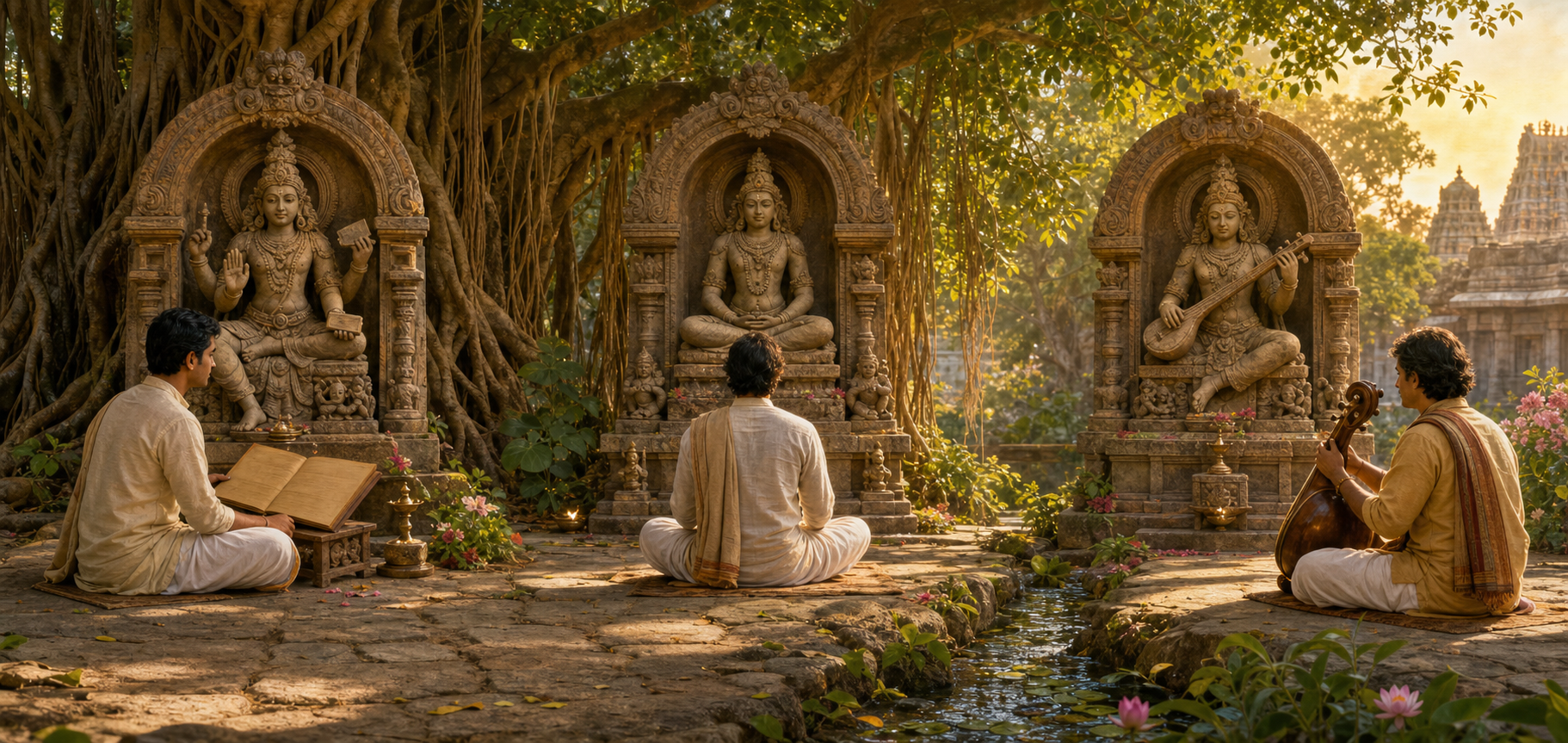
You do not have to choose one form as though it represented a permanent spiritual camp. Choose according to the obstacle before you. If the teaching remains vague or contradictory, you need the Vyakhyana emphasis. If you can explain it accurately but continue to experience it as remote theory, you need the Jnana emphasis.
For scriptural study, begin by stating one question precisely. Identify the passage or proposition that raises it. Explain your present understanding in your own words, then test it through reasoning and its relationship to shruti. This is the discipline represented by Vyakhyana Dakshinamurti: the question becomes narrower as understanding becomes clearer.
Once the doubt has been addressed, close the book rather than immediately collecting another idea. Sit with the Jnana form. Rest attention on chinmudra, then notice the difference between changing objects of awareness and the awareness by which change is known. The aim is not to manufacture a vacant mind. It is to let an understood teaching cease being merely external information.
A study circle can follow the same movement. Use the Vyakhyana mode while reading, defining terms and testing interpretations. End in the Jnana mode, allowing a period of undistracted contemplation instead of turning every insight into further discussion. This keeps conversation from becoming intellectual display and keeps silence from becoming an escape from unresolved questions.
If you are selecting a murti for a study room, favor a Vyakhyana image when systematic shastra study is the main activity. Favor a Jnana image when the space primarily supports contemplation. Readability matters more than decorative complexity: make sure the decisive hand, the posture and the principal attributes can actually be seen. Either form can support a complete practice when you understand its emphasis.
Thursday, Guruvara, is widely associated with Dakshinamurti observance, including recitation of the Dakshinamurti Stotra and remembrance of the Guru. Use that observance as a recurring point of integration: identify what still requires explanation, address it honestly, and then give the understood teaching room to settle.
Key takeaways
- Identify Dakshinamurti from the whole teaching scene before trying to name a subtype from one hand.
- Jnana Dakshinamurti emphasizes chinmudra, inward recognition and nididhyasana.
- Vyakhyana Dakshinamurti emphasizes an outward teaching gesture, careful exposition, shravana and manana.
- The manuscript and rosary can occur in both forms, so they support an identification but rarely settle it.
- Regional style can combine clues; read orientation, gesture, gaze and composition together.
- Use Vyakhyana when your doubt needs articulation. Use Jnana when a clear teaching needs contemplative assimilation.
The next time you stand before Dakshinamurti, pause before naming what you see. Determine whether the Guru is drawing you into a question or beyond a question that has already been answered. Then do the work the form asks of you: listen carefully, reason faithfully, or become still enough for knowledge to take root.