
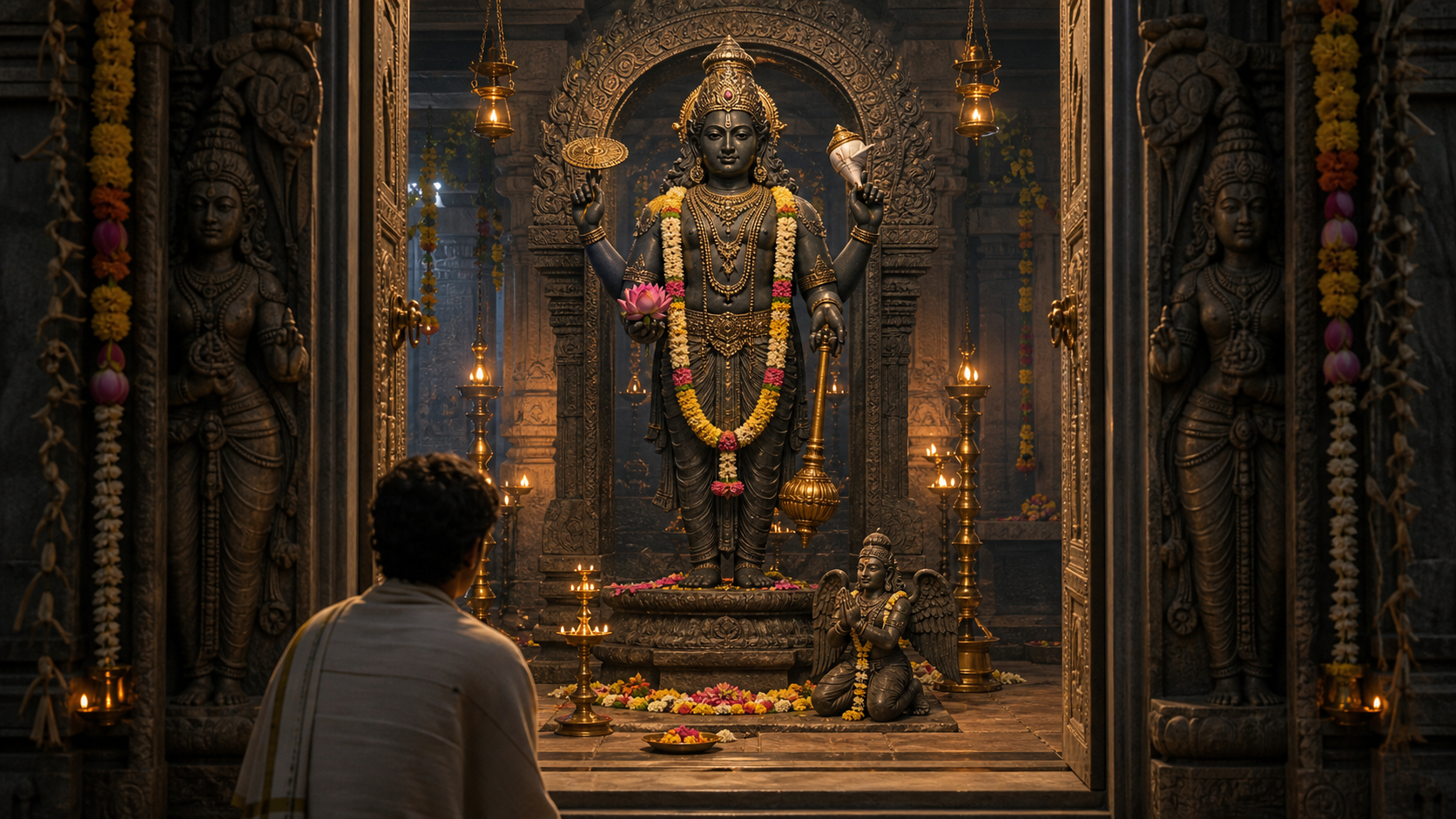
You may recognize the deity in front of you and still be unsure what the image is saying. Why does one form carry weapons while another sits in meditation? Why does a fierce face promise protection? Is a simple stone form less symbolic than a many-armed murti?
You do not need to memorize an encyclopedia of symbols. You need a reliable order of attention. Form, attributes, posture, companions, location and ritual work together as a visual language. Read them in that order, and a temple image begins to disclose a coherent theology rather than a collection of exotic details.
Start with the question the image is answering
Hindu sacred iconography is not a single code in which one object always has one meaning. It is better understood as a grammar. A grammar gives artists recognizable forms while allowing a deity’s identity, mood and function to appear in different combinations.
That distinction matters because identity and mode are not the same thing. Ugra Narasimha, Lakshmi-Narasimha and Yoga-Narasimha are all Narasimha, but they do not ask you to contemplate the same aspect of divine power. One embodies the decisive defeat of adharma, one reconciles strength with grace, and one turns protective power inward through yogic discipline. If you stop at the lion face, you miss the message carried by the rest of the image.
The same principle applies to the Shivalinga. It may be aniconic, naturally occurring, geometric or combined with faces and human figures. Calling every example merely a representation of a physical organ mistakes a possible visual association for the tradition’s complete meaning. The Sanskrit word linga means a mark, sign or indicator, and its iconographic forms point toward Shiva as the unmanifest reality made available to worship through a concentrated sign.
- What divine reality is present? Look for the features that establish identity.
- Which aspect of that reality is being emphasized? Protection, serenity, sovereignty, dissolution, grace and disciplined inwardness require different forms.
- What response is the image inviting? The intended response may be trust, reverence, moral courage, contemplation or awareness of the limitless.
This keeps interpretation rooted in the image. It also prevents two common errors: treating every symbol as an isolated dictionary entry and deciding what a sacred form means from its silhouette alone.
Read any murti in six deliberate passes
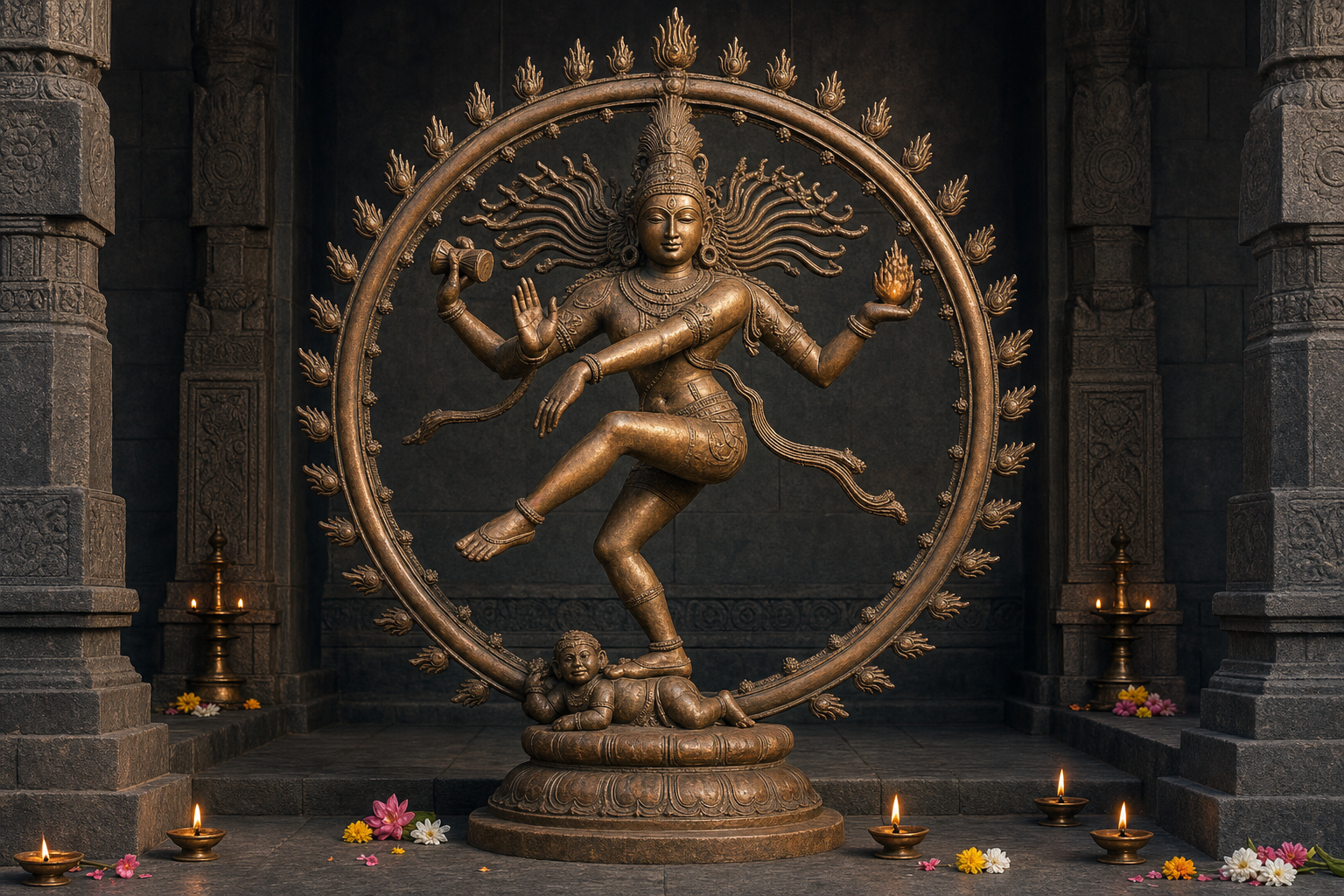
When you enter a temple or examine a sculpture, resist the urge to interpret immediately. First describe what is actually present. A dependable reading can be built in six passes.
- Classify the form. Is it anthropomorphic, aniconic, composite, geometric, natural or narrative? A lion-human body and an unadorned linga communicate through different visual strategies, but neither is symbolically simple.
- Establish identity. Look for repeated identifiers rather than relying on one dramatic feature. A crown, sacred thread, garland, forehead mark, conch and discus can locate Narasimha within Vaishnava iconography.
- Inspect the hands and attributes. Count the arms, distinguish front hands from rear hands, and notice whether they hold weapons or make gestures. An open palm in abhaya mudra communicates assurance; varada mudra grants a boon. The discus, conch, mace and lotus identify powers and affiliations, but their arrangement also helps define the particular form.
- Read the body and emotional register. A wide mouth, flaring mane, dynamic stance and taut limbs create an ugra or fierce mode. A seated posture, inward gaze or yogic band shifts the meaning toward restraint. Ferocity and serenity are not decorations; they are theological claims expressed through the body.
- Notice companions and action. Lakshmi seated on Narasimha’s left thigh changes the image from the climactic destruction of Hiranyakashipu to the harmonization of protection and grace. Prahlada, a defeated asura or a carved face on a linga can disclose the narrative or doctrine that a central form alone does not fully state.
- Restore the setting. Ask where the image stands, what direction it faces, whether it is fixed or processional, what surrounds it and how it is worshipped. Sanctum, wall panel, pilgrimage landscape, ritual bathing and festival procession all contribute meaning.
A practical discipline is to record three observations before offering an interpretation. You might note, for example, that the figure has a lion face and human torso, carries the conch and discus, and places a front hand in abhaya. Only then infer that you are seeing Vaishnava protective power joined to reassurance. This small pause separates recognition from projection.
Use Sanskrit terms when they make a distinction clearer, not merely to make a description sound learned. Ugra and saumya distinguish fierce and gentle modes. Ayudha identifies a divine attribute or weapon; mudra identifies a meaningful gesture. Sthira and cara distinguish fixed and mobile sacred forms. Each term should help you notice something visible or ritual, not replace an explanation.
The Shivalinga shows why resemblance is not enough
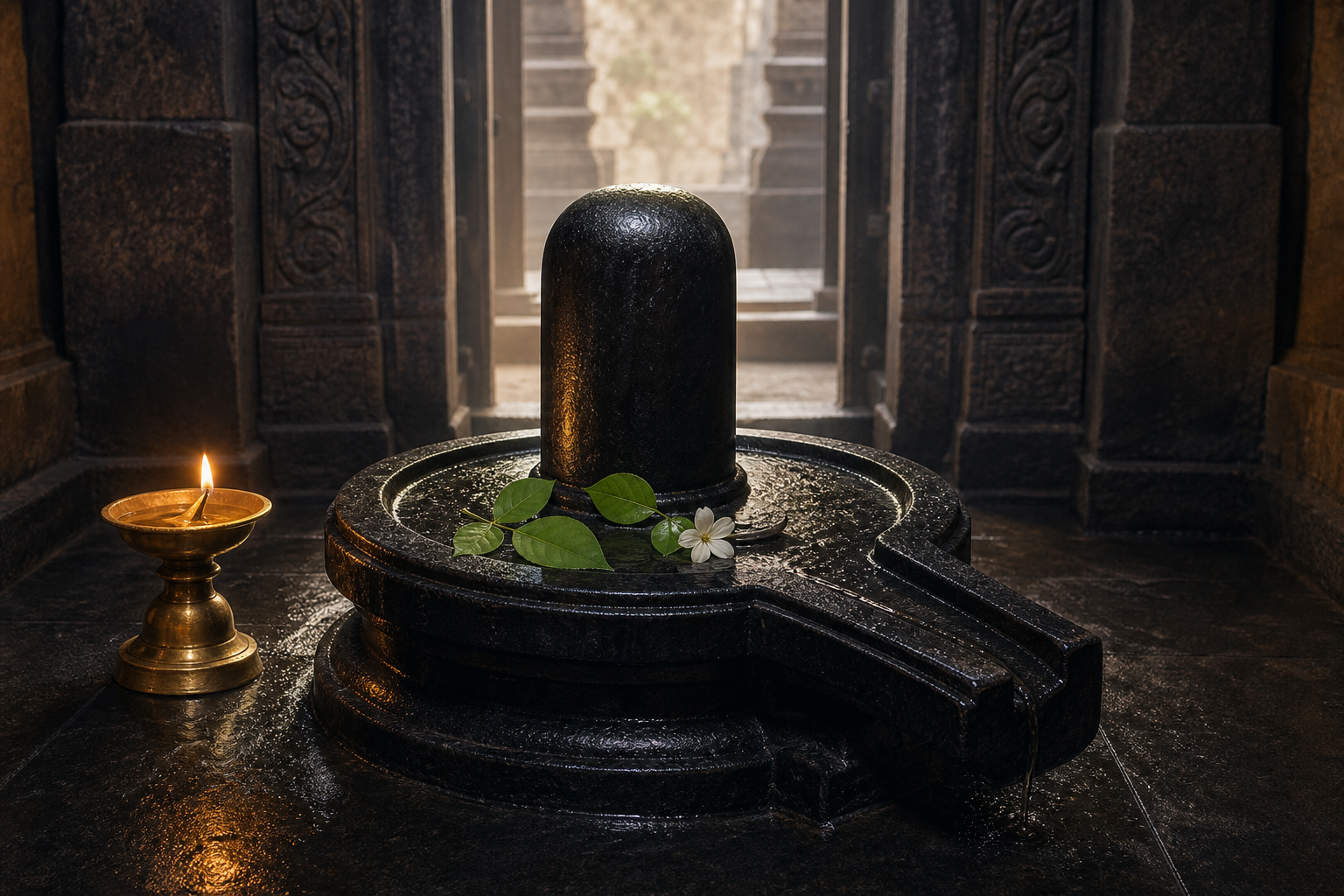
If someone asks whether the Shivalinga is phallic, the strongest answer does not begin with embarrassment or denial. Begin by testing the proposed meaning against language, canonical structure, variant forms, temple placement and worship. A resemblance can raise a question; it cannot settle the interpretation.
Test a one-feature claim against five kinds of evidence
- Name: Linga has the established semantic range of mark, sign and inferential indicator. In Shaiva usage, the form marks a reality that cannot be exhausted by an anthropomorphic portrait.
- Canonical geometry: Shilpa traditions describe a square Brahma portion at the base, an octagonal Vishnu portion in the middle and a cylindrical Rudra portion above. Creation, sustenance and dissolution are therefore built into the object’s geometry.
- Range of forms: A mukhalinga may carry one, four or five faces. A sahasralinga repeats many lingas within a larger composition. Narmada banalingas and other svayambhu forms are naturally occurring rather than sculpted to imitate anatomy.
- Architectural role: The linga occupies the temple’s inner axis. The Lingodbhava image presents Shiva as a beginningless and endless column of light, while the sanctum, vertical superstructure and circumambulatory movement develop that axial meaning spatially.
- Ritual use: Abhisheka, bilva offerings and mantra focus attention on steadiness, simplicity and the unconditioned. The outflow channel carries the liquid offered in worship and is commonly aligned to the north according to Agamic prescription.
These lines of evidence converge on a richer reading: the Shivalinga is a sign of Shiva, a sacred axis and a compact cosmogram. The Lingodbhava narrative makes the axial meaning especially vivid. Brahma and Vishnu cannot find the top or bottom of Shiva’s fiery column, so measurement itself reaches its limit before the infinite.
The surrounding yoni-pitha should also be read within this metaphysical structure. It signifies the matrix of manifestation, or prakriti, while the ensemble expresses the inseparability of consciousness and its power to manifest. Shiva and Shakti, purusha and prakriti, are presented as an ontological unity. Reducing that unity to anatomy strips away the very relationship the form was designed to disclose.
Concrete examples make the problem with a single reading difficult to ignore. The four-faced linga at Pashupatinath addresses the four quarters. The Gudimallam linga, dated to about the second century BCE, carries a relief of Shiva as a hunter on its shaft. The naturally forming ice linga at Amarnath exemplifies the svayambhu principle. Each preserves the linga’s identity while changing its material, surface or relation to anthropomorphic form.
A concise explanation you can use in conversation is this: the Shivalinga is first a sign of Shiva’s unbounded reality, rendered as axis, geometry and ritual presence. Its union with the pitha includes generative symbolism, but an exclusively sexual interpretation cannot account for the name, canonical divisions, column-of-light narrative, natural forms, faces, temple axis or modes of worship. You do not need to pretend generativity is absent from Hindu thought; you do need to resist mistaking one possible association for the whole tradition.
Narasimha shows how one deity changes mode without changing identity
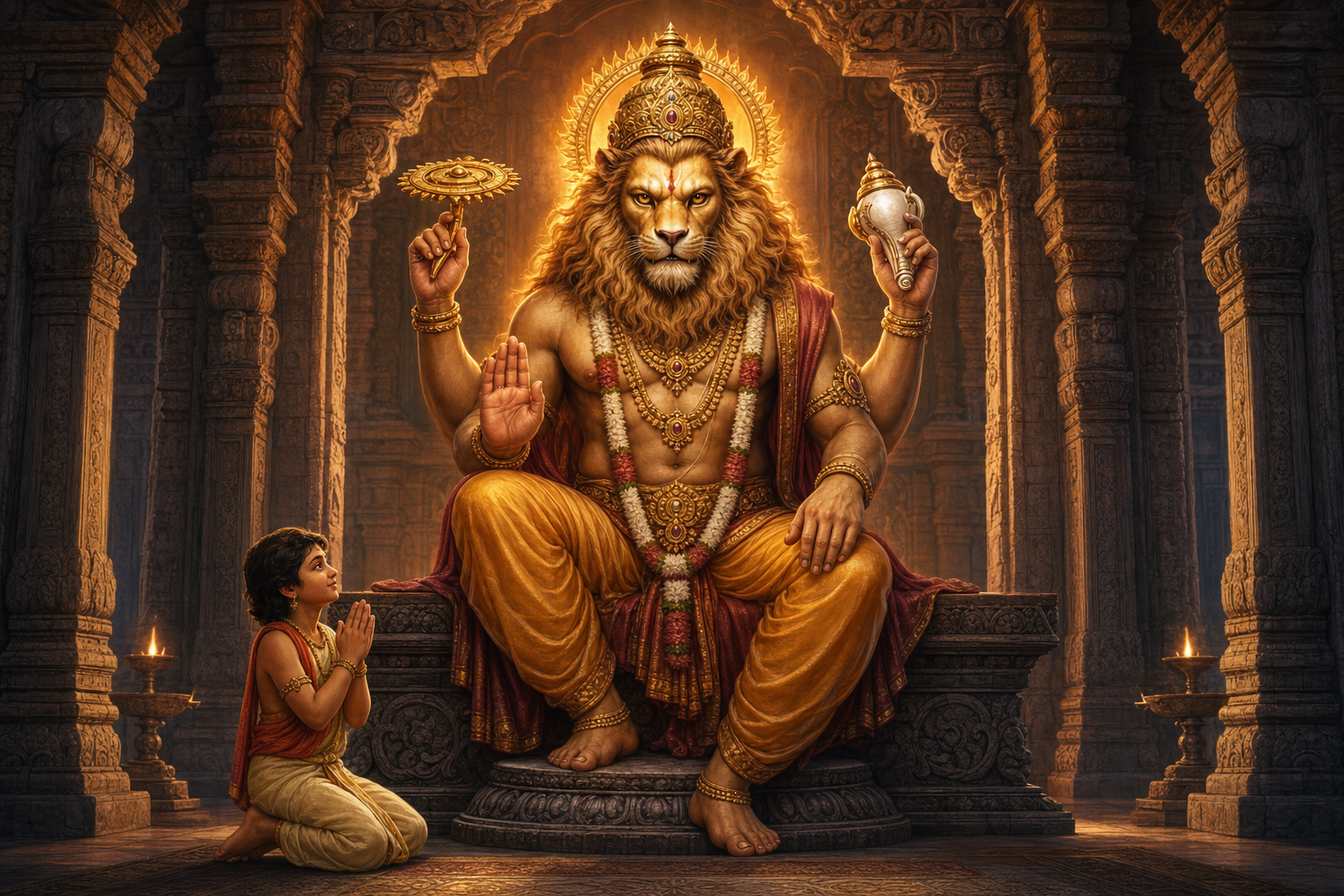
Narasimha offers the complementary lesson. Instead of an austere aniconic sign, you encounter a visually intense composite body: leonine face and mane, human torso and limbs, multiple hands, weapons, gestures and sometimes a full narrative scene. Your task is not merely to identify the lion-man avatar. It is to determine which Narasimha you are seeing.
Confirm the Vaishnava identity
Look beyond the face. The crown, sacred thread, long garland, Srivatsa mark and vertical Vaishnava forehead mark establish theological identity. Rear hands commonly carry the conch and discus, with the mace and lotus appearing in expanded arrangements. These identifiers tell you that the frightening visual energy belongs to Vishnu’s protective intervention, not to a hostile being.
Then distinguish fierce, gracious and yogic modes
- Ugra or Kevala Narasimha: Hiranyakashipu may lie across the deity’s thighs while the principal hands tear him with natural claws. Bulging eyes, exposed fangs, a flaring mane and a forceful stance intensify the moment when oppressive power is stopped.
- Lakshmi-Narasimha: Lakshmi sits on the left thigh, the facial expression softens, and the front hands commonly offer assurance and boons while the rear hands retain the conch and discus. Power has not disappeared; it has become visibly reconciled with grace.
- Yoga-Narasimha: The deity sits in a yogic posture, sometimes with a yogapatta securing the knees. Weapons may be reduced or omitted so that breath, stillness and inward command become the central message.
The narrative explains why the fierce mode is so exact. Hiranyakashipu’s protections excluded death by man or beast, by weapon, by day or night, and indoors or outdoors. Narasimha is neither man nor beast; the event occurs at twilight and at a threshold; natural nails are not conventional weapons. The image therefore portrays force bounded by a moral and narrative order. It is not rage for its own sake.
This is the point to emphasize when someone equates a fierce Hindu deity with evil. Fangs, flames and weapons do not determine moral character by themselves. Ask whom the force confronts, whom it protects and what limits govern it. Prahlada’s presence is crucial: the same form that terrifies the tyrant preserves the devotee. Abhaya mudra can make that protective purpose explicit.
Regional and temple traditions expand this range without dissolving it. Ahobilam brings together nine Narasimha forms with distinct fierce, gracious and contemplative emphases. At Simhachalam, sandal paste covers the murti through most of the year, with the underlying form revealed on Akshaya Tritiya. The cooling covering is not incidental decoration; ritual action interprets and pacifies the fierce presence.
When looking at an unfamiliar Narasimha, use a short diagnostic sequence: find the Vaishnava attributes, inspect the front hands, check for Lakshmi or Hiranyakashipu, read the seated or standing posture, and then identify the emotional mode. This is more dependable than assigning a name from facial ferocity alone.
Restore setting and ritual before settling on meaning
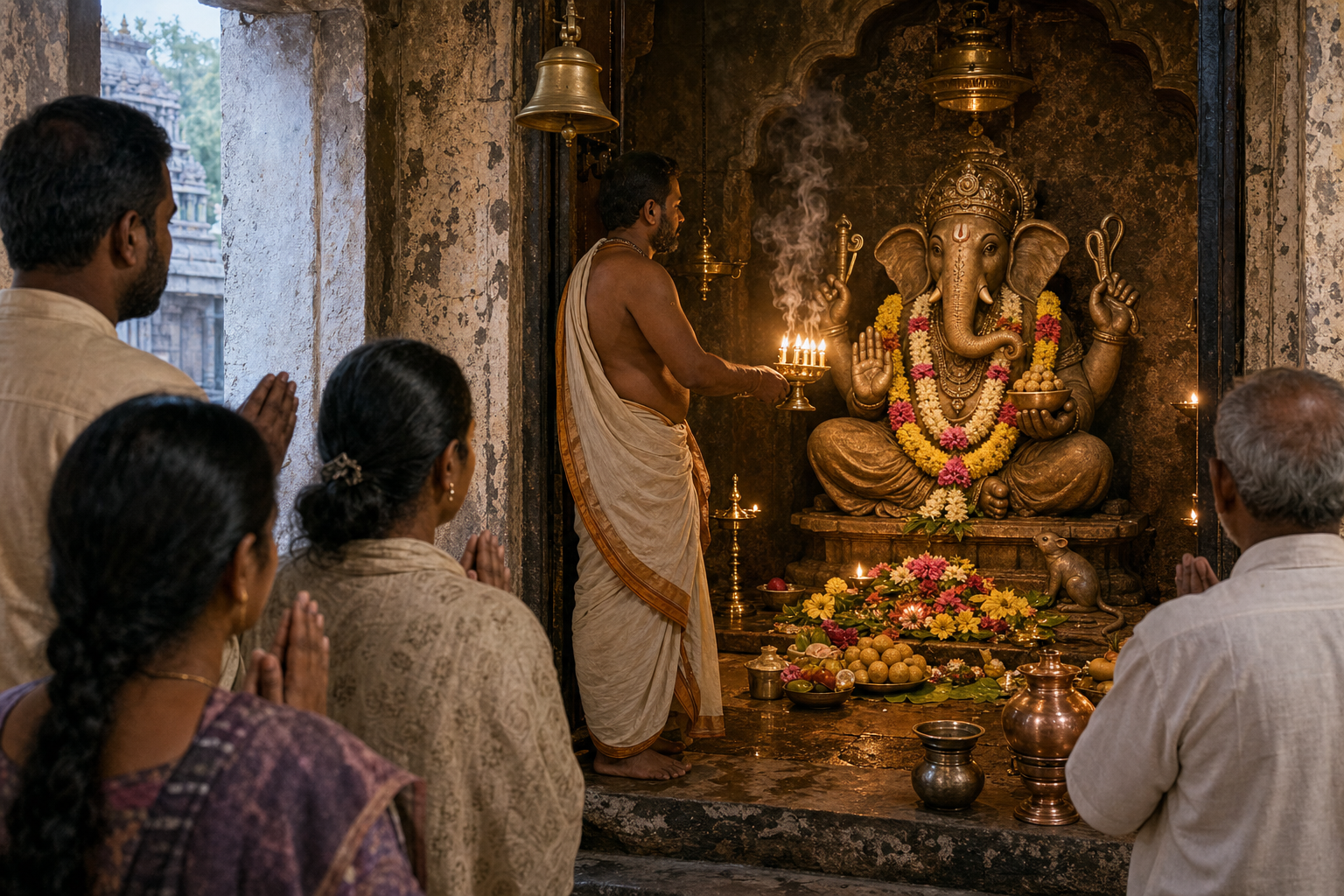
A sacred image does not end at its carved edge. Its material, placement and treatment tell you how it participates in worship. A fixed linga in a garbhagriha, a mobile image carried in procession, a narrative relief on a temple wall and a sculpture removed to a museum may share iconographic features while creating very different encounters.
Ask whether the form was made for a sanctum, a procession or an architectural surface. Shaiva traditions distinguish fixed and mobile lingas and prescribe different materials and consecration procedures. South Indian lost-wax bronzes of Narasimha can carry flowing details and readable gestures into public procession, while granite permits a fixed, forceful presence and extensive relief carving. Function helps explain why two formally related images look different.
Direction and adjacency also matter. A Lingodbhava panel on the western wall of a Shiva sanctum interprets the linga through the infinite column of light. A figure of Lakshmi beside or upon Narasimha changes the emotional center of the composition. A flame arch behind a fierce form makes heat and radiance visible. Before declaring a symbol’s meaning, look one step outward: at the base, backplate, neighboring figures, wall and ritual route.
Five mistakes that flatten sacred art
- Decoding one feature in isolation. A weapon can signify protection, sovereignty or the defeat of adharma. The hand holding it, the accompanying gesture and the narrative scene decide which meaning is active.
- Treating fierceness as moral disorder. In Narasimha imagery, visual ferocity is directed and constrained. Identify the protected devotee and defeated aggressor before judging the mood.
- Assuming simplicity means lack of content. The Shivalinga’s restraint is part of its function. A minimally differentiated surface can direct attention toward the formless more effectively than an elaborate portrait.
- Turning a resemblance into an explanation. Shape is one kind of evidence. Name, textual narrative, geometry, variants, placement and ritual provide independent checks.
- Forcing every regional image into one exact template. Material, local practice and ritual function create legitimate variation. Confirm the theological core, then ask what the regional form emphasizes.
If a label is missing or uncertain, describe before naming. Say, for example, “This appears to be a fierce Vaishnava protector because it combines a lion-human form with the conch and discus,” rather than asserting a precise regional form that the visible evidence cannot establish. Intellectual restraint is part of respectful looking.
Key takeaways
- Read identity, mode and function as separate questions.
- Move from visible evidence to interpretation: form, attributes, posture, companions, setting and ritual.
- Do not let one resemblance overrule language, canonical structure and the range of surviving forms.
- Read fierce imagery by asking whom the power confronts, whom it protects and what ethical limits govern it.
- When evidence is incomplete, give a careful description before assigning a precise name.
On your next temple visit, choose one image and spend five quiet minutes with it. Write down three visible facts, identify its likely divine family, distinguish its mode, and look at what the surrounding space adds. Then ask what response the whole composition invites from you. That habit will teach you more than a hurried catalogue of isolated symbols, and it will let the sacred form speak in its own visual grammar.
References
- DharmaRenaissance Blog – Shivling Beyond Form: Debunking Phallic Myths with Scriptural and Iconographic Evidence
- DharmaRenaissance Blog – Narasimha Iconography Decoded: Forms, Symbols, and Sacred Meanings in Hindu Temple Art