
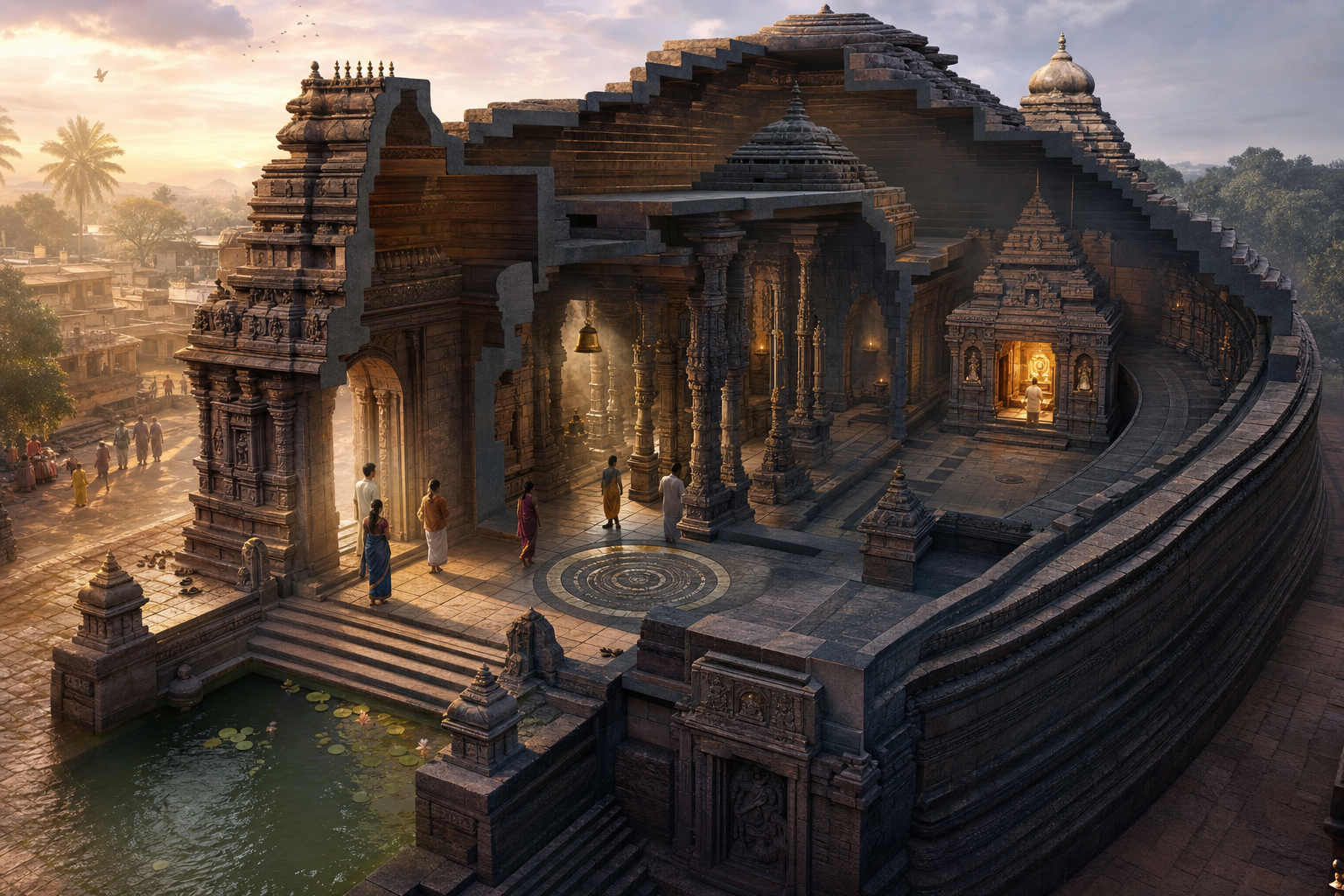
If you have entered an old temple, stupa, derasar or gurdwara and wondered whether you were missing its deeper meaning, you probably were not missing a secret code. Begin with a simpler question: what does this place ask your body, senses and attention to do?
A Dharmic sacred building is best approached as an ordered encounter. Its threshold interrupts ordinary movement. Its route regulates approach. Its centre gathers attention. Light, sound, water and material deepen that movement. The civilizational principle beneath these choices is that space can shape consciousness. Once you learn to notice that choreography, sacred architecture stops being scenery and becomes a practice you can participate in.
Cosmic order becomes meaningful when you enact it
Cosmic order in sacred architecture does not mean that every building is a literal model of the physical universe. Nor does it mean that every dimension conceals an astronomical secret. The more useful idea is relational: the building coordinates centre and boundary, direction and movement, visible and hidden form, human time and sacred time.
Within a Shaiva frame, rta is the order guarded by the Devas, while temple worship makes alignment with that order repeatable in a particular place. The sanctum supplies a centre; orientation places that centre within a larger field; ritual establishes a rhythm; and the worshipper enters that pattern through movement, mantra and offering. The result is an architecture in which outer order is used to cultivate inner order.
Three kinds of order usually need to be read together:
- Physical order concerns the site, foundation, orientation, proportion, circulation, water and choice of materials. The Mayamata, traditionally associated with Maya or Mayasura, addresses matters such as site selection, proportional canons, angula-based measurement, foundations, water systems and building types. Its attribution may preserve the memory of a Maya school rather than identify a historically verifiable individual author, so the connection should be treated as traditional rather than proven authorship.
- Ritual order concerns what is installed, how it is consecrated and what repeated acts keep the space alive. Mandala construction, nyasa, homa, yantra installation and prana-pratishtha connect the plan to a living lineage rather than leaving it as an attractive geometric shell.
- Ethical order concerns the kind of person and community the space is meant to form. A sacred building should steady attention, support restraint and make rightful worship possible. Grandeur alone cannot supply those purposes.
This distinction protects you from two common mistakes. The first is treating sacred geometry as an occult formula that works independently of ritual and conduct. The second is treating ritual as a performance that could happen in any neutral container. In a living sacred place, form, practice and purpose correct one another.
When someone assigns a cosmic meaning to a measurement, direction or ornament, ask three grounded questions. Which architectural or ritual lineage uses that interpretation? Does the visible feature actually support the claimed practice? Does the explanation fit the local temple rather than a generic diagram found elsewhere? A responsible interpretation becomes more precise as it approaches the particular place.
Read the sacred route before decoding individual symbols
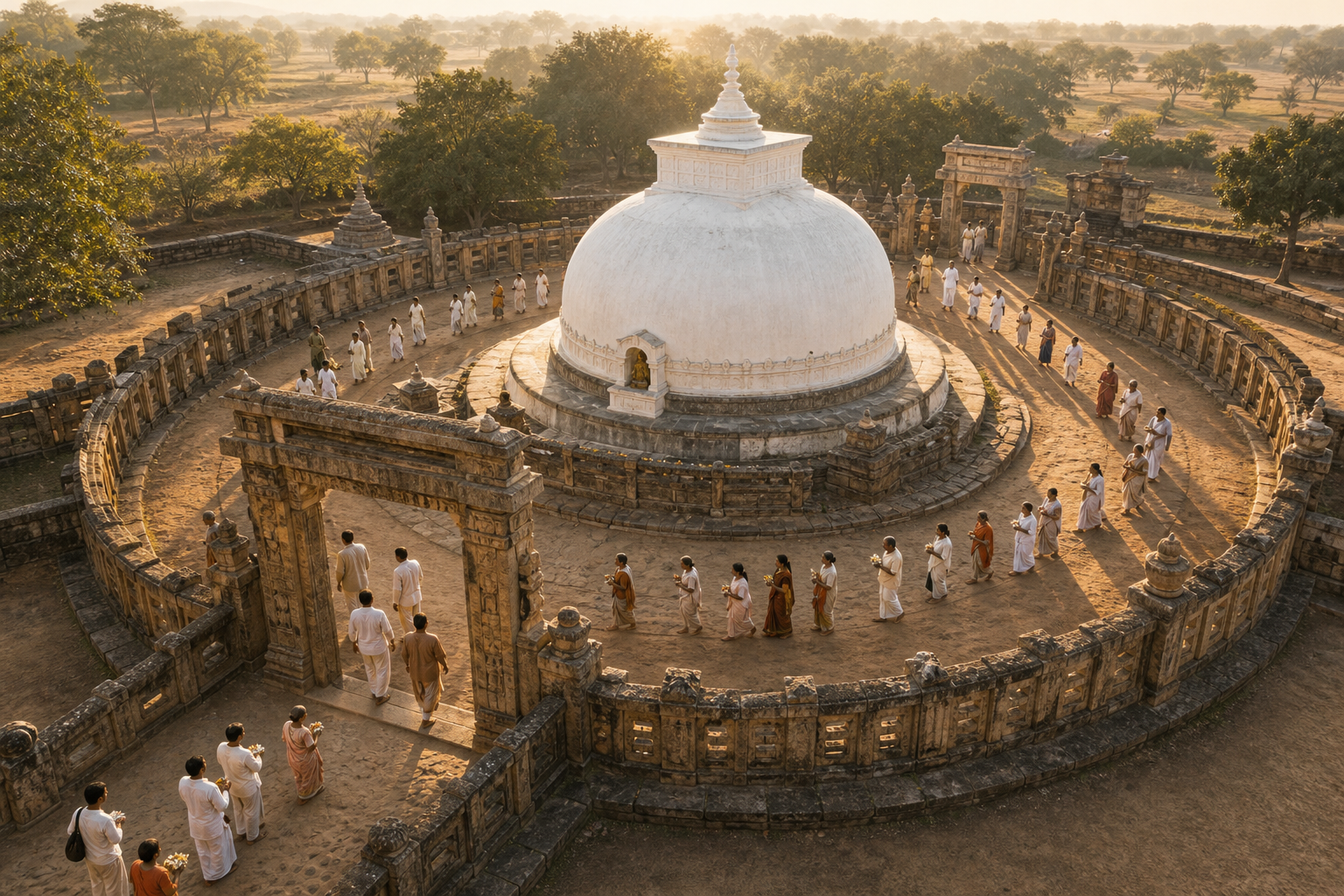
A symbol-by-symbol hunt can make a sacred building feel like a museum puzzle. The route is usually the better teacher because it shows how separate features work as one system. On your next visit, read the place in the following order.
- Pause at the threshold. Notice what changes as you cross it: enclosure, ground level, light, temperature, sound or the pace of the people around you. The threshold is the first architectural instruction. It asks you to stop moving as a passer-by and begin moving as a participant.
- Establish the local orientation. Find the principal approach, the central axis, subsidiary sacred points and any visible water outlet. Do not grade the whole complex against a rule remembered from another temple. In Shaiva practice, the soma-sutra carrying abhisheka water is frequently directed toward the north or northeast, but Vastu conventions and the local Agama together govern the actual arrangement. Use a general convention to form a question, not to condemn a variation.
- Follow the permitted route. Notice whether you approach directly, turn, circle, descend or ascend. Watch when the centre becomes visible and when it disappears again. A route that delays the full view is not necessarily an inconvenience; controlled revelation can move the mind from anticipation toward concentration.
- Find the centre of attention, not merely the largest object. In a Shaiva temple, the Linga in the garbhagriha serves as a condensed axis linking earth, mid-space and heaven. In other Dharmic settings, the ordering centre may work through a different sacred form or practice. Ask where voices soften, bodies turn and movement becomes deliberate.
- Listen before analyzing ornament. Sancta, corridors and adjoining surfaces can change resonance, focusing chant or giving a conch and recitation unusual depth. Acoustics are part of the sacred experience, not merely an accidental effect around visual art. Compare the sound near an outer threshold with the sound near the sanctum while remaining wherever visitors are permitted.
- Ask what the materials are doing. Water can carry offerings, cool air and multiply light through reflection. Polished stone and metal can sharpen highlights. Courtyards and patterned openings can support ventilation. These possibilities do not prove that every feature was designed for every effect, but they direct you toward function rather than surface description.
Do not rush to photograph each object before you have followed the route. A camera isolates forms; sacred architecture often derives its meaning from sequence. Complete an attentive circuit where local rules permit it, then record what you noticed about the route, centre, strongest sensory change and principal ritual action.
Only after observing should you consult the local sthala-purana, an informed custodian or a teacher from the relevant lineage. That order matters. Observation without tradition encourages fantasy, while inherited explanation without observation becomes a slogan. The place and its lineage should be allowed to answer each other.
The sacred centre joins geometry, ritual and matter
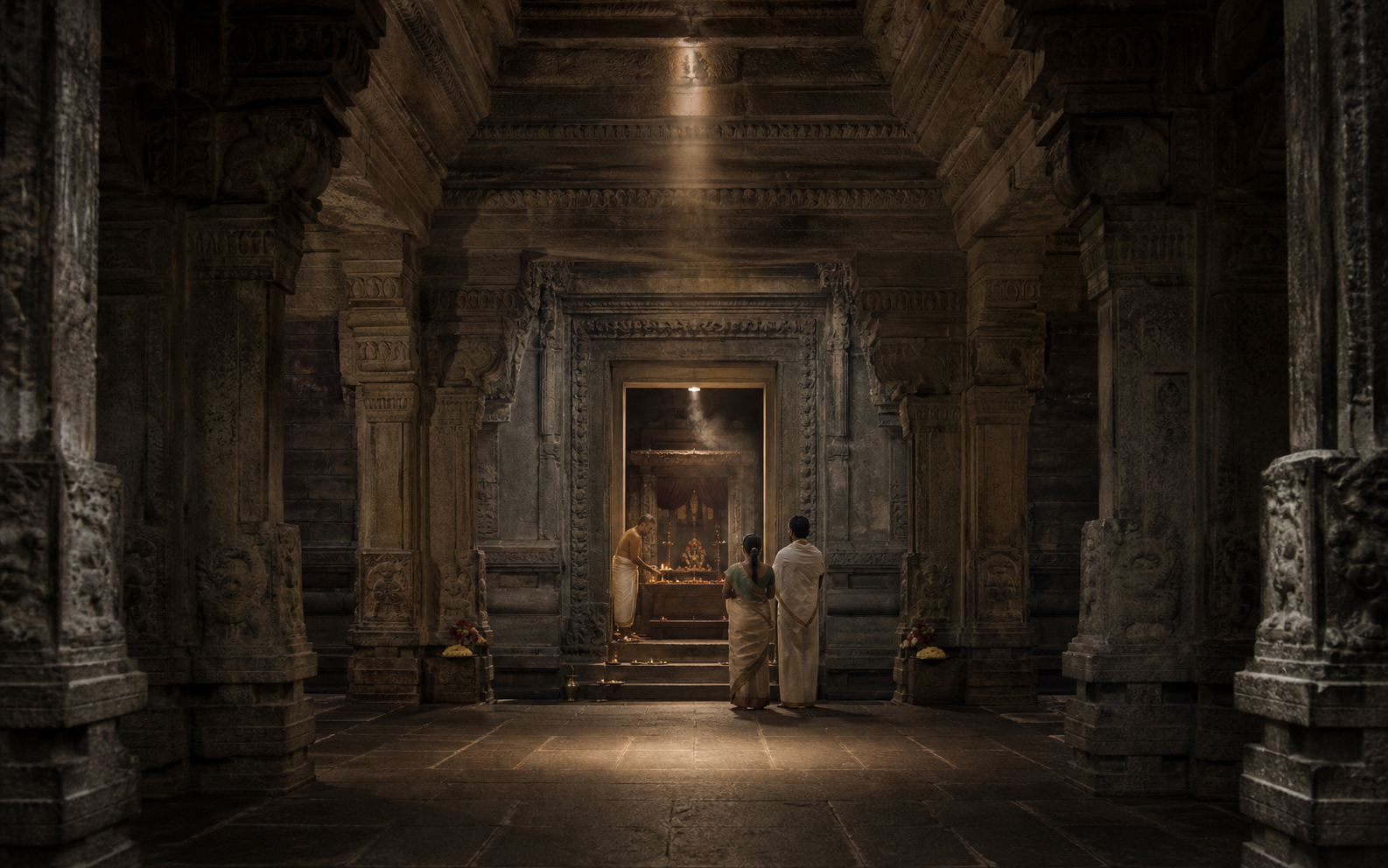
The Shaiva Linga provides a particularly clear example of how a sacred centre works. Linga means a mark or sign, yet it points toward the signless Absolute. That apparent paradox is essential. The form gives the senses somewhere to settle without claiming that the limitless Divine has been contained by a finite image.
Traditional Shilpa classifications describe a threefold Linga geometry: a subterranean square Brahma-bhaga, an intermediate and often eight-sided Vishnu-bhaga, and a visible cylindrical Rudra-bhaga. Creation, sustenance and dissolution are therefore carried by the whole form, including the portion a devotee cannot ordinarily see.
This hidden structure offers a practical lesson in reading sacred buildings: what supports the visible centre may be theologically important even when it is inaccessible to view. Foundations, buried yantras, concealed portions of an icon and the ritual history of consecration are not empty space beneath the photogenic surface.
The Linga also does not stand alone. The yoni-pitha receives it, while the soma-sutra carries abhisheka liquids away from the pedestal. Here metaphysics and practical engineering meet. The same arrangement must hold the sacred form, receive repeated offerings and move water without allowing the ritual environment to become disorderly. Cosmic order is not opposed to drainage and maintenance; it becomes credible through them.
Consecration completes what geometry begins. Shaiva Agamic practice can include mandala construction, nyasa or the placement of mantric energies, homa, yantra installation and prana-pratishtha. These are lineage-governed rites, not a do-it-yourself technique inferred from a floor plan. A visitor can recognize their architectural importance without pretending to perform or reinterpret them independently.
Material then modulates the encounter. Granite and black basalt can support durability, thermal stability and intensive abhisheka. Sphatika or rock crystal makes translucence and changing light more prominent. River-smoothed bana-lingas from the Narmada carry a different tactile character. Material does not by itself determine sanctity; it changes how light, temperature, touch and ritual substances participate in worship.
Time is another architectural material. The sanctum encountered in quiet is not identical in experience to the sanctum during abhisheka or the recitation of Sri Rudram. Daily worship, lunar observances, Pradosha and the intensified Lingodbhava contemplation around Mahashivaratri place recurring sacred time inside the same physical centre. The building remains in place while the liturgical calendar changes how it is inhabited.
When you attend an abhisheka, watch the complete system from a place where visitors are allowed to stand. Notice how the offering approaches the Linga, how the pedestal receives it, where the liquid leaves, how the chant changes in the enclosed space and how light behaves on the wet surface. If you look only at the central object, you miss the architecture that makes the rite coherent.
Mayasura shows why technical brilliance needs Dharma
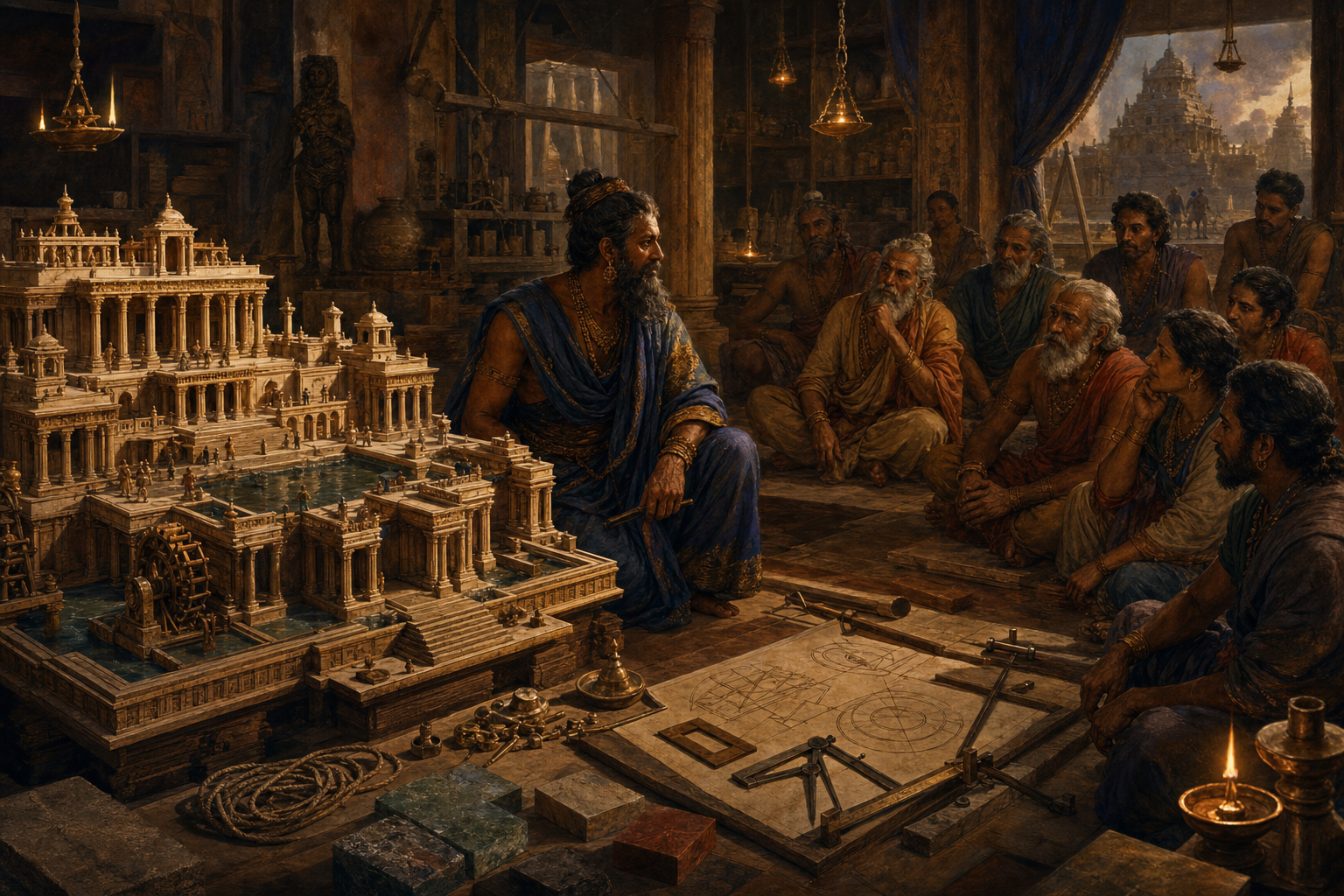
Sacred architecture is not automatically righteous architecture. The figure of Mayasura makes that distinction difficult to avoid. He is remembered as a Danava of extraordinary architectural, astronomical and perceptual skill. His identity as an asura does not erase his knowledge, and his knowledge does not guarantee the virtue of every purpose it serves.
During the burning of Khandava, Arjuna spares Maya. In gratitude, Maya constructs the Maya Sabha at Indraprastha for the Pandavas. The Mahabharata describes a hall in which reflective floors appear to be water and water can be mistaken for solid flooring. Duryodhana’s humiliating misjudgment is therefore both a demonstration of sensory design and a moral scene: pride becomes vulnerable when appearance outruns discernment.
The hall invites plausible technical interpretations involving highly polished stone, metal inlay, reflective water, controlled sightlines and carefully managed circulation. It does not give us an excavated blueprint from which every mechanism can be reconstructed. The safer conclusion is that perception itself functions as an architectural material in the Maya Sabha narrative. Claims about a precise lost technology should remain more modest.
The Tripura narrative sharpens the ethical point. Maya creates three mobile cities of gold, silver and iron for the sons of Tarakasura. Their movement makes them vulnerable only when their paths align. Shiva destroys the triad in a single decisive act yet spares Maya. The narrative distinguishes knowledge from the domination that knowledge can enable: craft is preserved, while a structure serving hubris and unrighteous power is brought down.
Visvakarma and Mayasura consequently offer complementary lenses. Visvakarma largely represents craft harmonized with cosmic order. Mayasura represents formidable skill whose ethical direction must still be tested. You need both lenses when judging a new temple project, a restoration or even a visually spectacular ritual installation.
- Ask whether the feature helps worshippers attend to the sacred centre or demands attention for itself.
- Ask whether the material was chosen for ritual durability, climate, acoustics and maintenance, or primarily for visual display.
- Ask whether circulation makes the ritual sequence intelligible or turns access into a performance of status and confusion.
- Ask where water will enter, collect and leave. A symbolic water system that cannot function cleanly has failed at both meaning and craft.
- Ask which priestly, artisanal and local knowledge holders shaped the decision. A generic sacred diagram cannot replace the requirements of a living lineage.
The same test applies to conservation. A shrine can lose part of its ordering intelligence even while its stone walls remain standing. Blocked ritual drainage, disrupted acoustics, lost liturgical melodies and forgotten local narratives all weaken the relationship between structure and practice. Protecting the tangible and intangible life of a shrine together is therefore more faithful than treating conservation as masonry repair alone.
Before approving an alteration, ask for its effects on movement, water, light, sound and ritual use to be explained separately. That simple discipline exposes proposals that preserve the facade while damaging the sacred system behind it.
Compare Dharmic spaces by practice, not superficial sameness
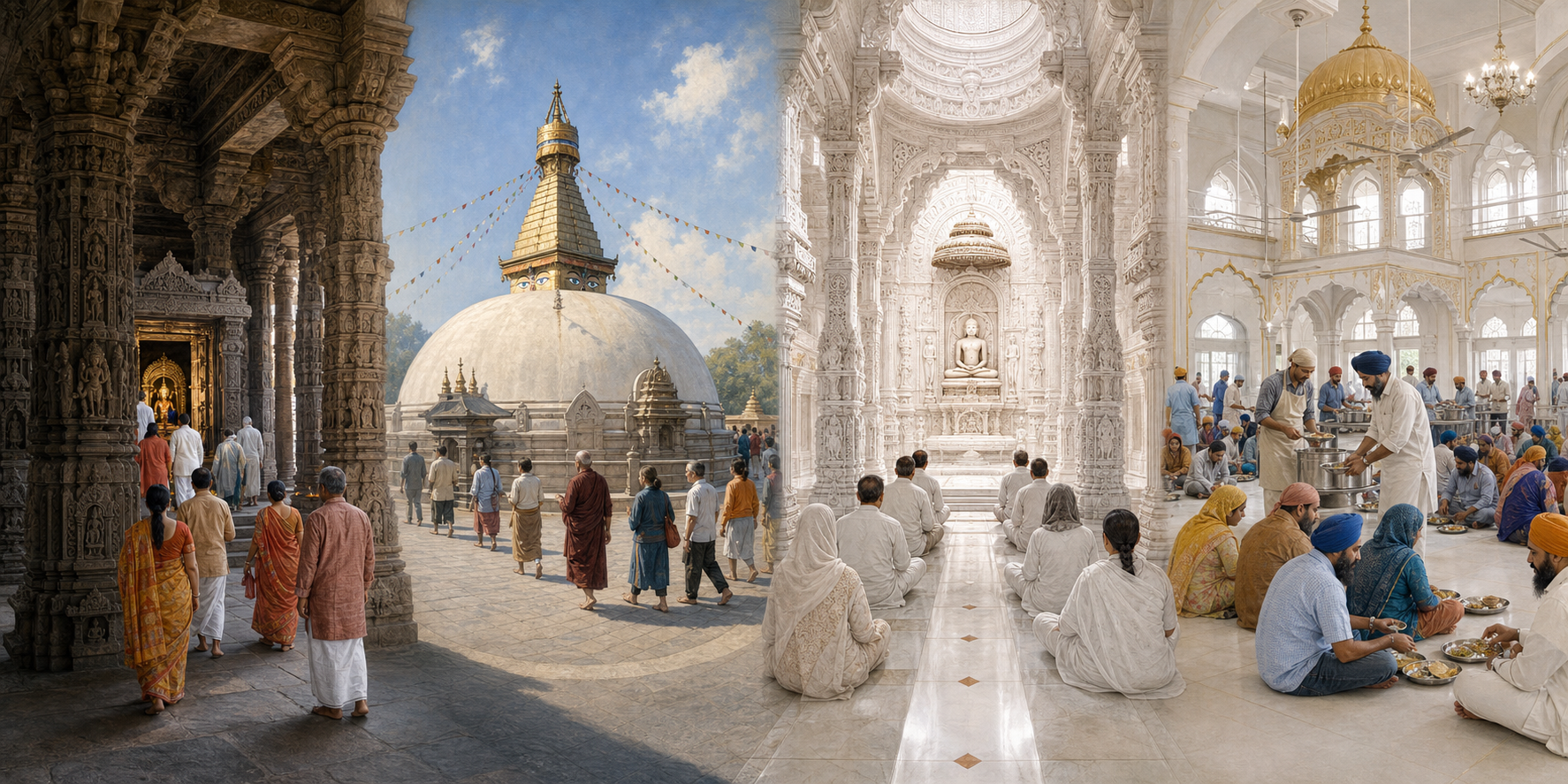
Hindu, Buddhist, Jain and Sikh sacred spaces can share an interest in orientation, ordered movement, light, geometry and concentrated attention. They do not become interchangeable because of those affinities. Rta belongs to a particular Vedic and Hindu vocabulary; it should not be pasted over every Dharmic tradition as though doctrinal differences were inconveniences.
The strongest comparison asks what kind of attention and conduct each space is designed to support. This keeps the relationship meaningful without forcing every building into the plan of a Hindu temple.
| Sacred setting | Ordering emphasis | Question to ask while visiting |
|---|---|---|
| Shaiva temple and Linga | A ritual and vertical centre integrating form, pedestal, abhisheka, sound and sacred time | How do approach, offering and chant gather attention around a sign of the formless? |
| Buddhist stupa | Cosmogrammatic orientation expressed in a distinct Buddhist sacred form | How does the arrangement orient attention around the stupa without requiring a temple sanctum? |
| Jain derasar and manastambha | Ordered sacred geometry alongside a vertical reminder of humility | How does the space discipline pride and prepare the visitor for reverence? |
| Sikh gurdwara | Luminous geometry serving attention to the formless Divine and the practice of naam | How do light, gathering and remembrance direct attention beyond architectural display? |
These are starting lenses, not exhaustive definitions. The shared family resemblance lies at the level of disciplined attention, ethical formation and the conviction that place can assist practice. The doctrines, ritual authorities and sacred forms remain their own. Mandala planning, axial relations, light and orientation appear across the wider Indic built world, but their meanings must be learned locally.
Key takeaways
- Begin with the route. Threshold, direction, movement and controlled revelation explain more than an isolated inventory of symbols.
- Treat universal-looking rules as questions for the local lineage. Orientation and proportion vary by building type, text, region and ritual tradition.
- Read a sacred centre as a system of form, support, water, sound, light, consecration and recurring time.
- Separate admiration for technical mastery from judgment about its purpose. Skill becomes sacred when it serves Dharma rather than spectacle or domination.
- Compare Dharmic spaces through the practices they support, not by pretending that similar geometry makes their teachings identical.
On your next visit, carry one question: where does this building ask my attention to settle? Enter without rushing, follow the permitted route, listen for changes in sound, trace the role of water and watch how light approaches the sacred centre. Afterwards, test what you observed against the local sthala-purana or the explanation of a responsible custodian. Observation first and lineage-guided interpretation next will let the architecture teach you without turning it into fantasy.
References
- DharmaRenaissance Blog – Unraveling Mayasura, the Demon Architect: Epic Engineering, Sacred Geometry, and Maya Sabha’s Legacy
- DharmaRenaissance Blog – Sura Linga Revealed: Celestial Shivalingas of the Devas, Cosmic Order, Ritual Science, Protection