
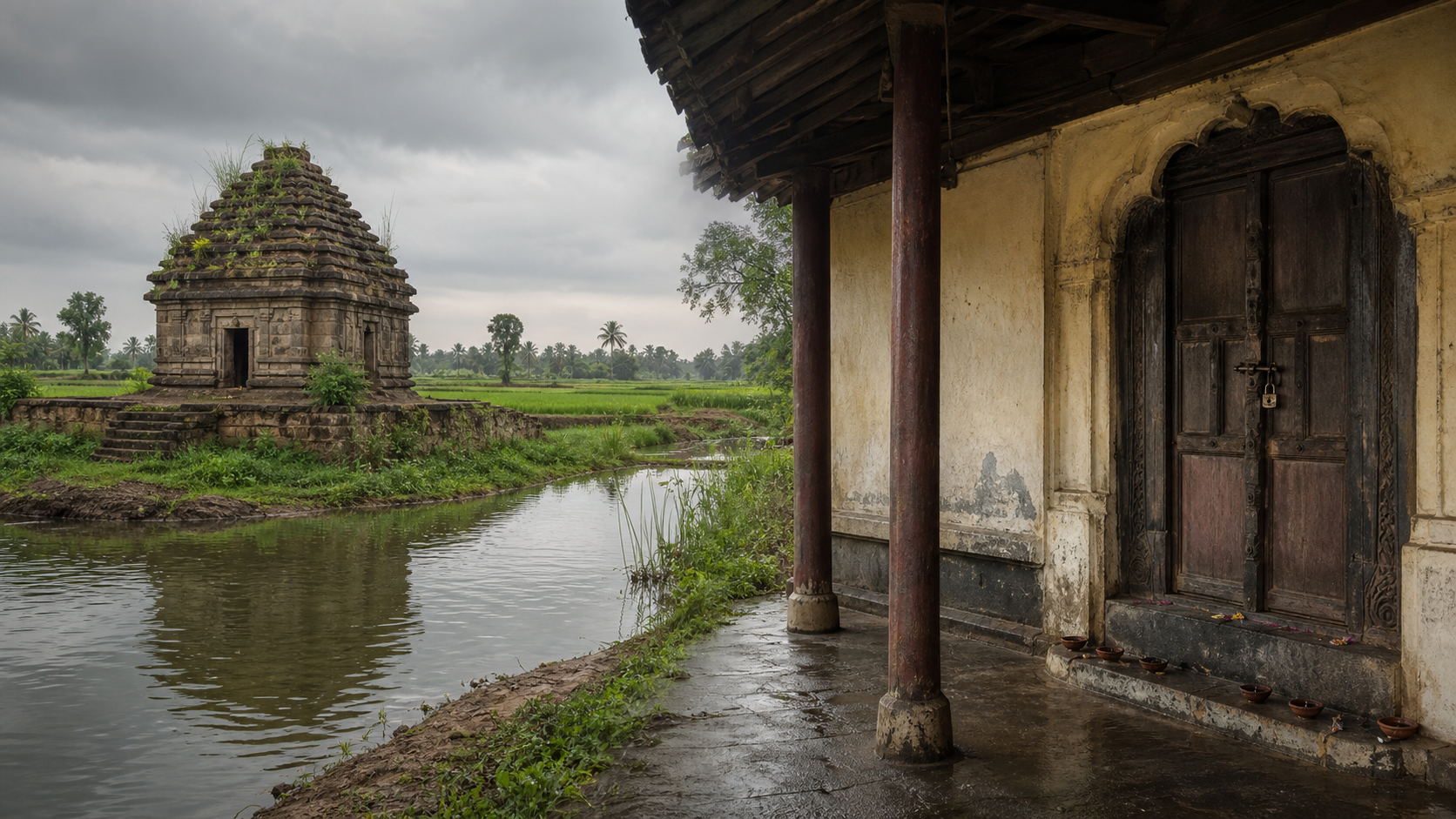
You may reach an old sacred place and wonder whether there is anything left to see. In one village, the temple is crumbling into an agricultural landscape. In another town, the sanctum is deliberately closed for most of the year. Neither place is empty. Each asks you to recognise a different form of heritage before deciding how to visit, document, or help preserve it.
The temple-water corridor at Devarabelakere in Karnataka and the Navratri-only Durga shrine at Paralakhemundi in Odisha offer a practical lesson: sacred heritage can fade through physical neglect, but it can also remain hidden through ritual discipline. If you approach both with the same expectations, you will misread one as a ruin and the other as an inconvenience.
Heritage disappears in two different ways
At Devarabelakere, invisibility is spatial. You have to leave the main road, follow the waterworks, notice an old channel depression, and continue along an embankment between cultivated land before the surviving shrines become legible. Modern infrastructure and fields have not erased the sacred landscape completely, but they have made its organising logic difficult to see.
At Paralakhemundi, invisibility is temporal. The shrine stands in an inhabited neighbourhood, yet its sanctum remains unavailable to ordinary public darshan through most of the year. Access is concentrated during Navratri. The correct question is therefore not merely, “Where is the temple?” but, “When does this temple reveal itself, and under whose ritual discipline?”
That distinction changes how you behave. A fading structure calls for careful observation, non-invasive documentation, and urgent conservation attention. A secluded living shrine calls for patience, confirmation of the local calendar, and obedience to community rules. In both cases, the first duty is to understand what kind of sacred place you have entered.
Key takeaways
- Do not equate poor physical condition with a loss of sanctity. A damaged shrine may still contain a worshipped murti or Linga.
- Do not equate closed doors with abandonment. At Paralakhemundi, restricted access is part of the shrine’s ritual life.
- Read the surroundings as evidence. Channels, embankments, fields, groves, roads, and settlement patterns can explain why a temple stands where it does.
- Preserve uncertainty in your notes. The proposed location of the medieval Haridra installation is a field interpretation awaiting further corroboration, not a conclusively recovered dam.
- Ask before photographing, entering, touching, cleaning, or moving anything. Devotional intent does not replace the authority of custodians or the need for archaeological care.
At Devarabelakere, read the water before the stone
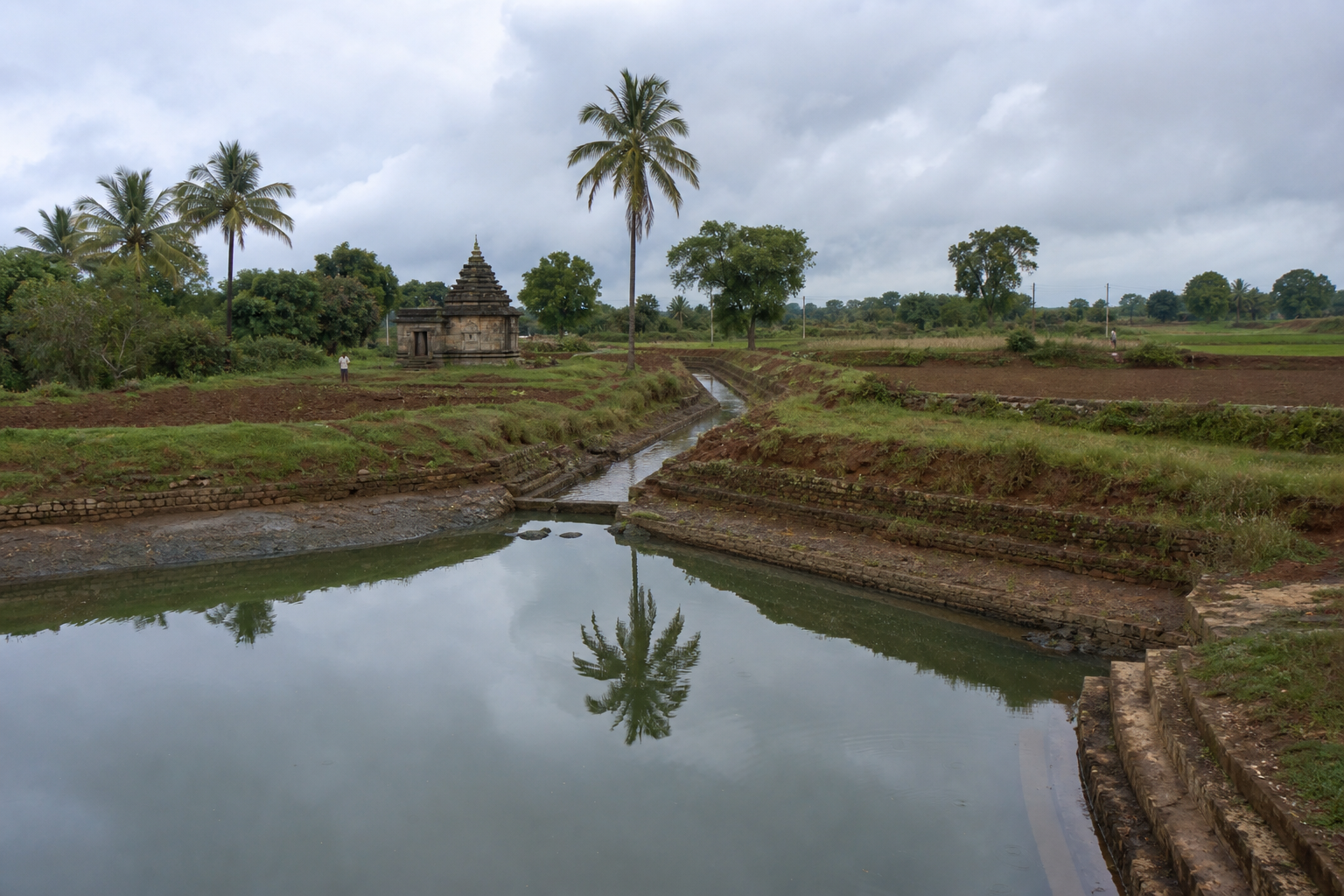
Devarabelakere lies on the Davanagere side of the northwest route from Bengaluru, reached through Shamanur from the NH-48 approach. The modest Mailaralingeshwaraswamy Mandira is the last clear landmark before the hydrological landscape begins. A narrow lane beside it leads toward the Devarabelakere Check Dam, a modern pick-up weir and reservoir complex built between 1978 and 1986.
The modern structure is not itself the principal heritage clue. Look downstream. A shorter alignment and a low trough in the terrain have been associated with the lost Haridra Dam and its channel system. Vijayanagara-era records place that communitarian hydraulic work in the reign of Devaraya I, but its original fabric has been destroyed. A field survey in 2003 identified the low depression below the modern weir as the likely basin of the Haridra, a Tungabhadra tributary; that identification still requires corroboration from future discoveries.
This uncertainty is not a reason to ignore the landscape. It is a reason to look more carefully and describe less aggressively. A shallow depression, remnant channel alignments, and a raised embankment can support a historical interpretation without proving every part of it. If you make field notes, write “probable channel” or “locally identified basin” where the evidence remains provisional. Do not convert a working hypothesis into a dramatic certainty for a caption or social-media post.
Two routes descend near the dam exit. The paved route on the right goes toward the riverbed. The left route follows an earthen embankment between an arecanut-and-coconut plot and a broad paddy field. Roughly a kilometre along that embankment is a ruined stone mandapa, commonly identified as the Kali or Kalleshwara Temple. It stands on a mud-covered mound without a proper approach. Inside are a pillared rangamandapa and a garbha-griha containing a Shiva Linga.
Before approaching, notice the condition of the building. Its masonry joints are opening and some courses are listing. Those signs indicate a real possibility of structural failure. Do not lean on pillars, climb the mound by pulling on dressed stones, or enter an area that appears unstable. A close photograph is not worth accelerating damage or placing yourself beneath shifting masonry.
The temple also carries an epigraphic memory that is no longer easy to verify on the structure itself. In 1902, the Archaeological Survey of India recorded a pillar inscription dated to 1054 CE, during the reign of Kalyana Chalukya ruler Someshvara I. The inscribed pillar is now understood to have been replaced or smoothed beyond legibility. That loss shows why documentation matters: once an inscription disappears from the surface, even an intact-looking pillar cannot recover the historical information it carried.
The record commemorated a grant by Vijayapandita, described as Kaliyuga Dhanvantari, to the spiritual preceptor Sovarasi. Revenue from the donated land was assigned to naivedya, a perpetual lamp, ghee, decoration, and illumination for the deity identified as Kali. The evidence supports an interpretation in which a shrine associated with Kali was later absorbed into a Shaiva identity as Kalleshwara. What survives, then, is not a monument frozen at one founding moment. It is a place whose ritual identity changed while sacred use continued.
Continue about 300 feet beyond the Kalleshwara mound and another small Shiva shrine appears in a coconut grove. It is also deteriorating, although its Linga remains. The two shrines stand along the left bank of the presumed diversion channel. Their position makes better sense when you read temple, water, and cultivation as one system rather than as separate subjects.
A diversion weir does not need to resemble a vast modern dam. By briefly holding monsoon flow and raising the water level, such a work could send water into a lateral channel serving fields, settlements, and sacred establishments. In 1410 CE, 108 public-spirited Brahmanas of Harihara financed the Haridra Dam. Their intervention linked agricultural productivity with a sacred economy sustained by land, offerings, lamps, teachers, and worship.
When you visit, therefore, do not frame the temples so tightly that the water landscape disappears. Make one set of observations from the structure outward: orientation of the shrine, relation to the embankment, distance from the suspected channel, nearby cultivation, and the route connecting the sites. The landscape is not background scenery. It is part of the historical evidence.
At Paralakhemundi, the calendar is the doorway
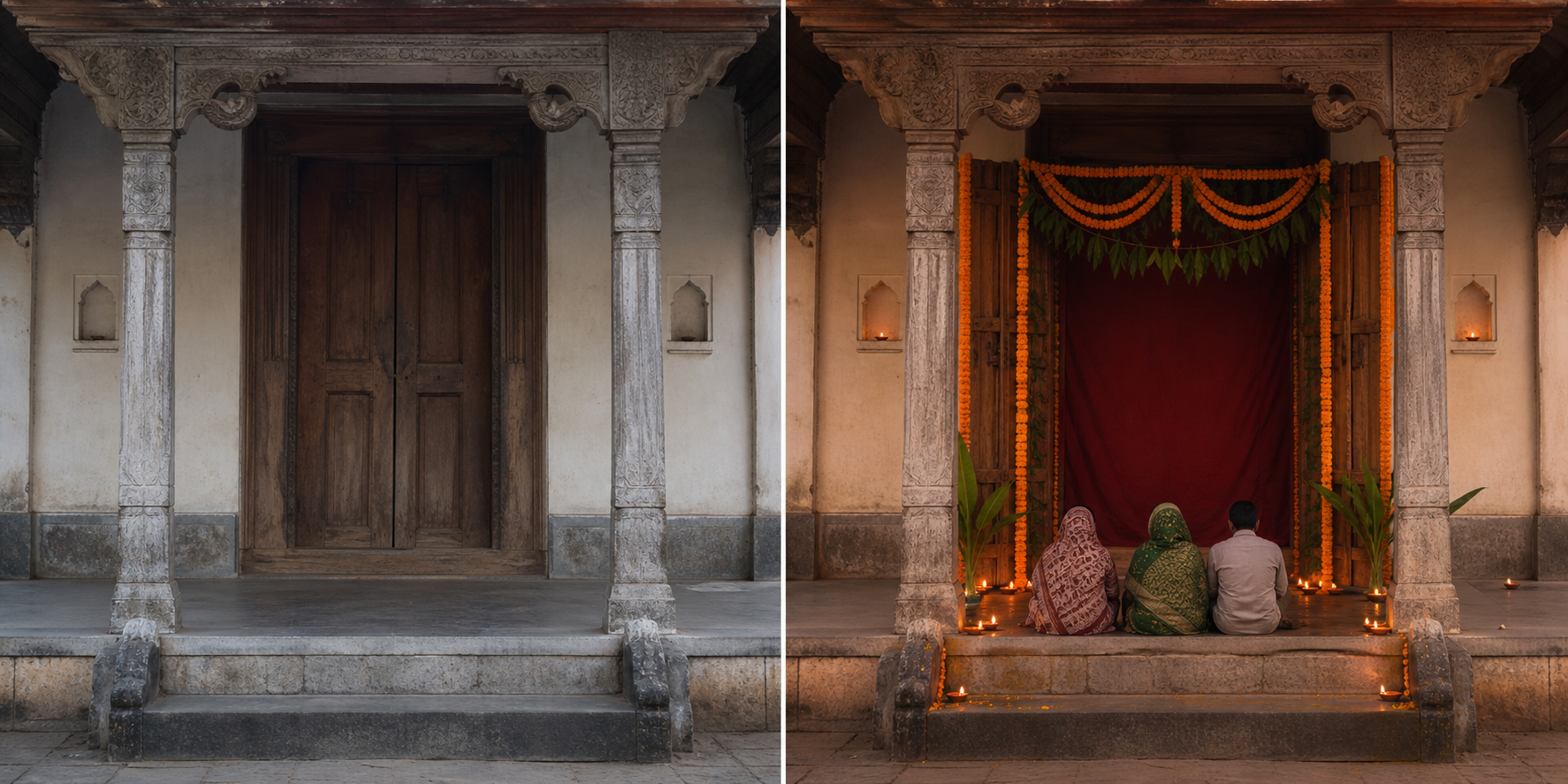
The Paralakhemundi Durga Temple stands on Dandumala Street, close to Dola Tank Road in Odisha’s Gajapati district. It is dedicated to Dandu Maa, who is also known across the Odisha-Andhra cultural border as Dandu Maramma. You can locate the neighbourhood shrine and still fail to encounter its central ritual life, because public darshan is ordinarily limited to Navratri.
Do not treat that schedule as an inconvenient opening-hours policy. The seclusion belongs to the temple’s sacred rhythm. In Shakta practice, restricted access can protect the sanctum’s ritual discipline, concentrate vows and worship within an appointed period, and distinguish ordinary time from the intensified nine nights of Devi worship. The closed months and the open festival are two parts of the same observance.
Dandu Maa’s bilingual identity also deserves attention. “Maa” and “Maramma” do not mark competing ownership of the goddess. They reveal how village-protecting Shakti traditions cross a linguistic boundary and settle into local devotional speech. Paralakhemundi has long stood within an Odia-Telugu cultural interface, and the shared theonym makes that relationship audible in worship.
The most respectful way to plan a visit is to confirm the locally observed Navratri dates before travelling. Ashwin Navratri is the usual reference point, but some communities also observe Chaitra Navratri, and a generic festival calendar cannot tell you precisely when this particular sanctum will open. Local confirmation matters more than an assumption based on dates elsewhere.
During the festival, the worship follows recognisable Shakta forms while retaining local custom. These can include ghata-sthapana or kalasha installation, daily alankara, lamps, naivedya, and recitation of the Devi Mahatmya. Ashtami, Navami, their ritual juncture, and Vijayadashami carry particular importance. Do not presume that every rite will be public or that every visitor may photograph it. A ritual can be communal without becoming unrestricted.
If you attend, arrive early enough to follow local queue arrangements without pressing for privileged access. Dress modestly, lower your voice near the sanctum, and keep your phone away unless photography has been explicitly permitted. If images are allowed only in the outer precinct, accept that boundary. Rarity is not a licence to capture what the community regards as private.
Carry offerings and personal items without disposable plastic where practical, and follow whatever waste arrangements the organisers provide. Buying flowers, food, or devotional objects from local vendors keeps more of the festival economy within the community that sustains the temple during its long period of seclusion. This is a modest but direct form of support.
The larger lesson is that monumental scale is a poor measure of sacred importance. A neighbourhood shrine can hold a disciplined ritual calendar, intergenerational memory, and a regional identity extending across a state border. If you arrive expecting elaborate architecture alone, you may miss the real heritage: the community’s ability to maintain attention, restraint, and annual transmission.
How to visit without turning sacred places into content
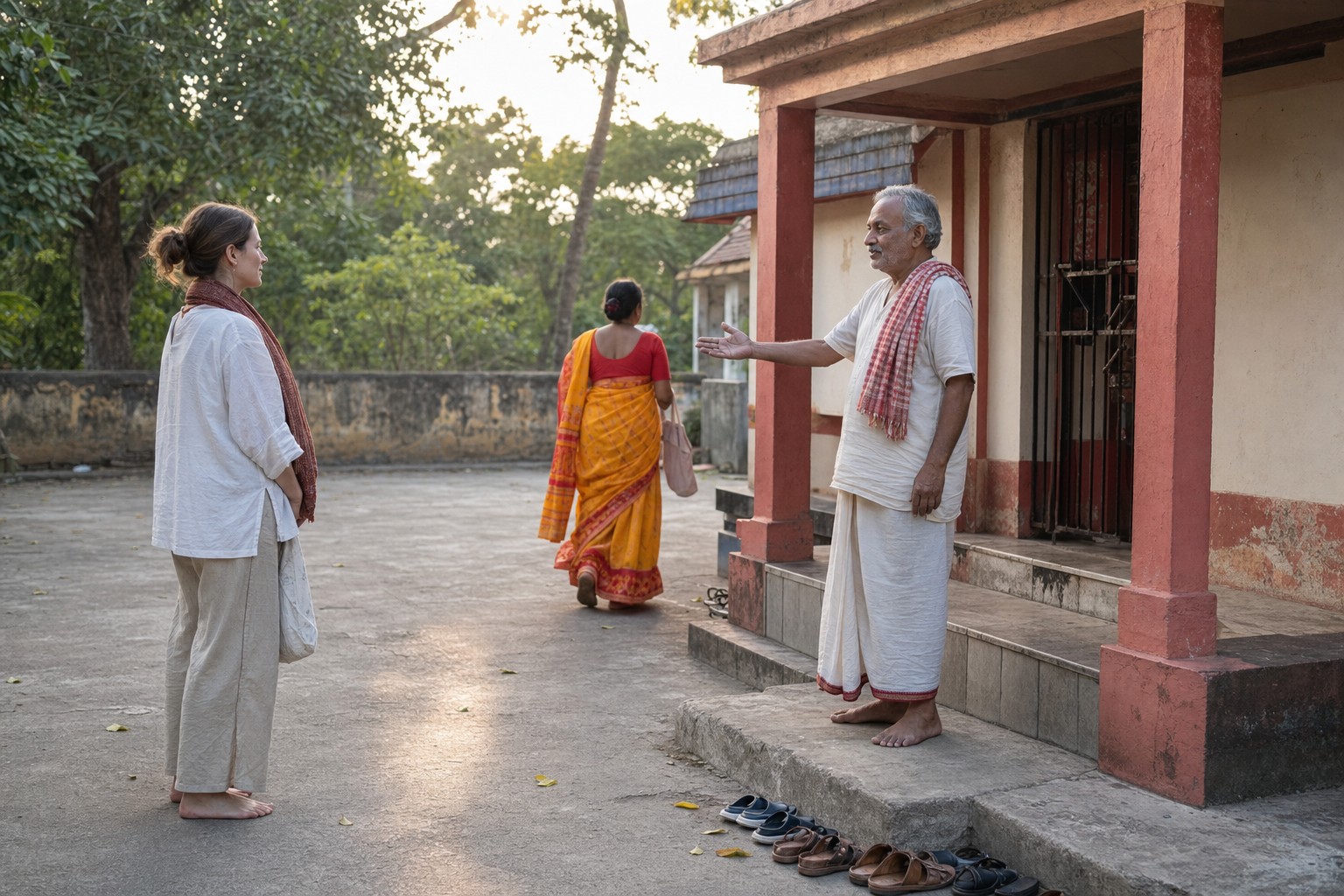
Hidden sites often become vulnerable at the moment they become visible online. A precise location can help serious visitors, but an unqualified caption can also encourage trespass, stone handling, intrusive photography, or crowds that the custodial community did not invite. The answer is not silence. It is disciplined documentation.
Use the following sequence when you encounter a little-known shrine:
- Identify its present status. Ask whether it is actively worshipped, seasonally opened, abandoned, privately maintained, or under institutional protection. Never infer abandonment merely from locked doors or damaged walls.
- Seek permission from the person who actually has standing. A nearby passer-by may know the local name but may not be authorised to permit entry, photography, cleaning, or publication. Look for a priest, recognised custodian, landholder, village representative, or festival organiser as appropriate.
- Record facts separately from interpretations. Note the visible material, local name, condition, surrounding features, and statements supplied by custodians. Label a historical reconstruction as a reconstruction. At Devarabelakere, the suspected Haridra basin and channel alignment must remain explicitly provisional.
- Leave the physical site unchanged. Do not rub an inscription, apply chalk or powder to make letters visible, reposition a murti, clear vegetation with tools, remove a loose fragment, or attempt a repair. These actions can destroy evidence even when they are presented as seva.
- Share selectively. Publish enough context to build awareness, but withhold sensitive interior images or exact approach details if custodians request privacy. For a fragile ruin, emphasise structural risk so that readers do not imitate unsafe access.
- Send useful material back. Give custodians copies of clear photographs, dates, transcriptions, or condition notes when they want them. Documentation should not flow only from the village to an outside audience.
A basic field record does not require specialised equipment. Write the date, local place-name, route used, names of features as given locally, visible condition, access restrictions, and the identity or role of anyone who granted permission. Photograph the overall setting before architectural details. If deterioration is visible, take comparable views from fixed, safe positions so later observers can notice change without touching the building.
Language matters as much as the images. “Neglected” may describe failing physical care, but it should not erase the people still offering worship. “Unknown” may mean unknown to an urban visitor, not unknown to the village. “Discovered” is especially misleading when local communities have preserved a name, festival, or devotional relationship for generations. Use descriptions that acknowledge local knowledge.
Preservation must protect relationships, not just structures
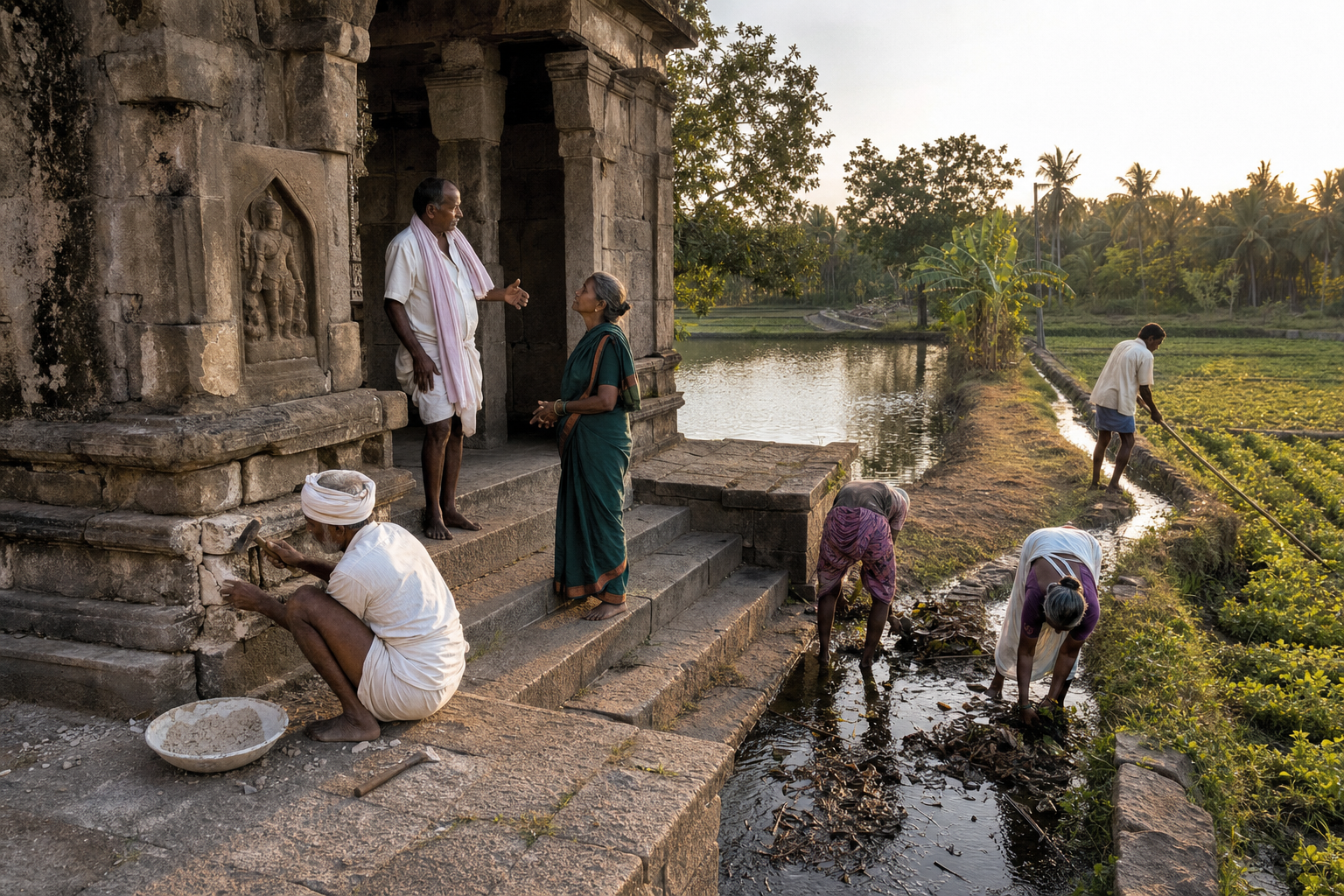
Devarabelakere cannot be understood by conserving a mandapa while ignoring its channel, embankment, fields, and inscriptional history. Paralakhemundi cannot be protected by keeping a building open for visitor convenience if year-long seclusion is integral to its tradition. Each place has a different preservation unit.
For the Karnataka corridor, the immediate priorities are condition documentation, professional assessment of unstable masonry, protection of surviving sculptural and epigraphic surfaces, and mapping of the probable hydraulic alignments. The work should preserve degrees of certainty. The 1054 CE inscription is documented history; the exact identification of the lost Haridra basin remains open to further evidence. Mixing those two evidentiary levels weakens rather than strengthens the case for conservation.
For the Odisha shrine, stewardship means protecting the community’s authority over access, the Navratri calendar, bilingual devotional memory, and the transmission of etiquette and worship to younger generations. Periodic closure may reduce physical wear, but its importance is not merely conservation-friendly. It carries religious meaning. Any future heritage programme should begin from that meaning rather than treating it as an obstacle to tourism.
Both places also correct a narrow idea of Indian civilisation as a collection of famous monuments. The Devarabelakere landscape preserves the interaction of Jaina, Shaiva, and Vaishnava presences, agricultural endowment, public engineering, and temple service. Paralakhemundi preserves a Shakta tradition shaped by Odia and Telugu devotion. Their plurality is not a modern slogan imposed on the past. It is visible in where people built, what they endowed, how names travelled, and how worship changed without severing sacred continuity.
If one of these places is within reach, choose one concrete act. At Devarabelakere, prepare a careful condition record without entering unstable masonry and share it with an appropriate local or heritage custodian. At Paralakhemundi, confirm the Navratri schedule locally, attend within the community’s rules, and support the people who maintain the festival. Heritage survives when attention becomes accountable service.
References
- DharmaRenaissance Blog — Haridra Dam to Vijayanagara: Field Evidence, Inscriptions, and Karnataka’s Fading Shrines
- DharmaRenaissance Blog — Paralakhemundi’s Hidden Durga Temple: Sacred Seclusion and the Navratri-Only Opening