
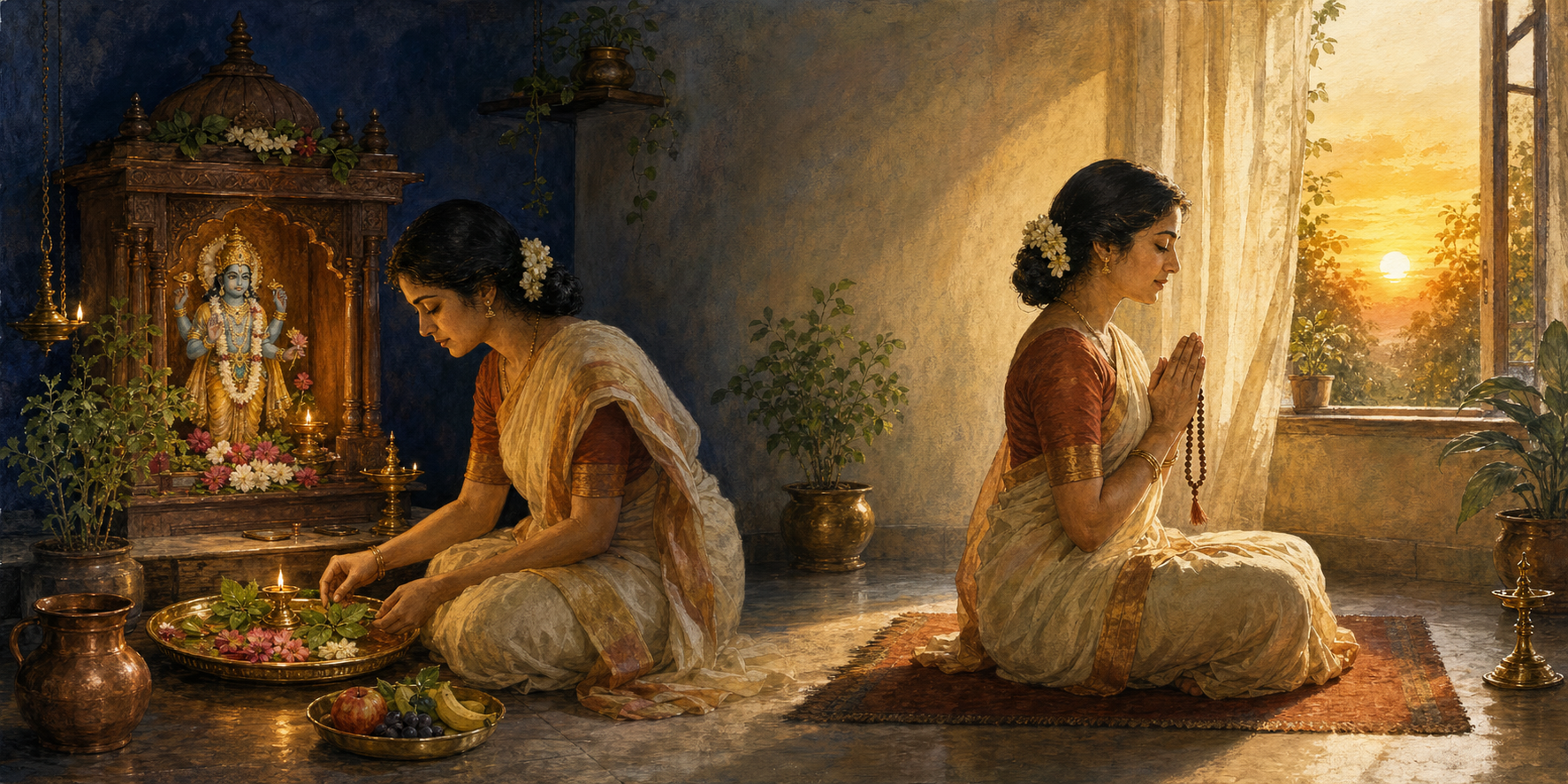
If you are deciding whether to keep the Ekadashi fast on April 12 or April 13, mark Monday, April 13. In the Indian Panchang timing used here, Sunday remains Krishna Paksha Dashami until 9:19 PM, so Ekadashi begins only on the night of April 12.
That makes April 12 the preparation day and April 13 the vrata day for most Smarta and Vaishnava observances governed by the tithi present at sunrise. Your local Panchang and sampradaya still have the final word, especially for the exact parana window.
Key takeaways
- Krishna Paksha Dashami continues until 9:19 PM on Sunday, April 12, after which Ekadashi begins.
- Most sunrise-based Smarta and Vaishnava calendars will assign the Ekadashi fast to Monday, April 13.
- Use April 12 for a lighter sattvika diet, svadhyaya, japa and practical preparation rather than treating it as the principal fasting day.
- Break the fast on Dwadashi after sunrise, inside the locally prescribed parana window and after Hari Vasara.
- Do not reuse Indian reference times unchanged in another city. Sunrise, sunset, avoidance periods, Nakshatra, Chandra Rashi, Yoga, Karana and parana must be checked locally.
Why the Ekadashi fast falls on April 13
A tithi does not begin at midnight. It is determined by the changing angular separation of the Moon and Sun, so its boundaries move independently of the civil calendar. Each tithi covers 12 degrees of lunar-solar elongation. Dashami runs from 108 degrees to less than 120 degrees; Ekadashi runs from 120 degrees to less than 132 degrees.
On April 12, the required separation does not reach the Ekadashi range until 9:19 PM. The date therefore contains two tithis: Dashami through almost the entire day, followed by Ekadashi at night. Midnight does not decide which civil date receives the vrata.
For the conventions relevant here, the decisive test is the tithi prevailing at sunrise. April 12 begins under Dashami, while Ekadashi prevails at sunrise on April 13. This is why beginning the principal fast on Sunday merely because Ekadashi starts that night would misread the observance rule.
This distinction also explains why two calendar displays can show different labels without necessarily contradicting one another. One may display the tithi that rules at sunrise; another may display every tithi transition occurring during the civil date. Read the accompanying start or end time before deciding that either calendar is wrong.
Many regional almanacs place these dates in Chaitra Krishna Paksha. Month names can nevertheless differ under amanta, purnimanta and regional conventions. If the month label changes while the tithi timing remains aligned, follow the naming system used by your family, temple or lineage rather than combining two systems.
A practical observance plan for April 12 and 13
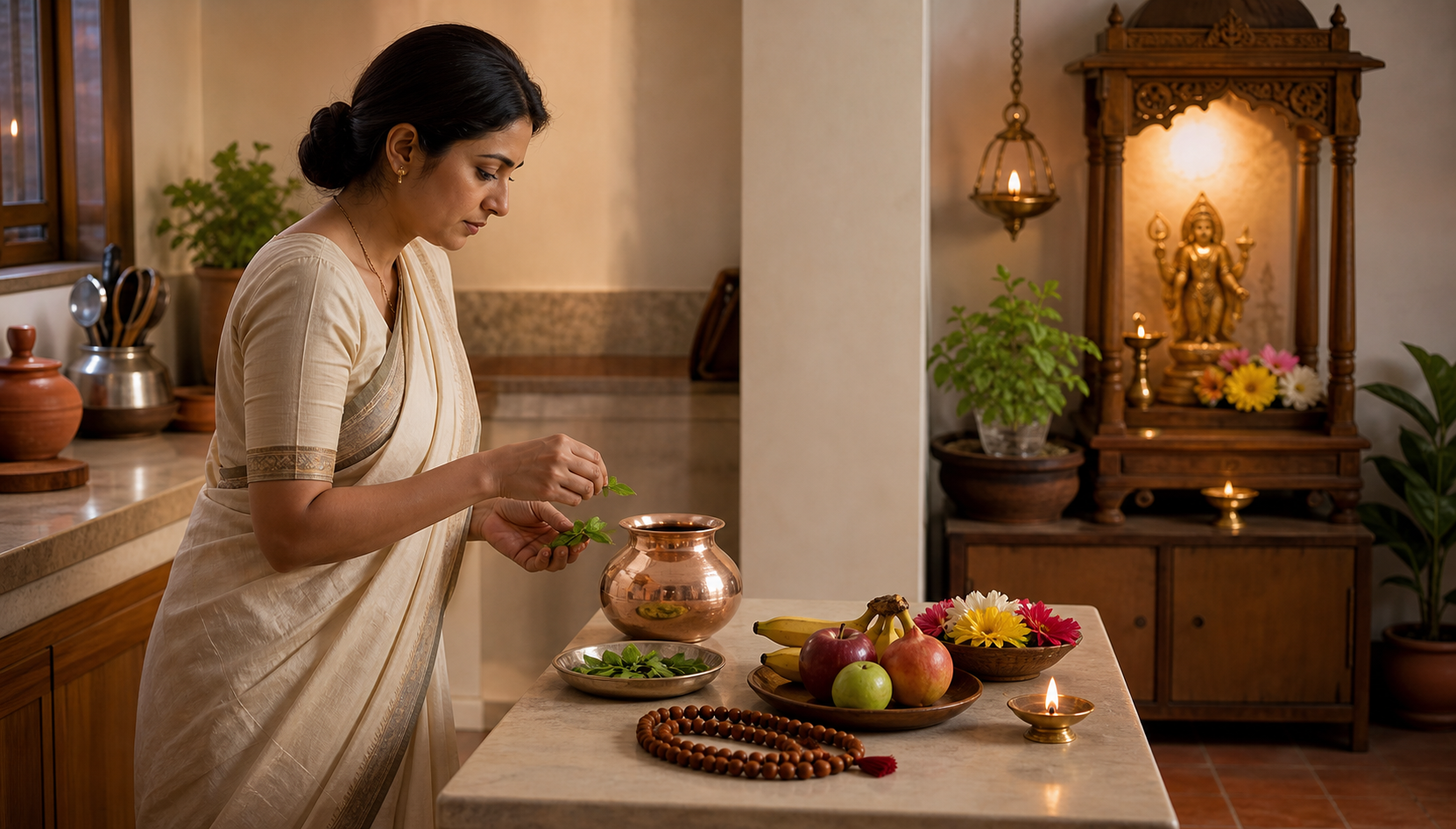
- Before April 12, select a Panchang calculated for your city. Record the local sunrise on April 13, the vrata designation used by your sampradaya, and the next Dwadashi parana window.
- During April 12, treat Dashami as preparation. Simplify meals, prefer a light sattvika routine, reduce heavy or rajasic food, and finish demanding household arrangements early. The point is to enter the vrata steadily rather than spend Ekadashi negotiating avoidable distractions.
- After the 9:19 PM reference transition, you may give the evening more fully to japa, prayer or quiet study. The tithi has begun, but most sunrise-based observers should not confuse that astronomical boundary with a separate instruction to move the official fasting date back to April 12.
- At sunrise on April 13, undertake the vrata in the form prescribed by your tradition. Keep the day oriented toward remembrance, self-restraint, svadhyaya, ahimsa, dana and satya instead of reducing it to a food rule.
- On Dwadashi, perform parana after sunrise within the stated local window. Confirm when Hari Vasara ends; do not assume that any convenient time after sunrise is automatically valid.
Keep the vrata larger than its menu
The dietary discipline gives structure to Ekadashi, but the structure is meant to support attention. A day spent arguing over ingredients while neglecting speech, conduct and remembrance has preserved the container while losing much of its purpose. Decide your permitted food and drink in advance according to your lineage, then leave the day free for sadhana and service.
The same inner disciplines echo across the broader Dharmic family without making the practices identical. Buddhist uposatha reflection, Jain poshad and vrata culture, and Sikh emphases on seva and simran each retain their own theological and communal settings. Their presence can remind us that restraint becomes spiritually meaningful when joined to awareness, compassion and truthful conduct.
If fasting would create a health risk or interfere with prescribed medication, do not improvise a severe regimen. Seek medical guidance and ask a knowledgeable sampradaya adviser which form of observance is appropriate. A vrata should deepen dharma, not turn necessary care into a test of pride.
How to use the April 12 Panchang for practical timing
April 12 is a Dashami preparation day, but you may still need to schedule travel, begin a task or conduct routine worship. The familiar muhurta frameworks can help, provided you calculate them from local sunrise and sunset rather than copying fixed clock times.
Abhijit Muhurta is the most useful fallback for an urgent beginning when a more carefully selected muhurta is unavailable. It is a window of roughly 48 minutes centered on local true solar noon. That does not mean 12:00 PM to 12:48 PM everywhere: Abhijit must be centered on the locality’s solar noon.
Rahu Kalam, Yamagandam and Gulika Kalam are generally avoided for initiating important, sacred or consequential activities. If sunrise were exactly 6:00 AM and sunset exactly 6:00 PM, the illustrative Sunday periods would be:
- Yamagandam: approximately 12:00 PM to 1:30 PM.
- Gulika Kalam: approximately 3:00 PM to 4:30 PM.
- Rahu Kalam: approximately 4:30 PM to 6:00 PM.
Those are not universal April 12 clock times. They assume a 12-hour day. For a real calculation, take the interval from local sunrise to local sunset, divide it into eight equal segments, and use the Sunday placement supplied by your city-specific Panchang. A later sunrise or longer day shifts both the beginning and duration of each period.
Sunday’s daylight Choghadiya follows the sequence Udveg, Chal, Labh, Amrit, Kaal, Shubh, Rog and Udveg. Labh, Amrit and Shubh are generally supportive; Kaal, Rog and Udveg are usually avoided for a new beginning. A favorable Choghadiya is one input, not permission to ignore a conflicting avoidance period or an unsuitable Nakshatra.
These restrictions concern initiation. They need not make you anxious about every ordinary action already in progress. Use them when choosing the start of something significant, not as a reason to suspend necessary care, established duties or routine spiritual practice.
What must be verified for your city and lineage
No single locality-free calendar can responsibly provide every Panchang limb for your intended moment. The Moon continues moving through Nakshatras and Rashis, while sunrise and solar noon change by longitude, latitude and time zone. Check the following fields in one internally consistent local Panchang:
- Your city and time zone. A Panchang calculated for an Indian city should not be treated as a clock-time calendar for Toronto, London, Singapore or another locality.
- Local sunrise and sunset on April 12 and 13. These govern sunrise-based observance and the division of daytime avoidance periods.
- Tithi at sunrise and the local tithi ending time. This confirms whether the April 13 Ekadashi assignment remains applicable where you live.
- The exact vrata listing used by your tradition. If your temple or sampradaya publishes a Smarta, Vaishnava or other lineage-specific calendar, use that classification rather than silently substituting a generic one.
- The Dwadashi parana opening and closing times, together with the end of Hari Vasara. Hari Vasara is the initial one-fourth portion of Dwadashi and is avoided for breaking the fast.
- Nakshatra and Chandra Rashi at the intended moment. Nakshatra identifies the Moon’s position among 27 equal lunar mansions of 13 degrees 20 minutes each; Rashi identifies its zodiacal sign.
- Yoga and Karana when selecting a sensitive muhurta. Yoga derives from the combined solar and lunar longitudes, while Karana divides a tithi into half-tithi units and adds finer timing detail.
- Locally calculated Abhijit Muhurta, Rahu Kalam, Yamagandam, Gulika Kalam and Choghadiya if you are planning a significant beginning on April 12.
If two calendars disagree, do not average their times. First check whether they use the same city, time zone, sunrise convention, lunar-month system and sampradaya rule. A precise number generated under the wrong convention is less useful than a modest answer from the calendar your tradition actually follows.
Before April 12 arrives, write down three things from that local calendar: the confirmed fasting date, the April 13 sunrise, and the Dwadashi parana window. If they support the April 13 observance, let Sunday become what Dashami is well suited to be here: a quieter runway into the vrata, not a second day of uncertainty.