

If you are deciding whether to support a Devasthan Inam reform, do not begin with the word abolition. Begin with a harder question: after the law changes, who will own each parcel, who may use it, and what dependable income will still reach the temple?
That question matters because a temple parcel is not merely vacant land waiting for a more efficient owner. It may be the asset that pays for daily worship, festivals, repairs, food distribution, education, healthcare, or the families and artisans who keep a living tradition functioning. A reform can correct an inequitable tenure without extinguishing this public purpose, but only if its design separates cultivation rights from permanent alienation of the endowment.
Start with the cash flow, not the label “abolition”
Devasthan Inam lands historically included tax-exempt or revenue-assigned properties granted to temples, mathas, and related trusts. Their produce or rent supported nitya, or daily, worship; naimittika, or occasional, observances; annadanam; maintenance; and community services. The endowment was therefore a financing arrangement as much as a form of tenure.
Post-Independence Inam abolition had a legitimate agrarian purpose: dismantling intermediary interests, regularising cultivation, and advancing equity. The difficulty is that the same legislative label can conceal very different legal operations. A measure may convert an old tenure into a modern patta or ryotwari title, recognise an occupant’s rights, vest ownership in the state, alter leasing powers, or permanently transfer the underlying title. You cannot judge the result until you know which operation the draft actually performs.
This is also why a promise of future government support is not automatically equivalent to land-backed income. A temple that owns a productive asset can plan around rent or produce. A temple dependent on annual appropriations must wait for administrative decisions that may change. If a proposal removes an income-producing right, its replacement mechanism should be written into law, ringfenced for the endowment’s purposes, and enforceable when payments are delayed.
Before taking a position, ask the department or temple board for a parcel-wise impact statement containing:
- The exact interest being abolished, converted, vested, or retained.
- The present titleholder, recorded occupant, actual occupant, and basis of possession.
- The gross income, collection cost, and net income for a clearly stated accounting period.
- The worship, conservation, welfare, and service obligations currently paid from that income.
- The proposed replacement revenue, the authority responsible for paying it, and the remedy for non-payment.
- The treatment of existing leases, rent arrears, pending proceedings, and disputed boundaries.
- Whether the change can be reversed if records are later found to be wrong.
Do not rely on a general explanation of the policy when the legal consequence is parcel-specific. Inam, revenue, tenancy, limitation, and endowment laws differ across states, and the entries in a revenue record may not answer every title question. A trustee or occupant facing mutation, transfer, eviction, or litigation should obtain advice from a lawyer familiar with the applicable state laws before signing a consent, surrender, lease, or settlement.
Build a parcel register that can survive a dispute
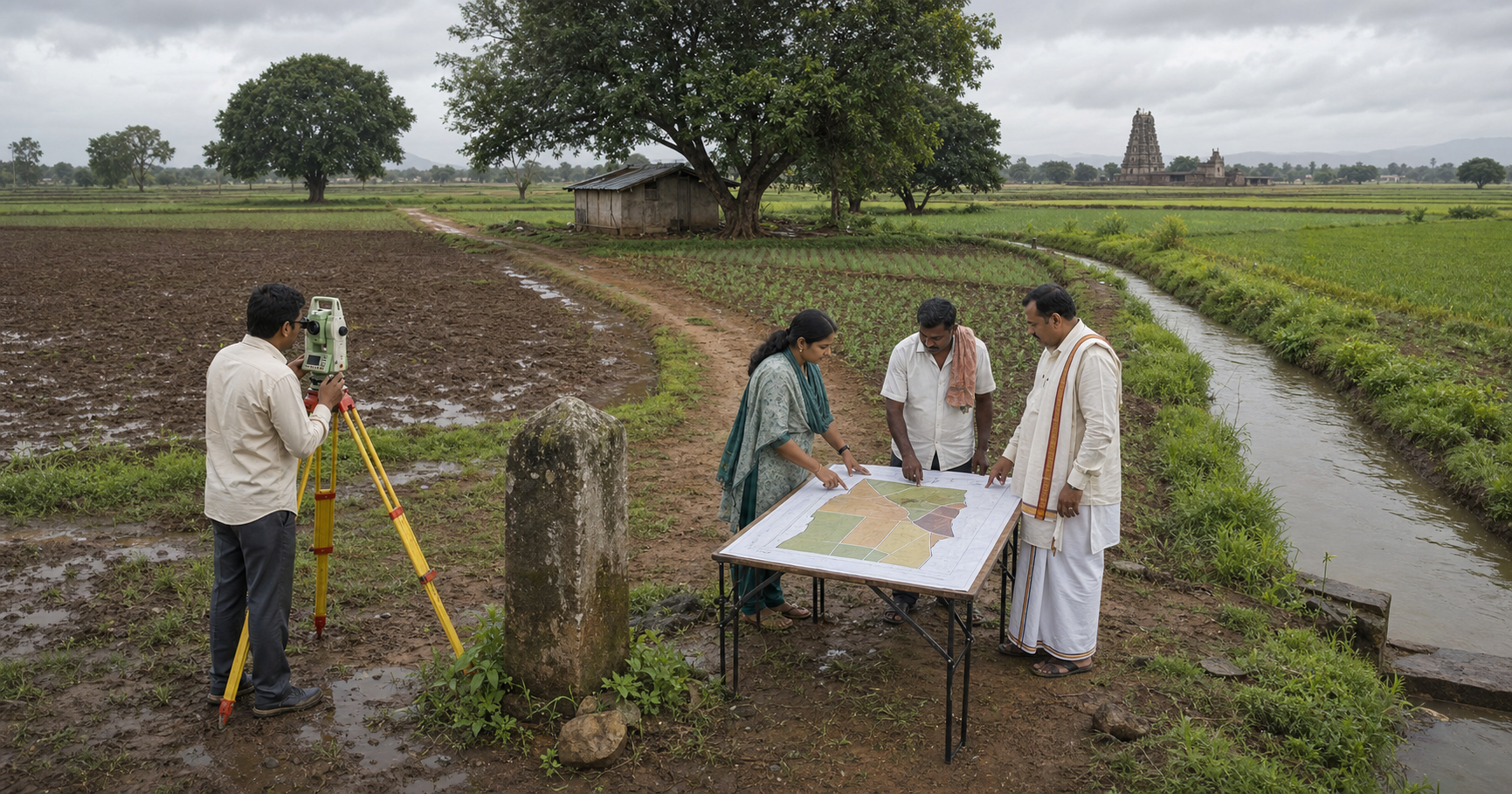
An acreage total is not an asset register. It does not tell you whether the temple can enter the land, collect rent, renew a lease, defend a boundary, or prove that the income is dedicated to a religious or charitable purpose. Each parcel needs four connected records: legal status, physical reality, occupation, and endowment use.
| Register layer | What to record | What it helps you detect |
|---|---|---|
| Legal | Grant or endowment instrument, survey number, revenue classification, patta or ryotwari entry, mutation trail, restrictions on transfer, and pending cases | A break in title, an unauthorised mutation, or a conflict between temple and revenue records |
| Physical | Cadastral boundary, GIS coordinates, access route, present land use, structures, conservation features, and dated ground verification | Boundary movement, subdivision, loss of access, or occupation that exists only on the ground |
| Occupancy | Occupant’s identity, claimed basis, lease or licence, term, rent, payment record, succession or transfer claim, and actual use | An expired arrangement, informal subletting, disputed possession, or a tenant wrongly described as an encroacher |
| Purpose and finance | Whether the parcel is ritual-critical, heritage-sensitive, welfare-supporting, or non-core; income received; collection cost; and expenditure head funded | Whether a proposed transfer would interrupt worship, conservation, or a community service |
The sequence matters. First reconcile the temple’s deeds and registers with endowment-department and revenue records. Then verify the boundary and occupation on the ground. After that, classify every mismatch: clerical error, missing mutation, tenancy dispute, boundary dispute, unauthorised occupation, or suspected alienation. Different defects need different remedies; putting all of them into an “encroachment” column creates bad decisions and weak cases.
GIS mapping, drone surveys, geo-fencing, and durable perimeter markers can make fresh intrusion easier to detect. They cannot, by themselves, establish legal title. Use them to connect the documentary record to the physical parcel, not to replace the documentary record. Every digital entry should show when it was verified, by whom, and which underlying instrument supports it.
Publish a useful public summary: parcel identifier, extent, broad location, tenure status, authorised use, lease status, dispute status, and income category. Personal information that is not necessary for accountability need not be exposed. The point is to let devotees and affected communities see whether the corpus is intact without turning an asset register into an intrusion on private data or ritual affairs.
Do not force a false choice between cultivators and the deity
A family that has cultivated land for a long period may have a serious livelihood interest. That does not automatically settle title. Conversely, a missing lease paper or irregular rent record does not automatically prove opportunistic encroachment when institutional records themselves are fragmented. Fair reform begins by determining the legal and factual basis of occupation before attaching a label.
A humane decision ladder can protect livelihoods while preserving the endowment:
- Verify the claim. Compare the occupant’s documents, payment history, possession, and claimed succession with temple, revenue, and endowment records.
- Correct the record where possible. Resolve clerical mistakes, survey mismatches, and unrecorded but valid arrangements before beginning coercive proceedings.
- Mediate eligible cases. If continued cultivation is compatible with the endowment’s purpose, consider a documented arrangement rather than permanent transfer.
- Use a renewable long-term lease or revenue-sharing model. Set rent through a transparent valuation method, provide a stated review mechanism, prohibit informal transfer, and preserve the endowment’s title.
- Protect ritual and heritage land. Parcels needed for worship, processions, water systems, access, archaeological fabric, or conservation buffers may require exclusive possession and should not be treated as interchangeable agricultural inventory.
- Provide relocation support where justified. If an otherwise deserving occupant cannot remain because the land is essential to religious or conservation use, assess a lawful rehabilitation route before eviction.
- Reserve eviction for clear, non-eligible occupation. Give notice, disclose the relied-upon records, allow objections, obtain an executable order, and provide access to the applicable appeal or review process.
A lease is not a complete solution unless it is governed well. Trustees need a calendar for renewals and rent revisions, a system for issuing receipts, an arrears protocol, and an inspection process that catches unauthorised construction or subletting. A low rent that is never reviewed can quietly drain the endowment just as effectively as a formal transfer.
Private regularisation bargains are especially dangerous. Any settlement should use published eligibility criteria, an independent valuation, the approvals required by law, and an entry in the public asset register. Otherwise, a policy intended to protect a vulnerable cultivator can become a channel for insiders to acquire trust property.
Use six tests to judge the law and the governing board
Articles 25 and 26 frame the constitutional setting. Where a religious denomination’s rights are engaged, Article 26 protects management of religious affairs and administration of property in accordance with law. The state may regulate secular property administration to address mismanagement, but that power should not be used to disable the institution’s religious functioning. This distinction is more useful than the slogan that either the state or the temple must control everything.
- Continuity test: After the reform, can the institution still fund its established daily and occasional worship, maintenance, festivals, and charitable obligations?
- Corpus test: Does the measure preserve endowment title where a lease, usufruct arrangement, revenue share, or better enforcement could meet the agrarian objective?
- Constitutional test: Does secular oversight improve records, finance, and accountability while leaving ritual priorities and religious affairs to the competent religious body?
- Equity test: Are good-faith cultivators distinguished from speculative or recent encroachers through published evidence and due process?
- Reversibility test: Can an erroneous mutation or classification be corrected before the land reaches a third party, or is the loss effectively permanent?
- Consistency test: Would comparable standards of transparency, corpus protection, and religious autonomy be acceptable for Hindu temples, Buddhist viharas, Jain derasars, and Sikh gurdwaras?
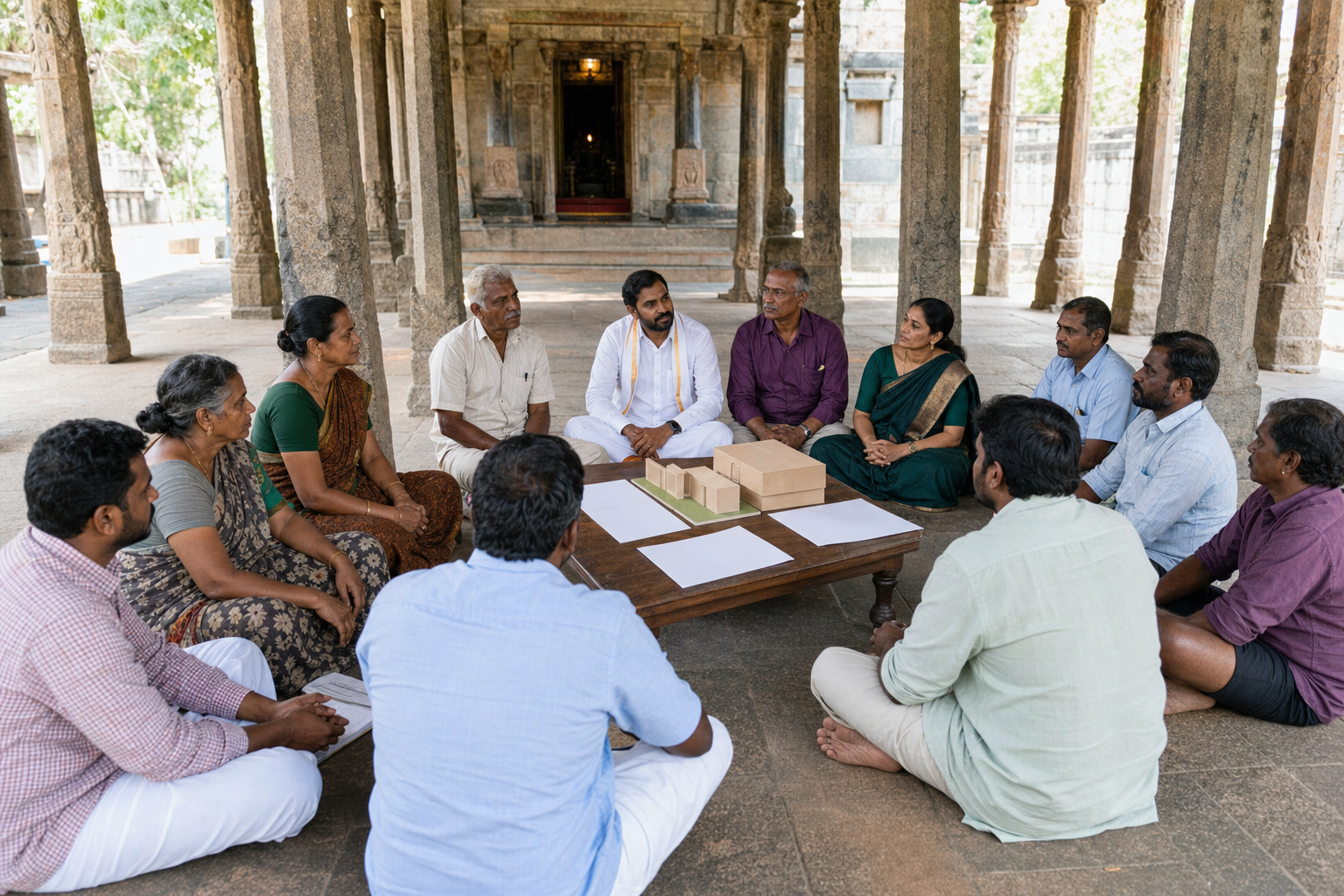
The institutional design should reflect those tests. The religious authority sets worship and service priorities. A professional estate team maintains records, manages lawful leases, and collects revenue. An independent audit examines asset integrity and use of funds without auditing doctrine or ritual choice. Revenue and endowment authorities correct records and enforce valid orders. A specialised adjudicatory route can reduce the delay that otherwise rewards continued unauthorised occupation, provided it preserves notice, evidence, and meaningful review.
The VHP has called for withdrawal of the proposed abolition measure and a time-bound campaign against encroachments. That is a defensible sequencing position: inventory the land, correct the records, enforce existing protections, and measure the remaining problem before making an irreversible tenure change. It is not enough, however, to promise an encroachment drive. The programme also needs deadlines, published classifications, due process for occupants, recovery of rent where appropriate, and reporting on land restored to productive endowment use.
The same discipline applies to temple boards. Invoking autonomy does not excuse missing deeds, opaque leases, uncollected rent, or unauthorised alienation. Religious autonomy and fiduciary accountability reinforce each other when audits protect the corpus and follow the money without attempting to direct worship.
Key takeaways
- “Abolition” is not a result. Identify whether the proposal converts tenure, recognises occupancy, vests title, changes leasing power, or permanently alienates the land.
- For every affected parcel, trace the link from title to income and from income to worship, conservation, or welfare.
- Do not confuse mapping with proof of title. Reconcile deeds, revenue entries, mutations, possession, leases, and boundaries.
- Protect legitimate cultivators through verified, transparent arrangements where possible; do not make permanent transfer the default remedy.
- Keep ritual and heritage decisions with the religious institution while subjecting secular asset management to professional records and public accountability.
- Pause an irreversible reform when the parcel inventory, financial impact, occupant protocol, or replacement revenue mechanism is missing.
If a proposal is active in your state, ask in writing for four things before endorsing it: the draft law and rules, the parcel-wise asset register, the income-and-obligations statement, and the protocol for cultivators and encroachment cases. Those documents turn a political argument into a decision you can test.
Until they are available, trustees should avoid consenting to mutations or permanent transfers, and authorities should avoid treating every occupant alike. Secure the records first, preserve the trust corpus, and choose the least destructive legal remedy that can deliver both agrarian fairness and a functioning temple.


References
