

You may be planning a puja, ancestor remembrance, important commitment, or ordinary Sunday and wondering whether June 14 is suitable. The answer is not a blanket yes or no. The day’s character changes in the late morning, and the right choice depends on what you intend to begin.
The central transition is from Krishna Paksha Chaturdashi to Amavasya at 11:14 AM. Use that time as a working reference, then verify it for your location. Tithi boundaries, sunrise, Nakshatra, Chandra Rashi, and muhurta intervals cannot be transferred safely from one city or time zone to another.
Key takeaways for June 14
- Before the locally verified 11:14 AM transition, Krishna Paksha Chaturdashi supports tapas, disciplined prayer, remedial observances, and Shiva-oriented worship.
- After the transition, Amavasya favors quiet sadhana, japa, charity, reflection, and pitri-tarpana where that rite belongs to your family or lineage.
- If you can choose another date for a major celebratory or worldly beginning, doing so is generally more consistent with the day’s inward character.
- If an important task cannot wait, calculate the local Abhijit Muhurat and also check Sunday’s Rahu Kaal, Yamaganda, and Gulika Kalam.
- Do not use the reported Amavasya ending of “8:45” for a time-sensitive rite. Its AM/PM designation and related context are unresolved, so the endpoint needs independent local confirmation.
- Do not copy a Nakshatra or Moon-sign entry from a calendar prepared for another place. Their applicable clock times depend on location and calculation method.
The 11:14 AM shift changes the purpose of the day
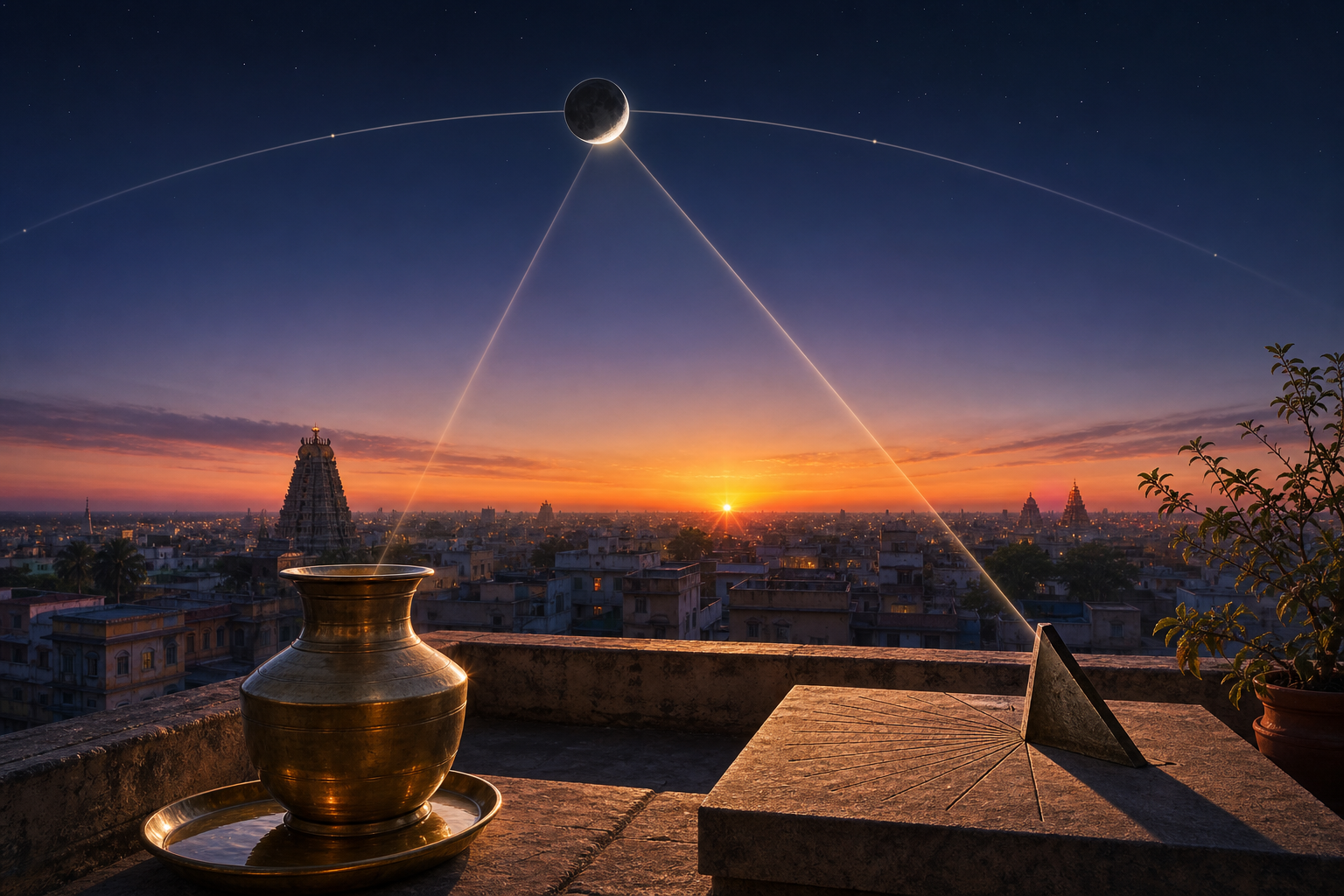
A tithi is not the same thing as a civil date. It is determined by the changing angular separation of the Moon and Sun, with each tithi covering a 12-degree interval. That is why a tithi can begin or end in the middle of your clock day and why June 14 has two distinct ritual phases.
| Working period | Tithi | Best use of the period | What to reconsider |
|---|---|---|---|
| Earlier part of June 14, until 11:14 AM | Krishna Paksha Chaturdashi | Tapas, focused japa, Shiva worship, self-discipline, and remedial observances | Do not assume the published clock time applies unchanged in your location |
| After 11:14 AM | Amavasya | Contemplation, silence, dana, service, cleansing observances, and customary ancestor remembrance | Optional major launches, festive inaugurations, and other high-stakes new beginnings |
Krishna Paksha is the waning half of the lunar month, and Chaturdashi is its fourteenth tithi. Its combination of restraint and concentrated worship makes the morning suitable for a practice that already has a clear spiritual aim. If you maintain a Shiva mantra, a simple morning session before the transition is more aligned with the tithi than turning the day into an elaborate social event.
Amavasya begins after the transition. It should not be reduced to an idea of a universally “bad day.” It is better understood as a strongly specialized day: less suited to outward celebration, more suited to purification, remembrance, accountability, and renewal. A day can be unsuitable for launching a worldly venture while remaining deeply valuable for spiritual work.
This distinction gives you a practical decision rule. If the purpose is prayer, restraint, charity, service, or remembering those who came before you, the day’s quality supports the intention. If the purpose is a wedding-related samskara, festive opening, major contract, or another consequential beginning for which you control the date, consult a complete local Panchang rather than treating a general daily entry as a final muhurta.
Calculate the Sunday intervals from local daylight
Your first task is to establish the correct location. A clock time calculated for India does not remain correct when carried to Toronto, London, Singapore, or another time zone. Even two places in the same time zone can have different sunrise, sunset, and solar-noon times.
Before scheduling anything sensitive to tithi or muhurta, record these five items from a dependable Panchang or temple almanac prepared for your city:
- Your precise location and civil time zone for June 14.
- Local sunrise and sunset.
- The local ending of Krishna Paksha Chaturdashi and beginning of Amavasya.
- The Nakshatra and Chandra Rashi at the time of your intended act, including any transition close to that time.
- The calculation standard being used, especially if your family follows a particular regional Panchang or distinguishes between Drik and traditional Surya Siddhanta calculations.
Rahu Kaal, Yamaganda, and Gulika Kalam are derived from the daylight interval, not from fixed all-season clock slots. Divide the period from local sunrise to local sunset into eight equal segments. For Sunday, Yamaganda occupies the fourth segment, Gulika the seventh, and Rahu Kaal the eighth.
| Interval | Sunday daylight segment | Formula |
|---|---|---|
| Yamaganda | Fourth | Sunrise + 3/8 of daylight to sunrise + 4/8 of daylight |
| Gulika Kalam | Seventh | Sunrise + 6/8 of daylight to sunrise + 7/8 of daylight |
| Rahu Kaal | Eighth | Sunrise + 7/8 of daylight to sunset |
Suppose D represents the exact duration from your local sunrise to sunset. Each segment is D divided by eight. Use the formulas above with the actual sunrise and sunset for June 14; do not substitute a generic Sunday chart whose clock times assume a fixed length of day.
Abhijit Muhurat provides another option when a necessary task cannot be postponed. It is centered on local solar noon and lasts approximately 48 minutes, extending about 24 minutes on either side. Local solar noon is not automatically 12:00 PM on the civil clock, so obtain it from an astronomical utility or a location-specific Panchang.
Abhijit is a practical window for necessity, not permission to ignore every other consideration. Confirm whether the intended act falls before or after the tithi transition, check the three Sunday avoidance periods, and ask a learned local practitioner when the activity is a consequential samskara. If different calculations place a boundary close to your intended minute, choose a time comfortably away from the boundary instead of trying to exploit a narrow edge.
A workable spiritual routine for the day
You do not need an elaborate ceremony to observe June 14 meaningfully. A restrained routine fits both the waning Chaturdashi morning and the Amavasya period that follows.
- Before sunrise, create a quiet period for meditation, mantra japa, or scriptural reflection. If Brahma Muhurta is part of your practice, calculate it from the local sunrise rather than importing another city’s clock time.
- During the Chaturdashi portion, perform your established Shiva-oriented worship or other disciplined sadhana. Keep the sankalpa specific: steadiness, correction of conduct, completion of a vow, or sincere prayer.
- If your observance must occur entirely within Chaturdashi, finish it before the locally verified transition. Leave a reasonable margin rather than planning to conclude at the final minute.
- After Amavasya begins, reduce outward activity where practical. Choose japa, silence, contemplation, dana, or direct service. Supporting a community kitchen or another charitable effort is a concrete way to turn inward reflection into care for others.
- Perform pitri-tarpana only in the manner customary to your family or lineage. If you have not been taught the rite, do not improvise technical steps from a generic calendar entry; seek family or temple guidance. Respectful remembrance, prayer, and charity can still give the day a clear ethical focus.
- In the evening, review one habit, obligation, or relationship that needs correction. Decide on one action you will carry into the next lunar cycle rather than leaving the reflection at the level of sentiment.
The wider Dharmic family also recognizes the moral usefulness of lunar rhythm, although its traditions should not be collapsed into one ritual system. Buddhist communities may align discipline with lunar phases. Jaina practice can emphasize pratikraman and heightened ahimsa. Sikh households may choose simran and ardas while continuing to use the Nanakshahi calendar for gurpurabs. If your household draws from more than one stream, honor the integrity of each practice instead of blending technical rites without guidance.
Match the Panchang to the decision in front of you
For ordinary duties, the Panchang does not require you to suspend life. Complete routine work, care for family, and meet existing responsibilities. The caution concerns elective beginnings and auspicious inaugurations, not the honest performance of duties already yours.
For a necessary secular action that cannot move to another date, identify local Abhijit Muhurat, remove any overlap with the locally calculated avoidance intervals, and keep the act simple. The Amavasya character of the day still favors humility over display.
For ancestor rites or another observance whose validity depends on the tithi endpoint, the unresolved “8:45” is decisive. It does not specify AM or PM and should not be guessed. Confirm the complete Amavasya span with a regional Panchang, your temple, or a competent practitioner before fixing the ritual time.
For a wedding, griha pravesh, major inauguration, or another samskara, tithi alone is not enough. The Moon’s Nakshatra and Rashi add timing information, and both must be checked for the intended location and hour. Family parampara, regional month convention, and the chosen computational system can also affect observance. Apparent differences between calendars are therefore not always mistakes; they may reflect different places or legitimate calendrical traditions.
Before June 14, write five things on one page: local sunrise, the Chaturdashi-Amavasya boundary, solar noon, the three Sunday avoidance intervals, and the exact practice you intend to perform. Share that plan with anyone participating. A few minutes of preparation will prevent a last-minute argument over copied clock times and let the day remain what it is meant to be: focused, quiet, and purposeful.
References
