
-
15 Timeless Tales from Srimad Bhagavatham: Devotion, Dharma, and Transformative Wisdom
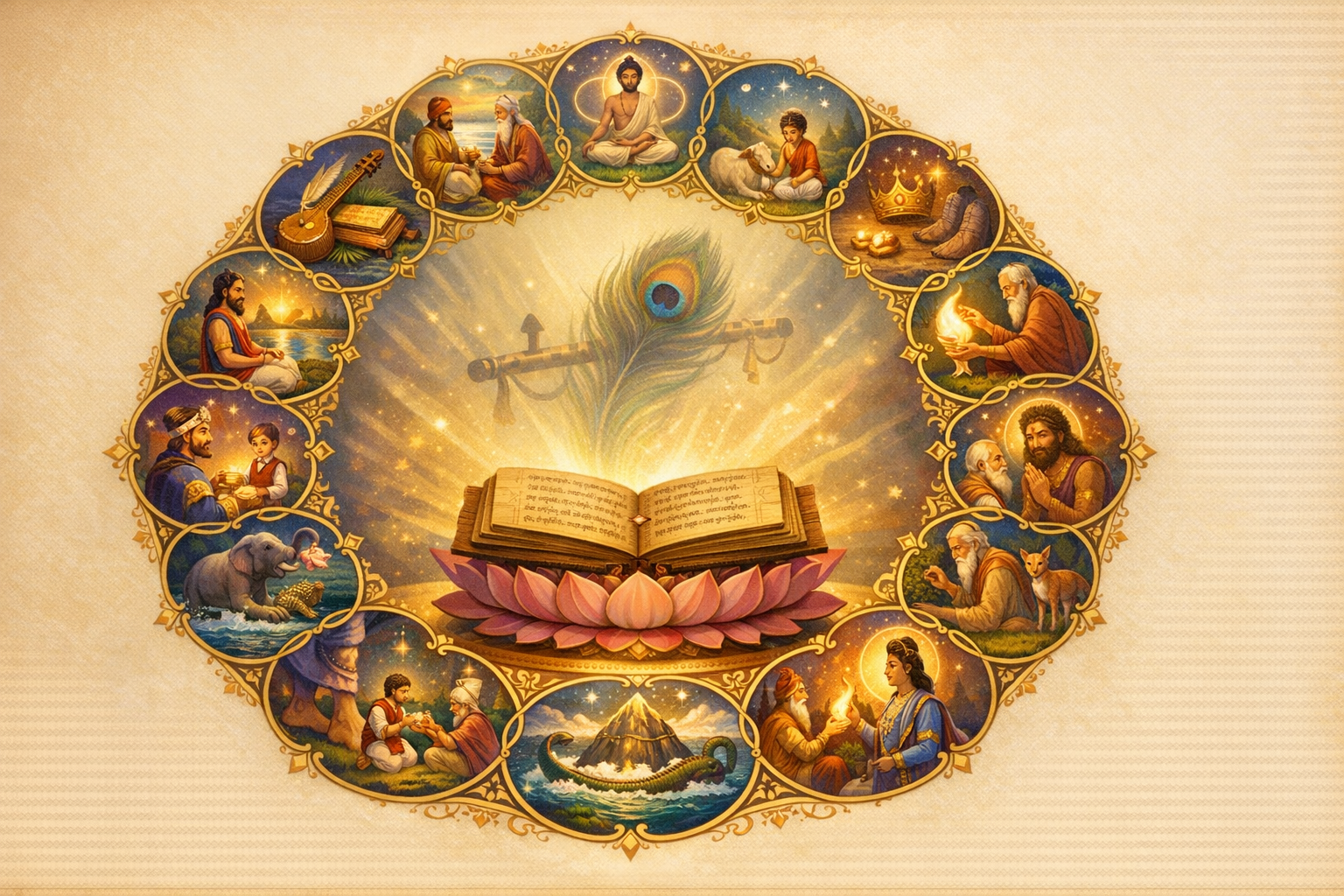
Srimad Bhagavatham (Bhagavata Purana) unites devotion, wisdom, and ethical action through narratives that are as practical as they are profound. This long-form guide curates 15 celebrated talesfrom Dhruva’s tapas and Prahlada’s fearlessness to Ambarisha’s forbearance and Krishna’s Govardhan-lilaeach situated in its Skandha context. Readers gain both narrative clarity and theological depth, including the power of…
-
Ravana, Ganesha, and Shiva’s Atmalinga: Decoding the Gokarna Legend, Symbolism, and Dharma

The legend of Shiva’s Atmalinga and Ravanacentral to the Gokarna Mahabaleshwar Temple traditionexplains how Ganesha redirected immense power to uphold dharma without violating Shiva’s boon. It frames the Atmalinga as Shiva’s undivided essence and shows that vows ethically constrain even divinely granted power. Ravana’s devotion is honored, yet the narrative cautions against concentrating absolute power…
-
When Power Bows to Wisdom: Kanha and Bahudi Yogini’s Yogic Duel Beyond Siddhis

The Kanha and Bahudi Yogini episode, preserved in the Mahanubhava tradition’s Lilacharitra and resonant with the Nath sampradaya, poses a classic dharmic lesson: siddhis may impress, but wisdom liberates. Presented with historical context from medieval India and anchored in Yoga philosophy, it maps the path from ethical foundations (yama–niyama) through meditative absorption (samadhi), showing why…
-
Divine Justice and Fallen Kings: How Hindu Scriptures Enshrine Honor for Women

Ancient Hindu scriptures deliver a consistent warning: mistreating women is adharma that invites downfallof men, dynasties, and entire realms. Drawing on the Mahabharata, Ramayana, Bhagavata Purana, and Dharmashastra, this analysis shows how narratives like Draupadi’s humiliation, Ravana’s abduction of Sita, Amba’s denial of agency, and Ahalya’s deception culminate in moral and political collapse. Legal traditions…
-
Thirunangur’s Eleven Divya Desams: How Shiva–Vishnu Harmony Shaped Tamil Nadu’s Sacred Landscape

Thirunangur near Sirkazhi hosts eleven closely clustered Divya Desams uniquely linked to a single sacred event in which Shiva’s Rudra Tāṇḍava leads Vishnu to manifest in eleven forms. This long-form guide situates the temples within Tamil Nadu’s Kaveri delta, clarifies the puranic and Āḻvār foundations of the tradition, and shows how Shaiva–Vaishnava harmony is lived…
-
Unveiling Brahma’s Wedding at Pushkar: Cosmic Timing, Gayatri’s Grace, and Yajna Power

Brahma’s marriage to Gayatri at Pushkar weaves together sacred geography, śrauta ritual law, and cosmic timing to explain why the Jagatpita Brahma Mandir and Pushkar Lake command exceptional sanctity. Drawing on Padma Purāṇa, Skanda Purāṇa, and regional memory, the narrative shows how the patnī-samyāja completes yajña, why muhūrta matters, and how Gayatri embodies both mantra-śakti…
-
Balarama’s Wrath and Wisdom at Naimisharanya: Dharma, Humility, and Romaharshana’s End

At Naimisharanya, Balarama’s startling decision to end Romaharshana’s life with a blade of kuśa grass becomes a profound lesson in dharma, humility, and institutional accountability. Set within the Bhagavata Purana’s sacred milieu, the episode weighs an assembly’s vow against the demands of ethical conduct in public religious life. By empowering Ugraśrava Sauti to complete the…
-
Nose Ring Miracle and Awakening: How Saraswati Bai Transformed Purandara Dasa and Carnatic Music

This long-form Hindu story examines the famed “Nose Ring of Grace,” where Saraswati Bai’s compassion catalyzes the spiritual awakening of Srinivasa Nayaka into Purandara Dasa, the Father of Carnatic Music. It situates the narrative within the Bhakti Tradition and the Vijayanagara Empire, explaining how a household act of dāna and dayā redirected a merchant’s life…
-
From Gourd to Glory: King Sagara’s 60,000 Sons, Kapila’s Curse, and the Descent of Ganga

This essay recounts the sacred narrative of King Sagara of the Ikshvaku dynasty: a childless sovereign who, through tapas and grace, fathered sixty thousand sons in an extraordinary birth motif remembered as “from pumpkin to princes.” It traces the aśvamedha episode, Indra’s theft of the horse, the princes’ confrontation with Kapila Muni, and their cremation…
-
When Agastya Drank the Ocean: The Cosmic Reset Behind Bhagiratha’s Ganga Avatara

This long-form exploration situates the startling image of Sage Agastya drinking the ocean within the Vedic–Puranic principle of rta (cosmic order) and reads it as the hidden prologue to Bhagiratha’s Ganga avatara. Drawing on references across the Ramayana, the Mahabharata, and Puranas such as the Skanda Purana, it explains how yogic containment (Agastya) and compassionate…
-
At the Guru’s Last Breath: A Mango, Mindfulness, and the Taste of Immortality

A classical Hindu teaching story recounts a Guru who, at the threshold of death, uses a simple mango to demonstrate how breath awareness, mindful attention, and remembrance reveal the peace of the Atman. The narrative is analyzed through the Bhagavad Gita and the Upanishads, showing how last-thought psychology aligns with daily practice in dhyana, japa,…
-
The Sacred Power of Small Acts: Hindu Scriptures on Daily Compassion and Life Mastery

Hindu scriptures teach that extraordinary lives are shaped by small, sincere actions aligned with dharma. Drawing on the Bhagavad Gita, Ramayana, Mahabharata, and Bhāgavata Purāṇa, this essay shows how everyday kindnessseva, dana, dayā, and ahiṁsābecomes transformative spiritual practice. It translates classical teachings like Karma Yoga and the Yoga Sūtra’s citta-prasādanam into practical micro-ethics for modern…
-
Sage Jaratkaru and the Serpent Princess: Dharma, Destiny, and the Rescue of the Nagas

This study of Sage Jaratkaru’s marriage to the serpent princess Jaratkaru situates the tale within the Mahabharata’s Adi Parva, where their destined son Astika averts Janamejaya’s snake sacrifice and rescues the Naga race. It analyzes the sage’s tension between asceticism and pitru-rna, showing how ancestral duty and spiritual striving can be harmonized without collapsing either.…
-
Devotion That Disarmed a Dacoit: Ramprasad Sen, Kali, and the Transformative Power of Grace

Set in eighteenth-century Bengal, this analysis revisits the famed encounter between the poet-saint Ramprasad Sen and Raghu the dacoit to show how devotion can disarm violence. It situates the legend within Shyama Sangeet performance, Kali worship, and the social volatility of the period. The story is unpacked theologically (kripa and sharanagati) and psychologically (music, breath,…
-
Divine Restraint: Bagalamukhi, Madanasura, and the Sacred Science of Vak Siddhi

Goddess Bagalamukhi, one of the Dasha Mahavidya, embodies Stambhana Shaktithe divine restraint that stills harmful speech and clarifies intention. The classical tale of Madanasura (Madana), who abused Vak Siddhi, frames an enduring ethic: as the power of voice grows, so must responsibility. This long-form study explores Bagalamukhi’s iconography, the mantra science around “Hleem,” and the…
-
The Golden Card Parable: How Discernment and Humility Unlock Dharma’s Hidden Wealth

A classic Hindu teaching story illustrates how cynicism, credulity, and humble discernment shape destiny. Three men receive identical envelopes promising wealth; only the one who asks, verifies, and follows conditions unlocks its value. Interpreted through dharmic ethics and behavioral science, the parable exalts shraddha, viveka, and guided practice. Cross-tradition insights from Hinduism, Buddhism, Jainism, and…
-
Brahma, Vishnu, and the Birth of Ego: A Powerful Hindu Lesson on Humility and Creation

This long-form analysis situates the well-known Purvakalpa scene of Brahma and Vishnu within Hindu cosmology to show how the birth of ego (ahamkara) emerges at the threshold of creation. It interprets the narrative through Samkhya’s technical cascadeprakriti, mahat, and ahamkaraclarifying why humility must precede and accompany creative agency. The discussion aligns the Vishnu-centered account with…
-
Sage Pippalada’s Covenant with Shani: A Purāṇic Vow Shielding Children from Saturn’s Trials

The Pippalada–Shani covenant, preserved in Purāṇic storytelling and Shani-mahātmya traditions, presents a striking synthesis of justice and compassion: at Sage Pippalada’s plea, Shani (Saturn) vows to spare very young children from his harsher influence. Grounded in the ethical lineage of Dadhīci and the pedagogical rigor of the Prashna Upanishad, this narrative reframes Saturn as a…
-
Decoding the Sacred Power of Om: Indra’s Epic Triumph in the Gopatha Brāhmaṇa Explained

The Gopatha Brāhmaṇa of the Atharvaveda preserves a striking motif: Indra and the devas overcome asuras through the sacred syllable Om. Read alongside the Chāndogya and Māṇḍūkya Upaniṣads, the narrative reveals Om as a ritual seed, acoustic map of consciousness, and instrument of non-violent victory. The symbolism frames Indra’s triumph as clarity over confusion, integrating…
-
Did Ashtavakra Curse Ravana? Evidence, Variants, and Dharma’s Powerful Warning on Ego

This long-form analysis examines the popular claim that Sage Ashtavakra cursed Ravana, distinguishing between canonical Ramayana sources and later oral retellings. It explains why the episode, though absent from early textual strata, persists as a compelling ethical parable about Dharma, ego, and consequence. The essay profiles Ashtavakra’s Advaita message and Ravana’s complex character, situating both…