
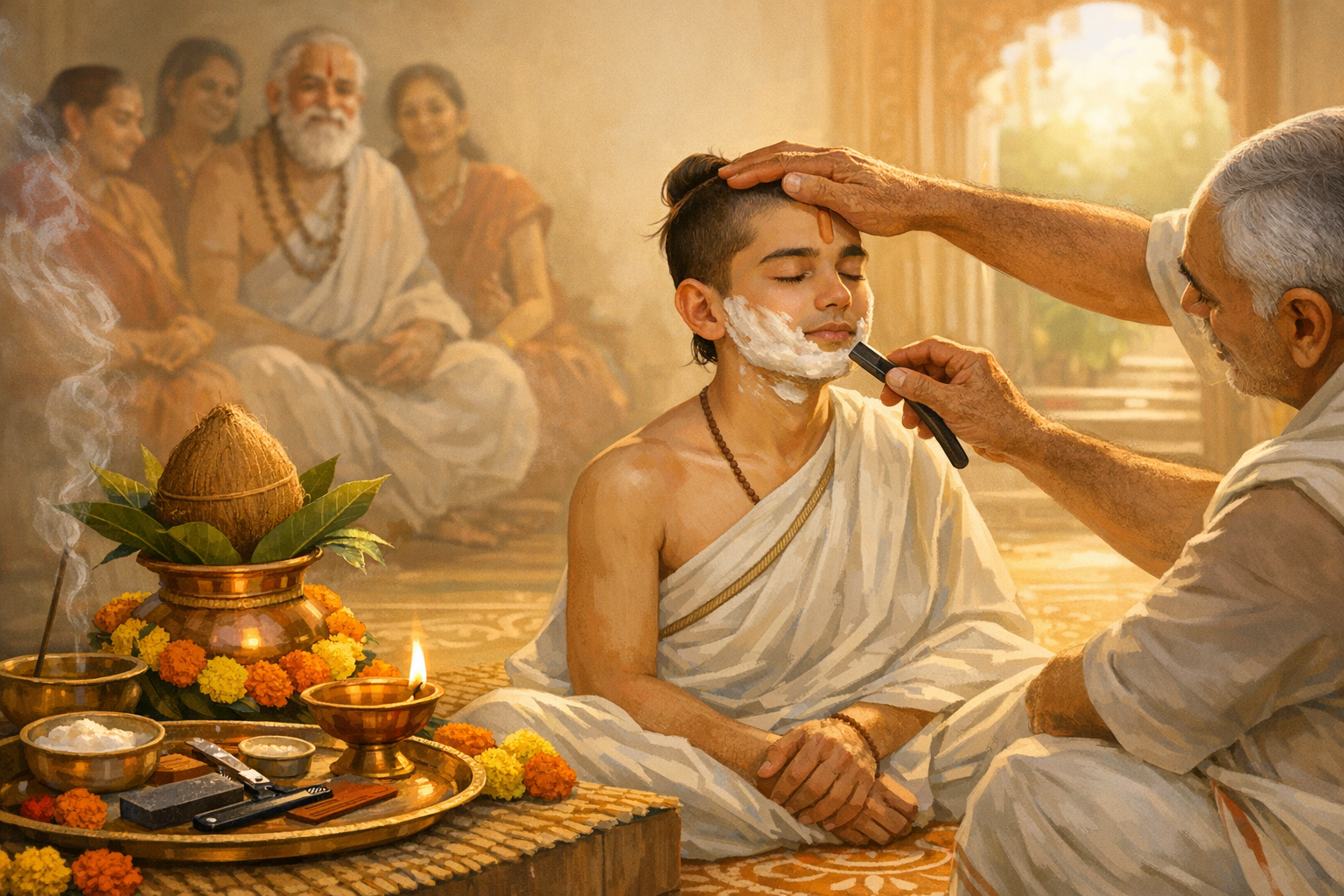
Within the structured rhythm of Hindu samskaras, Keshantaoften referred to in several ritual handbooks as godanastands as a pivotal coming‑of‑age rite. Traditionally associated with the first formal shaving, it signals the transition from early adolescence to disciplined youth and embeds the ethic of inner regulation into visible, bodily practice. Placed within the broader Vedic and post‑Vedic framework of life‑cycle observances, Keshanta belongs to the intricate matrix of Hindu rituals that weave social identity, spiritual aspiration, and dharmic responsibility into a single formative moment.
Textual traditions situate Keshanta in the lineage of Grihya Sutras and Dharmashastras, where it is treated as a rite of bodily refinement and social acknowledgment. While many schools describe it primarily as the first shaving of the beard and moustache, others attest to a more comprehensive regimen that may include the head and parts of the body such as the chin and armpits. The shared intent across sources is consistent: to mark the threshold where a student’s embodied life begins mirroring the restraint, cleanliness, and attentiveness expected in brahmacharya and beyond.
In numerous recensions, the rite is synchronized with the sixteenth year or the onset of facial hair, although regional and familial customs may adjust timing. Some lineages coordinate Keshanta with milestones of learningeither after foundational study or as a prelude to the more public transition of samavartana, when a brahmachari ceremonially concludes formal studentship. These variations reflect the broader pattern of Hindu rituals: uniform in aspiration yet flexible in application, always aligning with capacity, place, and time (desa‑kala‑patra).
The terminology invites careful reading. Keshanta literally evokes the “cutting or completion of hair,” and several authoritative lists treat Keshanta and godana interchangeably in the context of first shaving. Although the Sanskrit word go more commonly denotes “cow” or “senses,” later ritual glosses use godana in this samskara context to signal the formal offering or removal of hair; hence, it is prudent to understand godana here as a conventional synonym rather than a strict etymological derivation.
Distinguishing Keshanta from chudakarana (the early‑childhood tonsure) is central to accurate understanding. Chudakarana is typically performed in infancy or early childhood, often creating or honoring the sikha (tuft). Keshanta, by contrast, attends to the adolescent’s emergent facial hair and, in certain traditions, renews head and body shaving as a discipline aligned with study and restraint. Where the earlier tonsure forms a child’s belonging to lineage and deity, Keshanta frames a youth’s belonging to rule‑governed learning and self‑mastery.
Ritual architecture varies across regions but follows recognizable contours. An auspicious day is selected, often in consultation with local calendars and household tradition. After a purificatory bath (snana) and a formal intention (sankalpa), invocations to Ganesha and protective deities are offered, and the implements are ritually cleansed. The shaving proceeds under the guidance of elders or the guru, with attention to order and modesty; where the sikha is maintained by custom, it is preserved, while beard, moustache, and designated body hair are removed. Offerings of hair to water or fire follow in many lineages, together with gifts (dakshina) to the barber and charity to guests or Brahmanas.
Beyond procedure lies meaning. The rite inscribes the values of sauca (cleanliness), samyama (self‑restraint), and tapas (disciplined effort) onto the body itself, making visible the inner commitments of brahmacharya. It transforms the raw, unmanaged growth of adolescence into a sign of consent to order and responsibilitya lesson as social as it is spiritual. In this sense, Keshanta externalizes a pedagogical truth found across the Dharmasastra universe: that inner refinement is sustained by regular, mindful practices that harmonize the senses with discernment.
Keshanta also functions as a social covenant. The presence of family, community, and teachers transforms individual grooming into public acknowledgment of readiness to live by rules of study, speech, and conduct. Many households describe a quiet tenderness at this momentthe hush that settles as the first strokes begin, the elder’s palm upon the youth’s head, and the shared understanding that childhood is giving way to steadier responsibilities. The rite thus entwines emotion with obligation, memory with aspiration.
Textual witnesses span major Grihya Sutras and Dharmasutras, including schools associated with Apastamba, Baudhayana, Gautama, Asvalayana, and Paraskara, and later expositions in the Dharmashastra tradition such as Manusmriti and Yajnavalkya Smriti. While precise prescriptions differsome emphasize only beard and moustache; others include head and limited body hairthe overarching rationale remains stable: first shaving is an index of maturation, ritual purity, and educational discipline. This consensus, accompanied by local variability, typifies the samskara genre as a whole.
Relationship to adjacent samskaras is particularly instructive for students of Hindu rituals. Upanayana initiates formal study and the vows of brahmacharya; Keshanta, in many traditions, punctuates the mid‑course or culmination of that training by refining the external marks of the student’s life; samavartana then publicizes competence and confers the status of snataka, the one who has “bathed out” from formal tutelage. Read together, these rites narrate a coherent pedagogy: commitment, discipline, and mastery, each dignified by its own ceremony.
Questions of inclusion and scope recur in contemporary discussion. Traditional texts largely frame Keshanta for males; however, Hindu samskaras have always been taught as modulated by time, place, and family. Households rightly adapt with care and conscienceretaining the rite where it speaks to their lineage, or embracing equivalent markers of growth and study for daughters without replicating hair‑focused practices. What endures across genders is the educational and ethical core: the commitment to cultivate inner steadiness and responsibility.
Placed within the wider dharmic family, hair rites illuminate a profound, unifying theme. In Buddhism, monastic ordination entails shaving as a sign of renunciation; in Jainism, kesh‑lonchanaritual hair removalexpresses radical non‑attachment; in Sikhism, kesh (unshorn hair) is revered as a sacred trust. Together they demonstrate a single insight articulated through diverse practices: the body can be a vessel for discipline and devotion, and different paths honor that truth through distinct, equally valid signs. Honoring Keshanta within Hinduism naturally coexists with honoring these cognate practices, strengthening mutual respect and unity among Hindu, Buddhist, Jain, and Sikh traditions.
Modern observance benefits from sensitivity to health, ecology, and context. Clean instruments, informed consent, and attention to modesty uphold the rite’s dignity. Where hair is offered to rivers or fire, families increasingly opt for practices that avoid environmental strain, such as responsible collection and composting where appropriate, or small ceremonial consignments that minimize impact. Diaspora communities frequently integrate Keshanta with school calendars and community gatherings, preserving continuity without sacrificing prudence.
The psychological dimension is often understated yet essential. For adolescents, Keshanta can feel like crossing a thresholdmoving from being managed to managing oneself. Elders frequently observe a subtle shift in posture and speech after the rite, as youths align their self‑image with the responsibilities acknowledged in public. The ceremony’s measured solemnity helps transmute anxieties about growing up into a quiet confidence rooted in tradition.
Is Keshanta obligatory for all Hindus? Dharmashastra literature frames samskaras as ideals calibrated by capacity and context; what is central is the cultivation of dharma, not rigid uniformity. Where Keshanta is meaningful, it deepens belonging and resolve; where family or inter‑tradition commitmentssuch as in Sikh households that honor keshsuggest otherwise, the same dharmic goal is served by alternative practices of discipline and study. Unity in purpose with diversity in form is the hallmark of the dharmic ethos.
In sum, Keshanta (godana) is a precise yet adaptable rite of passage. Rooted in the Grihya Sutras and Dharmashastras, it refines the student’s life through embodied discipline; distinguished from childhood tonsure, it inaugurates a new seriousness suited to learning and service; and read alongside related practices in Buddhism, Jainism, and Sikhism, it highlights the shared conviction that sacred discipline may be worn on the body in different, equally luminous ways. Preserved with care and adapted with wisdom, Keshanta continues to guide Hindu families seeking to align growth with grace, study with self‑command, and tradition with a living sense of unity across the dharmic world.
Inspired by this post on Hindu Blog.
