
-
On Gita Jayanti, Bhismadeva’s Lens Reveals Krishna’s Dharma for Inner Peace and Purpose

Gita Jayanti commemorates the advent of the Bhagavad Gita, when Krishna shared Vedic knowledge with Arjuna. A lecture by HG Radhika Ramana Dasa at ISKCON of New Jersey explored the Gita through Bhismadeva’s perspective, highlighting duty with detachment and surrender to the Divine. The event emphasized Mokshada Ekadashi observances and practical ways to engage with…
-
Bhagavad Gita Jayanti 2025 on December 1: Significance and Heartfelt Ways to Celebrate

Gita Jayanti 2025 will be observed on Monday, December 1, aligning with Shukla Paksha Ekadashi in Margashirsha, also known as Mokshada Ekadashi. The day commemorates Lord Krishna’s rendering of the Bhagavad Gita to Arjuna at Kurukshetra, revered as a living holy scripture. Observances include Gita parayan, collective recitation, satsang, Ekadashi fasting, and acts of seva…
-
Stop Overthinking, Start Living: Hindu Wisdom for a Life of Presence and Joy

Hindu wisdom highlights a simple paradox: the more life is overanalyzed, the less it is truly lived. Drawing from the Hindu way of life and allied dharmic traditions, the path emphasizes presence, ethical action (dharma), and mindful awareness over relentless explanation. Karma yoga reframes daily duties as opportunities for clarity by releasing attachment to outcomes.…
-
Mastering Purushaartha: A Transformative Guide to Dharma, Artha, Kaama & Moksha

Purushaartha offers a complete frameworkDharma, Artha, Kaama, and Mokshafor a life that is ethical, prosperous, joyful, and inwardly free. Rather than rejecting wealth or desire, it refines them through Dharma so they support higher clarity. Practical steps include right livelihood, generosity, mindful restraint, and steady yoga-meditation practice. The Bhagavad Gita and the Upanishads inform a…
-
Bhagavad Gita as a Living Guide: Chaitanya’s Moving Lesson on Devotion, Duty, and Unity

The Bhagavad Gita offers practical guidance for daily life through duty, selfless action, and devotion. A noted account from Chaitanya Mahaprabhu’s travels in South India highlights how a sincere heart can grasp the Gita’s essence beyond textual study. The image of Krishna guiding Arjuna’s chariot symbolizes trust, ethical action, and inner steadiness. These themes align…
-
Detached Engagement in Dharma: Harness Emotions Without Attachment for Inner Freedom

Detached engagement offers a dharmic way to live fully while remaining inwardly free. The approach honors emotions and even strong impulses, yet channels them through discernment and ethical restraint. Rooted in the Bhagavad Gita’s nishkama karma and supported by Upanishadic witness-awareness, it unites action with non-attachment. Parallel insights from Buddhism, Jainism, and Sikhismupekkhā, Aparigraha, sehaj,…
-
Sacred Stillness, Lasting Clarity: A Dharmic Guide to Mindful Observation over Endless Seeking

Modern life rewards endless seeking, yet dharmic wisdom demonstrates that mindful observation offers deeper clarity and freedom. Drawing from Hindu philosophysakshi-bhava, pratyahara, dhyana, and aparigrahathis piece shows how observation refines attention and aligns action with dharma. Convergences with Buddhism’s vipassana, Jainism’s samayik, and Sikhism’s simran and sehaj reveal a shared contemplative core that nurtures unity…
-
Beyond Fashion: Recognize the True Guru and Surrender with Discernment for Inner Clarity

In dharmic traditions, a guru is not a trend but the principle of authentic guidance shaping a seeker’s life. Surrender means practicing the guru’s counsel with integrity, not passive or blind obedience. The Bhagavad Gita’s example of Arjuna and Sri Krishna illustrates how discerned acceptance refines agency and aligns action with dharma. Across Hinduism, Buddhism,…
-
Arjuna’s Path of Mastery: Harmonizing Effort and Grace for Transformative Learning
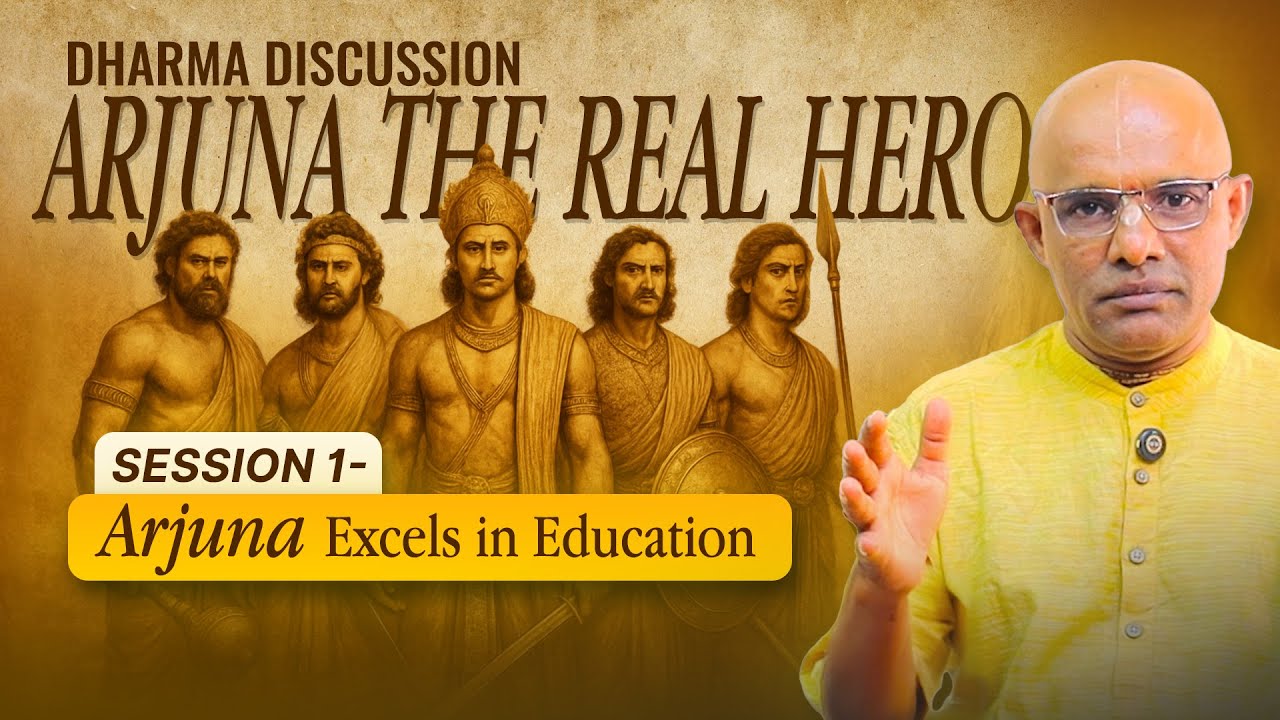
Arjuna exemplifies the union of disciplined effort and divine dependence, offering a powerful model of transformative learning. Drawing on the Mahabharata and the Bhagavad Gita, this discussion shows how mastery requires both rigorous practice and humility. Educationally, Arjuna’s formation reflects the guru–shishya tradition, integrating attentive study, reflection, and internalization. Practically, readers can translate these principles…
-
Why Krishna Calls Yoga ‘Evenness of Mind’: Timeless Guidance for Inner Strength

Bhagavan Sri Krishna’s teaching in Bhagavad Gita 2.48 defines Yoga as evenness of mind, placing equanimity at the heart of ethical action. This balanced awareness steadies decision-making amid success and failure, transforming stress into resilience and clarity. Practically, brief breath awareness, mindful pause, and dharmic intention help train this steadiness in daily life. The approach…
-
Who Really Acts? Bhagavad-gita on Nature’s Forces, Karma, and Dharmic Freedom

Bhagavad-gita’s teaching that all beings act under the modes of material nature (Bg. 3.5; 18.40) reframes agency as skillful alignment with dharma rather than absolute autonomy. This perspective resonates with broader dharmic insights: Buddhist dependent origination, Jain karma theory, and Sikh understanding of Hukam all address conditioning and the path to freedom. Readers gain a…
-
Endure the Challenge: Timeless Hindu Wisdom for Modern Resilience and Steady Mind

This reflection explores the Bhagavad Gita’s teaching on sthithaprajnasteady wisdomas a practical guide to modern resilience. Rooted in Chapter 2 (Verses 55–72), it emphasizes equanimity as the basis for ethical action and emotional balance, not detachment from life. The discussion connects Hindu insights with related ideas in Buddhism (upekkha), Jainism (sāmāyika), and Sikhism (Sehaj and…
-
Silent Victory: Redefining Success Through Dharma, Inner Peace, and Pluralistic Unity

This reflection redefines victory beyond visibility and dominance, grounding it in Dharma, inner peace, and responsible action. It emphasizes context-sensitive discernment, resonant with Srila Prabhupada’s guidance and shared across dharmic traditions. Readers discover how equanimity, compassion, and ethical conduct constitute a lasting success that does not polarize. The discussion connects teachings from the Bhagavad Gita…
-
Six Profound Transformations of Life: A Dharmic Guide to the Eternal Self Beyond Change

Hindu scriptures teach that embodied life unfolds through six universal transformationsexistence, birth, growth, decay, disease, and deathwhile pointing to the atman beyond change. Seeing these phases clearly reduces fear, strengthens resilience, and fosters compassionate conduct guided by dharma. Parallel insights in Buddhism, Jainism, and Sikhism reinforce impermanence, many-sided truth, and alignment with divine order, cultivating…
-
Vīra Swarga Explained: The Uplifting Hindu Ideal of Dharma, Courage, and Sacred Sacrifice

Vīra Swarga, the “Heaven of Heroes,” illuminates a central Hindu philosophical ideal: selfless courage in service of dharma. It affirms valor only within strict ethical boundsprotection of innocents, restraint, and last resortechoing the Bhagavad Gita and Kshatra Dharma. Distinguished from moksha, it represents a meritorious heavenly state that honors noble sacrifice while encouraging continued spiritual…
-
Timeless Analogies that Illuminate Dharma: Powerful Insights from the Bhagavatam and Gita
This curated collection of over 175 scriptural analogies, attributed to His Divine Grace A.C.B. Swami Prabhupada, translates profound ideas from the Bhagavad-Gita As It Is and Srimad Bhagavatam into clear, relatable insights. The metaphors illuminate body–soul discernment, ethical self-mastery, devotion, and time–cosmology with precision and warmth. Teachers and practitioners can apply these images in pravachan,…
-
Gunatita Explained: Rise Beyond Sattva, Rajas, and Tamas for Unshakable Inner Freedom

Gunatita, a core concept in Hindu philosophy, describes freedom from the three gunasSattva, Rajas, and Tamasthat bind the jiva to samsara. The Bhagavad Gita portrays the gunatita individual as steady in equanimity, acting from dharma without compulsion. Practical disciplinesmeditation, mantra japa, mindful action, and reflective studystrengthen Sattva and tame reactivity. This state enhances emotional resilience,…
-
Bhagavad Gita Chapter 2: A Powerful Sankhya Yoga Blueprint for Duty, Clarity, and Inner Peace

Chapter 2 of the Bhagavad Gita (Sankhya Yoga) serves as a concise blueprint for human existence, uniting clear metaphysics with practical ethics. It teaches that the atma is eternal while the body is transient, transforming fear and grief into clarity. The chapter introduces Karma Yogaacting without attachment to outcomesas the foundation of equanimity and wise…
-
If Something Changes Your Life, Let It: Dharmic Wisdom to Cultivate Resilience and Grace

The reflection “If something changes your life, let it” expresses a core dharmic insight shared by Hinduism, Buddhism, Jainism, and Sikhism: change, met with discernment and non-attachment, catalyzes spiritual growth. Drawing from the Bhagavad Gita, Patanjali’s Yoga Sutra, anicca, Anekantavada, Hukam, and Chardi Kala, the post outlines a practical pathpause, breathe, discern, act ethically, reflectto…
-
Indigenous Wisdom and Hindu Dharma: A Sacred, Just Path to Lead the Climate Era

Frontline Indigenous communities are demanding climate justice and genuine inclusion, a civilizational warning that negotiations must center those who protect living ecosystems. Hindu dharmaand allied insights from Buddhism, Jainism, and Sikhismoffers an ethical framework that treats Earth as sacred, translating ecology into moral duty. Drawing on the Atharva Veda and Bhagavad Gita, this approach frames…