
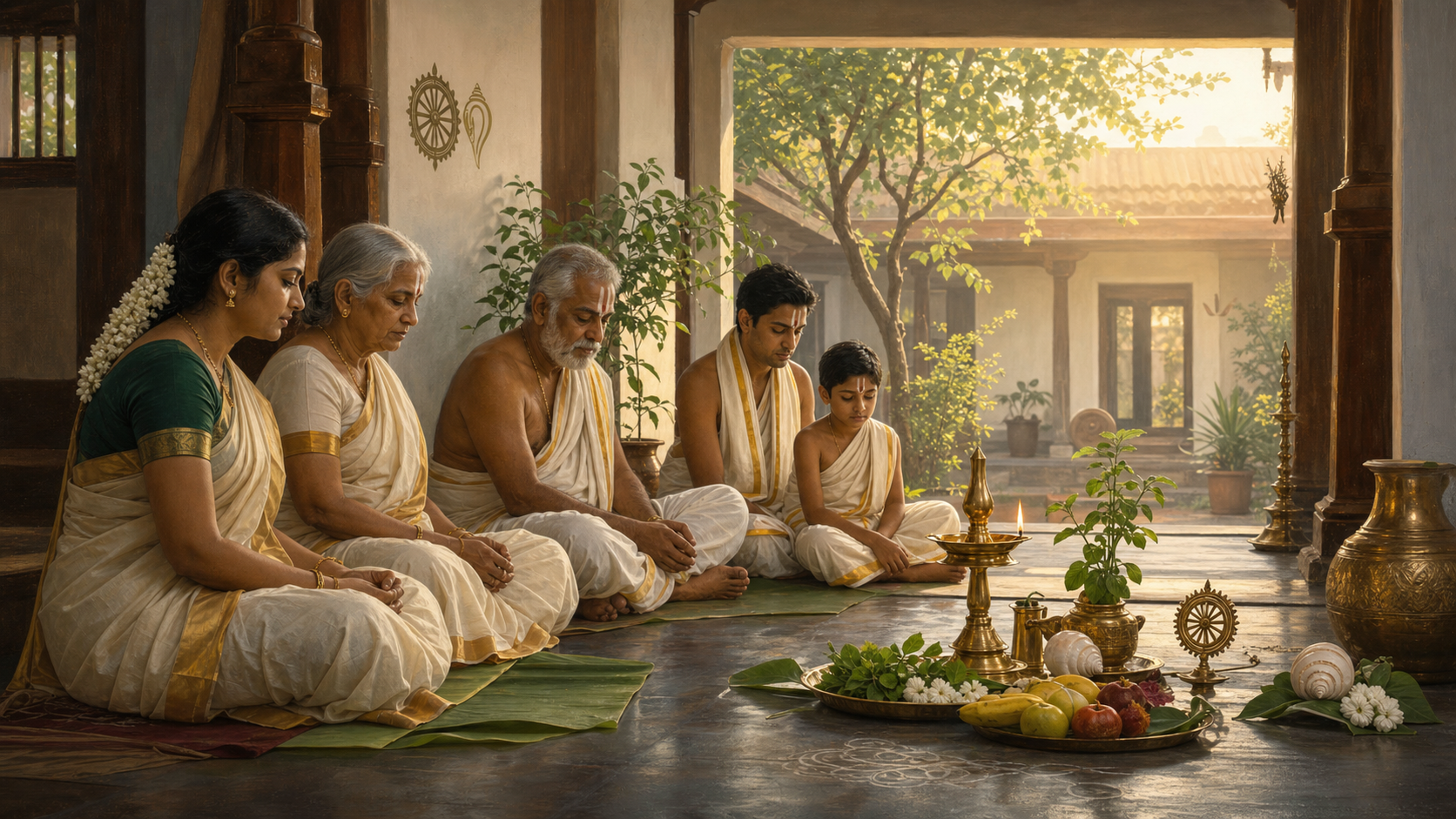
Vaikuṇṭha Samārādhana is best understood not as an isolated ceremony but as a point of convergence: funeral observance, devotion to Vishnu, remembrance of the departed, ancestral obligation, and the bereaved household’s return to ordinary life meet within it.
The supplied DharmaRenaissance account places the rite especially within Vaishnava and South Indian contexts. Read closely, it also offers a useful guide to a larger question: how can ritual acknowledge the finality of bodily death without treating death as the end of relationship, gratitude, or spiritual meaning?
Where the rite stands in the mourning sequence
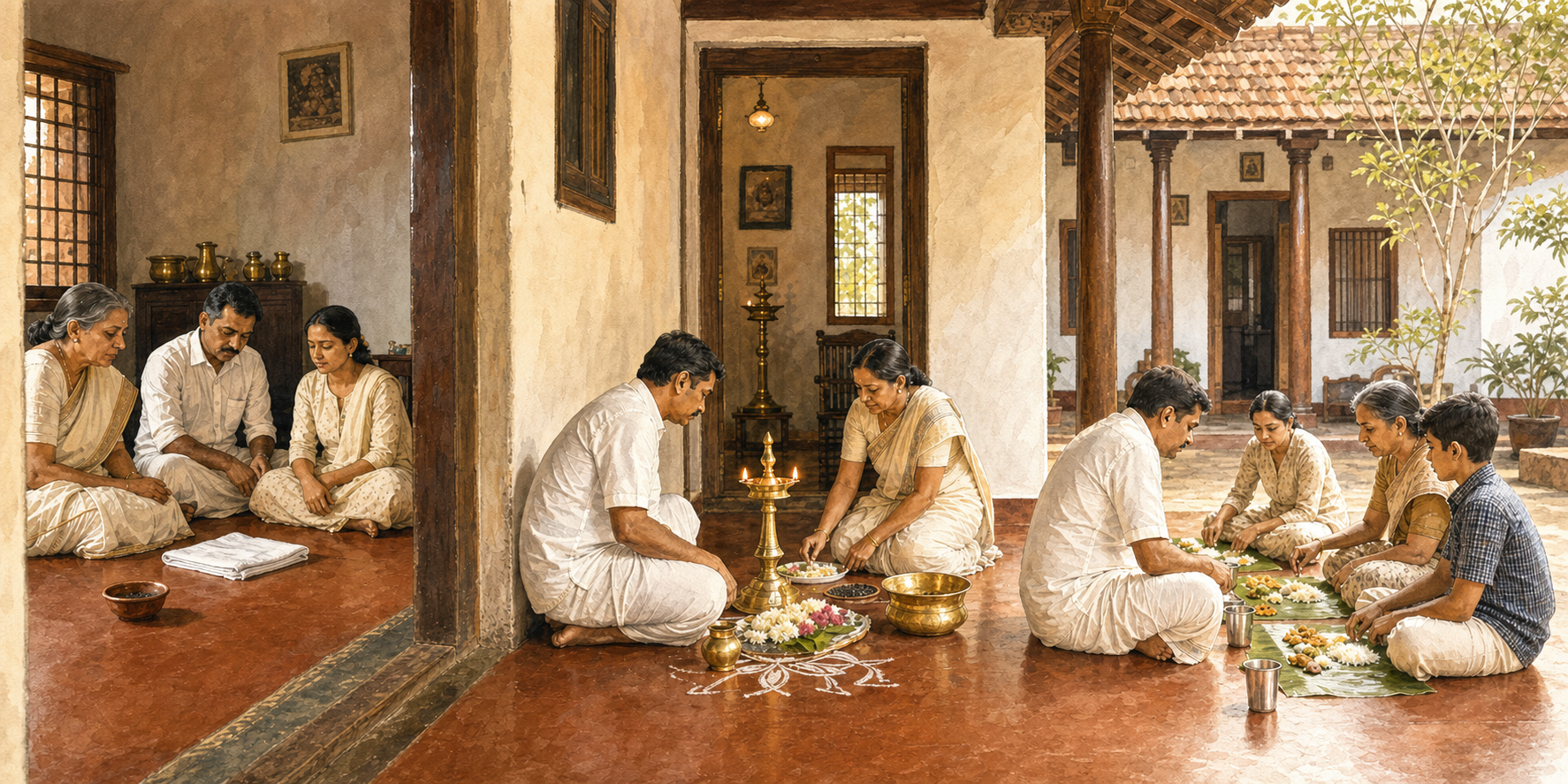
Vaikuṇṭha Samārādhana should not be confused with the funeral alone. The source describes it as a devotional observance associated with the formal completion of the initial mourning period. Its place in the sequence matters because Hindu mourning rites address more than one transition: the body must receive its final rites, the departed must be remembered and ritually supported, and the family must gradually re-enter social and religious life.
The timing is not presented as uniform. DharmaRenaissance reports that the initial sequence may culminate around the tenth, eleventh, twelfth, or thirteenth day, according to regional custom, family lineage, and sampradaya. A thirteen-day period is familiar in many communities, but it should not be turned into a universal rule. The appropriate observance is therefore determined by the tradition actually followed by the family, not by a single generalized template.
The name supplies the rite’s theological orientation. In the source’s explanation, Vaikuṇṭha is Vishnu’s divine abode, understood in many Vaishnava traditions as beyond sorrow and worldly limitation, while samārādhana denotes reverential worship, offering, and honoring. The ceremony consequently places bereavement within a devotional horizon: loss is neither minimized nor allowed to define the whole meaning of death.
Distinct rites serve distinct relationships
Several terms often heard during Hindu bereavement are related, but they are not synonyms. The source identifies antyeṣṭi as the final rites associated with the body. Śrāddha, whose name is connected with śraddhā or faith, concerns reverential offerings for the departed and the ancestors. Tarpaṇa refers to libations, commonly of water, offered in remembrance of the pitṛs. Piṇḍa offerings, often prepared from rice or other prescribed substances, provide symbolic nourishment and ritual support for the departed’s subtle journey.
Together, these practices address different dimensions of death. Antyeṣṭi marks bodily separation; piṇḍa and related offerings express continuing care; śrāddha and tarpaṇa locate the deceased within an ancestral relationship; Vaikuṇṭha Samārādhana gives the mourning period a devotional form of completion. This distinction prevents a common misunderstanding in which every post-death observance is reduced to a generic memorial service.
The rites also reflect a view of the person that is not exhausted by the physical body. DharmaRenaissance connects the observances with the Hindu distinction between the perishable body and the enduring ātman, invoking the Bhagavad Gita’s teaching that embodied existence passes through successive conditions and death much as worn garments are exchanged. In the source’s interpretation, this teaching enlarges the horizon of grief; it does not demand emotional hardness.
Ritual gives grief an inherited form
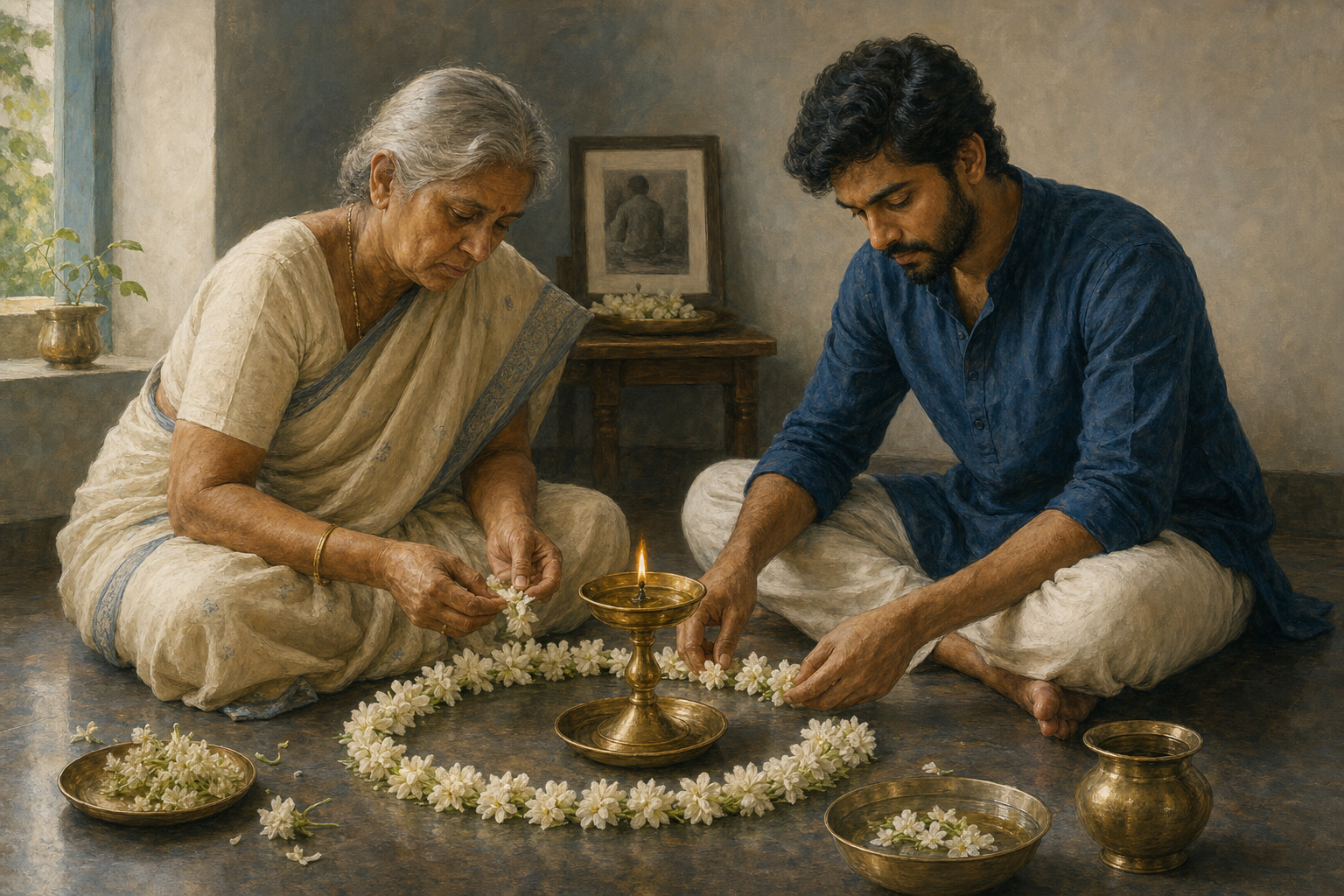
The practical intelligence of the mourning sequence becomes clearest when bereavement has made ordinary action difficult. Rather than requiring mourners to invent an explanation, compose a perfect tribute, or display a prescribed emotion, ritual supplies words, gestures, sounds, offerings, meals, and a timetable. The grieving person can participate even while numb, exhausted, angry, or unable to speak at length.
This structure does not make grief efficient or predictable. It gives grief a form that can be inhabited. Lighting a lamp, offering water, reciting mantras, preparing food, sharing a meal, and performing charity in the deceased’s name allow affection to continue as disciplined action. None reverses death. Their value lies in making care possible after physical separation, when the impulse to do something for the departed remains strong.
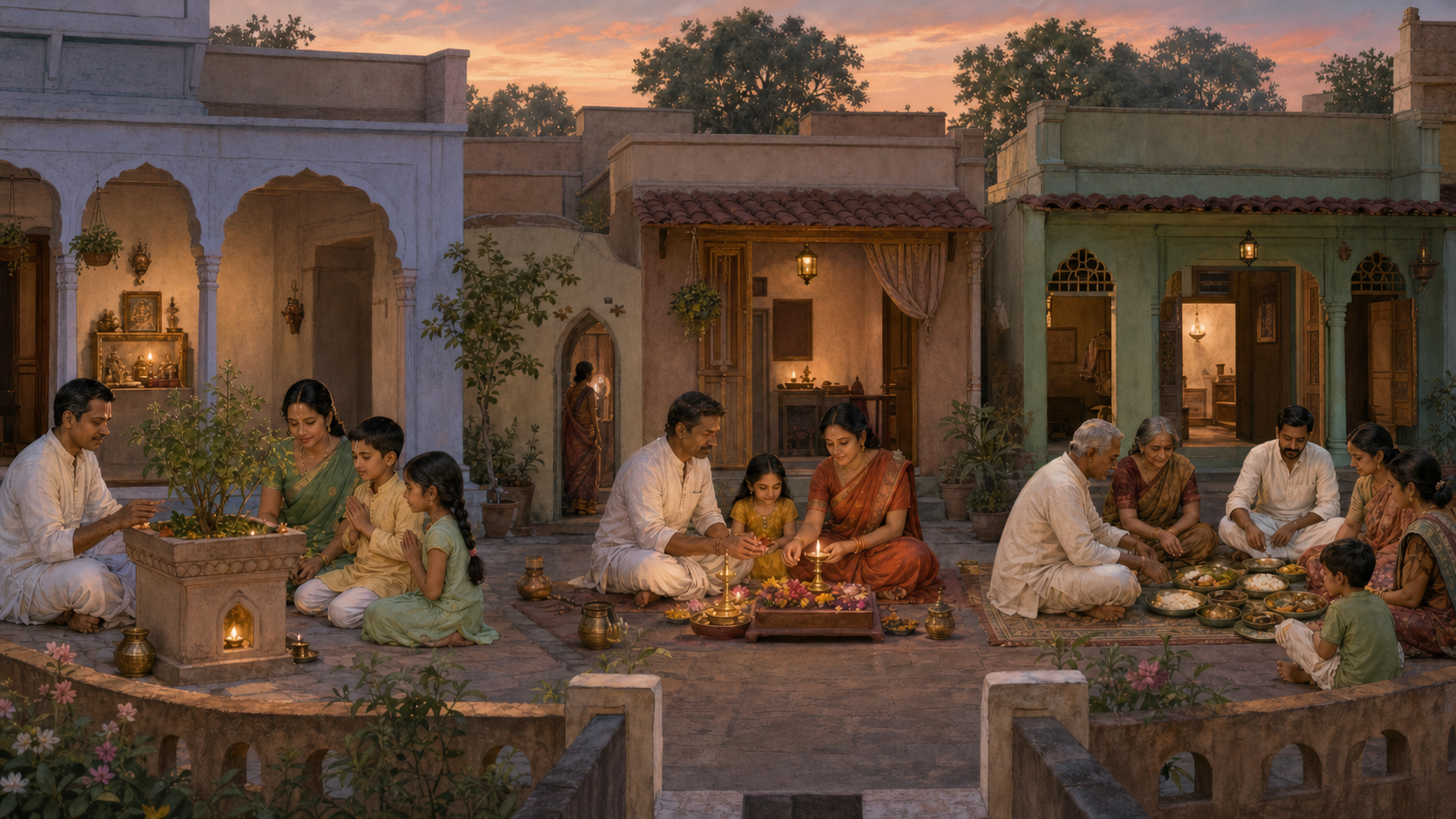
The communal dimension is equally important. According to the source, relatives, friends, priests, and community members gather around the bereaved household. Their presence distributes the work of mourning: inherited practice carries the sequence, ritual specialists guide unfamiliar actions, and the community witnesses both the loss and the family’s gradual transition. The ceremony is therefore theological, social, and psychological at once rather than a private emotion with religious decoration added afterward.
Ancestral duty turns memory into responsibility
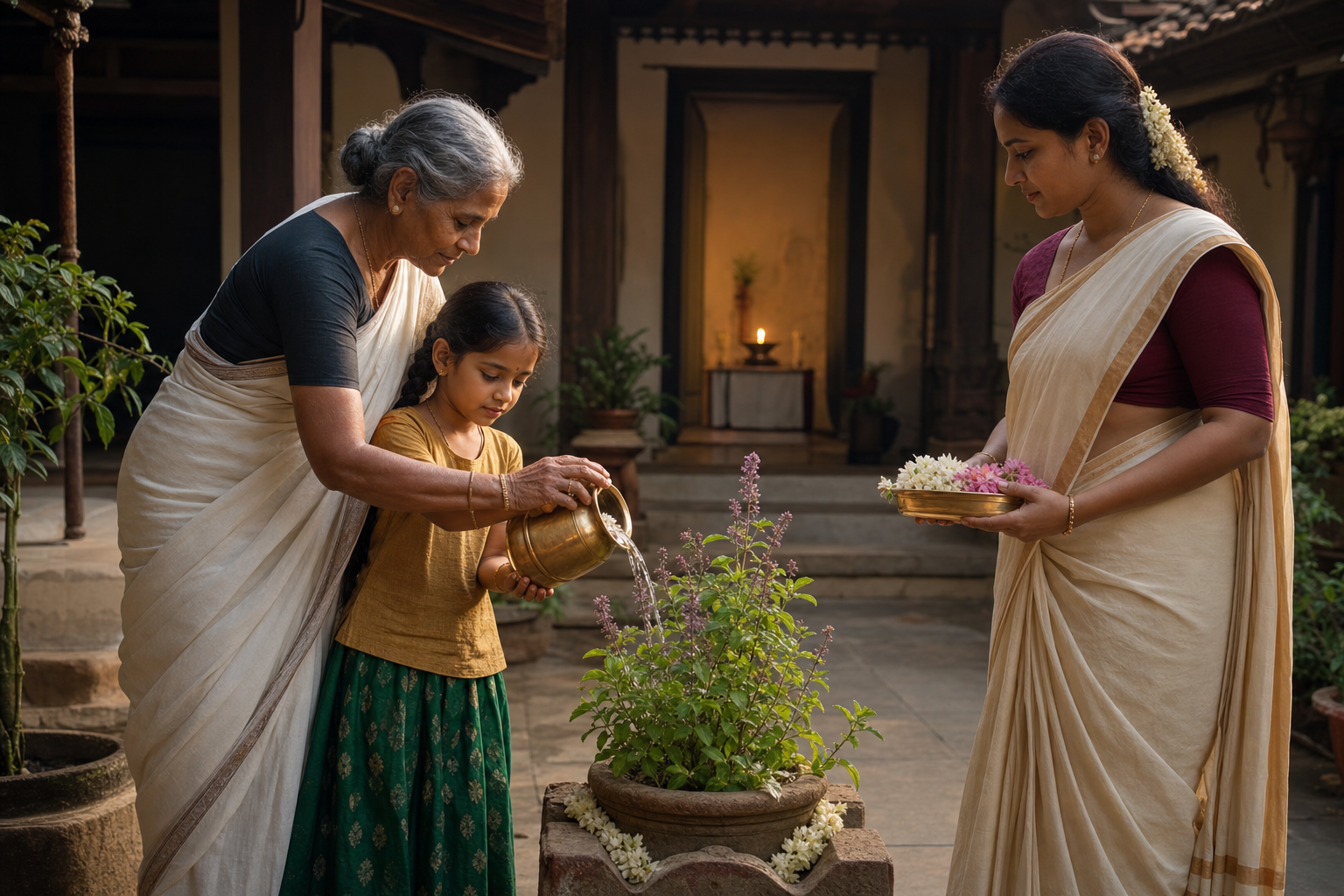
Vaikuṇṭha Samārādhana also belongs within the broader Hindu idea that a life is embedded in lineage. The source connects ancestral rites with pitṛ ṛṇa, the obligation owed to parents and forebears. This is not described merely as a burden. It recognizes that bodies, names, customs, stories, food practices, prayers, and moral formation are received through others.
Śrāddha and related offerings consequently do more than preserve recollection. They train gratitude. Memory becomes something enacted through attention, hospitality, worship, food, water, and charity. The dead are not treated as interchangeable ancestors, yet the newly departed is gradually understood within a lineage extending beyond one household’s immediate crisis.
This movement also explains why mourning rites can serve the living without being only about the living. They honor the departed on the tradition’s own theological terms while helping restore a household unsettled by death. The two purposes need not compete: care for the deceased and care for the bereaved are joined within the same sequence.
Key takeaways
- Vaikuṇṭha Samārādhana is a devotional completion of initial mourning observances, not simply another name for the funeral.
- Its timing and precise form vary by region, lineage, and sampradaya; the thirteenth day is familiar but not universal.
- Antyeṣṭi, śrāddha, tarpaṇa, and piṇḍa offerings have related yet distinct ritual functions.
- The rite holds bodily loss and spiritual continuity together without asking mourners to deny sorrow.
- Offerings, meals, prayer, charity, and communal presence transform remembrance into sustained care and ancestral gratitude.
Preserving meaning without imposing uniformity
The most useful way to approach Vaikuṇṭha Samārādhana is neither as an empty formality nor as a standardized procedure shared identically by all Hindus. The supplied account supports a more careful understanding: it is one tradition-shaped response to death whose meaning arises from the relationship among theology, family duty, embodied action, and community.
As families transmit these observances in changing circumstances, careful explanation can preserve their depth without erasing legitimate differences. The future of the rite depends not only on repeating its actions, but also on helping each generation understand how those actions allow grief, gratitude, and surrender to remain in conversation.