
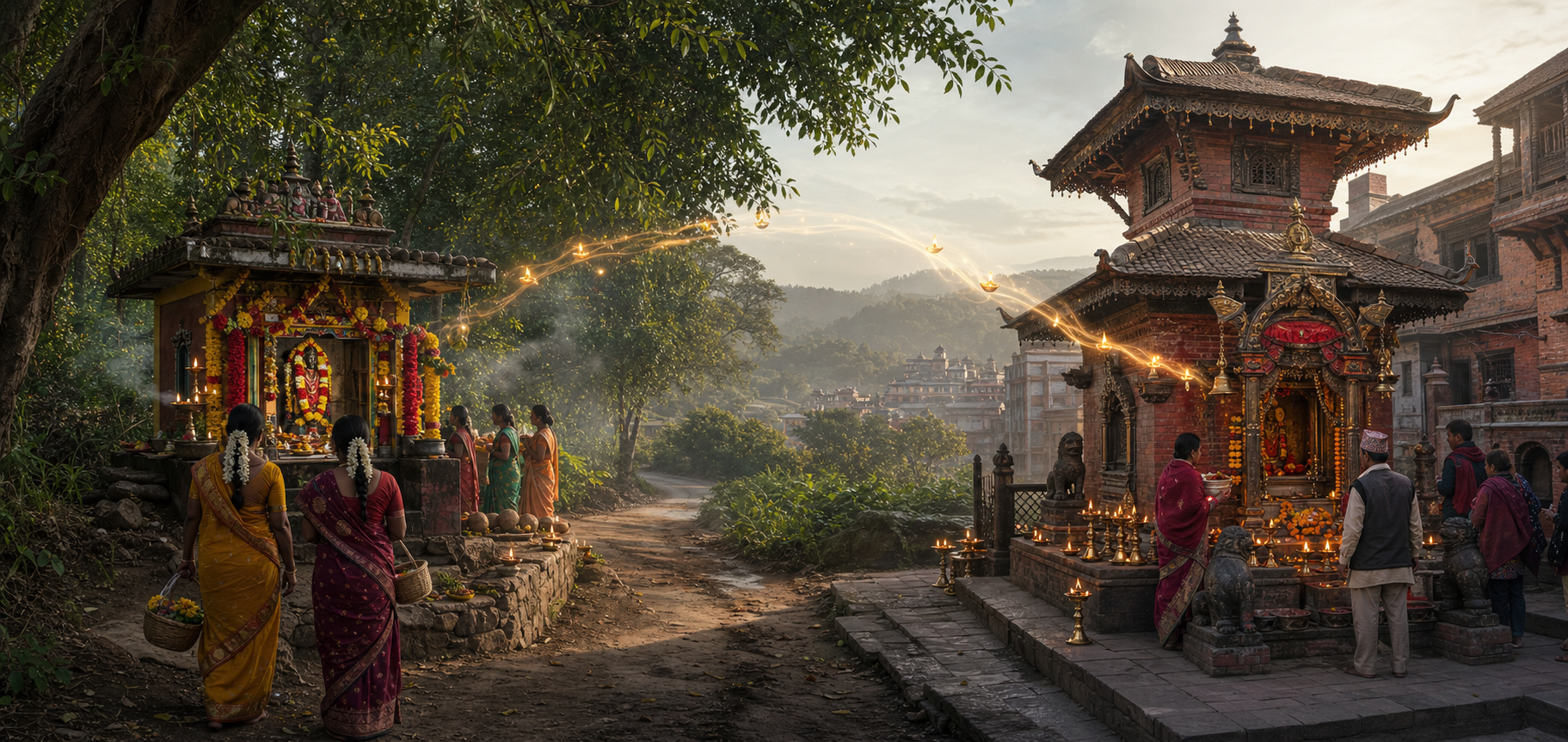
Protective mother-goddess traditions become clearer when motherhood is understood as a sacred relationship rather than a uniformly gentle personality. The source accounts of Bannari Amman in Tamil Nadu and Kanga Ajima in Kathmandu Valley portray maternal care as nourishment, vigilance, correction, and the power to confront danger.
Read together, the traditions show what makes Shakti living: divine power is encountered through a particular form, sustained by ritual, grounded in place, and woven into communal memory. The comparison also explains why an idol, shrine, or procession cannot be understood fully as an isolated object. Each belongs to a continuing relationship between the goddess and those who approach her for protection.
Maternal love that is tender, watchful, and fierce
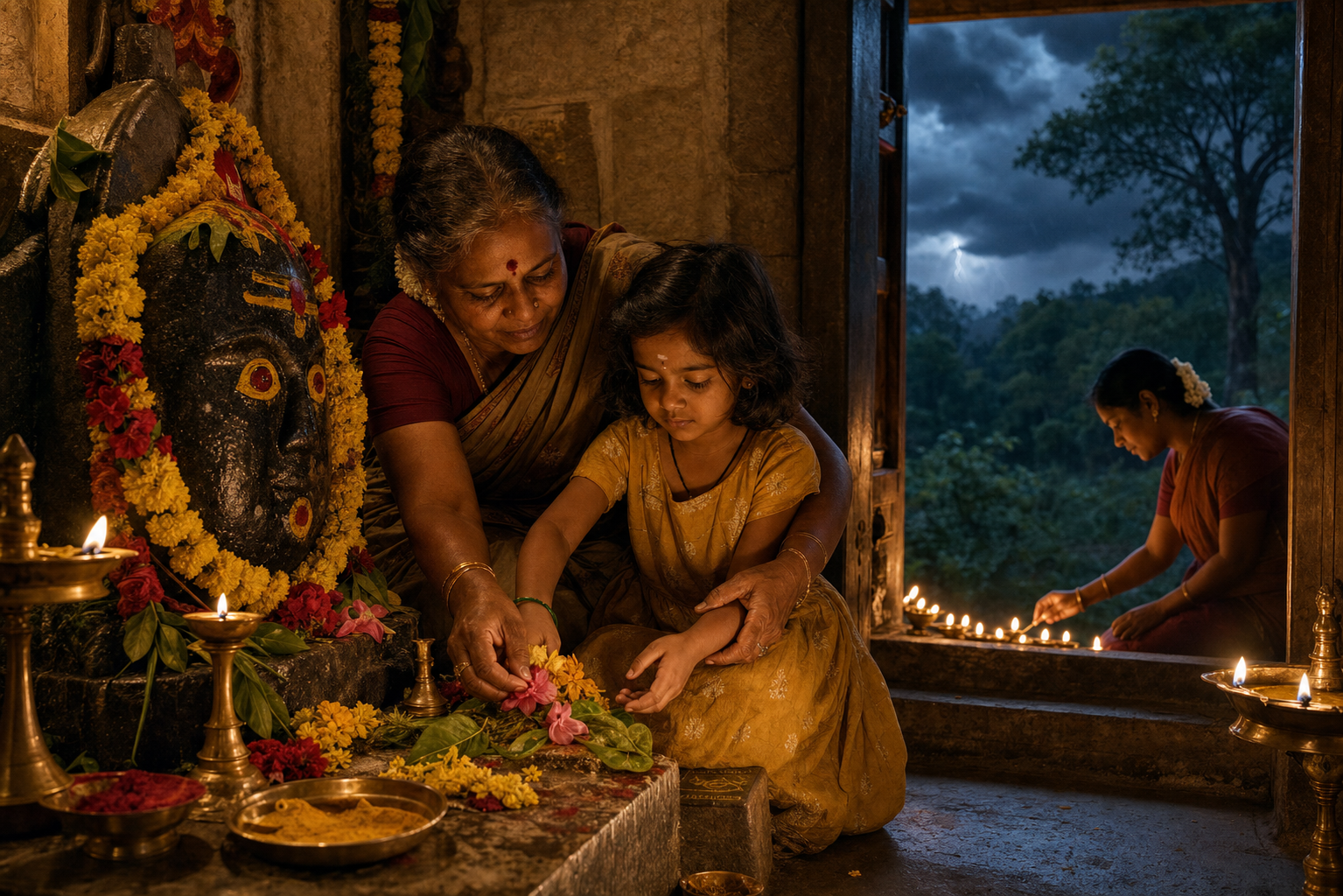
Both accounts begin with the language of kinship. The Bannari article explains that Amman carries the emotional force of mother, making the goddess a protector, healer, guardian, and sovereign presence rather than a remote abstraction. The Kanga Ajima account similarly associates Ajima with grandmother and mother in Nepal Bhasa, but expands that intimacy outward: the mother of a household becomes the guardian of a neighborhood and, ultimately, a city.
This shared maternal identity does not exclude fierceness. Bannari Amman is presented as a form of Shakti whose nurturing grace and protective intensity are complementary. The Kanga Ajima article identifies her with Chamunda, a fierce form of Devi associated with the Matrikas. In that account, her severity expresses the capacity to face disease, decay, death, disorder, and the vulnerabilities of urban life.
The synthesis corrects a common misunderstanding: divine motherhood is not defined by softness alone. A protective mother may reassure the frightened, sustain families, discipline arrogance, or remove what threatens collective well-being. Fierceness and compassion therefore describe different operations of the same care. The goddess is formidable because the lives entrusted to her are fragile.
How sacred form becomes a living presence
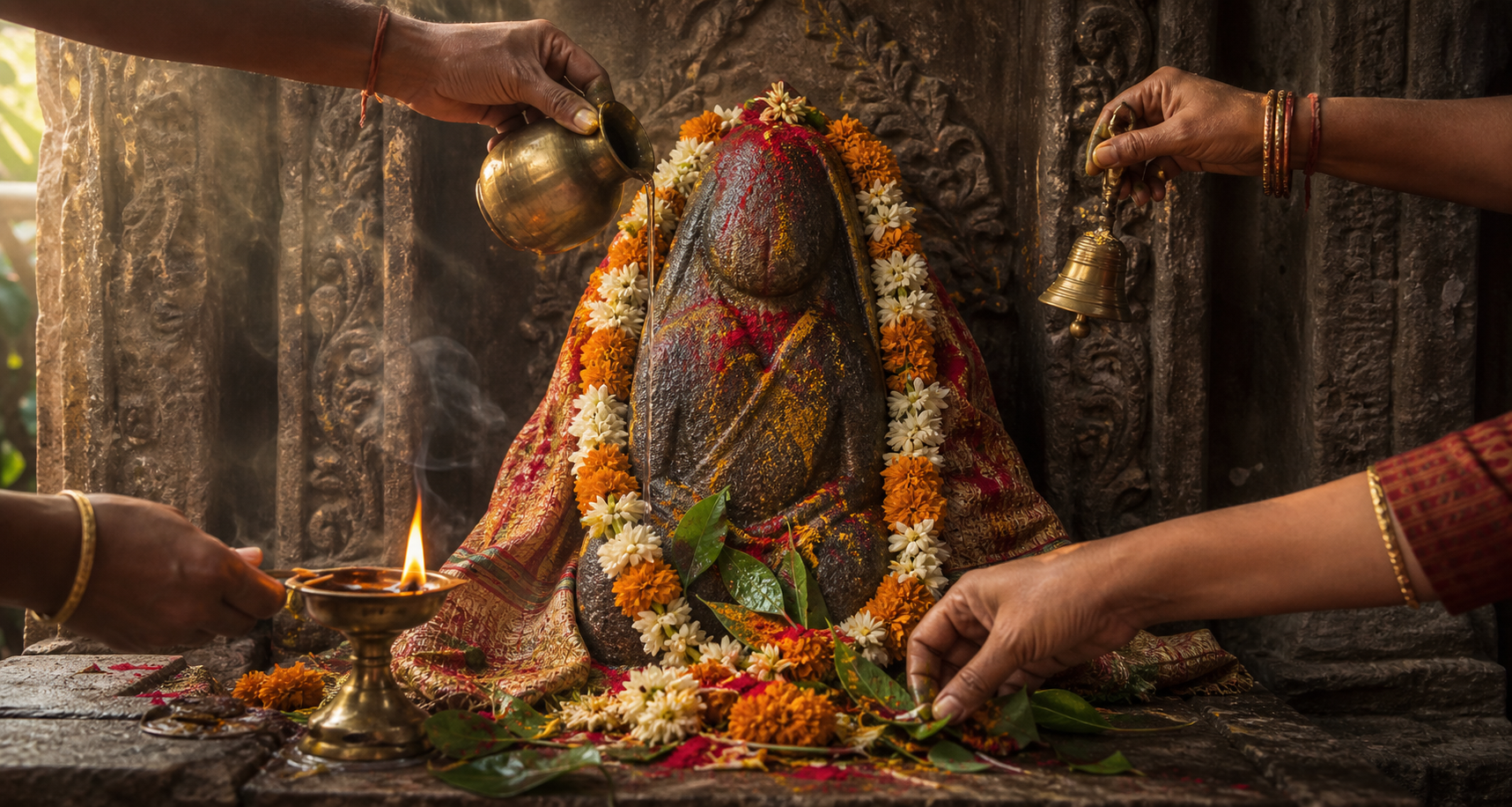
The Bannari account places particular emphasis on the consecrated idol. It reports that traditional iconographic disciplines guide proportion, expression, attributes, and ritual usability, while processes such as Pran Pratishtha and continuous puja establish the image as a focus of worship. Abhishekam, alankaram, lamps, food offerings, flowers, turmeric, kumkum, and other acts of service maintain the relationship. The sacred form is approached as the ritual body of a present deity, not simply admired as sculpture.
Darshan makes that relationship reciprocal. According to the Bannari article, the devotee does not only look at the goddess but experiences being seen by her. The expression and direct gaze of the idol consequently belong to a devotional encounter involving worries, vows, gratitude, illness, family concerns, and moral self-examination. Iconography communicates theology, but ritual makes that theology personal.
The Kanga Ajima account foregrounds another mode of presence: movement through the city. During the wider Pahan Charhe cycle described by the source, portable shrines of mother goddesses travel with music, offerings, and community participation. The reported Dyah Lwakegu encounter, including the exchange of ritual torches, dramatizes kinship among the Ajimas and among the communities connected with them.
A fixed sanctum and a moving procession may appear to be opposite forms, yet they perform related work. At Bannari, repeated service gathers attention around the goddess in the temple. In Kathmandu, procession carries protective presence across civic space and renews relationships among neighborhoods. In both cases, living presence depends on continuity: a form becomes socially and spiritually consequential through consecration, attention, offerings, movement, and remembrance.
Protection written into landscape and city
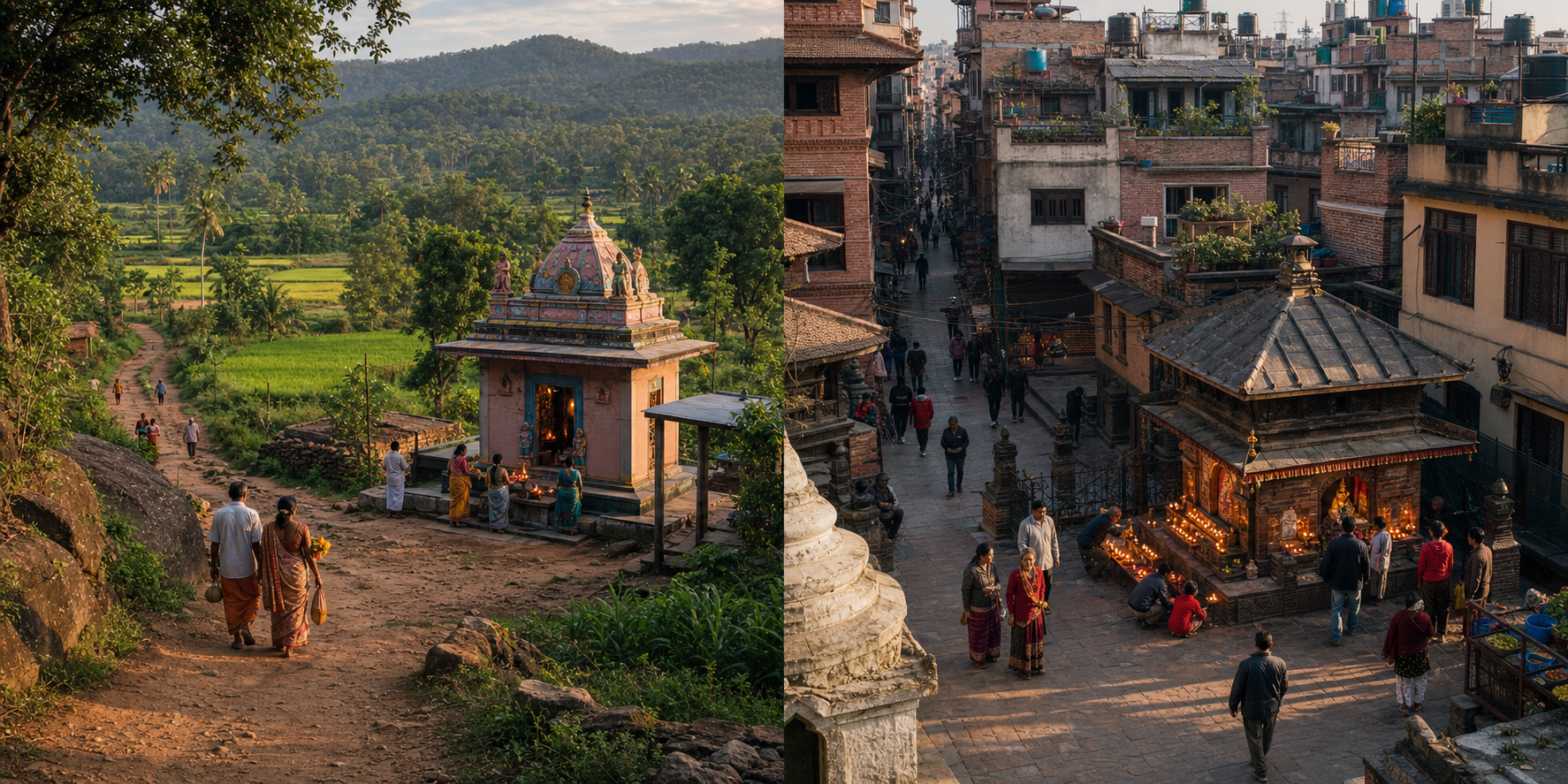
The two traditions are rooted in markedly different sacred geographies. The Bannari article situates the shrine near the Sathyamangalam forest region in the Erode area and connects it with routes of movement, pilgrimage, trade, rural settlement, and agrarian memory. In this setting, the goddess anchors communities whose lives remain exposed to land, weather, animals, cultivation, travel, and seasonal uncertainty.
Kanga Ajima belongs to an urban pattern. The source describes Kathmandu through a network of Ajima or Matrika shrines associated with directions, boundaries, processional routes, ritual seats, and inherited civic obligations. Streets, markets, temples, neighborhoods, and public authority form one layer of the city; its protective mothers form another. Their festivals periodically reactivate this sacred map.
These are not identical systems, and their differences should be preserved. Bannari’s forest-edge and agrarian setting gives protection an ecological and everyday immediacy. Kanga Ajima’s place within a ritual city emphasizes boundaries, neighborhood bonds, civic order, and collective exposure to danger. Yet both sources make the same larger point: sacred place is produced through an enduring relationship among deity, community, memory, and repeated practice.
Locality does not diminish the theological significance of either goddess. It is the means by which cosmic Shakti becomes approachable. Protection is not left at the level of an abstract universal power; it is encountered at a particular sanctum, threshold, route, festival, or moment of darshan. Place gives the relationship obligations as well as meaning.
Plural worship without erasing distinct identities
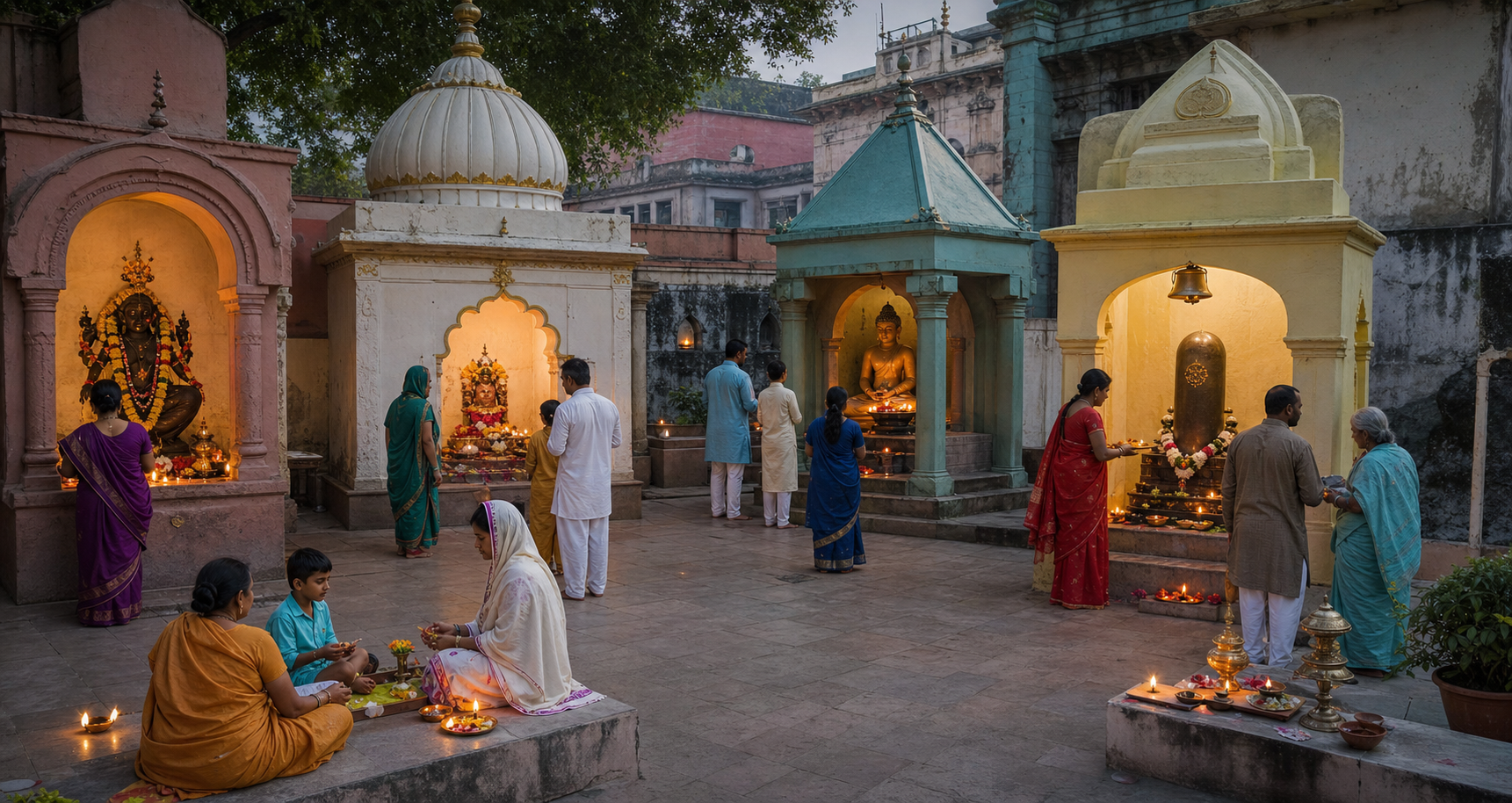
The Bannari account places the goddess within a plurality that includes Durga, Kali, Mariamman, Meenakshi Amman, Kamakshi, Bhagavathi, and other manifestations of Shakti. Its theological argument is that many names and forms can make divine power accessible through different regions, lineages, and devotional relationships without requiring ultimate reality to be fragmented.
The Kanga Ajima article offers a different kind of plurality. It describes a Newar religious environment in which Hindu Shakta and Shaiva elements, Vajrayana Buddhist practice, ancestral reverence, and civic ritual coexist. Kanga Ajima is identified with Chamunda within a Hindu framework, while the Ajima tradition is also honored by Newar Buddhist communities. The source presents this as shared reverence that does not require participating communities to abandon their distinctive ritual identities.
Together, the cases distinguish plurality from vagueness. A goddess may participate in a broad theology of Shakti while remaining inseparable from a specific place and inherited mode of service. Sacred space may also be shared without making every interpretation interchangeable. This balance helps explain how protective mother traditions can connect households, temples, neighborhoods, and religious communities while retaining their particular names, forms, and responsibilities.
Key takeaways
- Protective motherhood joins nurture with vigilance; fierce action is presented as a mode of care rather than its opposite.
- Living Shakti is sustained through relationships expressed in consecration, darshan, offerings, adornment, procession, and community participation.
- Sacred geography shapes the form protection takes: Bannari is interpreted through a forest-edge and agrarian setting, while Kanga Ajima belongs to Kathmandu’s ritual urban map.
- Plurality can accommodate multiple forms and participating traditions without dissolving their distinct theological and ritual identities.
Future engagement with these traditions will be most illuminating when it attends not only to images and legends, but also to the people, places, ritual disciplines, and civic bonds that keep protective motherhood alive. Preserving that living context allows sacred form to remain a relationship rather than becoming only a cultural exhibit.
References
- DharmaRenaissance Blog — Bannari Amman Idol: Powerful Sacred Iconography, Shakti, and Living Temple Meaning
- DharmaRenaissance Blog — Kanga Ajima of Kathmandu: Fierce Mother, Ancient Protector, Living Shakti