
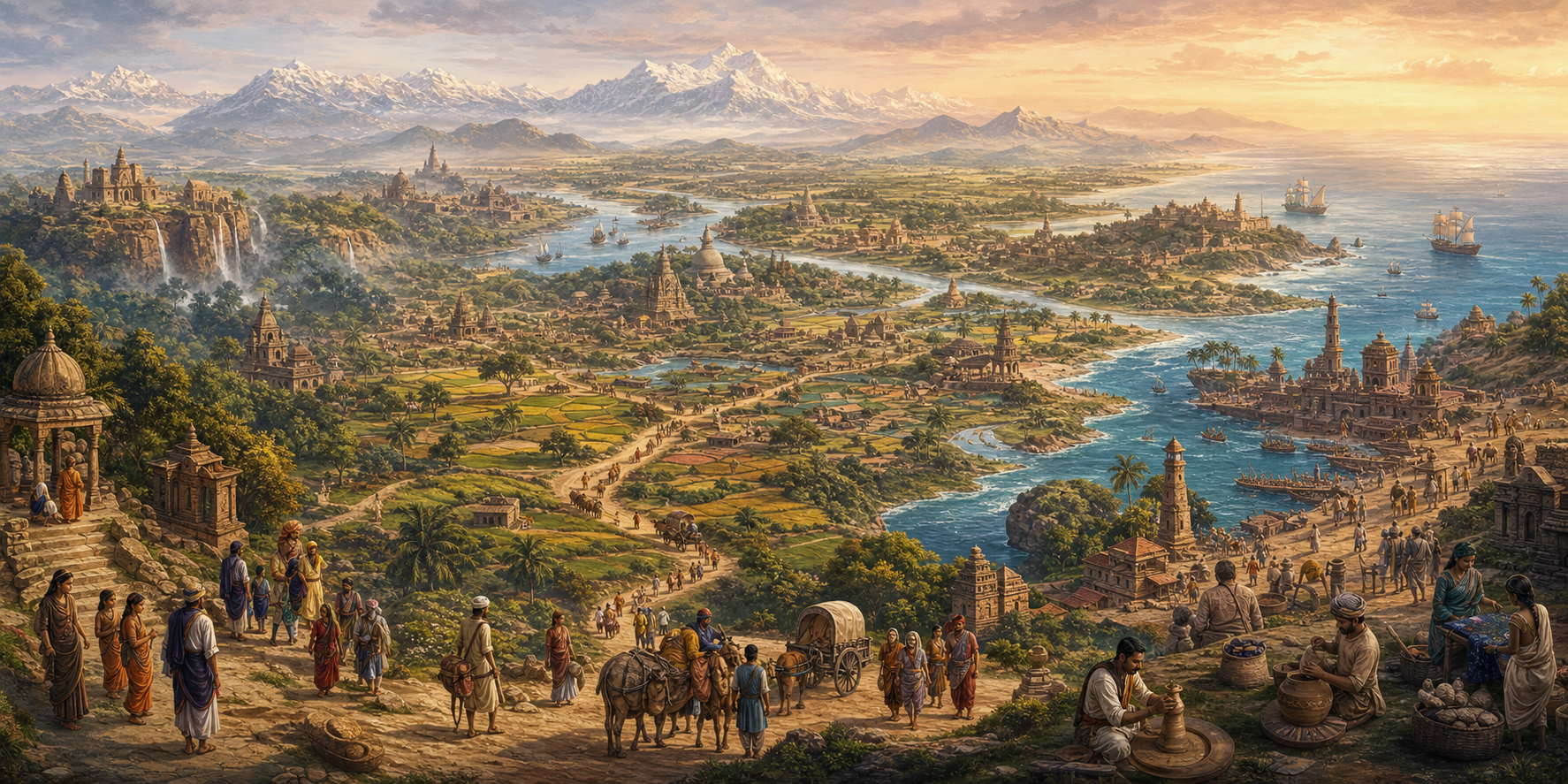
The phrase “India, that is Bharat” can be read as a constitutional naming formula, but the source article asks readers to consider a larger question: what makes a people recognize themselves as participants in a civilization whose memory exceeds the lifespan of the modern state?
Its discussion of Abhijit Joag’s Bharat That Is India: Reclaiming Our Real Identity brings several dimensions of that question together: sacred geography, dharma, philosophical inquiry, cultural transmission, colonial categories and regional plurality. Read critically, these elements offer a useful framework for understanding Bharat without reducing it either to a political slogan or to an idealized, unchanging past.
A name carrying more than political sovereignty
The source article presents Bharat as more than an alternate label for the Republic of India. In its account of Joag’s argument, the term signifies a civilizational memory formed through knowledge traditions, pilgrimage, sacred places, languages, artistic practices, temples, monasteries, gurukulas, trade routes and everyday customs. These institutions did not require a single ruler or uniform administration to generate connections across the subcontinent.
This distinction matters because a civilization and a state are different kinds of community. A state is defined through institutions, jurisdiction and political sovereignty. A civilization is sustained through inherited meanings, practices and relationships that can survive changes of dynasty, boundary and administrative form. To say that Bharat possesses civilizational depth is therefore not the same as claiming that a modern nation-state existed unchanged in antiquity.
The article gives sacred geography an important place in this account. Pilgrimage networks allowed people rooted in particular languages and regions to encounter a wider cultural landscape. Such movement could create overlapping forms of belonging: local without being isolated, and civilizational without demanding cultural sameness. The resulting unity was not identical to modern nationalism, but it supplied a mental map in which distant communities and sacred centres could be understood as parts of an interconnected land.
Bharat, in this reading, is best approached as a shared grammar rather than a single script. A grammar makes communication possible while allowing many expressions. Similarly, civilizational identity can connect different regions and lineages without erasing their distinctive histories. This interpretation is stronger than one based only on territorial antiquity because it identifies the institutions and practices through which belonging was actually transmitted.
Continuity is a pattern, not an absence of change
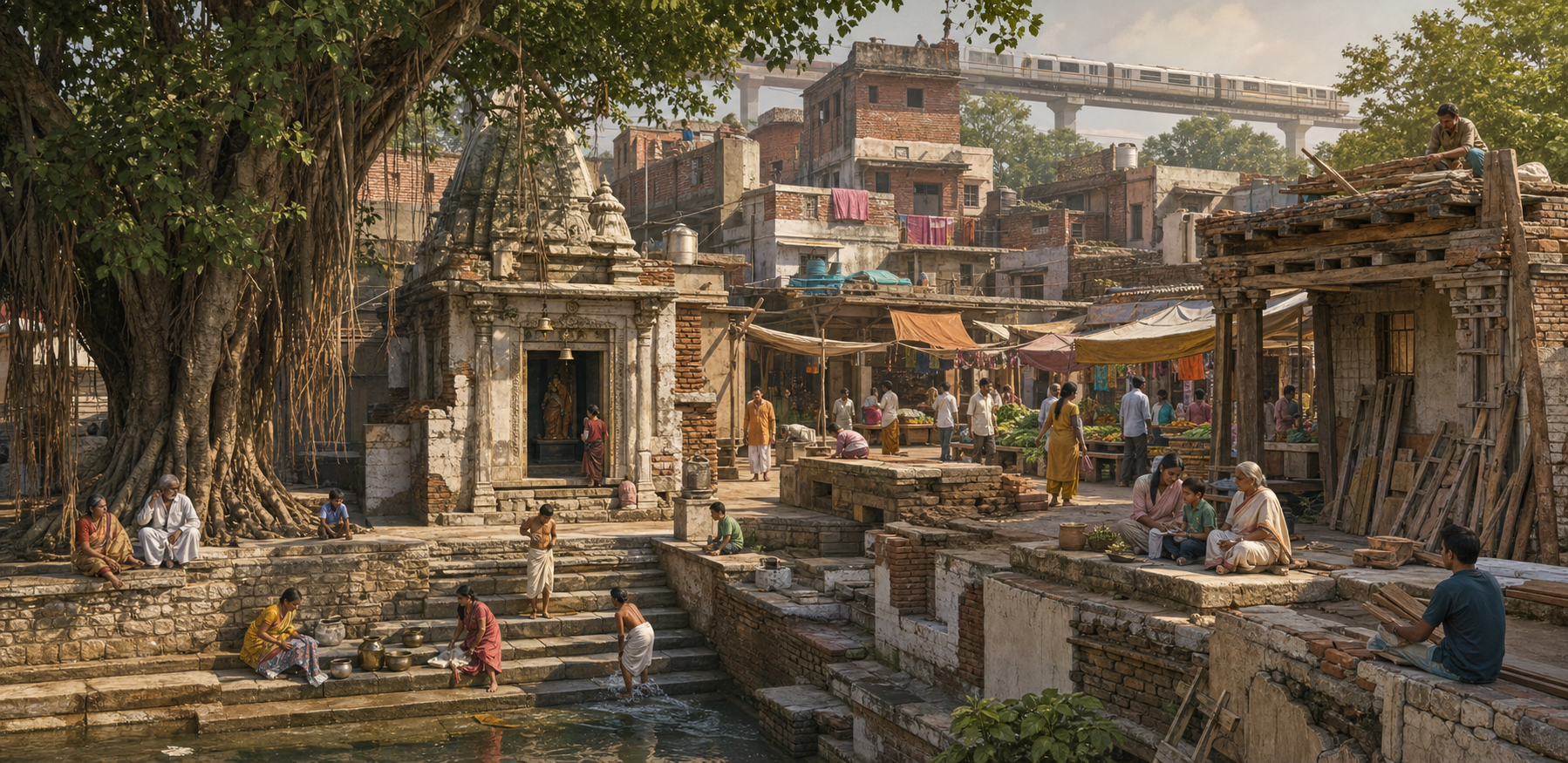
The source reports that Joag’s narrative emphasizes more than five millennia of continuity, but it also warns that continuity must not be confused with unbroken sameness. The subcontinent experienced migrations, political upheavals, invasions, linguistic change, social tensions, reform movements and religious innovation. A credible civilizational account must make room for these transformations rather than treating change as evidence against continuity.
What persists across change is not necessarily one institution, doctrine or political order. It may instead be a recurring field of questions and practices: how responsibility should be understood, how knowledge should be disciplined, how suffering may be overcome, how liberation should be pursued, and how personal conduct relates to social and cosmic order. Texts can be reinterpreted, rituals can acquire regional forms, and philosophical schools can disagree while remaining engaged with recognizable problems.
The article places Vedic traditions, Shramanic movements, Buddhist and Jain developments, classical Hindu darshanas, Bhakti lineages, Sikh teachings, vernacular cultures and modern reform movements within this evolving civilizational field. That framing does not establish that every tradition shared the same origins or conclusions. Its more defensible insight is that disagreement itself became one mode of continuity. Debate, commentary, adaptation and reform kept inherited questions alive by refusing to freeze them.
This approach also guards against two opposite errors. One is fragmentation: interpreting every regional or doctrinal difference as proof that no larger civilizational relationship existed. The other is homogenization: treating diversity as superficial and projecting a single uniform identity backward through history. Bharat becomes historically intelligible when connection and difference are examined together.
Dharma can connect traditions without making them identical
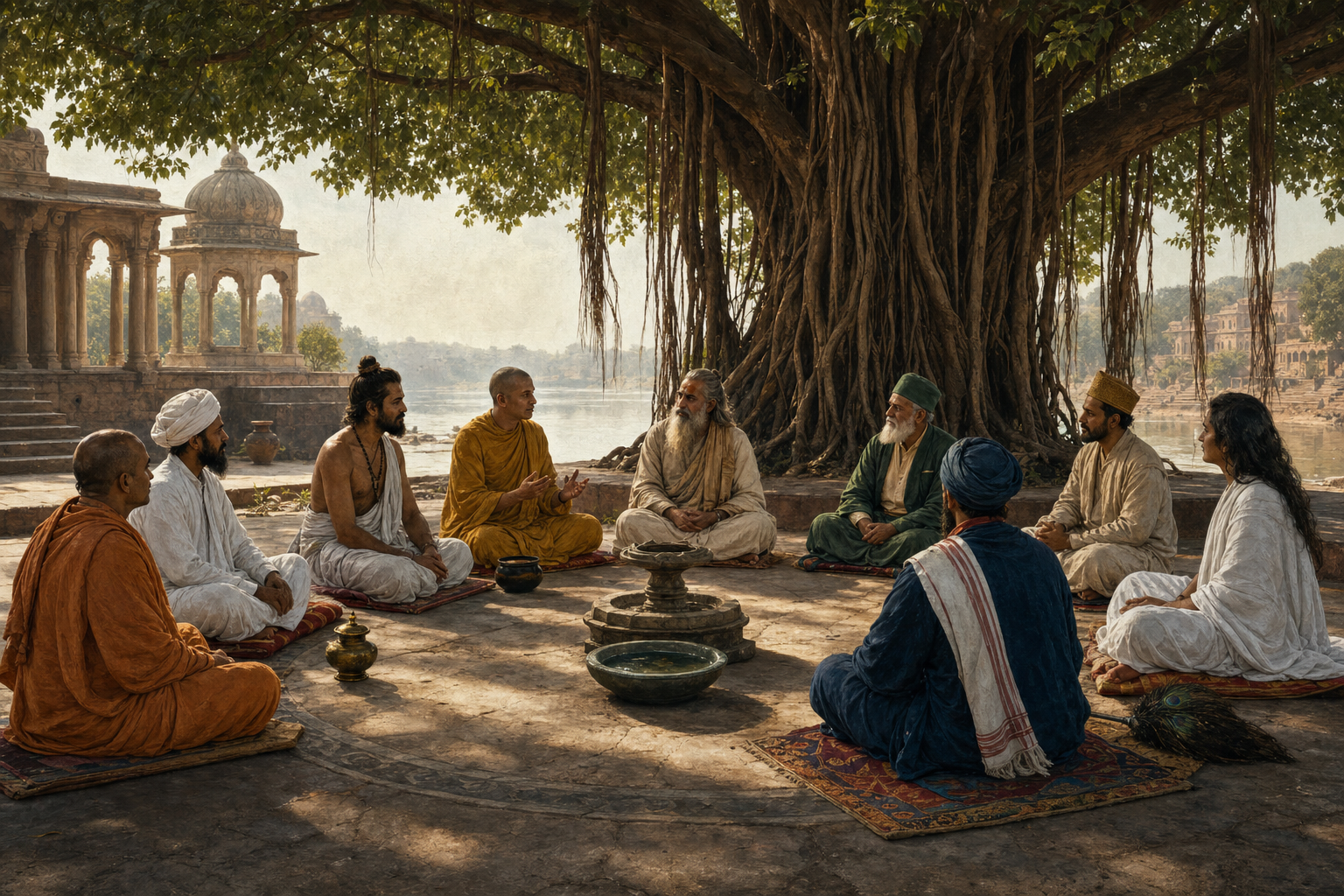
Dharma supplies the conceptual centre of the source article. It is described as a term that touches religion, ethics, law, duty and social order without fitting neatly into any one of those English categories. Its underlying sense is sustaining order: the responsibilities and disciplines through which personal, social and cosmic life remain balanced and meaningful.
That meaning makes dharma relevant to civilizational identity, but only if it is not converted into a demand for doctrinal uniformity. The article treats Hinduism, Buddhism, Jainism and Sikhism as distinct traditions formed within a broad dharmic environment. It points to recurring concerns such as moral accountability, self-discipline, compassion, liberation, non-possessiveness, spiritual practice and the cultivation of consciousness. These affinities are better understood as a family resemblance than as proof that the traditions are interchangeable.
The intellectual range cited by the article reinforces this point. Advaita Vedanta investigates non-duality; Buddhist traditions developed rigorous accounts of mind, suffering and logic; Jain anekantavada addresses the many-sided character of truth; and Sikh teachings articulate disciplined devotion, ethical action and relationship with the Divine. Placing these currents within one civilizational conversation should preserve their disagreements, not dissolve them into a generic spirituality.
A dharmic account of Bharat is therefore most persuasive when it describes a culture of inquiry and practice rather than a creed imposed from above. Its unity lies partly in the seriousness with which different traditions approached consciousness, conduct, knowledge and freedom. Its plurality lies in the fact that they did not always answer those questions in the same way.
Decolonizing knowledge requires method, not nostalgia
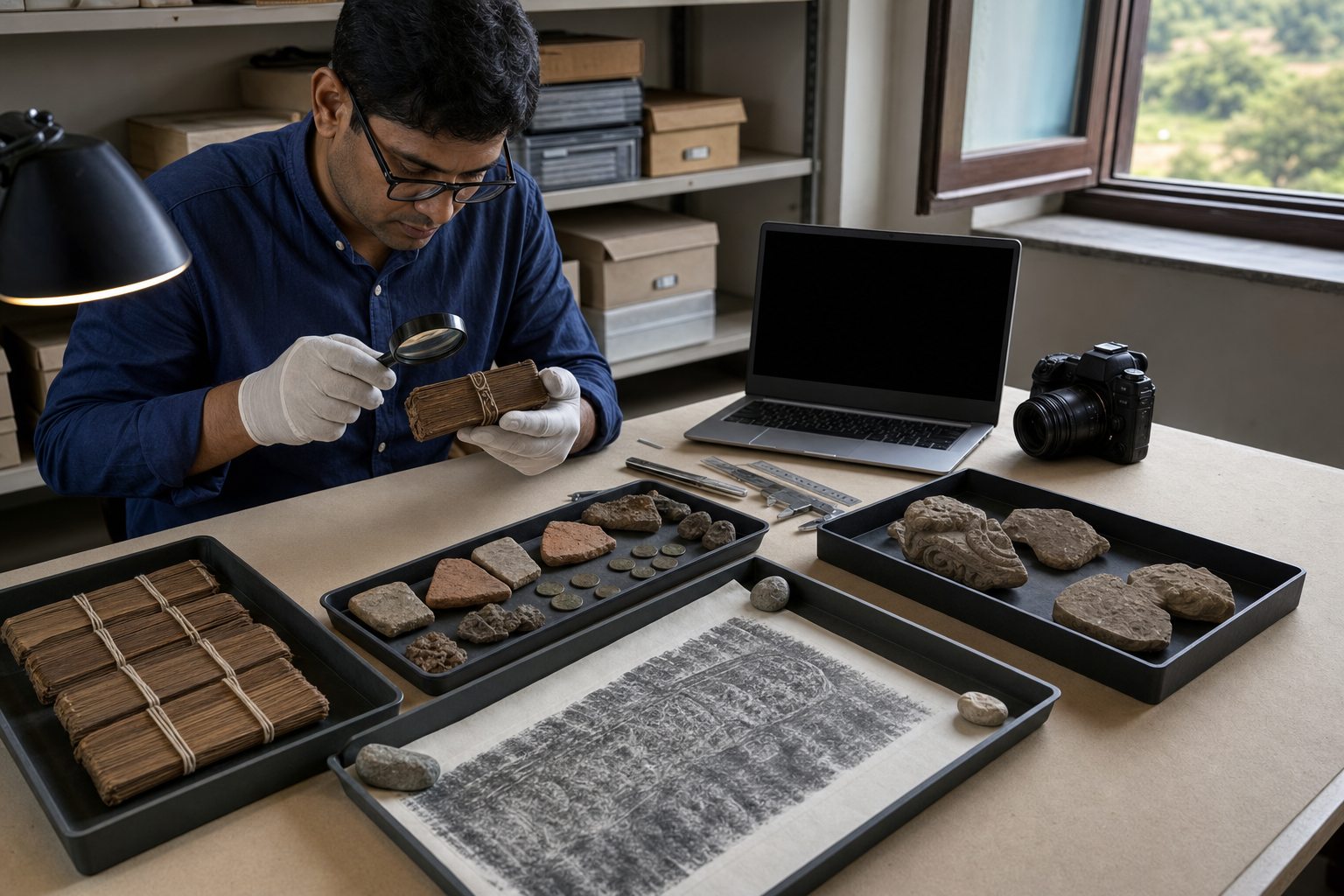
The source article argues that colonial knowledge systems classified Indian traditions through European religious, racial and political categories. In its account, these classifications encouraged a form of mental colonization: Indian civilization could appear fragmented, static or irrational when judged only through concepts external to its own traditions.
Recovering indigenous categories can correct that imbalance. Terms such as dharma, moksha, karma, yajna, seva, shastra, parampara, tirtha and sampradaya carry networks of meaning that are often lost when each is assigned a single English equivalent. Taking those terms seriously does not place them beyond analysis. It means allowing a tradition’s own vocabulary to help define the subject before evaluating it through comparative or modern frameworks.
Decolonization becomes intellectually useful when it improves the questions being asked. It can examine how institutions transmitted knowledge, how regional traditions interacted, how colonial classifications altered self-understanding, and which inherited practices continued or changed. It becomes less useful when reclamation is treated as immunity from evidence, internal criticism or the difficult parts of history.
The source explicitly separates civilizational confidence from rejection of constitutional democracy, science, global exchange or modern life. That separation is essential. Reclaiming Bharat need not mean recreating a vanished social order. It can instead mean participating in modern institutions with a fuller understanding of Indian intellectual resources and with the confidence to translate between civilizational vocabularies.
This distinction has practical consequences for education and cultural interpretation. A curriculum shaped by civilizational self-knowledge would not merely add celebratory facts about the past. It would teach students how philosophical concepts developed, how knowledge moved across languages and institutions, how traditions argued with one another, and how historical change affected continuity. Cultural confidence would then rest on disciplined understanding rather than inherited assertion.
Key takeaways
- Bharat is presented as a civilizational identity carried by practices, institutions, ideas and sacred geography, not merely as another name for a political state.
- Continuity is most credible when understood as transmission and adaptation across historical change, rather than as a claim that the past remained uniform.
- Dharma can provide a shared ethical and philosophical vocabulary while Hindu, Buddhist, Jain and Sikh traditions retain distinct teachings and histories.
- Decolonizing knowledge means recovering Indian categories and testing inherited assumptions; it does not require rejecting evidence, modernity or critical inquiry.
- A durable account of Bharat must hold unity and plurality together, without turning either fragmentation or homogenization into a predetermined conclusion.
The future relevance of Bharat will depend less on repeating claims of antiquity than on renewing the habits that make a civilization intellectually alive: serious study, open debate, responsible cultural transmission and the capacity to meet modern problems through both inherited insight and critical judgment.