
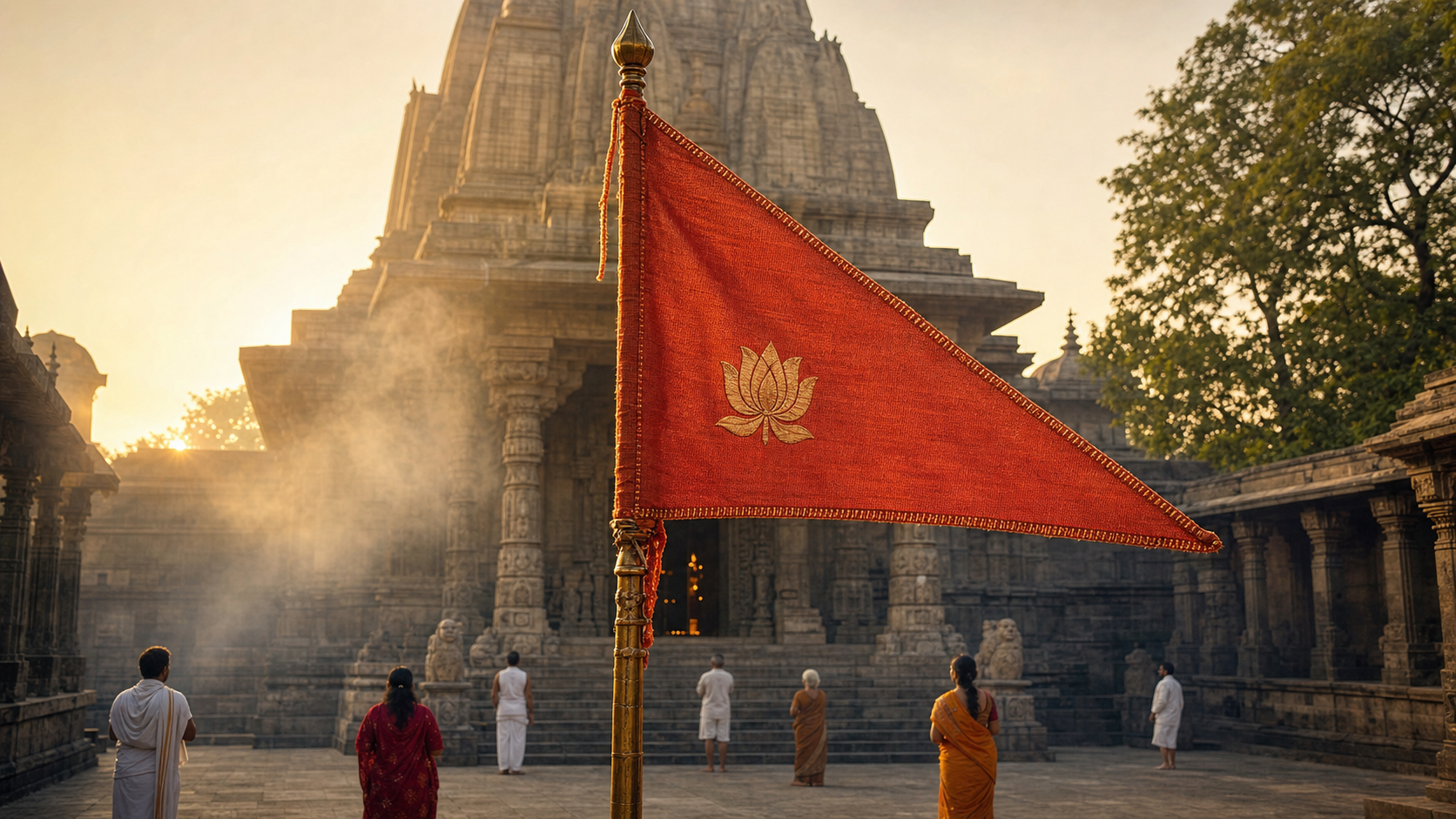
You see a dhvaja above a temple entrance, beside a shrine, or at the head of a procession. Should you bow, identify the emblem, treat it like a national flag, or simply admire the workmanship? The right response begins by recognising that you are looking at a relationship, not merely a decorated piece of cloth.
You can read that relationship through four questions: whose banner is it, what does its emblem invoke, where is it being displayed, and what duty does it place before the people gathered around it? Those questions also help you decide whether and how to display a sacred dhvaja yourself.
What a sacred dhvaja communicates
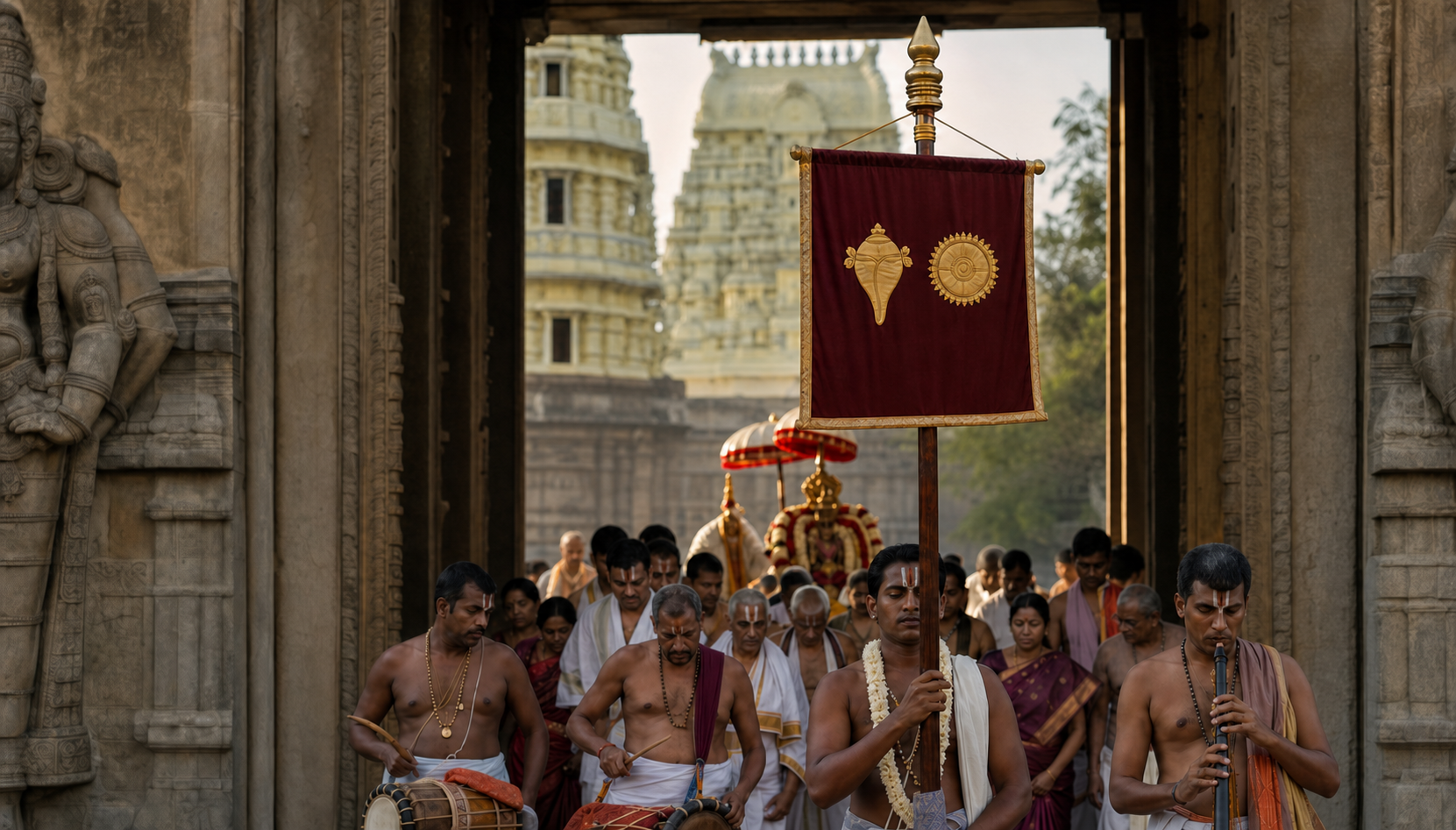
Dhvaja can mean a flag, banner, or standard. Its meaning does not come from cloth and colour alone. The bearer, emblem, location, and occasion work together. A banner over a temple therefore communicates something different from a flag carried by a military formation, raised over a fort, or used to identify an institution.
Flags have gathered people in battle, announced sovereignty from forts and palaces, and marked divine presence at temples. In each setting, the flag makes an otherwise invisible bond visible. It can show belonging, identify the authority being invoked, preserve a memory, and hold an ideal before the community.
This is why calling a dhvaja an ornament is incomplete. An ornament can be replaced without changing the identity of the object it decorates. Remove a defining emblem from a dhvaja, however, and you may remove the very relationship the banner was meant to proclaim.
Four elements give you a practical grammar for reading it:
- The bearer: Ask whether the dhvaja belongs to a deity, temple, lineage, institution, procession, individual, or community.
- The emblem: Identify the sacred figure or sign accurately before interpreting its qualities. Recognition must come before symbolism.
- The place: A banner on a temple, chariot, gateway, dedicated staff, or public platform acquires meaning from its setting.
- The occasion: A permanent temple display, festival procession, ceremonial raising, and temporary community event need not carry the same ritual expectations.
Do not collapse all four elements into modern politics. A national flag principally identifies a political community and state. A temple dhvaja can announce sacred presence and devotional belonging. A warrior’s standard can identify its bearer while invoking courage, protection, and an ethical cause. These meanings can interact in a living culture, but they are not interchangeable.
Kapi-dhvaja shows how an emblem carries meaning
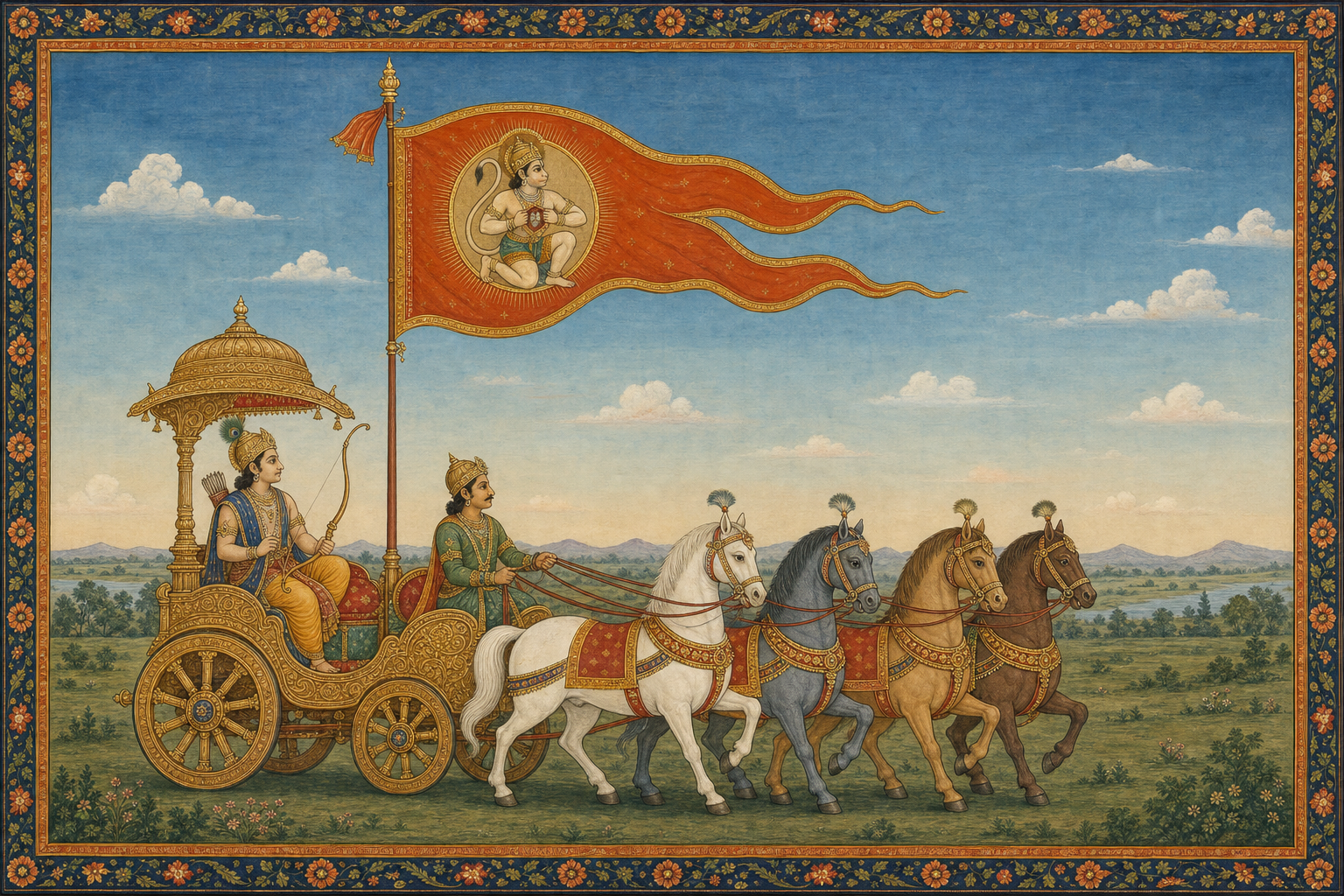
The clearest way to understand this symbolic density is to look at Arjuna’s chariot. The Mahabharata gives it the Kapi-dhvaja, a standard bearing Hanuman. The emblem does not function as a nameplate or an attractive animal motif. It joins Arjuna’s identity in battle to strength, protection, sacred memory, and divine companionship.
That single example corrects two common mistakes. The first is to treat an emblem as a generic mascot. Hanuman must be recognised as Hanuman before the banner’s associations can be understood. The second is to assume that a sacred banner communicates only ownership. Kapi-dhvaja says who is present, but it also says what kind of assurance and responsibility accompany that presence.
The banner consequently changes how the chariot is perceived. It is no longer just a vehicle carrying a formidable archer. It becomes a moving declaration that the struggle is being placed within the horizon of dharma. The emblem makes sacred companionship perceptible before anyone explains it in words.
Use the same method when you encounter another dhvaja. First name the emblem correctly. Then ask what quality, memory, vow, or relationship it brings into the setting. If you do not know, resist guessing from the colour or shape alone. A short question to a priest, elder, custodian, or organiser is more respectful than an elaborate interpretation imported from somewhere else.
Key takeaways
- A dhvaja communicates through its bearer, emblem, location, and occasion; no single visual detail explains it completely.
- A temple dhvaja can mark divine presence, while a martial or institutional standard may perform a different function.
- Arjuna’s Kapi-dhvaja shows that an emblem can invoke strength, protection, memory, companionship, and commitment to dharma at once.
- Correct recognition comes before interpretation. Do not reduce Hanuman or another sacred figure to a generic mascot.
- If you display a dhvaja, decide its devotional purpose, placement, caretaker, maintenance, and eventual retirement before raising it.
How to read a dhvaja at a temple or procession
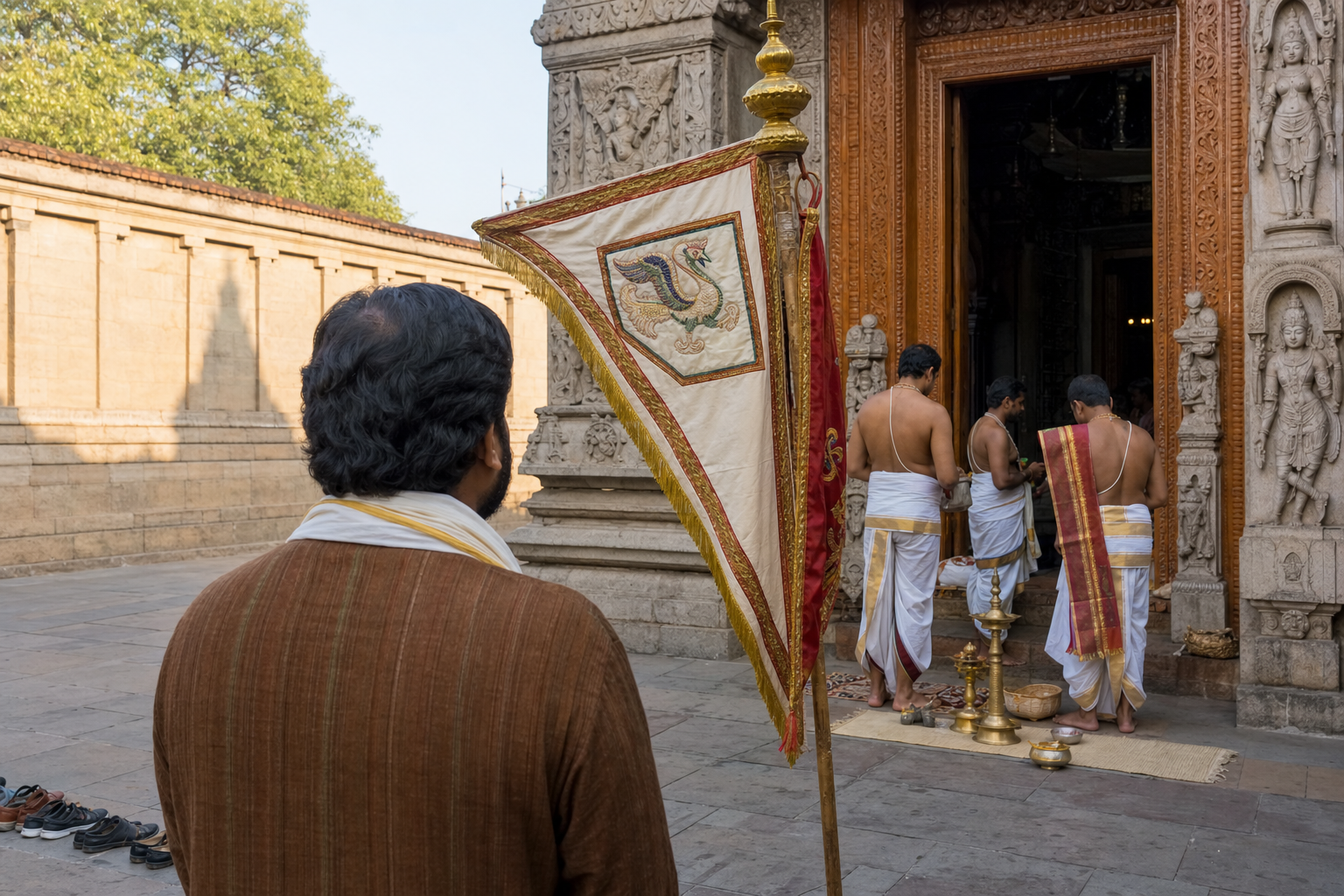
You do not need specialised knowledge to begin reading a dhvaja well. You do need patience. Follow this sequence instead of deciding what the banner means at first glance:
- Locate it in the sacred space. Notice whether it stands at the approach, over an entrance, near a shrine, on a dedicated staff, or at the head of a procession. Placement tells you what role to investigate, even when it does not reveal the complete ritual meaning.
- Identify only what you can see confidently. Record the figure, sign, wording, and dominant visual features. Do not assign a universal meaning to a colour simply because it has one association in another context.
- Find the custodian. Ask which temple, deity, lineage, organisation, or family is responsible for the banner. The custodian is usually the best person to explain its local significance.
- Observe what is happening around it. A banner that leads a procession is doing something different from one permanently raised at a temple. Watch where people pause, who carries or tends it, and whether a particular gesture accompanies it.
- Ask a local, answerable question. Ask what the dhvaja represents in that specific place and whether visitors are expected to follow a particular custom. This produces a more reliable answer than asking what every flag of that colour or shape means.
A safe baseline is simple: do not touch, move, step over, sit on, or adjust a sacred banner without permission. Do not assume photography is welcome merely because the dhvaja is visible. If people around you follow a gesture you do not understand, you need not imitate it theatrically. Pause, make room, and ask about the custom when the ceremony is not being interrupted.
At a procession, practical care is part of reverence. The route, carrier, mounting, and clearance should be settled before movement begins. A tall or wind-catching banner can become difficult to control near traffic, crowds, roofs, branches, or overhead wires. Sacred intent does not remove the organiser’s responsibility for secure fittings and a safe path.
Do not decide from appearance alone whether a particular dhvaja has undergone ritual installation or carries special handling requirements. Two visually similar banners can have different histories and uses. The local sampradaya and the people entrusted with the sacred space should determine the applicable practice.
How to display and care for a dhvaja responsibly
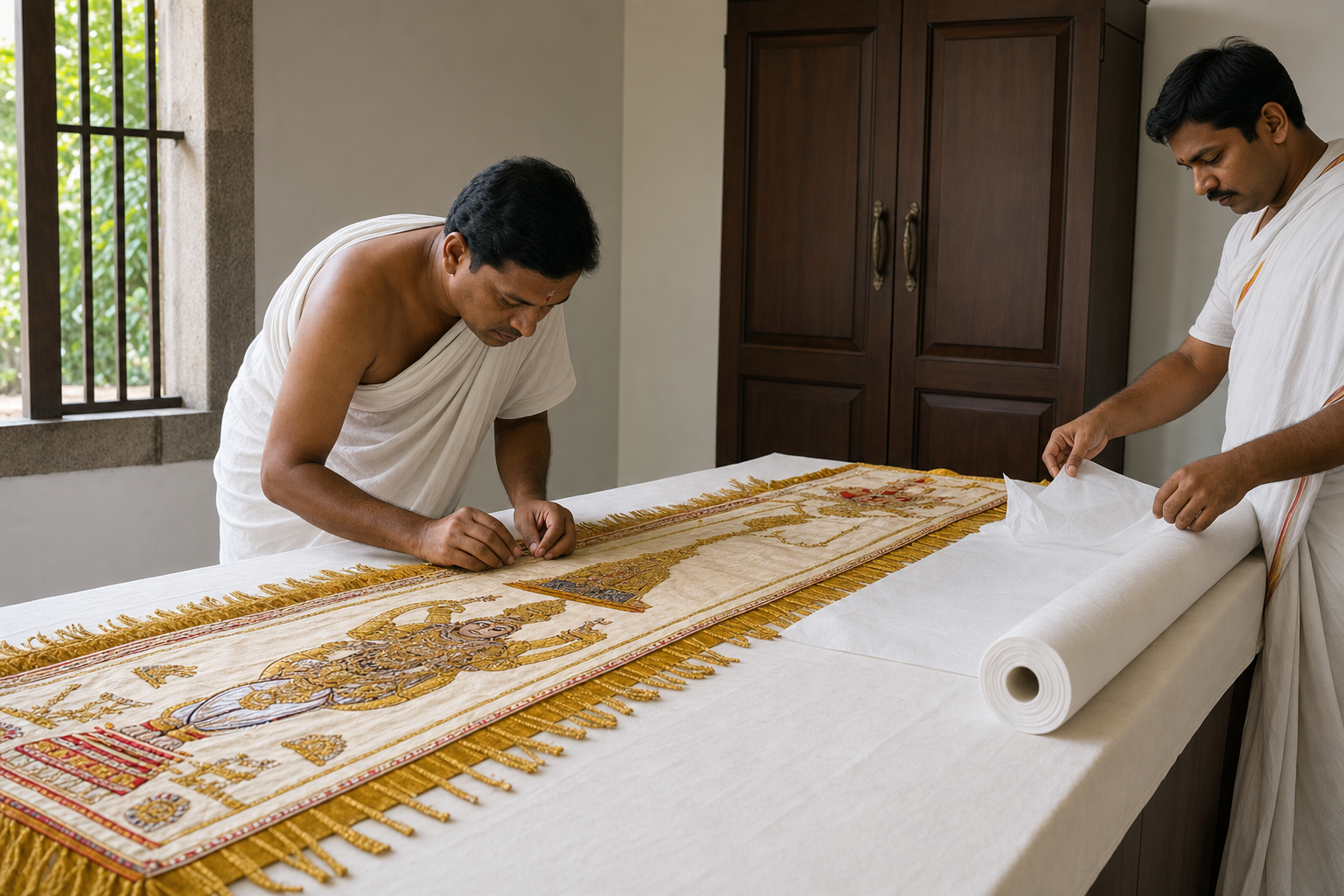
Before acquiring a dhvaja, decide whether you want a living devotional symbol or simply a visual reference to Dharmic culture. If your purpose is decorative, a framed image or textile motif may be more honest than reproducing a temple or processional banner whose meaning and customs you do not intend to maintain.
At home
Begin with the deity, tradition, or relationship you intend to honour. Do not start with a fashionable design and invent a sacred explanation afterward. Show the proposed form to a knowledgeable practitioner or temple connected with that tradition, especially if you are unsure about the emblem or wording.
Ask whether the tradition expects a particular installation or raising procedure. If it does, follow that guidance rather than improvising a mantra or ceremony. No universal rule about direction, colour, date, or ritual should be imposed on every dhvaja.
Choose a clean, stable, and visible position where the banner will not be stepped on, obstruct a passage, brush against footwear, or be treated as ordinary packaging. Outdoor placement requires secure fastenings and regular inspection after strong wind or severe weather. Assign one person to notice fading, tearing, loose mounts, or soiling; shared responsibility too easily becomes nobody’s responsibility.
At a temple or community event
Write down the protocol before the event. Identify who may carry or raise the dhvaja, where it will wait before use, what path it will take, who checks the mounting, and what happens if weather makes the plan unsafe. Briefing the carrier is not bureaucratic excess. It prevents hurried handling of a sacred object in front of a crowd.
Keep the sacred identity clear. Adding a sponsor’s logo, commercial message, partisan slogan, or unrelated campaign mark can turn a devotional emblem into an instrument for another purpose. If any addition is proposed, the temple or tradition responsible for the dhvaja should approve it explicitly.
When a dhvaja is damaged or no longer used
Plan for retirement at the same time you plan for display. Cloth exposed to weather will eventually wear. Do not wait until a torn banner has become an embarrassment and then place it in ordinary waste because no one knows what else to do.
Ask the relevant temple or sampradaya how that particular dhvaja should be replaced and retired. Do not assume that burning, burial, or immersion is universally required. Those actions can carry fire, land-use, or environmental consequences, and practices differ. Local religious guidance must be combined with lawful and environmentally responsible handling.
In print and online
A digital image is not automatically equivalent to a ritually installed banner, but representation still shapes public understanding. Name the emblem accurately in captions. Avoid flipping, crudely cropping, or covering a sacred figure with promotional text. If the image belongs to a specific temple or procession, preserve that context instead of presenting it as a universal design for all Hindus.
If you already own or manage a dhvaja, conduct a short audit now. Can you name what it represents? Can you explain why it occupies its current place? Is one person responsible for its condition? Do you know whom to consult when it must be replaced? Any unanswered question identifies the next conversation you need to have.
The next time a sacred banner comes into view, pause before photographing or categorising it. Identify the bearer, recognise the emblem, notice the setting, and ask what conduct the dhvaja calls forth. A banner dedicated to dharma is honoured most fully when its visible symbol leads to steadier, more responsible action.
References
