
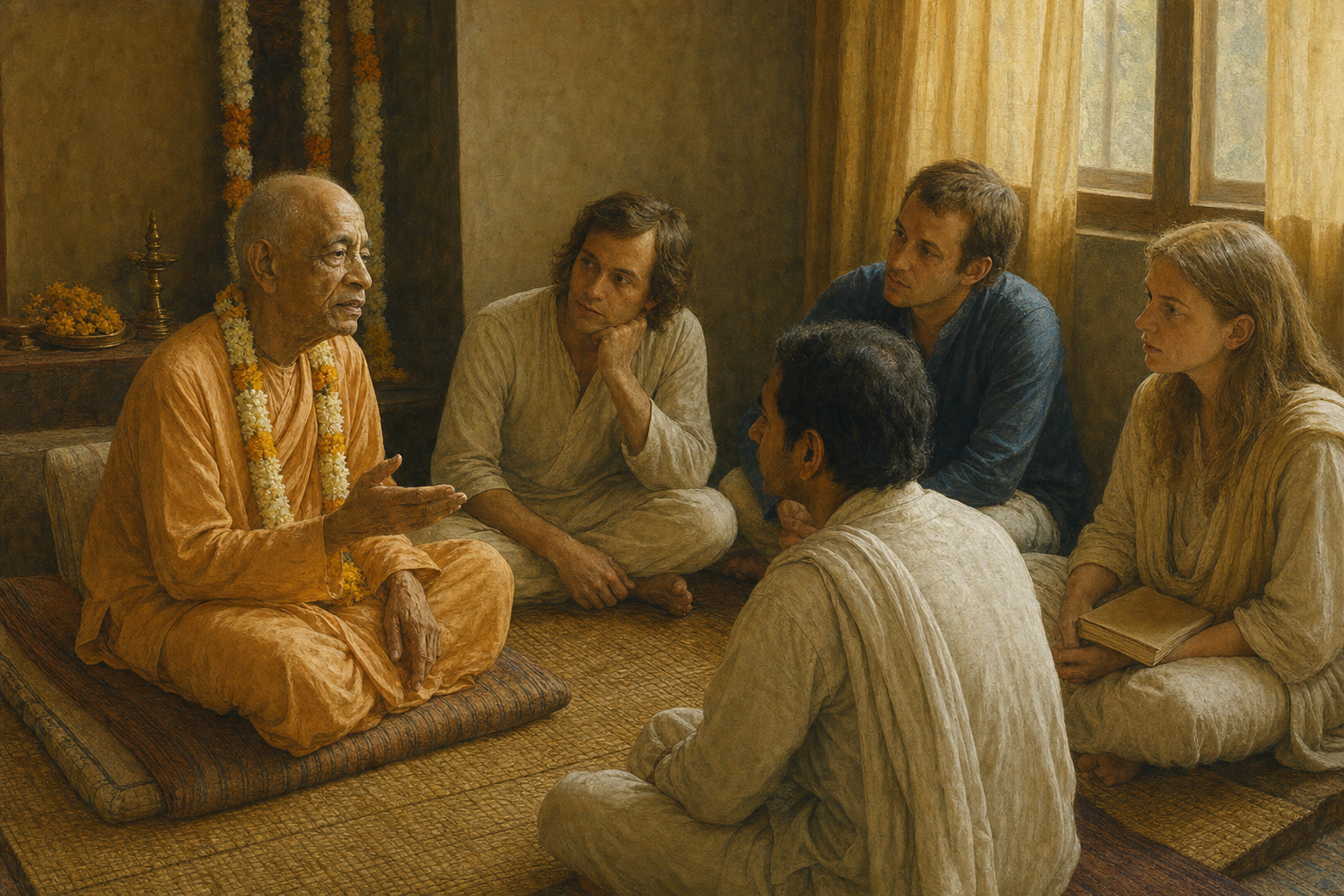
If you know Srila Prabhupada mainly through formal teachings and the public history of ISKCON, personal recollections can bring you closer to the human texture of guru-seva. They also raise an important question: how do you receive a devotee’s memory with reverence without turning every remembered detail into a universal rule?
You need neither uncritical acceptance nor detached scepticism. Listen for three distinct things—the encounter, the service and the realization—then record each one carefully. That approach lets a personal memory deepen your spiritual life while preserving its value as history.
The gift and the limit of a personal memory
A formal history can tell you what happened publicly. A personal memory can reveal what remained in a person’s heart: a gesture that gave courage, an instruction that changed the course of a service, a correction that became clearer years later or the spiritual atmosphere surrounding an ordinary task.
That is the particular value of hearing people who were present during a movement’s formative years. Hrimati dasi, Dvaipayana and Dhrutakarma recount serving Srila Prabhupada and participating in the early development of the Hare Krishna movement. Their importance lies not merely in proximity to a revered acharya, but in the distinct human viewpoints through which that relationship is remembered.
A memory is strongest when you let it answer the kind of question it can genuinely answer. It may show how one person experienced Srila Prabhupada, how that person understood a particular exchange and what effect the encounter had on later service. By itself, it may not establish a complete chronology, settle a disputed institutional question or turn a context-specific direction into a standing instruction for everyone.
This distinction protects both devotion and truth. Reverence does not require pretending that one vantage point is complete. Historical care does not require stripping a sacred relationship of meaning. A personal memory can be sincere, spiritually significant and still partial.
Listen on three levels: encounter, service and realization

Before deciding what a recollection means for you, separate what the speaker remembers from what the speaker later understood. Use these three levels:
- Encounter: What does the person say happened? Note the people, setting, words and sequence only when they are actually given. If a place or date is missing, leave it missing rather than completing the scene from assumption.
- Service: What responsibility was the person carrying, and how did the interaction affect that service? This often reveals why a seemingly small exchange became memorable.
- Realization: What meaning does the speaker draw from the event? Record this as the person’s realization, especially when it emerged over time, rather than silently converting it into an objective detail of the original encounter.
This method prevents two common mistakes. The first is collecting moving anecdotes without noticing what they teach about responsibility, discipleship or service. The second is extracting isolated details as if every remark carried the same doctrinal or historical weight.
Pay particular attention to the kind of instruction being remembered. A direct spiritual principle, a direction for one service and a disciple’s later inference are not interchangeable. In your notes, use exact labels such as “remembered instruction,” “speaker’s interpretation” and “possible application.” Those few words can prevent confusion when you return to the memory later or share it with someone else.
Emotion also needs the right place. A devotee’s gratitude, awe, humour or regret is evidence of how the encounter was experienced. It is not automatic proof of every surrounding historical detail. Receive the feeling respectfully, then evaluate factual claims according to the evidence available.
Turn one listening session into a usable record

Passive listening produces a warm impression that often fades. A simple listening page preserves what you heard and makes later reflection possible. Prepare these fields before you begin:
- Provenance: Write the speaker’s name, the title attached to the recording, its link and the date on which you accessed it. Preserve the speaker’s preferred spelling rather than normalizing it from memory.
- Relationship and context: Note how the person describes the connection to Srila Prabhupada and the service being performed. Record only what is disclosed.
- Remembered moment: Add a timestamp and a plain description of the event. Keep observation separate from interpretation.
- Words and response: If you transcribe exact words, check them against the audio. Otherwise label your wording as a paraphrase. Then note what the speaker says or does in response.
- Realization: Write the lesson in the speaker’s terms before adding your own reflection. This stops your conclusion from displacing the testimony.
- Verification flags: Mark names, dates, locations or institutional claims that would need corroboration. A question mark is more honest and more useful than a confident guess.
- Personal application: Choose an action only when the speaker clearly connects the memory to a principle you can responsibly apply. If the connection remains uncertain, your next action may simply be to listen again or consult the relevant formal teaching.
A compact entry can follow this pattern: “[timestamp] — remembered event — effect on service — speaker’s realization — question to verify — possible practice.” It gives you enough structure to distinguish the layers without reducing a living recollection to a database entry.
When several people remember related events, make separate entries before comparing them. Do not merge their wording into one smoother story. Agreement can strengthen confidence in a detail; difference can reveal distinct positions, later interpretations or gaps that deserve further inquiry. Variation is something to preserve before it is something to explain.
Preserve testimony without flattening the person
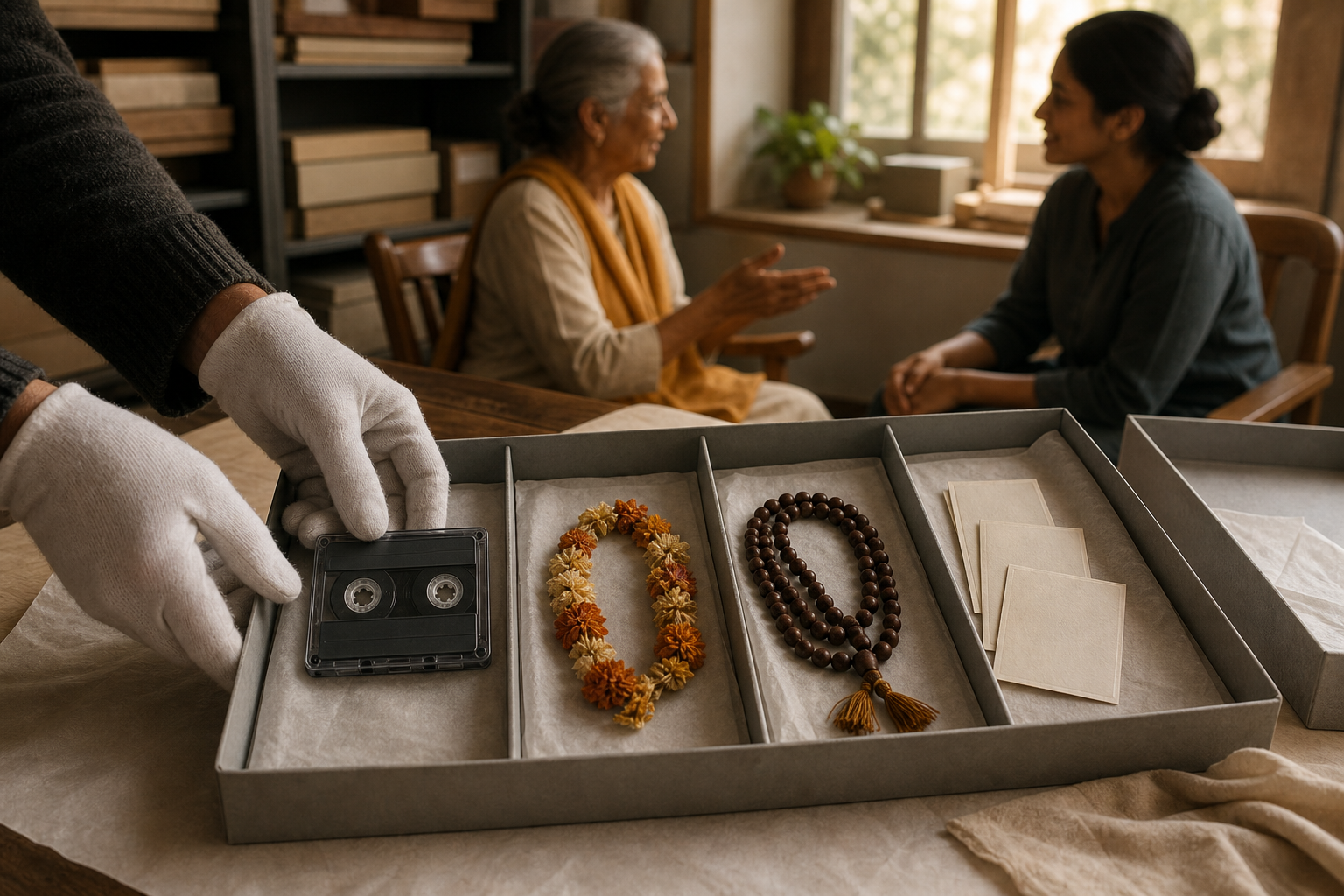
The duty to preserve these memories does not belong only to large institutions. Siddhanta Dasa founded the Prabhupada Memories Project, which has documented hundreds of hours of interviews with devotees around the world. That scale shows what becomes possible when personal testimony is treated as an archive rather than as disposable conversation.
If someone in your temple or family had personal contact with Srila Prabhupada, you can help preserve that person’s testimony responsibly:
- Obtain clear permission. Ask separately about recording, transcription, editing, public distribution and long-term archiving. Consent to speak is not automatically consent to publish everything.
- Begin with open questions. “What do you remember about that service?” gives the person room to recall. A leading question can place your preferred answer inside the prompt.
- Ask for one scene at a time. Follow up with who was present, what happened next and what the person understood at the time. Do not demand a precise date when the person does not remember one.
- Preserve the original. Keep the unedited recording apart from any shortened or cleaned version. An edited presentation may be easier to hear, but the original retains pauses, uncertainty and context.
- Label later additions. If the speaker corrects a name or adds context after the conversation, append the correction with an explanation. Do not silently rewrite the earlier testimony.
- Create useful metadata. Record the speaker’s preferred name, the interviewer’s name, the place and date of the interview, subjects discussed and any restrictions on access. Do not confuse the date of the interview with the date of the remembered event.
- Return a copy. Give the speaker or the speaker’s family access to the preserved material and explain where it will be kept.
Do not pressure an elder to produce a polished devotional moral. Ordinary details can carry historical value: how service was organized, how a person received a correction or why a brief encounter remained unforgettable. Let the testimony retain the speaker’s cadence and uncertainty. Preservation fails when an editor’s desire for a perfect story erases the person who actually remembers it.
Key takeaways
- Receive a personal recollection as testimony to a relationship, not automatically as a complete historical account or universal instruction.
- Separate the remembered encounter, its effect on service and the speaker’s later realization.
- Transcribe exact words only when you can check them; label everything else as paraphrase.
- Leave missing dates, names and places unresolved until they can be verified.
- Preserve different accounts separately before trying to reconcile them.
- Turn inspiration into practice only when the connection to a clear spiritual principle is sound.
Start with one testimony and one page of careful notes. Hear the person fully, preserve what was actually remembered and identify one lesson that is genuinely supported. That disciplined attention is itself a form of service: it allows Srila Prabhupada’s personal influence to reach future listeners without replacing memory with legend or devotion with mere data.
References
