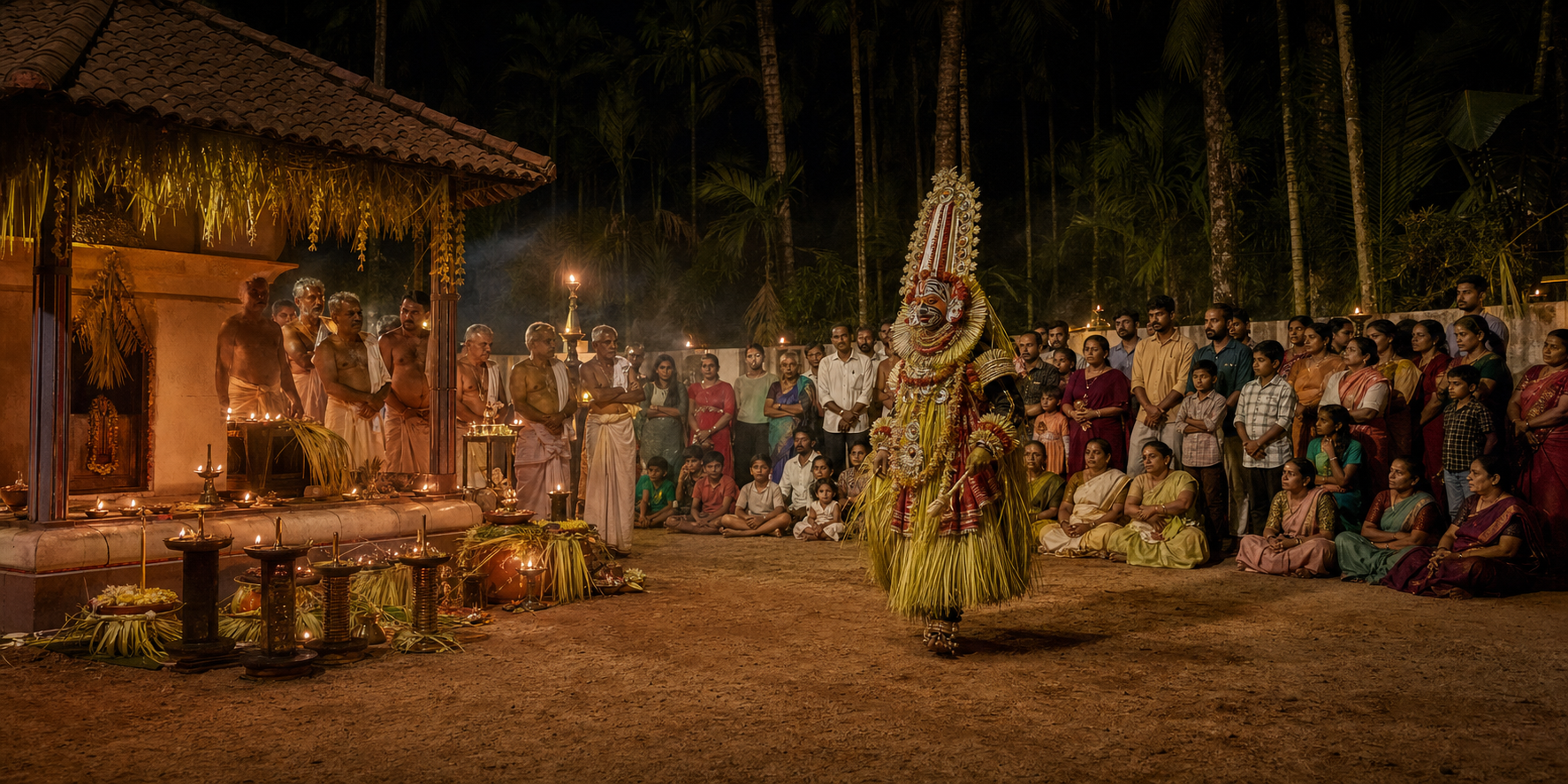
You may recognize Panjurli by the towering headdress, painted face, bells, firelight, and surging movement of a Bhuta Kola. If you stop at those images, however, you miss the part that matters most to the people who sustain the tradition: a relationship among the daiva, the land, hereditary ritual families, and a community answerable for its promises.
Whether you hope to witness a kola or simply understand what you are seeing, begin with one question: what obligation is being renewed here? That question opens the ritual more faithfully than treating Panjurli as a colorful character, Bhuta Kola as a dance show, or the sacred boar as an isolated symbol.
First separate the daiva, the ritual, and the community
Panjurli belongs to Tulunadu, the coastal cultural region extending through coastal Karnataka and into Manjeshwar and Kasaragod in northern Kerala. The region sustains numerous daivas, including Pilichamundi, Bobbarya, Koti-Chennaya, and Jumadi. Each has particular narratives, relationships, ritual responsibilities, and local forms. Panjurli is especially associated with the boar, cultivated land, boundaries, agricultural protection, and truth.
Three distinctions will keep your understanding on firm ground:
- The daiva is the sacred presence and moral authority recognized by the worshipping community.
- Panjurli is a particular daiva whose boar form carries agrarian and ecological meaning.
- Bhuta Kola or Nema is the locally organized rite in which that presence is invoked, narrated, embodied, addressed, and honored.
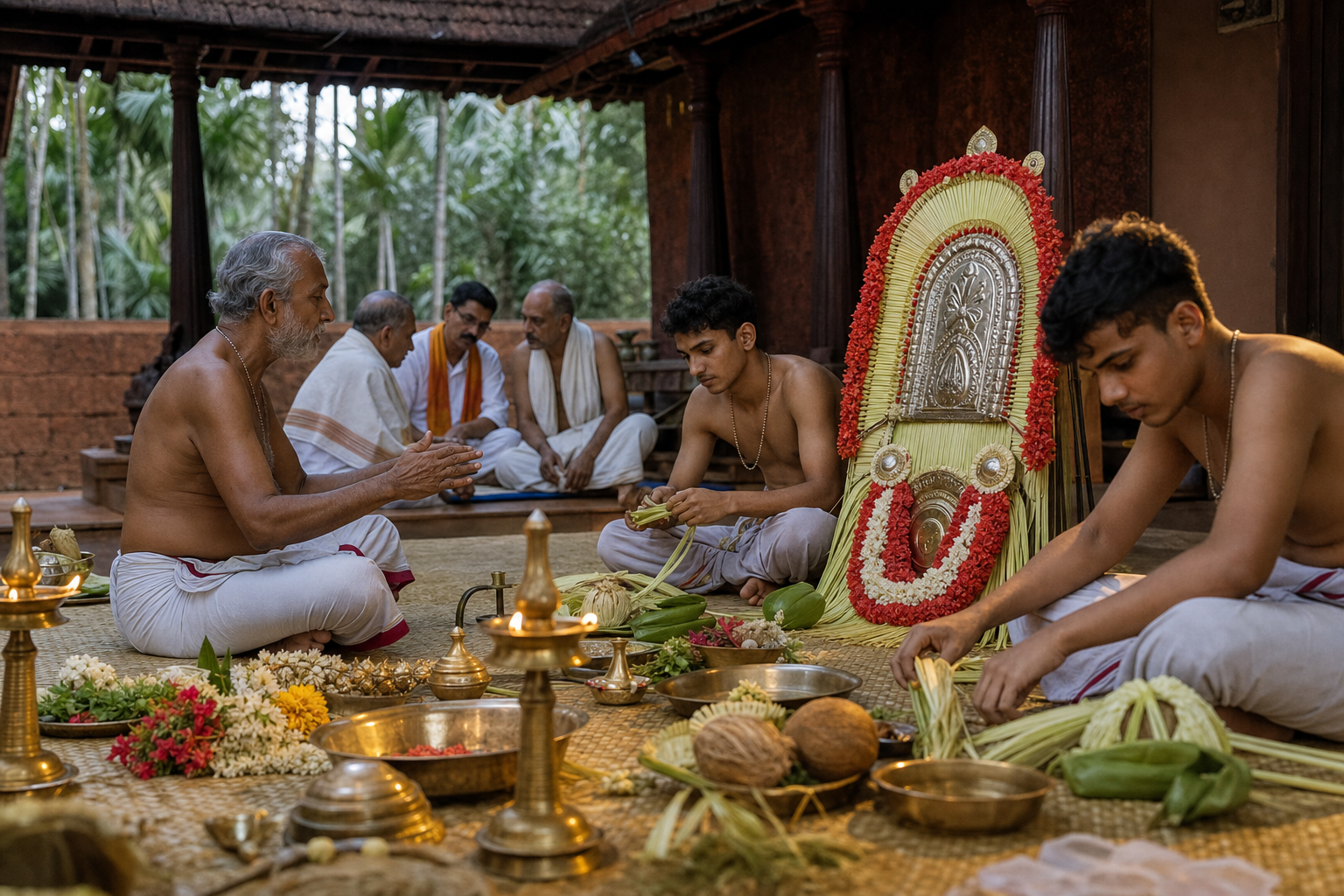
The human performer is therefore neither a costumed actor playing a fictional role nor an interchangeable religious functionary. In many places, hereditary performer-ritualists from communities such as Nalike and Parava prepare for and enact the kola. Poojaris maintain offerings and shrine rites, while gurikars or other custodians coordinate responsibilities involving families, patrons, and the shrine. This distribution of ritual work matters because no single dramatic figure constitutes the whole institution.
That gives you a practical test for photographs, videos, captions, and explanations. If the presentation names only the daiva and performer while erasing the shrine, paddana, musicians, custodians, petitioners, and inherited community obligations, it is showing you a fragment as though it were the whole. The correction is not to ignore the visual power of the kola. It is to place that power back inside the sacred relationship that gives it meaning.
Follow the whole night, not just its visual climax
A Panjurli kola often takes place in the post-harvest season and may continue through the night. Exact practices differ by locality, so there is no universal script that lets an outsider predict every action. A broad sequence nevertheless helps you recognize why preparation, narration, embodiment, and judgment belong to one continuous rite.
- The sacred place is prepared. The shrine is cleaned and redressed, and ritual objects associated with the bhandara are brought into use. Notice that the event begins before the elaborate appearance of the performer. Material care for the shrine is already an act of renewing responsibility.
- The paddana establishes memory. Oral narratives recount the daiva’s origin, journeys, conflicts, agreements, broken promises, and reconciliations. Listen for names, places, kinship relations, and repeated obligations. The paddana is not merely background music; it places the gathering inside a remembered moral history.
- Costume and sound make authority perceptible. Palm-spathe elements, a high headdress, face painting, anklets, waist bells, weapons or staffs, percussion, and wind instruments create a visible and audible grammar. Reds, blacks, and whites, tusk-like facial features, and the sound of the gaggara announce more than aesthetic transformation.
- The intensity changes. Movement and music build toward possession-trance, understood within the tradition as the arrival or manifestation of the daiva. You do not have to manufacture a private metaphysical certainty to behave respectfully. You do have to recognize that worshippers are participating in a sacred event, not inviting an audience to judge a performance technique.
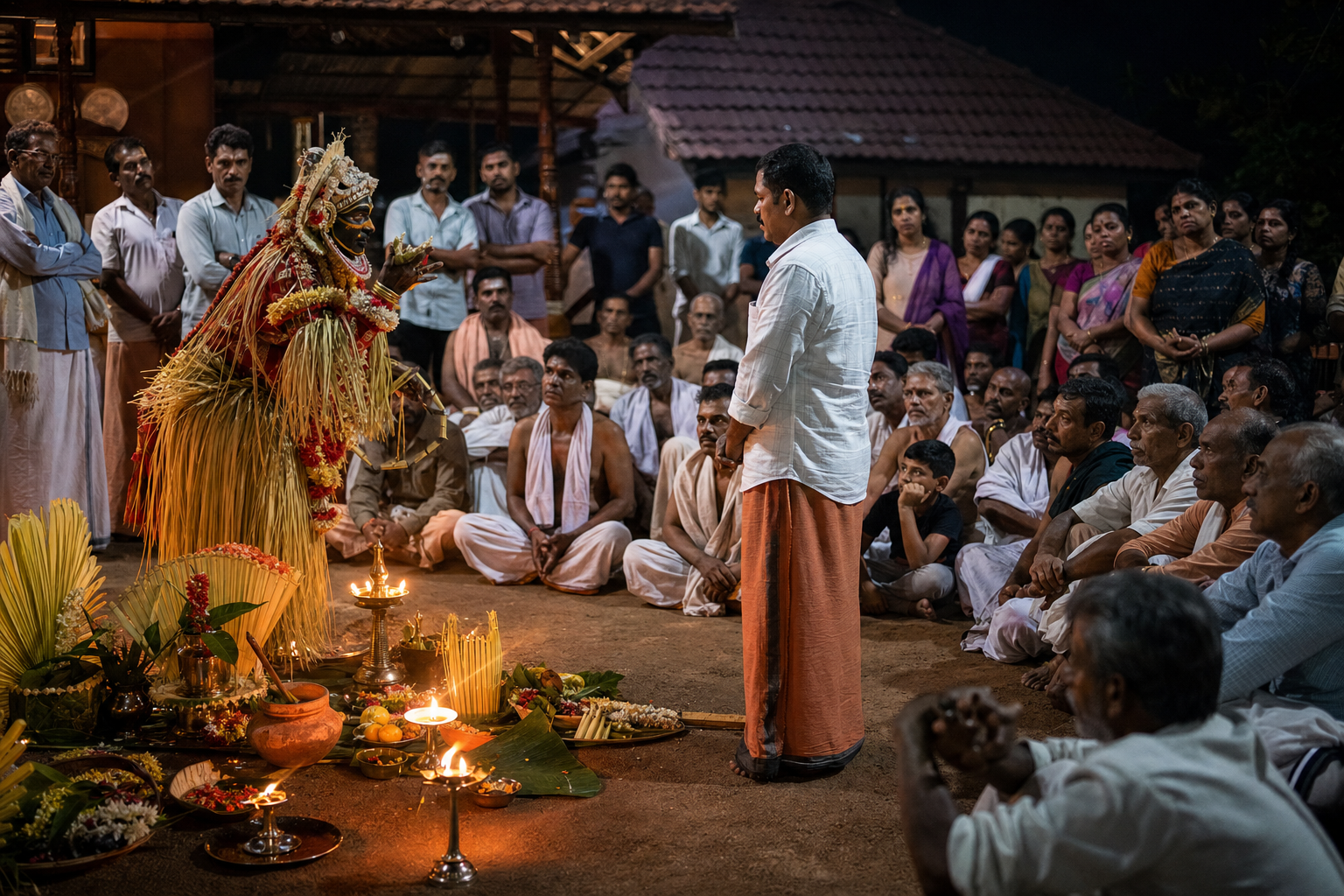
- The daiva hears the community. People may present grievances, confess failures, ask for relief, or seek a ruling. The daiva questions, admonishes, consoles, and directs. This exchange is why leaving after the most dramatic dance can mean leaving before the ritual’s civic and ethical center.
- The obligation is sealed. Offerings such as rice, coconuts, areca nut, flowers, lamps, and local produce express gratitude and reciprocity. The commitment to return and honor the relationship gives the rite its future tense.
The speech phase deserves particular attention. Panjurli’s authority does not remain in an otherworldly realm. It can be directed toward a damaged relationship, an unfulfilled promise, a disputed boundary, a neglected share, or a common resource that must be maintained. The community hears the exchange, so a remedy becomes a publicly witnessed undertaking rather than a private intention.
It is useful to call this a customary forum, but careless to equate it with a modern statutory court. Its force comes from sacred accountability, inherited legitimacy, community memory, and public consent. When you hear the daiva speak, listen less for fortune-telling than for the movement from grievance to responsibility: Who must repair what? Which promise must be honored? What conduct will restore a workable relationship?
The boar marks the difficult boundary between forest and field
The name Panjurli is commonly connected with panji, the Tulu word for boar. Local origin narratives are not identical, and their variation should not be forced into one official storyline. A recurring pattern, however, concerns the conflict between cultivators and a boar that damages fields. Ritual agreement changes the relationship: the feared animal presence becomes a guardian when human beings accept continuing obligations of offering, restraint, remembrance, and right conduct.
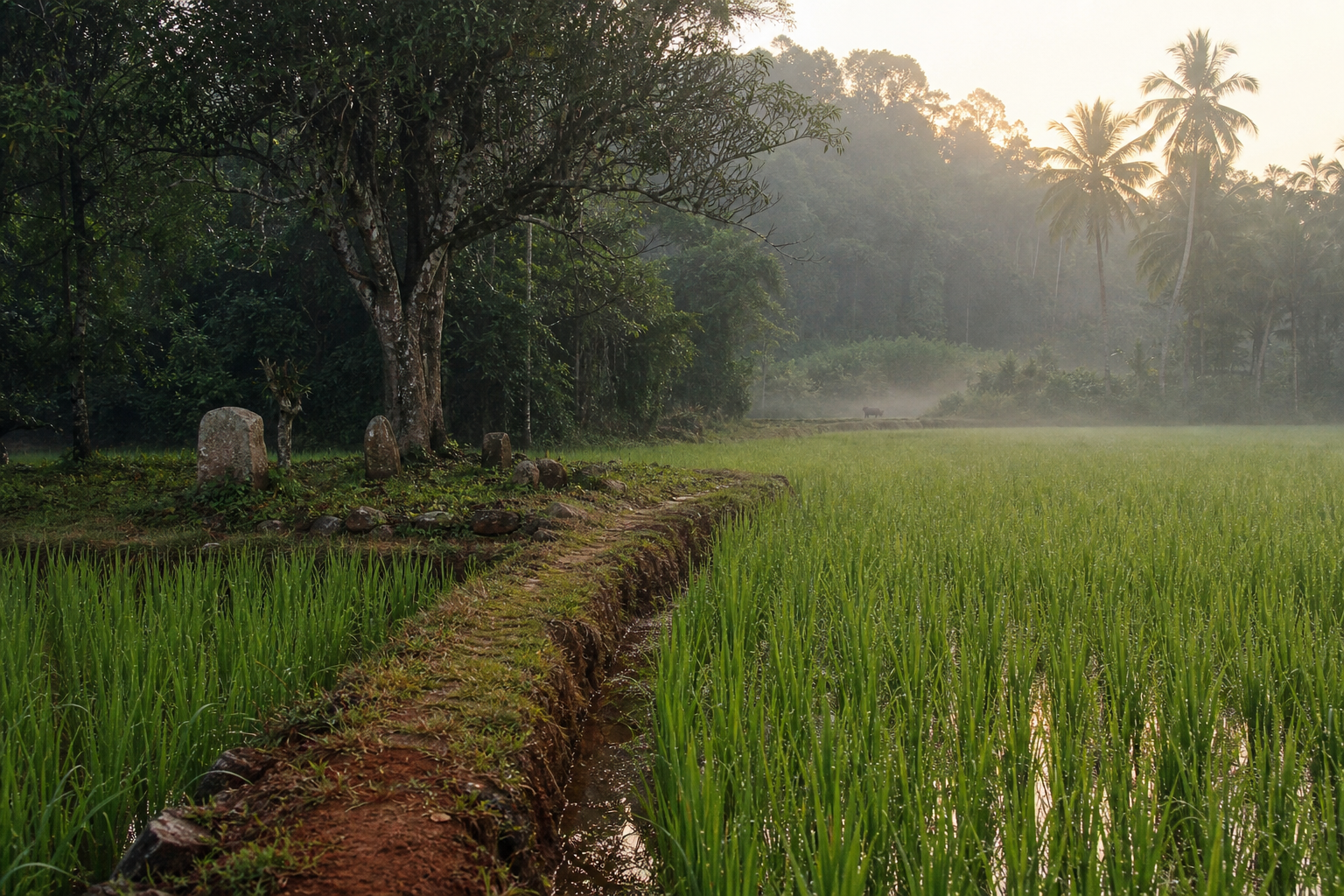
This is why the boar is more than a convenient emblem of strength. Wild boar occupy the unstable meeting place of forest and farm. They can cross boundaries that cultivators depend upon, consume what households have labored to grow, and reveal that a field is never completely detached from the surrounding ecology. Panjurli sacralizes precisely that seam between kadu, the forest, and the cultivated field.
The resulting covenant does not pretend that conflict has vanished. It gives conflict a moral form. Cultivation is permitted to become a relationship rather than a declaration that human possession is absolute. Protection comes with duties: respect boundaries, keep agreements, share water responsibly, maintain what the community depends on, and return what has been promised. This is ecological responsibility expressed through sacred accountability, not environmental language added to the tradition after the fact.
When you interpret a Panjurli image, then, do not ask only, “What does the boar symbolize?” Ask what the boar compels people to remember. A symbol can remain safely decorative. A guardian who hears petitions and enforces covenants places demands on households, landholders, neighbors, and shrine patrons.
This also explains why boundary disputes and agricultural duties belong in a sacred rite. Dharma here is not restricted to private belief. It appears as truthful speech, proportional repair, restraint in the use of land, fulfillment of a vow, and renewed peace among people who must continue living together. The metaphysical claim and the practical remedy strengthen one another.
Panjurli and Varaha belong in a layered Dharmic world
The boar form naturally brings Varaha to mind. Vishnu’s boar avatara rescues the Earth, while Panjurli protects a local moral and agrarian order. The resemblance is meaningful, but it does not justify collapsing one into the other. Panjurli has Tulu names, paddanas, custodial lineages, shrines, petitions, and obligations that cannot be replaced by a pan-Indic label.
A better approach is layered recognition. Panjurli can resonate with Varaha without becoming merely a regional costume for Varaha. Local sacred identity and wider Hindu cosmology need not compete for exclusive possession of the boar form. Tulunadu’s practical religious life already accommodates connections among household worship, daivasthanas, and larger temple networks, sometimes through shared calendars, resources, and routes of pilgrimage.
Related ritual worlds along the western coast, including Theyyam and Kaliyattam in northern Kerala, help reveal a larger coastal ecology of shrine, grove, oral memory, costume, movement, and sacred speech. Similarity should lead you to comparison with care, not to the claim that every coastal possession rite is the same tradition under another name. Regional vocabulary, ritual authority, narrative lineage, and the community’s own distinctions must remain visible.
The same discipline applies when locating Panjurli within the broader Dharmic family. The tradition’s concern with truthful conduct and accountability can speak to Sikh emphases on truthful living and seva. Its recognition of duties beyond the isolated human self can resonate with Buddhist compassion and Jain ahimsa. These are ethical consonances, not proof that Hindu, Buddhist, Jain, Sikh, and Tulu ritual identities are interchangeable.
Three common interpretations should therefore make you pause:
- “It is only folk theater.” This notices artistry but misses invocation, possession, petition, judgment, and vow.
- “Panjurli is simply Varaha.” This recognizes a genuine resonance but erases the local narrative and custodial world that makes Panjurli Panjurli.
- “It is a relic of an earlier religion.” This treats a living institution as archaeological residue even while communities continue to use it for worship, memory, reconciliation, and responsibility.
Dharmic plurality is clearest here not as a slogan but as a method. It allows connection without forced sameness. If you can hold Panjurli’s local specificity and wider sacred resonances together, you are closer to the religious intelligence of the tradition itself.
How to witness a Bhuta Kola without reducing it to spectacle
A visitor’s first duty is not to master every symbol. It is to enter a community’s sacred space without assuming that visibility equals permission. Customs differ among shrines and families, so local guidance outranks a generic checklist. These practices will help you ask the right questions and avoid the most common mistakes.
- Learn whose kola it is. Ask for the daiva’s name, the shrine’s name, and whether the observance is called a kola, nema, or another local term. Do not label every elaborate coastal ritual as Panjurli.
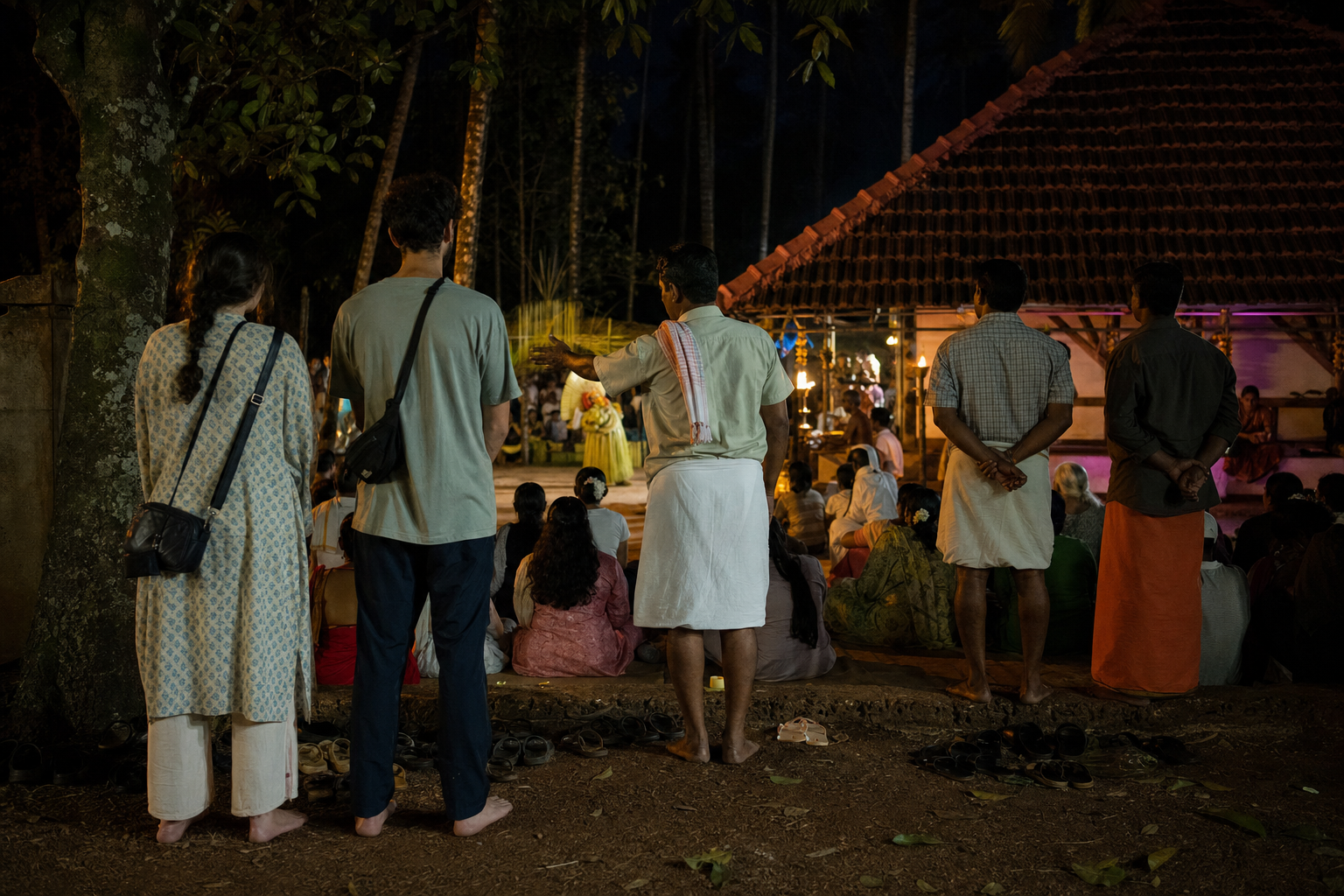
- Ask the custodians about access. Find out where visitors may stand or sit, whether particular areas are restricted, and when movement is inappropriate. Follow shrine authorities and local families rather than copying another spectator.
- Arrive early enough to see preparation. If the gathering is open to you, the shrine, bhandara, paddana, and musicians will teach you more about continuity than an isolated clip of the most dramatic moment.
- Request permission before recording. A public gathering is still a sacred proceeding. Permission to attend does not automatically include permission for close photography, flash, livestreaming, or the online circulation of a petitioner’s personal dispute.
- Remain attentive when the daiva speaks. Reduce movement and conversation, and do not interrupt an exchange. The petitions and directions are central to the event, even if you do not understand every word.
- Do not imitate trance, gestures, costume, or sacred speech. These forms belong to disciplined ritual roles and inherited responsibilities. Removing them for casual performance turns authority into an accessory.
- Follow local offering practice. Offerings vary and may change over time, including movement toward symbolic forms in some places. Ask what is appropriate instead of arriving with assumptions about what the daiva requires.
- Share context, not just visual intensity. If you have permission to publish images, name Tulunadu, Panjurli or the correct daiva, Bhuta Kola or Nema, and the sacred purpose of the event. Do not expose private petitioners or present trance as a curiosity detached from worship.
Respect also means allowing the tradition to change under the authority of those who carry it. Safety measures for performers, documentation, youth education, and apprenticeship can support continuity without turning every inherited detail into a museum exhibit. The meaningful question is not whether the kola looks frozen in an imagined past. It is whether ritual knowledge, custodial responsibility, community consent, and the daiva’s moral authority remain connected.
Key takeaways
- Panjurli is a sacred guardian associated with the boar, cultivation, boundaries, protection, and truthful conduct.
- Bhuta Kola or Nema is not simply a dance; it joins shrine care, oral history, music, embodiment, possession, petition, judgment, offering, and renewed obligation.
- The boar expresses a covenant at the forest-field boundary, where human cultivation remains answerable to land, shared resources, neighbors, and non-human life.
- Resonance with Varaha enriches Panjurli’s meaning but does not cancel the daiva’s distinct Tulu narratives, lineages, and ritual authority.
- A respectful visitor follows local custodians, seeks permission to record, protects petitioners’ privacy, and stays attentive to the spoken obligations rather than chasing only the spectacle.
If you are welcomed at a kola, stay long enough to hear what follows the transformation. Then, when an appropriate opportunity arises, ask a local custodian which promise or relationship the observance renews. That answer will take you closer to Panjurli than the most arresting image ever could.