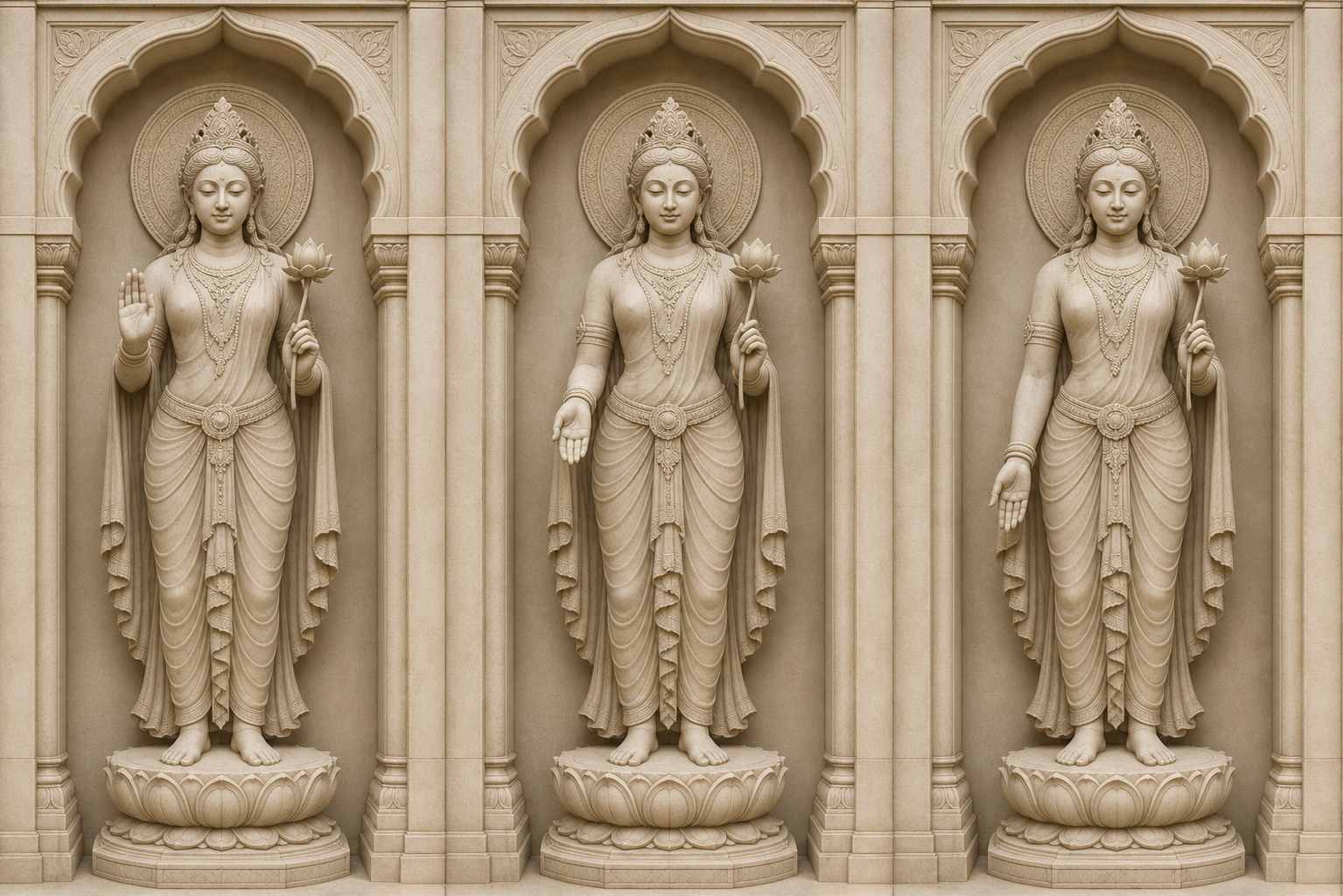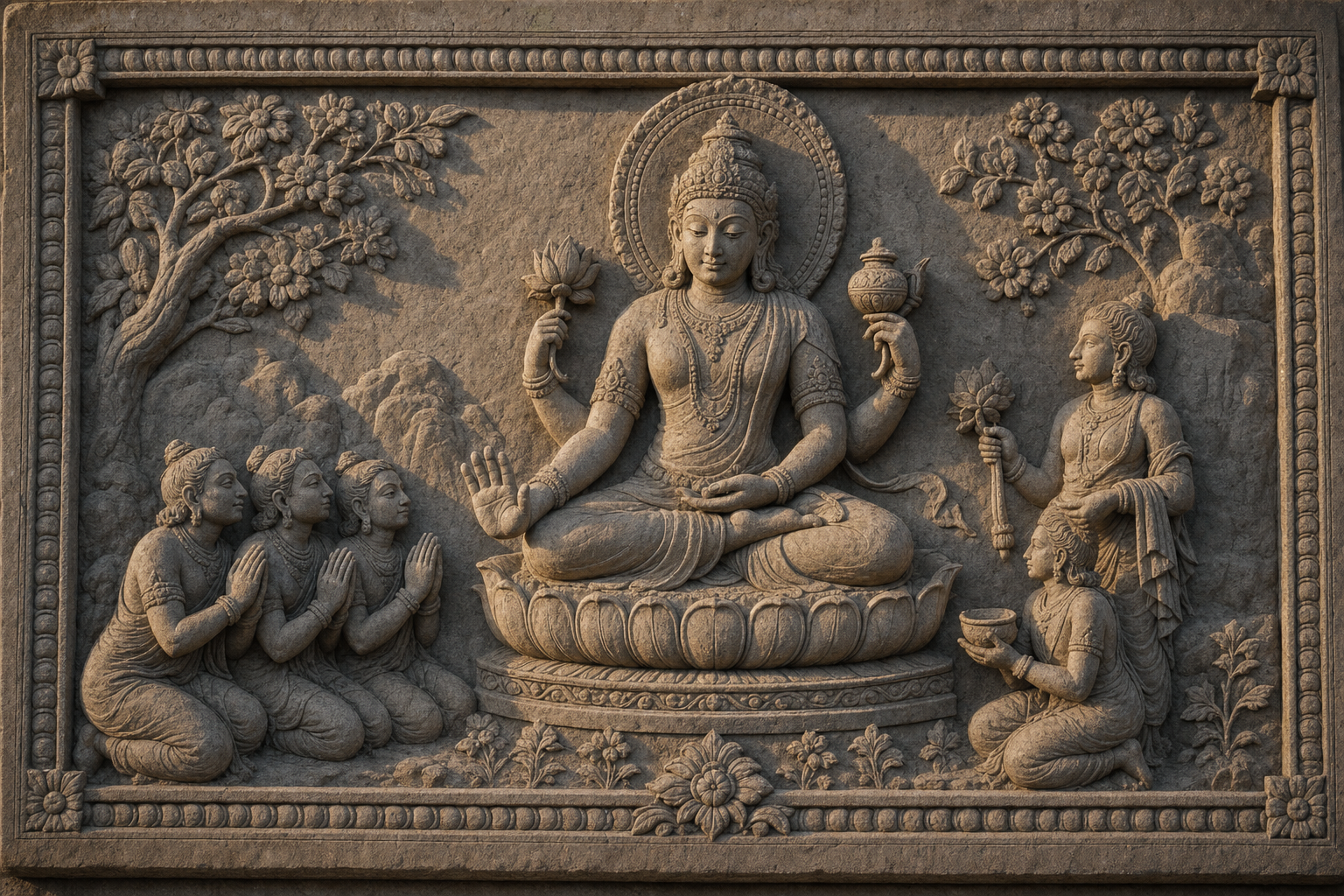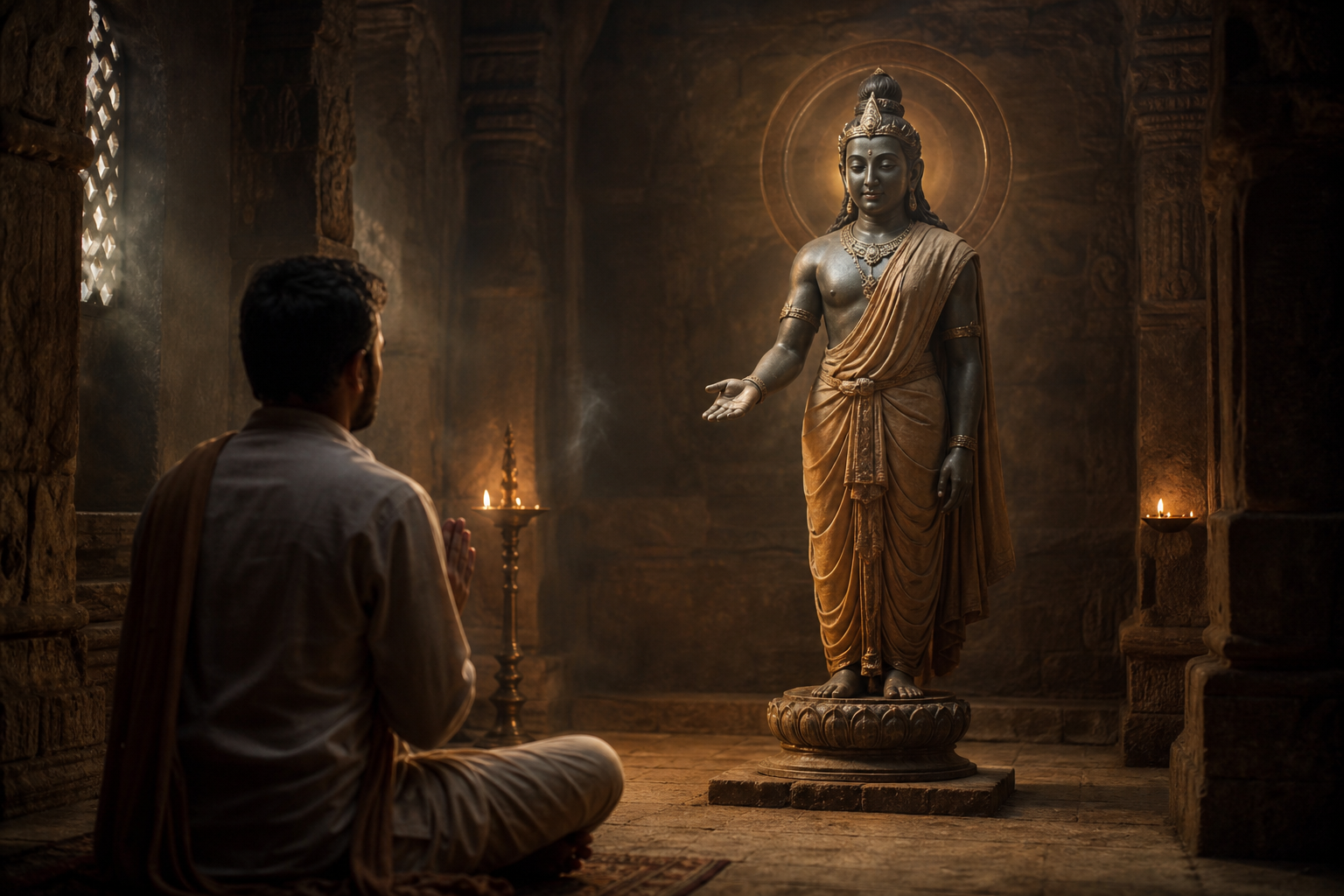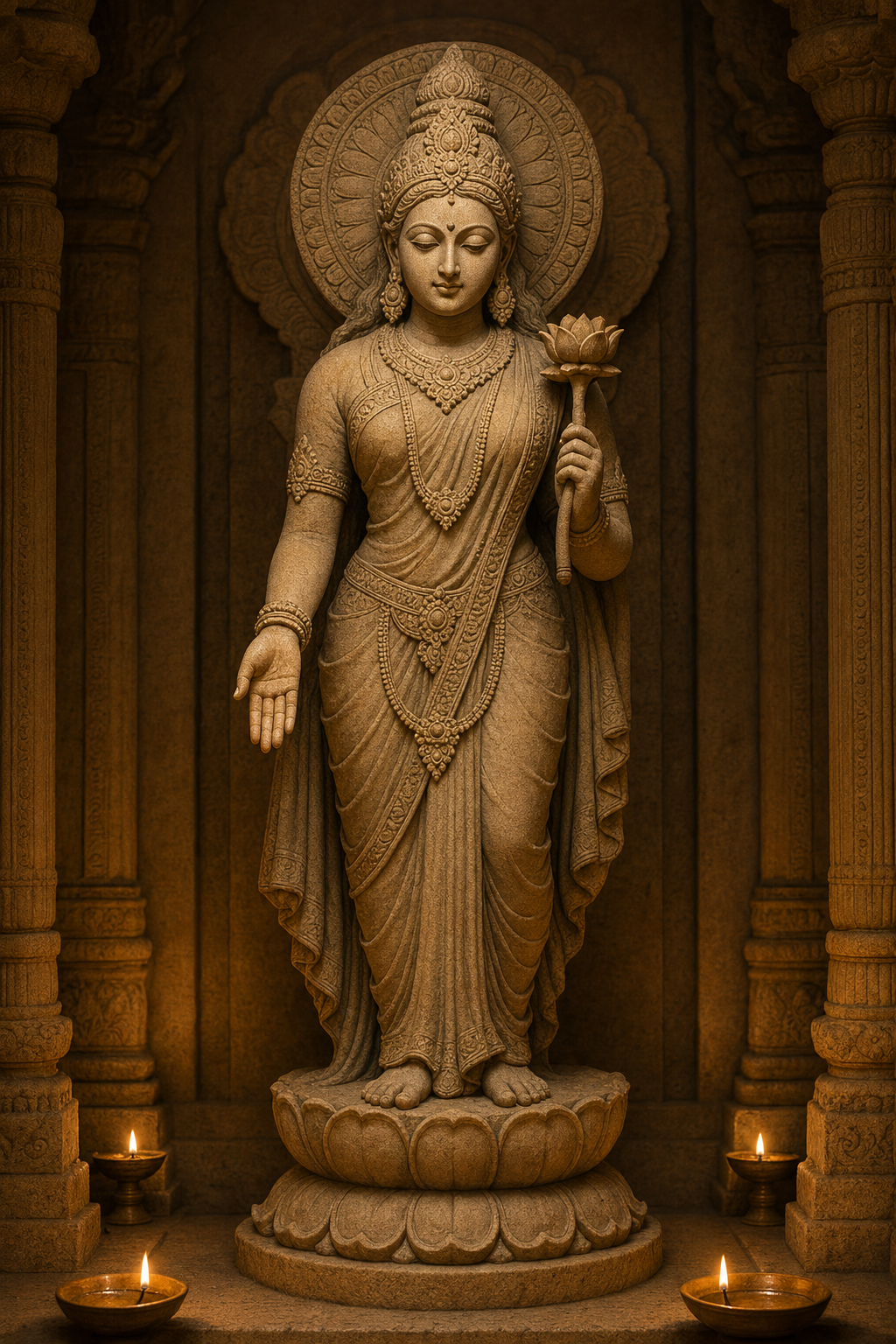
You are standing before a murti with one open hand lowered toward you and another that seems to welcome your approach. Is this Ahuya-Varada, the familiar Abhaya-Varada pairing, or simply a regional way of carving an open palm?
You can usually reach a sound identification without memorising every iconographic label. Read the palm, height, fingers, attributes, and theological setting in that order. The decisive meaning lies in the relationship between the hands: an invitation to approach followed by the bestowal of grace.
Key takeaways
- Varada is normally the easier hand to identify: the palm faces outward and somewhat downward, usually near the navel or hip, with relaxed fingers extending toward the earth.
- Ahuya is less uniformly labelled. Where it is distinguished, look for a softly inclined or subtly beckoning hand rather than the high, upright palm of Abhaya.
- Do not identify a mudra from the open palm alone. Hand height, finger shape, deity attributes, posture, and narrative setting must agree.
- If the supposedly invitational hand is upright at chest or shoulder height, Abhaya-Varada is often the safer identification.
- Regional carving can blur the boundary between welcome and assurance. A careful caption should preserve that uncertainty instead of forcing a precise name.
Identify the gesture in six passes
The compound name gives you a useful starting hypothesis. Varada comes from vara, a boon, and da, giving. Ahuya is associated with forms such as āhūya and āhvāna, carrying the sense of calling or inviting. As a paired devotional statement, the hands can therefore be read as: approach, then receive.
That interpretation is stronger than the label itself. Ahuya is not named with complete consistency across regions, periods, treatises, and catalogues. A welcoming hand may be classified under another regional term, or absorbed into the much more familiar Abhaya-Varada formula. Use the following sequence when you examine a sculpture, bronze, painting, or manuscript image.
- Find the palm plane. A Varada palm generally opens toward the devotee while tilting downward. Abhaya faces outward more vertically. An Ahuya reading becomes plausible when the other hand inclines toward the viewer or appears to draw the viewer inward.
- Mark the height. A hand at the hip or around the navel is more likely to bestow than to proclaim fearlessness. A palm raised to the chest or shoulder is more characteristic of Abhaya. Height is especially valuable when weathering has erased the fingertips.
- Inspect the fingers. Varada fingers are usually relaxed and extended, often pointing earthward. Ahuya, when deliberately differentiated, may have a gentle inward curl or beckoning articulation. A rigidly raised index finger points away from this reading.
- Follow the wrist. A slight wrist turn can transform the emotional force of an otherwise open hand. A vertical wrist presents a protective barrier; a softened, inclined wrist can create welcome; a lowered wrist completes the movement of giving.
- Identify attributes and posture. A conch, discus, trident, modaka, lotus, weapon, teaching posture, or cosmic dance supplies the iconographic family in which the hand operates. The same open palm does not carry an identical emphasis in every ensemble.
- Read the hands as a sentence. Ask what the full composition does. Does one hand invite and another give? Does a raised palm assure while a lowered palm grants? Does a teaching gesture redirect the image toward instruction? The pair matters more than an isolated finger.
Record your conclusion at the level the evidence supports. If every feature agrees, write “Ahuya-Varada.” If the welcoming hand is visually close to Abhaya, write “Abhaya-Varada, with an invitational inflection” or “Ahuya/Abhaya-Varada.” That is precision, not indecision.
Separate Ahuya-Varada from nearby hand gestures
Most misidentifications happen because an open hand is treated as a complete definition. It is only the first clue. This comparison gives you a more reliable working test.
| Gesture | Typical palm and height | Finger clue | Primary visual force | Best confirmation |
|---|---|---|---|---|
| Ahuya | Inclined toward the devotee; generally less vertical than Abhaya | Soft inward curl or restrained beckoning articulation | Welcome or invitation | A companion Varada hand and a devotional context of approach or refuge |
| Varada | Outward and downward, commonly near the navel or hip | Relaxed, extended fingers often directed earthward | Boon, generosity, or grace | A lowered hand aligned with the deity’s beneficent role |
| Abhaya | Outward and upright, commonly at chest or shoulder height | Open fingers without a beckoning curl | Fearlessness and assurance | A protective context or a complementary Varada hand |
| Vitarka | Usually oriented for discourse rather than giving | Thumb and forefinger touch | Teaching, reasoning, or exposition | A pedagogical scene or teacher form |
| Tarjani | Directed emphatically rather than openly offered | Index finger projects | Warning, command, or admonition | A forceful narrative or protective context |
Three errors deserve particular attention. First, a low Abhaya in a later or regional work can resemble Varada. Check whether the palm is still essentially vertical. Second, a damaged Vitarka may look like an ordinary open hand if the joined thumb and forefinger are missing. Examine the surviving knuckles before deciding. Third, a graceful hand is not automatically Ahuya. Ornament, curvature, and softness belong to sculptural style as well as iconographic meaning.
Let the deity, scene, and regional style decide
The hand must agree with the theological identity of the figure. This is the rule of ensemble: attributes establish who stands before you, posture establishes the action, and the mudra completes the relationship with the devotee.
Vaishnava images
In a four-armed Vishnu image, begin with the upper attributes. When the śaṅkha and cakra occupy the upper hands, a lowered open right hand is strongly positioned to be Varada. The remaining lower hand may rest at the hip or contribute assurance and welcome. In images of Rāma or Kṛṣṇa, a boon-giving hand fits the Vaishnava emphasis on divine care for the devotee. A softly cupped or inclined companion hand may intensify that relationship as invitation, but its identification still depends on the regional idiom.
Shaiva images
Dakṣiṇāmūrti requires you to notice the teaching setting before naming every hand. Abhaya or Varada can harmonise with the serene authority of the guru beneath the banyan, while a distinctly discursive finger arrangement belongs to the language of instruction. In Somāskanda panels, boon and assurance contribute to the image’s familial, protective balance.
Natarāja provides an especially clear lesson in relational reading. The raised Abhaya hand answers the danger represented by cosmic fire with fearlessness. A lowered or benevolent companion gesture carries the eye from cosmic dissolution toward refuge and grace. Calling every open hand “Varada” would erase that carefully organised choreography.
Shakta, Ganesha, and Skanda images
Lakṣmī’s lowered open palm belongs naturally to the visual theology of abundance and compassionate giving. In some Eastern Indian and Odishan forms, a softly inclined companion hand can add the sense of invitation. In images of Durgā or Mahīṣāsuramardinī, a benedictory hand can stabilise an otherwise dynamic battle composition: the defeat of adharma culminates in protection rather than violence for its own sake.
Gaṇeśa often places Varada in a lower hand while another holds a modaka, pāśa, or another identifying attribute. Read the palm alongside the trunk’s curve and the disposition of the other arms. The resulting welcome is consistent with auspicious beginnings and an opened path. Skanda or Subrahmaṇya can similarly use Varada to express guidance and blessing in disciplined endeavour.
Regional handling changes what the hand looks like
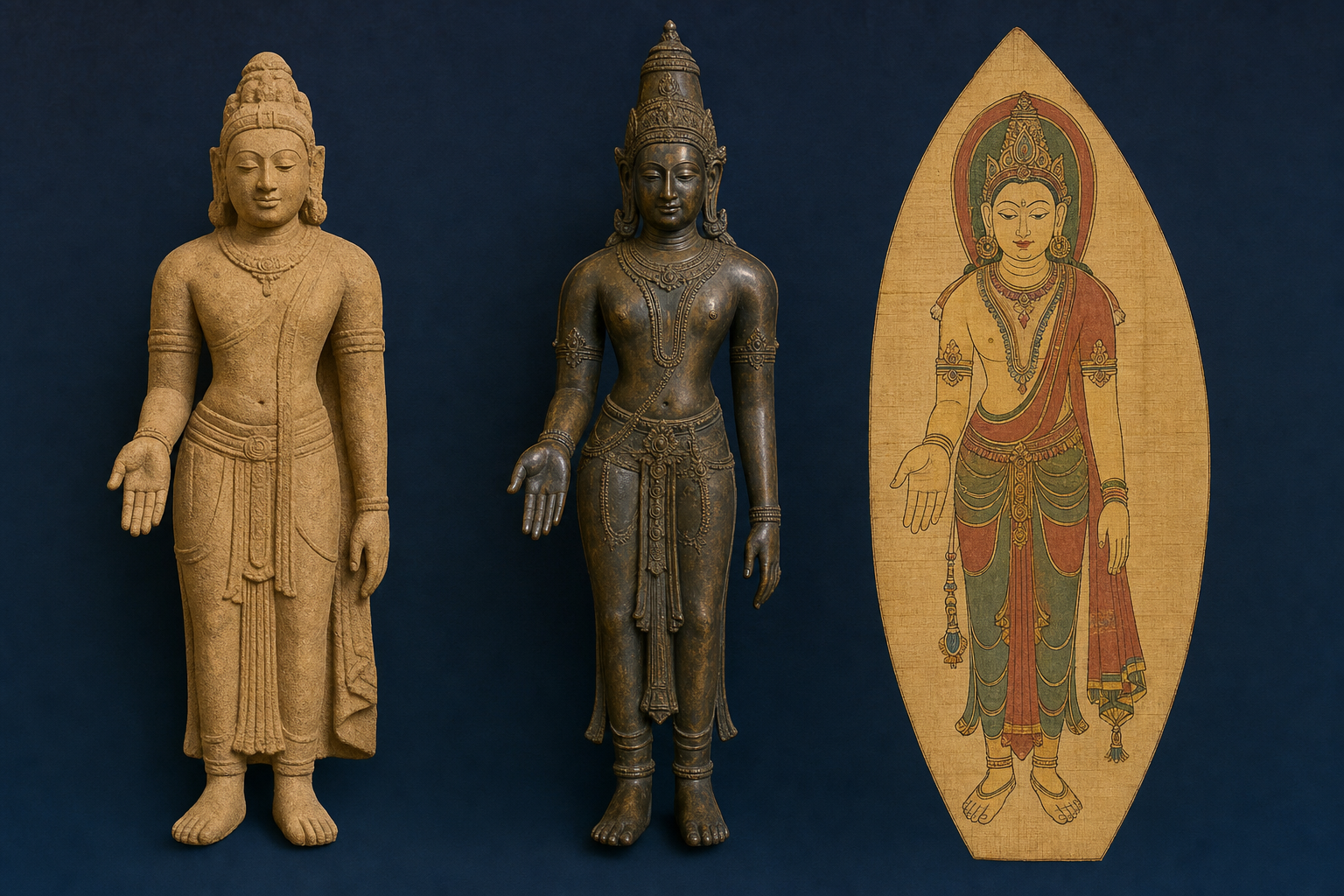
Chola bronzes often make the wrist turn and descending fingers exceptionally supple. Odishan stone can present broader palms, incised creases, and a softly inclined hand associated with local conventions of invitation. Pāla-Sena sculpture favours rounded volumes and generous palms, while Hoysala carving may surround the gesture with dense jewellery and minute detail.
Use these tendencies to calibrate your eye, not to identify provenance from a hand alone. A broad palm does not prove an Odishan origin, and elegant descending fingers do not by themselves establish a Chola bronze. Style explains why the same iconographic function may look different; attributes and the full sculptural programme still have to confirm the reading.
Temple display adds another complication. Garlands, vastras, flowers, lamp soot, distance, and mandapa light can conceal the angle that separates welcome from assurance. Move laterally if permitted, compare both hands, and examine an unobstructed photograph before reaching a firm conclusion. In an utsava procession, notice which palm faces the gathered devotees. Its outward presentation is part of how the deity’s presence and blessing move into public space.
Recognise a shared visual grammar without flattening traditions
The lowered, open hand travels widely across the Dharmic world, but similar form does not make every image theologically interchangeable. In Buddhist art, Varada appears in Gandhāran, Gupta, and Pāla-Sena settings and can express the giving of Dharma, charity, and refuge. Avalokiteśvara and Maitreya may combine assurance with beneficence. Identify the Buddha or bodhisattva through posture, attributes, and setting before transferring a Hindu compound label to the image.
Jain images place their central emphasis on the Jina’s meditation or standing abandonment. An open, Abhaya-like palm may occur in standing images, while attendant yakṣas and yakṣiṇīs more frequently carry Varada. Here the visual language of generosity and non-harm remains compatible with the Jina’s ascetic stillness, but it does not convert the Jina into a boon-granting deity of another tradition.
Sikh dharma centres the Śabad Guru rather than murti worship. Later Pahari paintings, murals, and Janamsākhī imagery may nevertheless portray a Guru with a gentle benedictory palm resembling Abhaya or Varada. Read that resemblance through dayā, seva, and fearless compassion, while preserving the Sikh framework in which the image appears.
This distinction is the practical value of careful iconography. Shared forms reveal a civilisational vocabulary of welcome, refuge, generosity, and non-harm; differences in setting reveal how each tradition gives that vocabulary its own theological work.
The next time you encounter the gesture, resist naming it in the first second. Trace the palm, height, fingers, companion hand, attributes, and scene. If those clues form the sequence “approach and receive,” Ahuya-Varada is a meaningful reading. If the first hand primarily says “do not fear,” keep Abhaya-Varada. Let the visible evidence determine the name.