

If you still speak your loved one’s name, keep their photograph nearby, cook something they taught you, or pause when an ordinary sound brings them back, you may wonder whether you are honoring the bond or refusing to let go.
You do not have to erase a relationship in order to accept a death. A well-chosen ritual helps you acknowledge the absence, give love somewhere honest to go, and return to the life that still asks something of you.
A continuing bond is not the same as denial
Acceptance means recognizing that the person or animal has died. It does not mean becoming indifferent, discarding every object, avoiding the name, or reaching a final day when the relationship no longer matters.
Continuing Bonds Theory gives a useful name to what bereaved people often discover for themselves: maintaining an inner relationship can be a normal and adaptive part of grief. The relationship changes from physical companionship into memory, values, habits, prayer, storytelling, responsibility, and service. You may hear a parent’s phrase in your own voice, care for an animal because a departed companion awakened that concern, or make a decision by asking what someone you loved taught you to value.
The useful question is not, Have I finally let go? Ask instead: Does the way I carry this bond help me live truthfully?
- A healthy remembrance practice can say plainly that the death occurred.
- It lets affection and sorrow coexist without demanding that either disappear.
- It can influence how you live, while leaving you free to form new relationships and responsibilities.
- It can be paused, shortened, or changed when you do not have the capacity for it.
- It does not require you to behave as though physical return is expected.
This distinction matters when a photograph, scent, song, familiar route, or animal on the street suddenly brings grief close. Sensory reminders can reactivate interconnected memory and emotional networks, so the force of the moment is not proof that you have failed to progress. It is often the nervous system recognizing something that mattered before the reflective mind has caught up.
You can meet that moment without turning it into a verdict on your whole life. Name what happened: This reminded me of her. Let the feeling be present. Then decide whether you need a few minutes of remembrance or whether today’s wiser choice is to return to the task in front of you.
Choose a ritual for the grief you actually have

A ritual should answer a real need. Copying an elaborate observance because it looks solemn can leave you more burdened than held. Begin by noticing the form your grief is taking today.
When grief arrives as an overwhelming wave
Use a short ritual with a visible ending. Say the name. Recall one ordinary detail. Offer a prayer or a few words of gratitude. Close by bowing, placing the photograph back, extinguishing the lamp safely, or leaving the place where you sat. Follow it with one grounded action such as bathing, eating, walking, or completing an errand.
The closing action is not a rejection of the dead. It tells your body that direct remembrance has ended for now. Grief can return later without having to occupy every remaining hour.
When the death removed the structure of your day
Sometimes you are not only missing a being. You are missing the timetable that formed around their presence: preparing food, making a call, visiting a hospital, taking a dog outside, arranging medicine, or sharing an evening meal. When that care ends, the hours themselves can feel disorganized.
Preserve one useful time anchor without pretending the old life continues. If you used to walk a companion animal in the morning, keep the walk and change its purpose. If caregiving structured the evening, use part of that period for yoga, prayer, a shared meal, or seva. Predictable movement, meals, sleep, and social contact can help rebuild the physiological and practical scaffolding that a death disrupted.
Do not replace every lost duty at once. Choose the time of day that now feels most unmoored and give that period one repeatable action.
When other people minimize the relationship
Grief can become lonely when the relationship was private, complicated, socially unrecognized, or with an animal. This is sometimes called disenfranchised grief: the loss is real, but the bereaved person receives little permission to mourn it.
Make recognition part of the ritual. Use the name. Place one photograph or meaningful object where you can sit with it intentionally. Tell one trustworthy person what you miss, and ask them to listen without ranking the loss. For an animal, you might dedicate an act of care to another living being. Ahimsa and karuna give moral language to what the heart already knows: a bond formed through protection, dependence, companionship, and daily care is not trivial.
You do not need a large memorial or public agreement. You need a truthful witness, even if that witness is initially only your own disciplined attention.
When guilt dominates the memory
Do not use ritual to manufacture an answer about what the dead would forgive. Use it to separate fact, regret, love, and responsibility.
- Write what happened in concrete language, without adding accusations against yourself that you cannot prove.
- Name what you wish you had done differently.
- Name what was outside your knowledge or control at the time.
- Identify one value the relationship now asks you to practice.
- If a repair is possible among the living, make a proportionate plan for it. If it is not, dedicate an act of seva rather than repeating a private punishment.
Retelling a memory does not change the event, but structured storytelling and journaling can place remembered pain within a wider emotional context. Include the whole relationship, not only its final scene or your worst decision. A person’s life should not be reduced to the hour of death, and your bond should not be reduced to the point you most regret.
When relatives need different forms of remembrance
One person may need to speak; another may need silence. One may want photographs displayed; another may find them unbearable for now. One may be meticulous about inherited rites; another may participate only in a simple act of respect.
Agree on the shared observance, then leave room for private practice. Do not make visible tears the price of belonging, and do not interpret quiet participation as lack of love. If a rite carries specific obligations in your sampradaya, sangha, Jain community, gurdwara, or family lineage, consult a trusted elder or qualified religious guide rather than treating a general grief practice as a replacement.
Give the ritual a clear beginning, center, and end
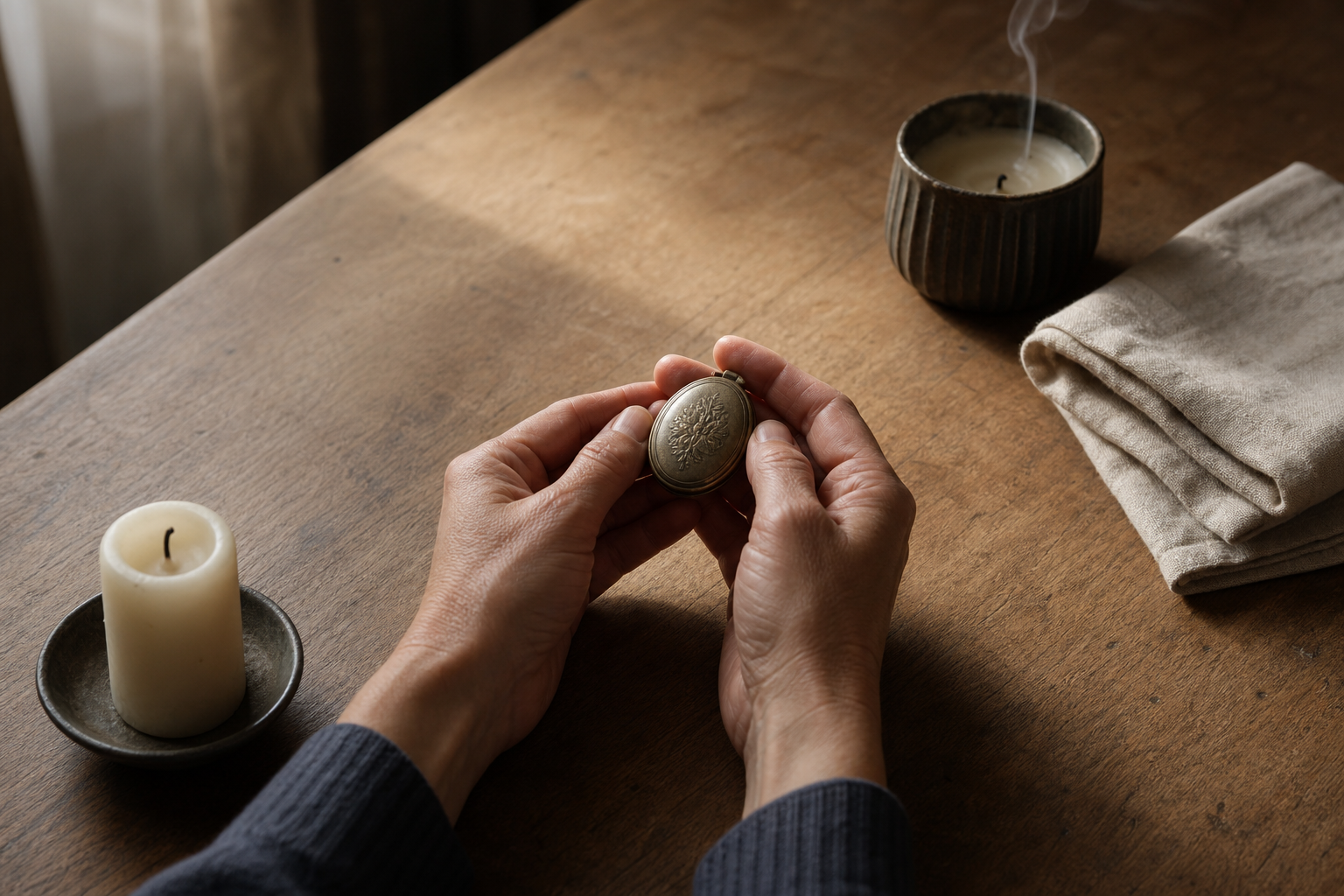
A repeatable ritual does not need to be elaborate. Its strength comes from clarity. The following structure can be adapted to your tradition, relationship, capacity, and home.
- Set a narrow scope. Choose one person, animal, memory, date, or quality to remember. Do not ask one sitting to contain the entire relationship.
- Mark the beginning. Sit in a chosen place, place a photograph or flower before you, light a lamp only where it can be supervised safely, or join your palms. Use the same simple gesture often enough that your attention recognizes the transition.
- Name reality. Say the name and acknowledge the death in language you can bear: You died, I miss you, and I am remembering you now. This keeps remembrance joined to acceptance.
- Recall one living detail. Choose the cadence of a laugh, a repeated phrase, a stubborn habit, a meal, a kindness, or an ordinary routine. Small details restore the person’s character more faithfully than a polished tribute made only of achievements.
- Make a response. Pray within your tradition, chant an appropriate mantra or passage, write a few sentences, speak gratitude, or dedicate an act of seva. Let the response express what the memory asks of you now.
- Close and re-enter the day. Bow, put away the object, extinguish the flame, wash your hands or face, and do one restoration-oriented activity. The ritual has a boundary; the love does not.
If you are exhausted, use the smallest complete version: say the name, remember one detail, offer one gesture of reverence, and close. A ritual you can actually perform is more useful than an ideal observance that becomes another source of failure.
Use breath to steady attention, not to suppress emotion
If remembrance produces a rush of bodily tension, try two to five minutes of gentle 4-6 breathing: inhale without strain for a count of four and exhale for a count of six. The longer exhalation can support autonomic settling and make it easier to remain present. Slow breathing, brief mindful movement, and compassion practices can help regulate arousal.
Keep the breath soft and do not hold it. Stop if you become dizzy, breathless, or more distressed. A breathing practice is a momentary regulation tool, not a test of spiritual maturity and not a substitute for medical or psychological care.
Let your Dharmic tradition shape the meaning
Dharmic traditions share compassion, disciplined attention, and an honest encounter with impermanence, but they are not interchangeable. Use the language and forms that belong to your path rather than assembling a decorative mixture.
- Within Hindu traditions, anitya helps you face change without pretending that love was meaningless, while shraddha gives remembrance a reverential and duty-conscious form. Exact rites differ by family, region, sampradaya, and circumstance.
- Within Buddhist traditions, dukkha names the vulnerability present in attachment to changing life. Mindfulness makes room for grief as it is, while metta or maitri can extend goodwill toward the deceased, yourself, and others who mourn.
- Within Jain traditions, aparigraha invites a gentle loosening of possessiveness rather than deletion of affection. Ahimsa can turn remembrance toward more careful conduct toward living beings.
- Within Sikh tradition, hukam offers a way to receive what cannot be reversed, while chardi kala keeps sorrow joined to moral courage. Seva allows love to continue as useful action rather than private sentiment alone.
None of these teachings requires emotional numbness. Impermanence is not an argument against tears. Non-attachment is not indifference. Acceptance of hukam is not passivity. Resilient spirit is not compulsory cheerfulness. The practical test is whether a teaching helps you meet death more truthfully and care for life more responsibly.
Keep remembrance in conversation with ordinary life

Grief needs attention, but so do sleep, food, work, children, elders, friendships, health, and the duties that remain. Treating either side as a betrayal creates an unnecessary conflict.
The Dual Process Model describes healthy adaptation as movement between loss-oriented attention and restoration-oriented activity. At one moment you remember, weep, pray, or tell a story. At another you answer a message, exercise, repair something, laugh, or make plans. Oscillation between these modes allows sorrow and functioning to coexist.
This means a good day does not dishonor the dead. Neither does an unexpectedly painful day cancel the life you have rebuilt. Grief can become quieter and still return vividly when something touches the bond.
Connect every memorial practice to one living responsibility
If you visit a memorial place, decide what you will do afterward. If you tell a story over a family meal, let the meal continue. If you observe an anniversary, include both remembrance and care for the living. If you inherit a practice from the deceased, perform it because it remains valuable, not because you must recreate the past perfectly.
Seva is especially useful when grief has become inward and repetitive. Choose an act proportionate to your capacity: help a relative, feed someone, support an animal, volunteer within your community, or complete a neglected duty. Do not use service to avoid every feeling. Let it be the outward half of remembrance.
Revise a ritual that has become rigid
A ritual is a container, not a contract with suffering. Shorten it, move it, share it, or pause it if the form no longer serves its purpose. Consider changing the practice when:
- you feel compelled to repeat it until it is perfect;
- missing it produces terror rather than ordinary disappointment;
- it consistently prevents sleep, meals, work, caregiving, or necessary contact with others;
- it demands money, physical strain, or risk you cannot safely bear;
- it keeps the relationship fixed only at the death scene;
- it is being forced on another mourner who has not consented to participate.
You are allowed to put some objects away without putting the person away. You are also allowed to keep a photograph visible without defending it as evidence of recovery. The object is not the bond; it is one possible doorway to it.
Know when ritual is not enough
Grief has no simple timetable, so the continued presence of sadness is not by itself a diagnosis. Seek help from a qualified mental health professional or bereavement counselor when distress is seriously disrupting sleep, eating, personal safety, essential responsibilities, or relationships; when it is intensifying rather than becoming more workable; or when guilt, panic, traumatic memories, substance use, or compulsive rituals are making daily life harder to manage.
If you might harm yourself, cannot keep yourself safe, or are in immediate danger, contact local emergency or crisis services now and involve a trusted person who can remain with you. Prayer, meditation, family rites, and seva can accompany professional care. They should not be used to replace urgent help.
You can also ask for support before reaching a crisis. Bring the actual problem to the conversation: I cannot sleep after the anniversary ritual; I keep reliving the final hours; my family is fighting about the memorial; or no one understands why the death of my animal has affected me so deeply. A concrete description gives a counselor, religious guide, or trusted community member something they can help you address.
Key takeaways
- Accepting a death does not require erasing the relationship. The bond can continue through memory, values, prayer, story, and service.
- Choose a ritual for today’s need: containment for an emotional wave, structure for a disrupted day, recognition for an overlooked loss, or truthful reflection when guilt dominates.
- Use a clear sequence: mark the beginning, acknowledge the death, remember one specific detail, make a response, and close before returning to ordinary activity.
- Follow the forms of your own tradition carefully. Shared Dharmic values do not make every rite or teaching interchangeable.
- Let remembrance alternate with sleep, work, movement, relationship, and seva. Restoration is not betrayal.
- Change a practice that becomes compulsive, unsafe, isolating, or disabling, and seek professional or urgent help when grief is threatening safety or basic functioning.
Begin with one small observance you can complete today. Say the name, remember one ordinary detail, dedicate one useful action, and then return to the living world carrying the bond in a form that can travel with you.