
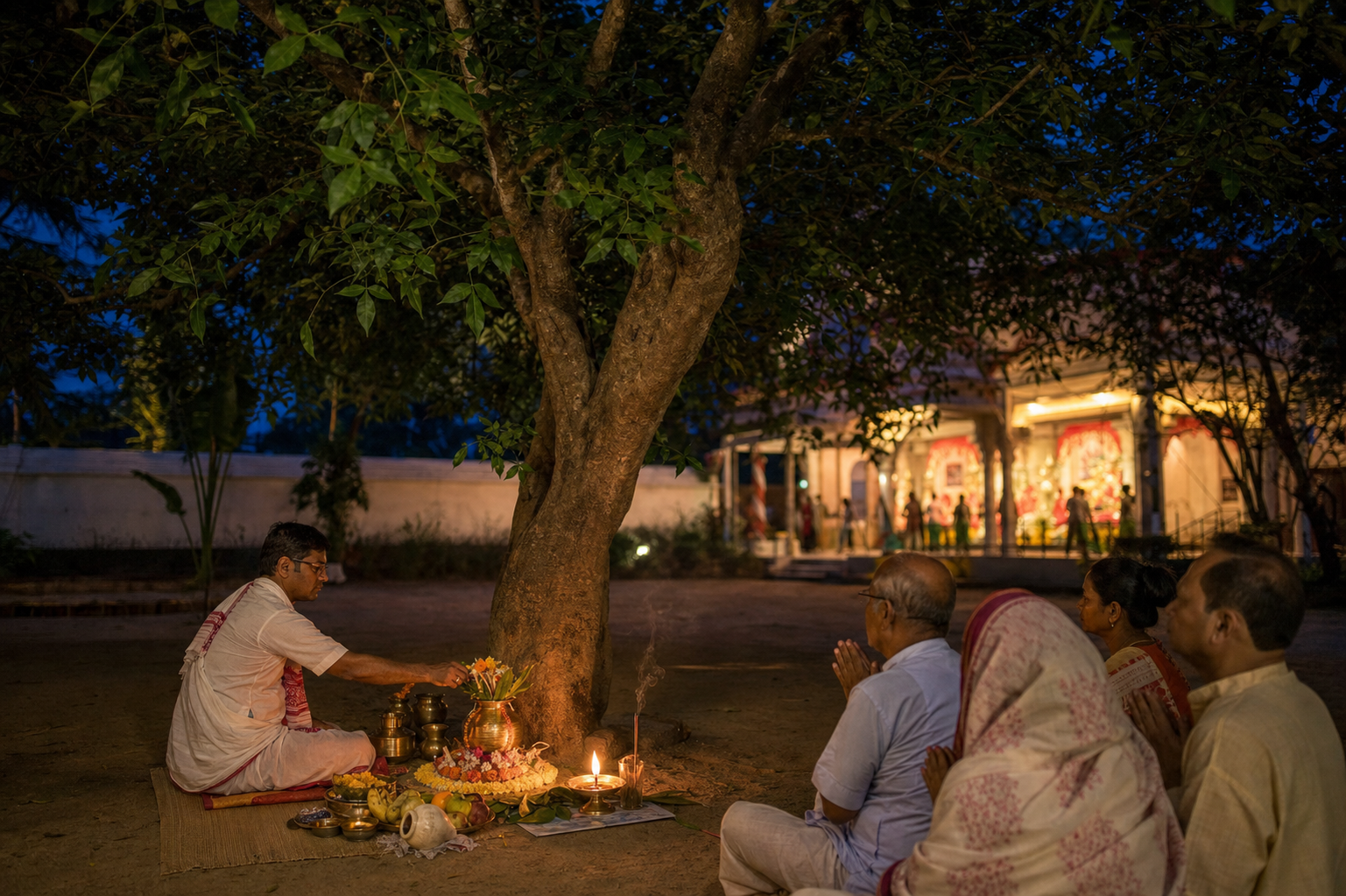
If you attend Durga Puja on Shashthi evening, the most important movement may occur away from the main image. The priest approaches a bel tree, branch, or sapling; a consecrated pot is prepared; and the Goddess is formally awakened, invited, and established. If you have wondered why this moment belongs beneath a tree, or why Rama enters an autumn festival for Durga, the answer lies in Akal Bodhan.
Understanding the rite changes how you participate. You can distinguish regional sacred memory from the Valmiki Ramayana, recognize the different ritual roles of the tree, branch, and leaves, and help preserve a living tradition without reducing the bel to festival decoration.
Akal describes Rama’s unusual timing, not improper worship
The word akal answers a question of timing. Vernal worship, remembered through Basanti Puja, was treated as the customary seasonal setting for invoking Durga. Rama’s autumnal appeal therefore became Akal Bodhan: an awakening performed outside that customary season. The expression does not mean that Sharadiya worship is defective or inauspicious. It preserves the memory of an exceptional invocation made under urgent circumstances.
In the Bengali Krittivasi Ramayan tradition, Rama invokes Durga before his decisive battle with Ravana. The righteous objective is already clear, but righteous intention alone is not treated as sufficient. Rama seeks Shakti: the divine power through which disciplined action becomes effective.
The best-known popular telling intensifies that lesson. Rama prepares 108 blue lotuses, discovers that one is missing, and resolves to offer one of his own eyes in its place. His willingness to surrender what is personally precious moves the Goddess to awaken and confer victory. Whether you receive this as sacred history or devotional allegory, its moral sequence is precise: knowledge identifies the duty, effort carries it forward, and surrender removes the final claim of ego.
Textual honesty matters here. You should not present Akal Bodhan as an episode found in the canonical recension of the Valmiki Ramayana. Its prominent narrative home is the Bengali and regional Ramayana tradition, especially the Krittivasi stream. That distinction does not make the observance less sacred. It tells you what kind of authority is being invoked: a living regional tradition with enduring ritual and devotional force, rather than a passage attributed to Valmiki.
This distinction is particularly useful when explaining the festival to children, visitors, or an interregional congregation. A reliable one-sentence introduction is: Bengali Durga tradition remembers Rama awakening and invoking the Goddess in autumn before his battle with Ravana, a narrative associated especially with the Krittivasi and regional Ramayana traditions.
The encounter should not be turned into a contest between Vaishnavas and Shaktas. Rama, the avatara of Vishnu, does not lose stature by invoking Durga, nor does Durga become merely an instrument in Rama’s campaign. The rite holds righteous agency and divine energy together. Dharma gives action its direction; Shakti gives it power. That complementarity is one reason Akal Bodhan speaks comfortably across sectarian boundaries within Sanatana Dharma.
Why the awakening takes place at the Bel Tala
Bel Tala means the place beneath the bel tree. In a traditional setting, it is not a decorative corner constructed after the rest of the pandal has been planned. It is the ritual locus at which preparation becomes invocation. Where a living tree is available, its canopy defines the sacred place. Where it is unavailable, a consecrated bel branch or sapling can serve as the ritual anchor, according to the local tradition.
The botanical identity matters. Bel or bilva is Aegle marmelos, also described as wood-apple. Common plant names can vary between regions, so Aegle marmelos is the useful identifier when a committee, temple, or diaspora congregation has to obtain the correct species. A random plant with three leaflets is not automatically a bilva substitute.
The plant has three related but distinct roles in the observance:
- The living tree establishes the Bel Tala, the sacred place beneath its canopy.
- A consecrated branch or sapling can represent that living axis where a mature tree is unavailable.
- Individual trifoliate leaves are offered during worship and carry their own contemplative meanings.
Keeping these roles separate prevents a common misunderstanding. Offering bel leaves near the murti does not, by itself, explain why Bodhan is situated at the Bel Tala. The leaves are offerings; the tree or branch also organizes sacred space. It makes the living world a participant in the invocation rather than a backdrop to it.
The familiar bel leaf has three leaflets. Different traditions read that form through several triads: sattva, rajas, and tamas; past, present, and future; the three fires of Vedic sacrifice; Shiva’s three eyes; and the manifold energies of the Goddess. The leaf is offered to both Shiva and Durga, so its presence at a Shakta rite does not erase its Shaiva associations. It expresses complementarity.
You do not have to force all these correspondences into one rigid code. They are contemplative lenses, not competing botanical definitions. Choose the one that assists your practice. Reading the three leaflets as thought, speech, and action, for example, turns the offering into a concrete examination: Are you thinking one thing, saying another, and doing a third? Reading them as bhakti, jnana, and karma asks whether devotion, understanding, and service are moving together.
Bel also participates in the wider vegetal imagery of Durga Puja. In many traditions it is included among the nine sacred plants of the Nabapatrika. This is more than greenery placed around a human ceremony. It locates the Goddess’s powers in a living field of plants, water, soil, seasonal change, and human care.
The intuition is recognizably Dharmic without making every tradition identical. Buddhist memory gathers around the Bodhi tree; Jain accounts associate Tirthankaras with awakening beneath sacred trees; and Sikh scripture treats air, water, and earth as members of a sacred cosmic kinship. The shared point is practical: nature can teach, shelter, and mediate remembrance. A sacred tree is therefore neither an idol to be caricatured nor a raw material to be consumed at festival time. It is a living altar entrusted to the community.
What actually changes on Shashthi evening
Bodhan is not another name for the whole of Durga Puja. It occupies a defined place in the festival’s sequence. If you know that sequence, you can follow the ritual even when the mantras or local arrangements are unfamiliar.
| Festival point | Ritual movement | What to notice |
|---|---|---|
| Mahalaya | Transition into Devi Paksha | Pitru Paksha concludes and the festival turns toward the Goddess. |
| Shashthi and Kalparambha | Ritual intention is established | Preparations acquire a formal sacred direction. |
| Shashthi evening | Bodhan, Amantran, and Adhivas | The Goddess is awakened, welcomed, and ritually established at the site. |
| Saptami through Navami | Worship deepens | Mantra, offerings, homa, and other upacharas unfold according to the local kalpa. |
| Vijaya Dashami | Triumph and completion | The Goddess’s victory is celebrated, with Rama’s victory over Ravana echoed in festival memory. |
The three actions on Shashthi should not be collapsed into one vague idea of opening the festival. Bodhan is the awakening or invocation. Amantran is the formal invitation. Adhivas establishes or seats the sacred presence at the chosen place. Together they move the puja from readiness toward a consciously consecrated field of Shakti.
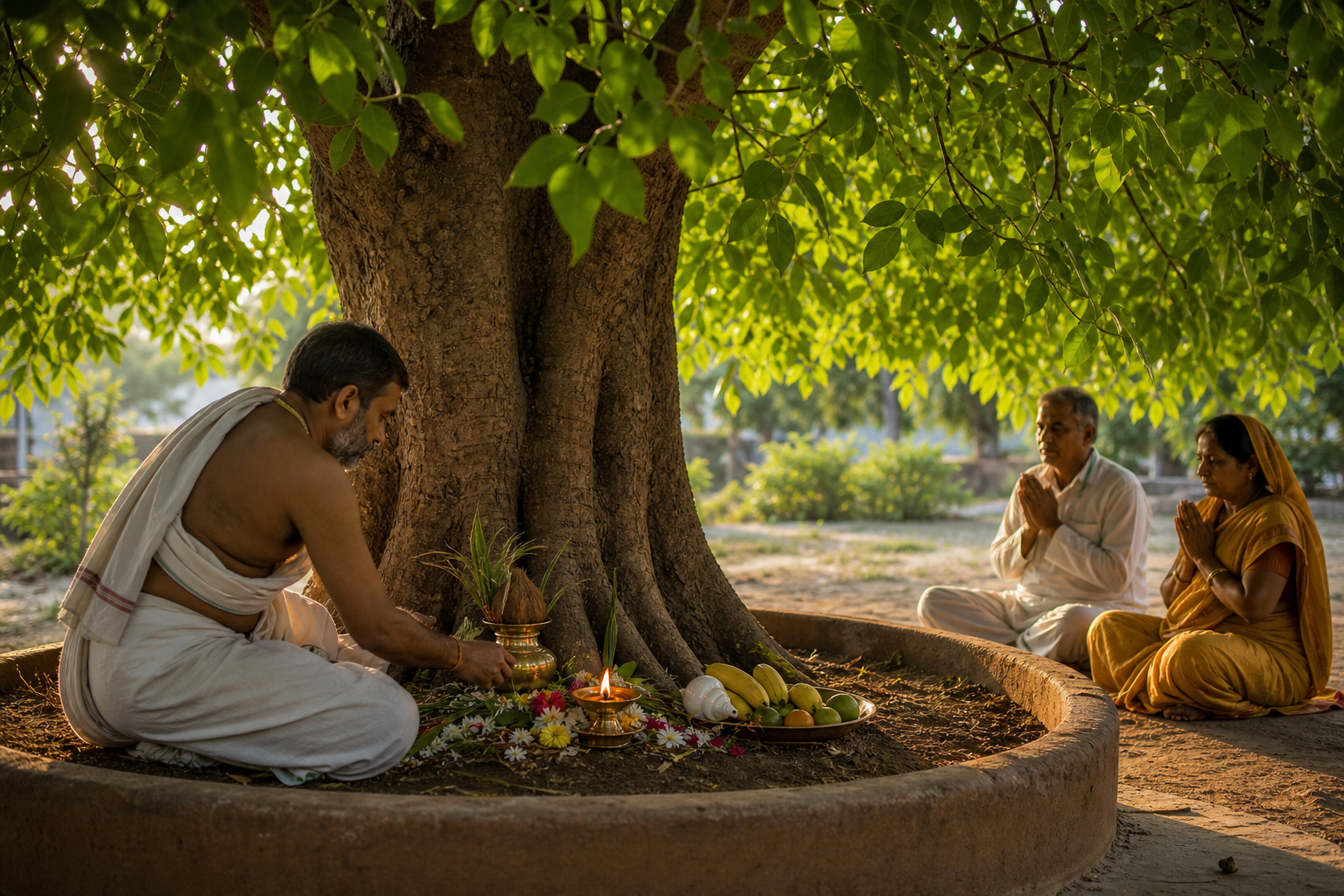
At the Bel Tala, the officiant may sanctify a ghata, a bel branch, or the ritual arrangement associated with the tree; invoke the Goddess through mantra; and present bel leaves, flowers, incense, and light. The precise mantra, placement, and order belong to the local kalpa. Bengal, Assam, Odisha, and individual lineages preserve variations in emphasis. Some settings give greater prominence to mantra, while others surround the rite with communal singing or alpona.
Variation is not evidence that one community has forgotten the rite. The stable core is the awakening, invitation, and establishment of the Goddess in relation to the sacred bel locus. The variable layer includes the ritual handbook, inherited family practice, regional language, music, and visual treatment. When you visit an unfamiliar puja, look for that core before judging its local expression.
Nor should awakening be reduced to the claim that the divine sleeps like a biological being until human beings intervene. Ritual language marks a change in relationship. The community turns from preparing a shrine to attending to divine presence. The outer sequence trains an inner one: stop arranging the conditions of worship and begin becoming present to what you invoked.
How to honor the rite without turning the tree into a prop
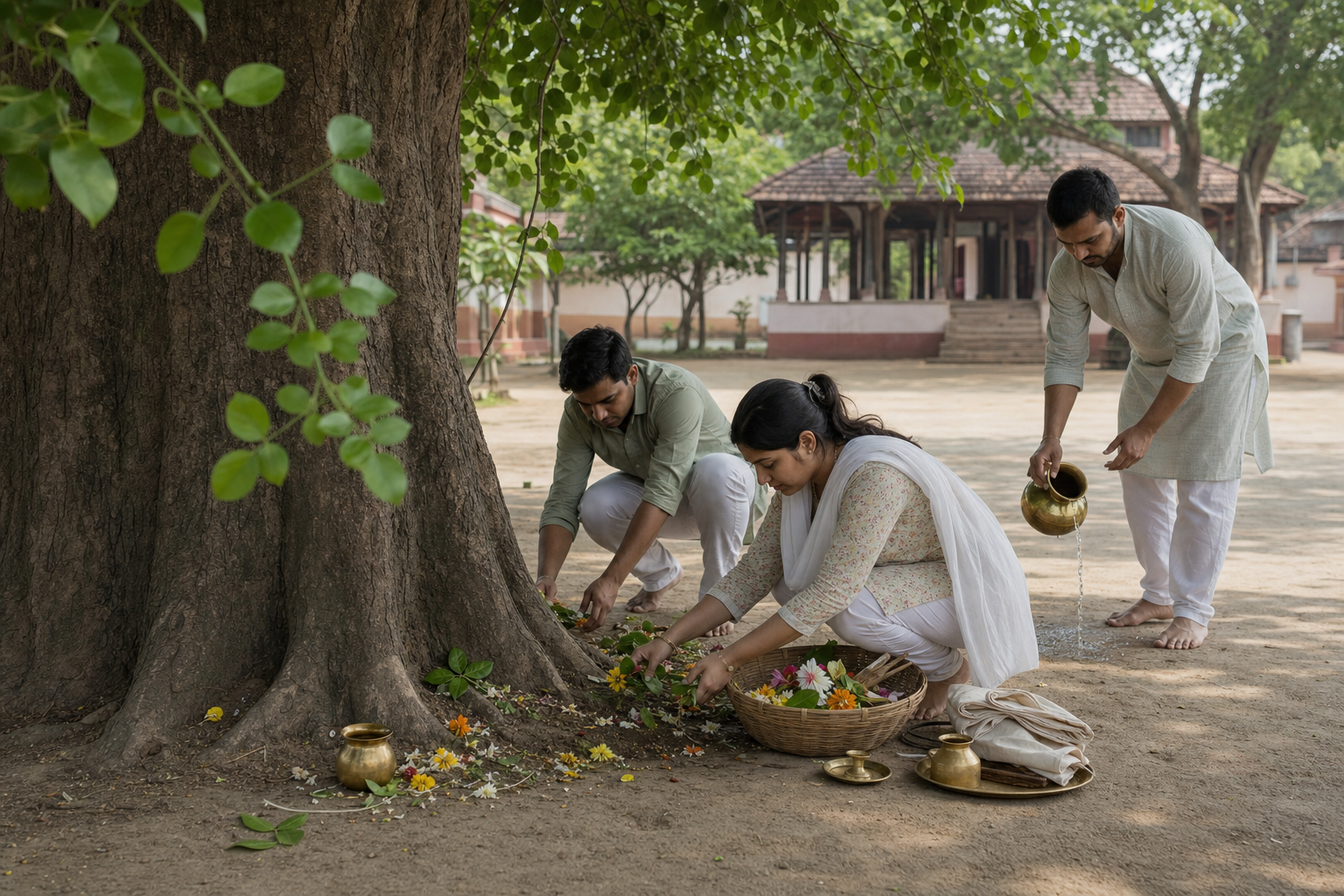
If you help organize a puja, the Bel Tala has to enter the plan before lighting, signage, and crowd flow are finalized. If you are a participant, you need much less ritual knowledge, but you should know where to stand, what to observe, and how the plant is being treated. The following sequence keeps ritual fidelity and ecological responsibility together.
- Confirm the local kalpa and officiant first. Decide which inherited ritual sequence will govern Bodhan before volunteers prepare the site or publish an explanatory program.
- Identify Aegle marmelos correctly. Where a living bel tree is unavailable, ask the officiant whether the tradition calls for a consecrated branch or sapling. Do not choose a look-alike merely because it has three leaflets.
- Define and protect the Bel Tala. Keep fixtures, cables, nails, constricting decorations, and heavy foot traffic from damaging a living tree. If incense or lamps are used, arrange them with appropriate fire safety and without scorching the plant.
- Prepare only the ritual materials the local practice requires. A ghata or bel branch, bel leaves, flowers, incense, and light commonly appear, but the precise arrangement and mantras should come from the officiating tradition rather than an improvised universal script.
- Explain Bodhan, Amantran, and Adhivas as distinct movements. A short announcement or printed note can help participants recognize awakening, welcome, and establishment instead of seeing an unexplained ceremony at the edge of the pandal.
- Tell Rama’s story with its regional location intact. Name the Krittivasi and Bengali devotional setting, and avoid attributing the episode to the Valmiki Ramayana. This small act of precision prevents both careless historical claims and needless dismissal of regional sacred memory.
- Give ecological language a measurable outcome. A sapling drive, care for an existing bel tree, or a river-cleaning effort can become seva connected to the festival. If saplings are distributed, assign responsibility for suitable planting, watering, and continuing care after the pandal closes.
As a visitor, watch for three cues. First, notice whether the rite is oriented toward a living tree, a branch, or a sapling. Second, listen for the transition from invocation to welcome and establishment. Third, observe whether bel leaves are handled as offerings rather than disposable décor. Do not pluck from a living tree without permission; offer or receive leaves when the officiant or host community directs you.
For a household or diaspora community, the absence of a mature bel tree does not automatically make Bodhan inauthentic. Urban and diaspora observances can use a sanctified branch or sapling while preserving the rite’s purpose. Fidelity lies in the relationship among the invocation, the sacred plant, and the inherited ritual method, not in pretending that every setting has the ecology of rural Bengal.
If your family has no established Bodhan practice, attending a temple or community rite is usually more faithful than assembling specialized mantras from unrelated traditions. You can still contemplate the bel leaf, learn the Rama-Durga narrative, and support care for the tree. Participation does not require pretending to be the officiant.
The same restraint applies to the story of the 108 lotuses. Its force does not depend on reproducing Rama’s ordeal theatrically. The missing lotus exposes the difference between possessing the correct materials and offering oneself without reservation. For you, the practical question is not what dramatic sacrifice to imitate. It is which attachment prevents thought, speech, and action from serving the dharmic duty already in front of you.
Key takeaways
- Akal Bodhan means Durga’s awakening outside the formerly customary vernal season; it does not label autumnal worship as improper.
- Rama’s autumn invocation belongs especially to Bengali, Krittivasi, and regional Ramayana memory, not to the canonical Valmiki Ramayana recension.
- The living bel tree creates the Bel Tala, a branch or sapling can anchor the rite where necessary, and trifoliate leaves function as offerings and contemplative symbols.
- Bodhan, Amantran, and Adhivas are related but distinct: awakening, formal welcome, and ritual establishment.
- Local kalpas legitimately vary. Preserve the stable ritual purpose while following the mantra and sequence of the officiating tradition.
- Tree care is part of the rite’s meaning. A community contradicts the Bel Tala when it celebrates sacred nature while damaging the plant that embodies it.
At the next Shashthi observance, go to the Bel Tala before the main days of worship carry you into the crowd. Identify the living plant or consecrated branch, listen for the movement from Bodhan to Amantran and Adhivas, and ask how the tree will be cared for after Vijaya Dashami. That one act of attention joins narrative, ritual, and responsibility at the place where Durga Puja passes from preparation into presence.
References
- DharmaRenaissance Blog – Bel Tala and Akal Bodhan: Durga’s Sacred Awakening That Empowered Lord Rama