
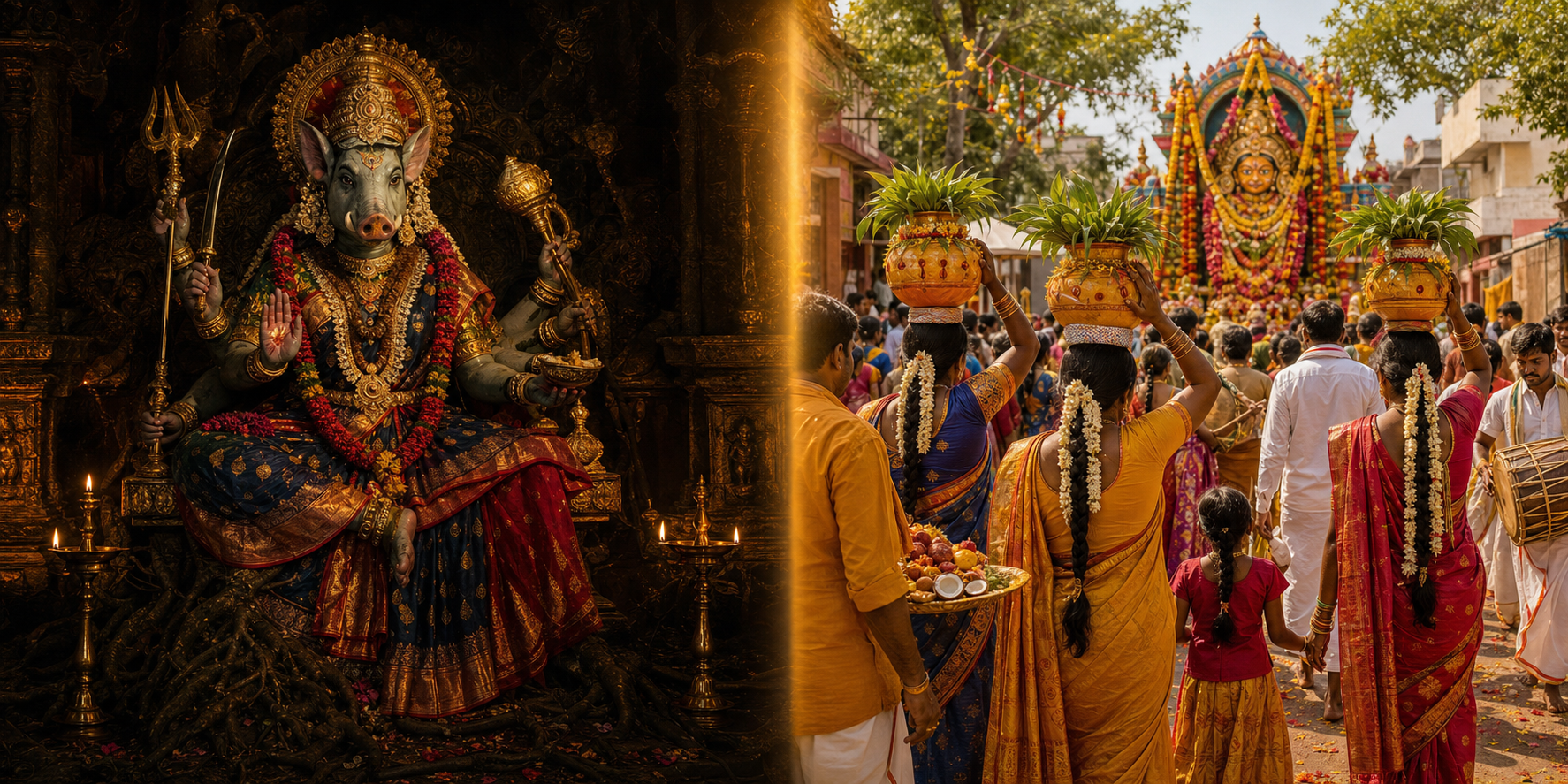
Varahi and Mahankali are approached as formidable forms of maternal protection, yet their traditions make protection visible in different ways. Varahi’s scriptural narratives confront disorder that reproduces itself, while Mahankali’s Telangana festival world binds protection to food, vows, procession, and the shared life of a community.
Read together, these traditions reveal a broad Hindu understanding of protection as restoration rather than passive shelter. They also show why distinct goddesses and ritual settings should not be collapsed into a single generalized image of fierce Shakti.
Key takeaways
- Both traditions place fierceness in the service of care, order, and the containment of danger.
- Varahi’s narratives emphasize identifying and uprooting destructive forces that multiply when addressed only at the surface.
- Mahankali worship during Bonalu turns protection into a reciprocal public relationship expressed through food offerings, vows, processions, and community participation.
- The traditions are related without being interchangeable: one source foregrounds scriptural and psychological meanings, while the other documents a regional, embodied, and civic ritual system.
A shared protective grammar with different expressions
Across the account of Varahi and the guide to Mahankali Bonalu, divine fierceness is directed toward safeguarding life and restoring order rather than destruction for its own sake. Varahi joins other maternal powers against forces of adharma. Mahankali is approached as the Mother who guards devotees and communities against disease, disorder, fear, and misfortune.
Protection in both accounts is relational. Varahi does not act in isolation: she belongs to the Sapta Matrikas, whose specialized powers operate together in mythic battle. At Bonalu, a family’s individual offering enters a much larger stream of neighborhood and temple worship. In each case, danger calls forth coordinated participation rather than solitary self-preservation.
The required human response nevertheless differs. The Varahi article interprets her battles as lessons in moral clarity and inner discipline. The Bonalu article emphasizes gratitude, fulfilled vows, ritual responsibility, and the organization of collective sacred space. One tradition asks how disorder can be stopped at its root; the other asks how protection can be acknowledged, renewed, and shared.
Varahi and the protection that reaches hidden roots
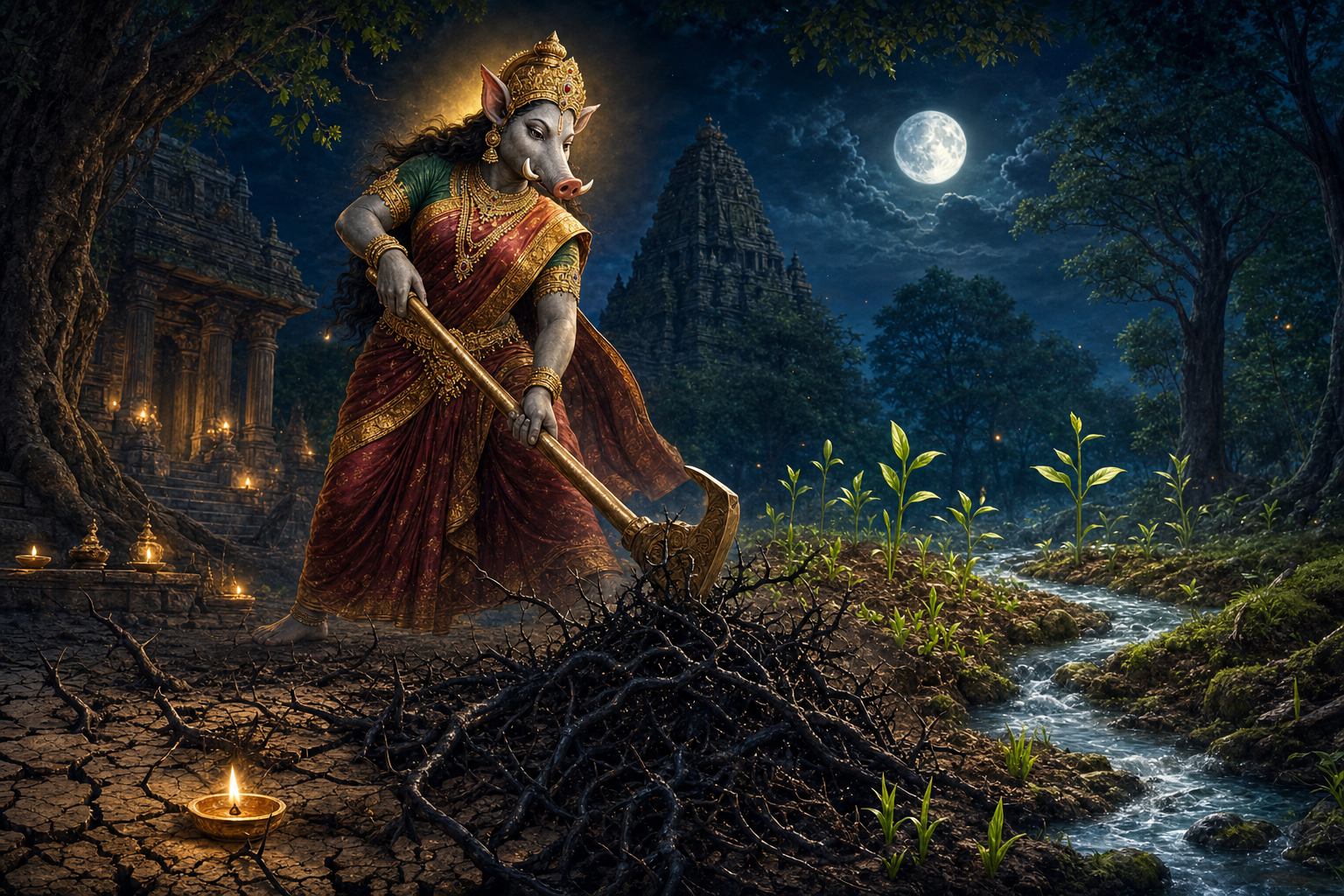
The Varahi source identifies the boar-faced goddess as one of the Sapta Matrikas and connects her with Varaha, the form of Vishnu associated with rescuing the Earth from the depths. It reads her unusual form as a theological statement: protective power must sometimes enter neglected or difficult regions of existence to recover what has been overwhelmed. Her tusks and weapons consequently signify penetration through illusion, pride, and entrenched disorder.
The article reports several scriptural accounts without forcing them into a single genealogy. In the Devi Mahatmya, Varahi appears in the collective manifestation of divine feminine powers during the conflict with Shumbha and Nishumbha. The Varaha Purana presents her as emerging from Vaishnavi and describes her in association with Shesha. The Matsya Purana places the Matrikas within Shiva’s struggle against Andhakasura. These versions connect her variously with Vaishnava, Shaiva, and Shakta frameworks while preserving her protective function.
Two battle motifs sharpen that function. Raktabija generates another form of himself whenever his blood reaches the ground, while the Andhakasura narrative also involves danger reproduced through falling blood. As interpreted by the source, these images describe a problem familiar beyond the battlefield: some forms of disorder expand when only their visible symptoms are attacked. Anger can generate retaliation, and envy can generate further comparison and resentment. Varahi therefore represents not indiscriminate force but precise containment.
The Varaha Purana association between Varahi and asuya, or envy, adds an inward dimension. The article does not equate the goddess with the vice; it presents her as the power capable of governing and transforming it. Protection here includes guarding the moral field of the mind, where concealed habits can reproduce suffering before they become outward actions.
Mahankali protection as offering, presence, and public duty
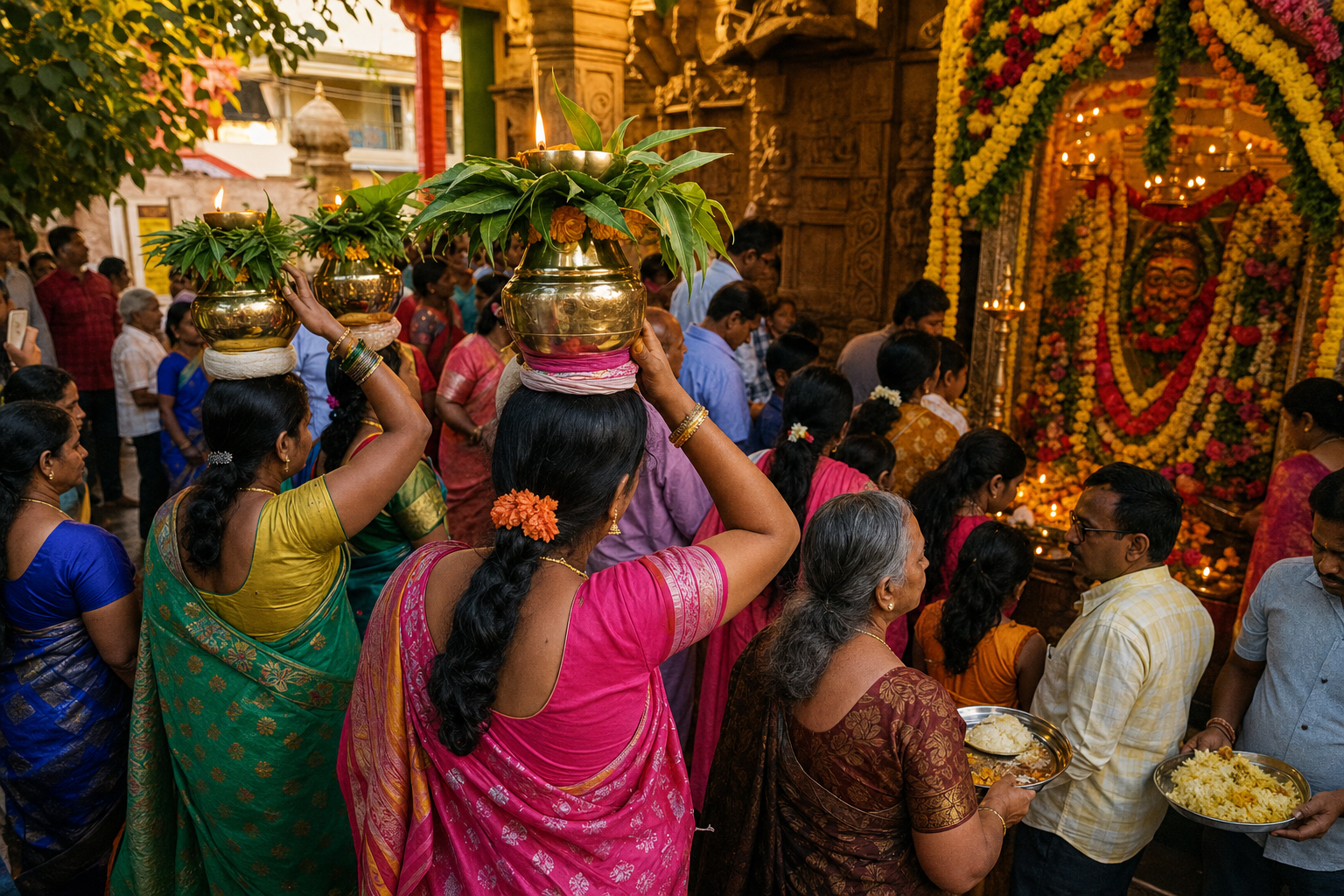
The Bonalu source describes a different ritual language. Celebrated during Telugu Ashada Masam in Hyderabad, Secunderabad, and other parts of Telangana, Bonalu centers on a Bonam, a food offering whose name is commonly connected with bhojanam. Rice cooked with milk and jaggery is placed in a brass or earthen pot decorated with turmeric, vermilion, neem leaves, and a lamp. Women carry the pots to the Goddess as acts of thanksgiving and fulfillment of vows.
This protective tradition begins not with a weapon but with prepared food. Nourishment becomes the devotee’s response to divine guardianship, while carrying the vessel turns gratitude into disciplined, embodied action. The source stresses that women’s participation is not decorative: women assume visible ritual responsibility, linking the work of the family to the worship of the wider community.
The Ujjaini Mahankali tradition in Secunderabad is linked in the article to a widely repeated memory of soldiers praying to Mahakali at Ujjain during a period of severe illness and promising to install the Goddess after their return. The source presents this as sacred memory, community history, or devotional inheritance rather than as independently established fact. It also points to discussion of older inscription-associated practices, suggesting that Bonalu should not be reduced to one modern urban origin account.
Processional roles extend protection across public space. Pothuraju, traditionally regarded as Mahankali’s brother or guardian attendant, leads and energizes the procession. The Ghatam is a sacred vessel representing the Goddess and carries her ritual presence through neighborhoods. Rangam, generally performed after the principal observance, involves a woman believed by devotees to speak under the Goddess’s inspiration. Taken together, these practices clear a path, bring sacred presence among residents, and provide a recognized setting in which community concerns can be voiced.
What comparison reveals without erasing difference
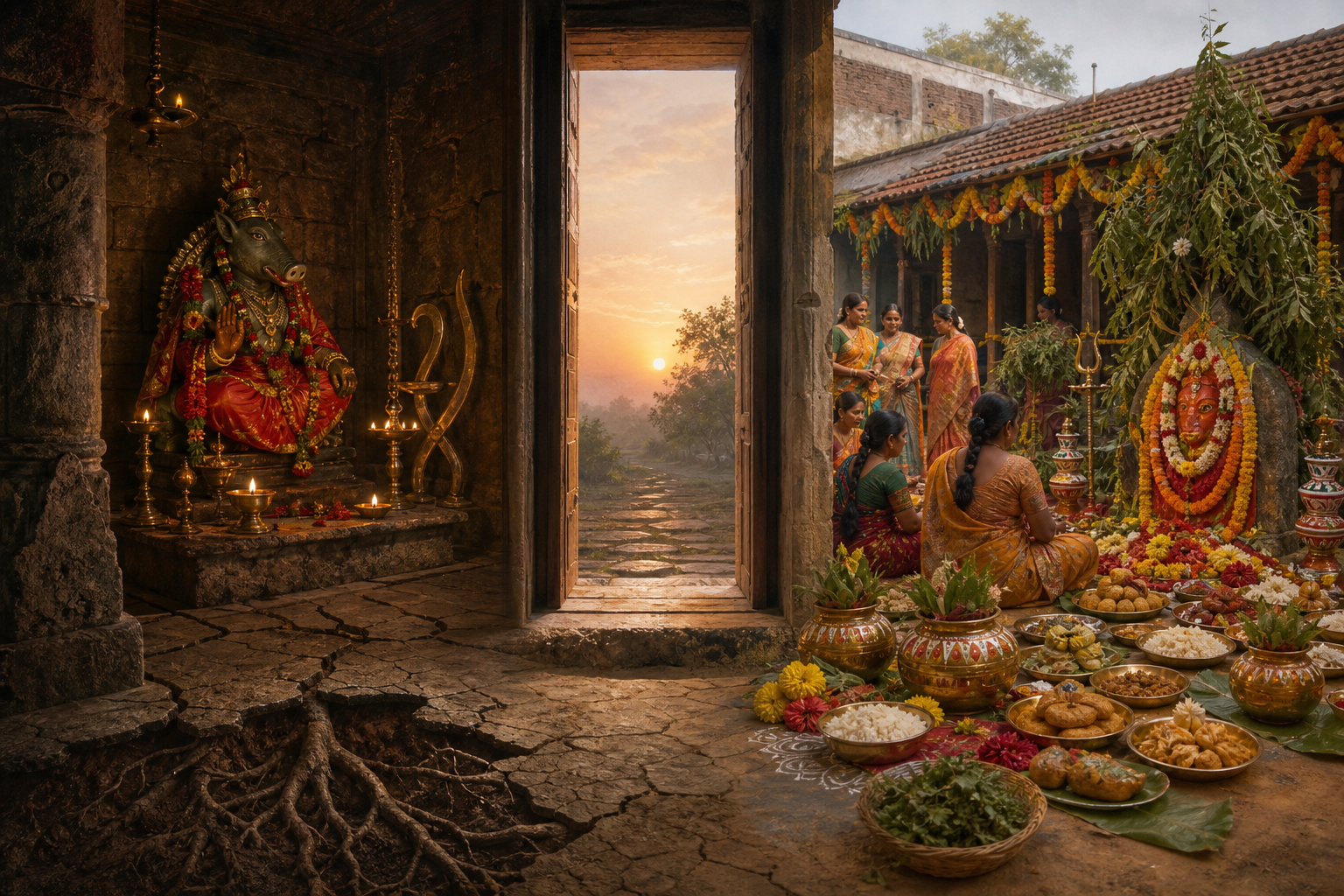
The most important contrast is one of medium. Varahi’s protective logic is narrated through Puranic conflict, iconography, and theological interpretation. Mahankali’s is enacted through cooking, carrying, drumming, bodily performance, temple movement, and the coordination of streets and crowds. Textual memory is central to the former account; transmitted participation is central to the latter.
The traditions also frame vulnerability differently. Varahi confronts cosmic enemies that the source reads as moral and psychological tendencies, especially those that regenerate when handled superficially. Mahankali devotion addresses remembered disease, misfortune, fear, and the fragility of collective life. These are differences of emphasis, not a hierarchy between a scriptural tradition and a folk or regional one.
The comparison further highlights collective feminine agency. The Matrikas manifest coordinated Shakti in the mythic field, while women carrying Bonam exercise ritual responsibility in the civic field. Neither model confines maternal power to softness. Care may appear as nourishment, but it may also require boundaries, disciplined intervention, and the prevention of further harm.
Careful interpretation must preserve the devotional identities involved. Varahi is more than an abstract psychological symbol, and Bonalu is more than a colorful public spectacle. Likewise, the Bonalu source’s account of protection from illness records sacred memory and community belief; it should not be recast as an independently verified biomedical claim. Rangam is similarly described as a practice trusted by devotees, not as externally validated prediction.
Future engagement with these traditions can be strongest when scripture, regional memory, women’s ritual labor, and public culture are allowed to illuminate one another without being made identical. That approach preserves both the breadth of Shakti worship and the particular ways communities understand the protective presence of the Mother.
References
- DharmaRenaissance Blog — Varahi Devi Katha: Powerful Story, Symbolism, and Scriptural Wisdom of Varahi Mata
- DharmaRenaissance Blog — Bonalu 2026 Guide: Powerful Mahankali Jatara Dates, Rituals and Meaning