
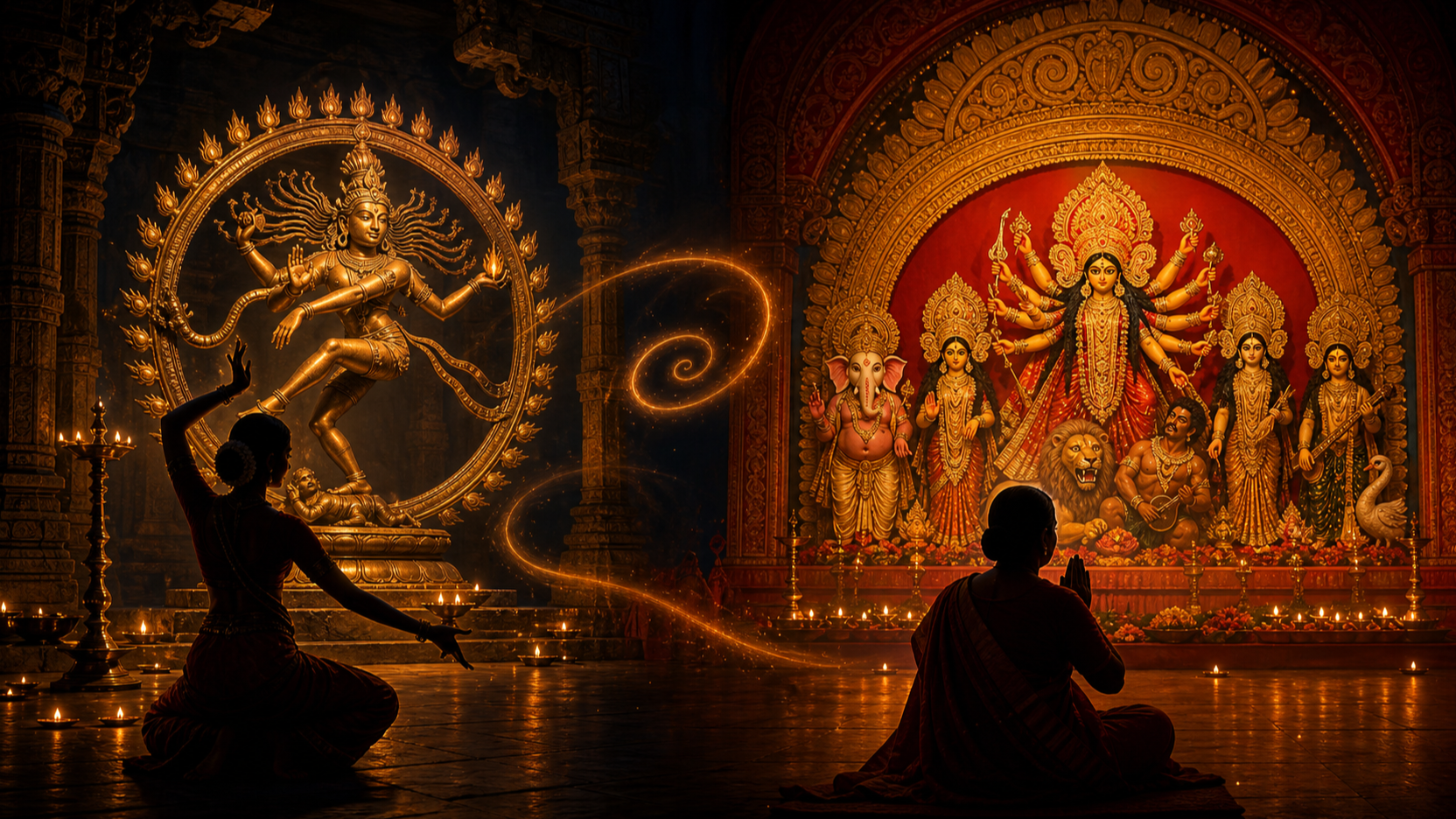
You may recognize every deity in a Nataraja bronze or a Bengali Durga mandapa and still miss what the sacred image is doing. Nataraja dancing within fire, Kali moving over the still body of Shiva, and Uma returning to Bengal with her divine family are not unrelated scenes. Each asks you to notice how awareness and power, stillness and action, renunciation and care belong together.
If you are watching a sacred dance or entering a Durga Puja mandapa, begin with one practical question: what moves, what remains steady, and where is grace being offered? That question turns an impressive performance or beautiful image into a theology you can read.
Start with the relationship, not the gender labels
Shiva-Shakti symbolism is often flattened into a simple pairing of masculine and feminine. That reading is too narrow. In this devotional grammar, Shiva-tattva signifies consciousness or awareness, while Shakti-tattva signifies the power through which awareness becomes manifest as thought, nature, action, protection, and transformation. Their sacred union joins awareness and energy; it does not place an active Goddess beneath a superior male deity.
This distinction matters when you encounter tandava and lasya. Tandava is associated with vigorous, forceful, world-revealing movement, while lasya is associated with graceful unfolding and cultivated softness. Shiva and Parvati provide their archetypal associations, but the contrast describes complementary qualities of movement, not rigid permissions assigned to male and female bodies. Tandava and lasya belong to one non-dual choreography: intensity requires balance, and grace need not be weak.
Three common misreadings disappear once you keep that relationship in view:
- Stillness is not passivity. It can be the conscious ground that makes purposeful action possible.
- Fierceness is not uncontrolled anger. In Durga and Kali imagery, formidable power can serve protection, justice, and the defeat of adharma.
- Conjugal or familial imagery does not cancel the Goddess’s sovereignty. Hargauri devotion brings Durga near as daughter, mother, and bride without reducing her to any one domestic role.
When you look at an image, therefore, do not begin by ranking the deities. Look for the relationship between energy and its ground. That relationship is the key that will also explain why Shiva can be the dancer in one image and the unmoving support of Shakti in another.
Read Nataraja from the ring of fire to the raised foot
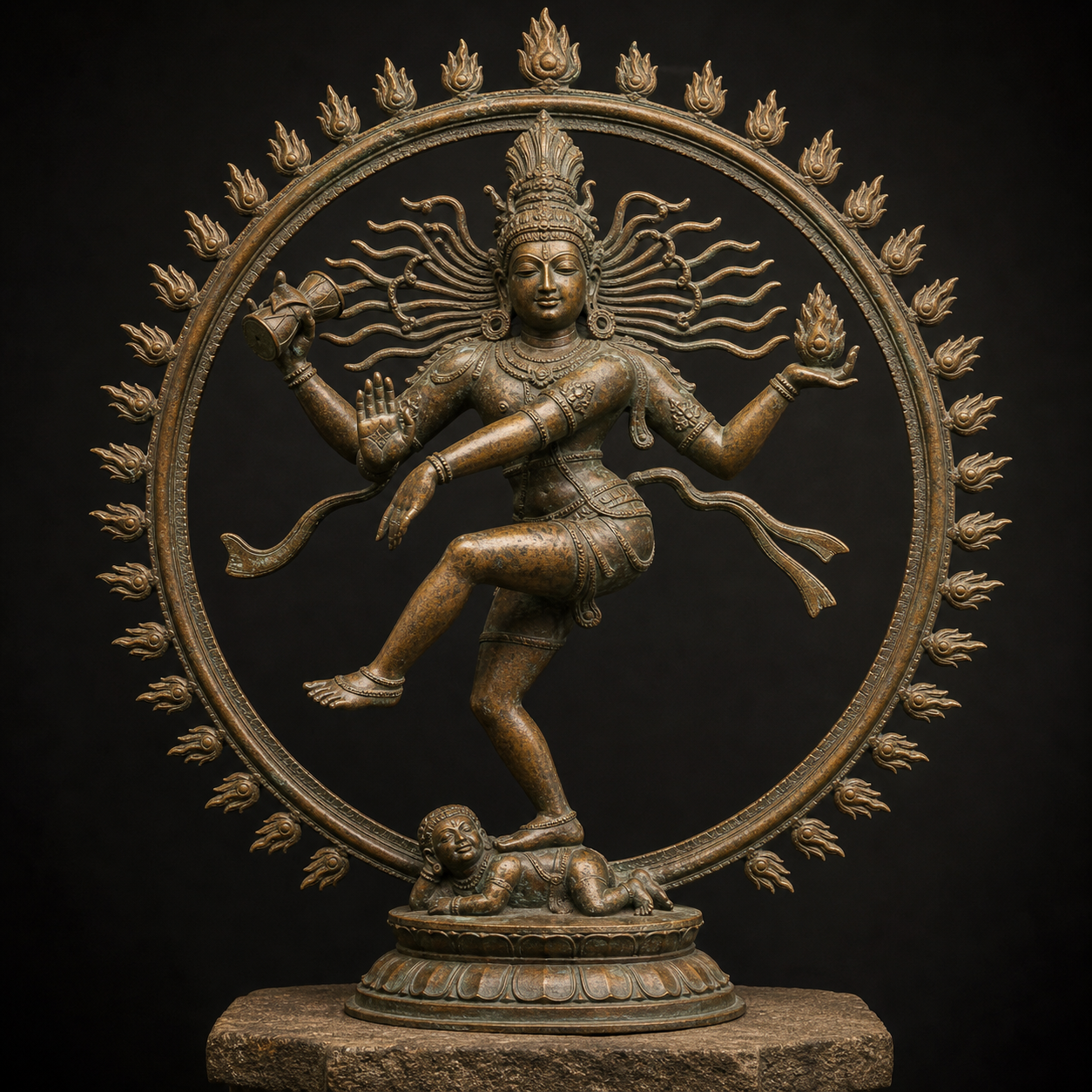
Nataraja is easiest to understand when you read the image in a deliberate order. Do not isolate the famous dancing pose from its surrounding symbols. The hands, feet, flame, drum, and subdued figure form one visual sentence.
- Begin with the flaming aureole. The prabhamandala places the dance inside a cosmos that is continually in motion. The circle is not mere decoration around Shiva; it establishes the scale of the action.
- Move to the rear hands. The raised right hand carries the damaru, whose pulse evokes primordial vibration, time, sound, and linguistic order. The left hand carries agni, the fire of dissolution. Emergence and ending are held within the same balanced body.
- Read the front hands as a response to fear. The front right hand displays abhaya mudra, the assurance of protection. The front left hand directs your gaze toward the uplifted foot, the place of refuge and grace.
- Finish at the two feet. One foot subdues Apasmara, the dwarf of forgetfulness or ignorance. The other is raised. Liberation is therefore shown through a double action: ignorance is restrained, and refuge is made available.
The whole form expresses Shiva’s five cosmic operations, the pancha-kritya: creation, preservation, dissolution, concealment, and grace. This is why Nataraja should not be reduced to a god of destruction. Dissolution is only one movement in a larger cycle, while protection and liberating grace are visibly present in the same icon. The complete icon holds all five operations together.
The damaru deepens the connection between dance and knowledge. Traditional accounts associate its pulse with the fourteen Maheshvara Sutras used in Sanskrit phonology. Whether you are listening to recitation, percussion, or a dancer’s rhythmic footwork, sound is not being treated as background accompaniment. It participates in the ordering of the sacred action. The idea of nada-brahman, ultimate reality understood through sound, gives rhythm a metaphysical role.
This kinetic theology also explains why movement could be preserved in material form. Chola artists brought the Nataraja bronze to an extraordinary refinement, while the 108 karanas associated with the Natya Shastra were carved into temple architecture at Chidambaram. Bronze and stone do not freeze the dance into lifelessness; they teach your eye how to recover movement from a still form.
Try that recovery before taking a photograph. Give the image one uninterrupted minute. Trace the fiery circle, compare drum and flame, follow abhaya to the pointing hand, and end at the two feet. You will see that terror, order, ignorance, protection, and release have been composed into a single equilibrium.
Three sacred tableaux overturn a simplistic reading
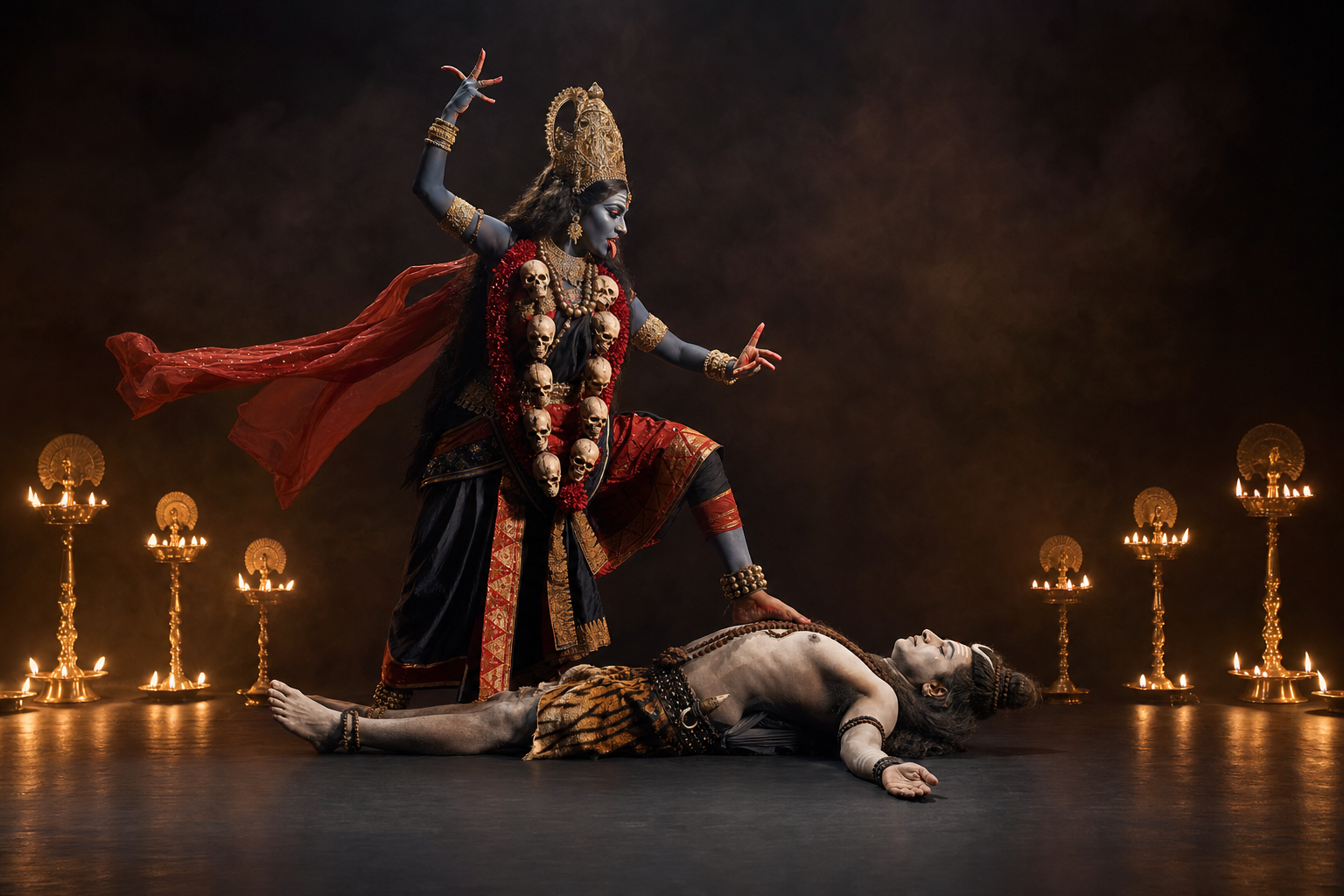
One image cannot exhaust Shiva-Shakti symbolism. The most useful comparison is among Nataraja, Kali dancing upon Shiva, and Bengal’s Hargauri Durga. The roles change, but the underlying relationship remains intelligible.
| Sacred tableau | What moves | What provides the ground | What you should notice |
|---|---|---|---|
| Nataraja | Shiva dances within the flaming cosmos. | The pose holds motion in perfect balance while Apasmara is restrained below. | Consciousness is not merely static; it creates, preserves, dissolves, conceals, and grants grace through rhythmic action. |
| Kali upon Shiva | Shakti appears in fierce, unbounded movement. | Shiva reposes beneath her as the still ground of consciousness. | The image can be read as power recognizing its own ground and returning from excess to harmony. |
| Hargauri Durga | Uma’s seasonal arrival and departure move the household and community through welcome, presence, and leave-taking. | Shiva appears as calm spouse, witness, guardian, or ascetic presence near the Goddess. | Conjugal harmony joins renunciation and responsibility without displacing Durga from the center. |
The reversal between the first two tableaux is decisive. If you assume Shiva must always represent stillness, Nataraja breaks the rule. If you assume Shakti’s dynamism must remain subordinate, the Kali image breaks it again. Kali’s movement over Shiva’s repose makes energy and consciousness mutually intelligible rather than competitive.
Hargauri introduces a third mode. Hara is Shiva as the ascetic; Gauri is the radiant and auspicious Parvati. In Bengal, their pairing places cosmic union inside the emotional world of a daughter’s autumn homecoming. Shiva may stand quietly near Durga’s pedestal as spouse, Bhairava-like guardian, or witness. His presence does not confer authority upon an otherwise dependent Goddess. Durga’s sovereignty remains central, while Shiva makes the inseparability of consciousness and power visible.
This also clarifies the relationship between the ascetic and the householder. Shiva signifies nivritti, the inward or contemplative orientation. Durga’s presence amid family, seasonal rites, and community expresses pravritti, engaged life and responsible action. The tableau does not ask you to choose one path and despise the other. It asks whether inward steadiness is guiding outward duty.
You can apply that question beyond the mandapa. Before an important action, identify both halves of the pair: what inner clarity should remain steady, and what energy must be released into the world? Shiva without Shakti would remain unexpressed awareness; Shakti without a conscious ground could become directionless force. The sacred image trains you to look for their coordination.
Bengal turns cosmic choreography into a season of return
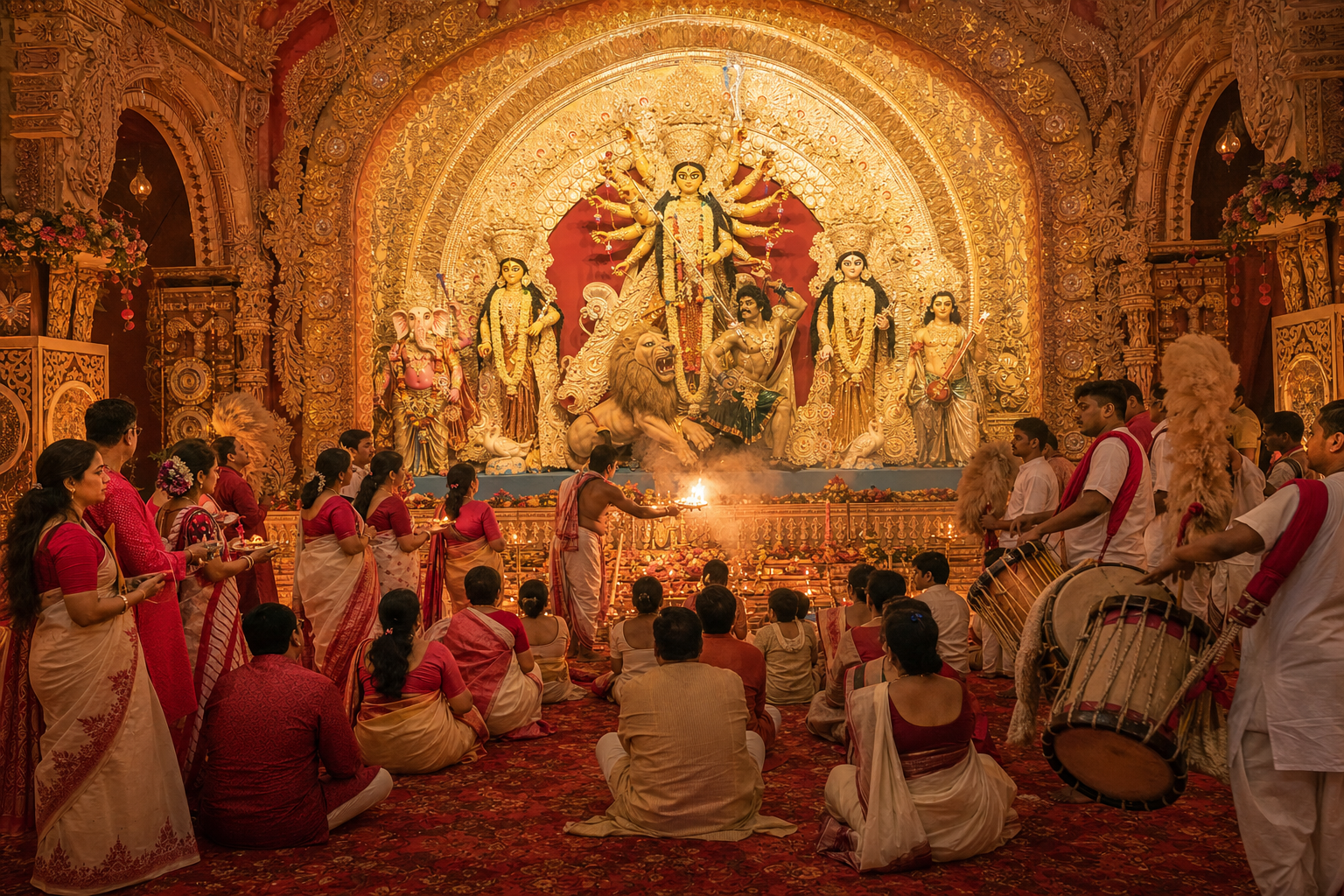
Bengali Durga devotion adds emotional and communal movement to iconographic movement. Mahishasura Mardini and Hargauri are not rival versions of the Goddess. The first foregrounds righteous valor and the defeat of adharma. The second brings the same sovereign Shakti near as Uma, the daughter whose arrival fills a parental home with tenderness. If you encounter fierceness at one ritual moment and intimate family feeling at another, do not try to eliminate the tension. Bengal preserves both.
Follow the ritual sequence as choreography
The autumn Puja has a movement pattern: awakening, arrival, installation, intensified presence, farewell, and return to ordinary social life. Following that sequence helps you understand why the mood changes across the festival.
- Mahalaya: Devi Paksha begins as Pitru Paksha closes. The community turns toward the Goddess’s arrival.
- Mahashashthi: Bodhana, kalparambha, and adhivasa awaken and establish the Goddess in her autumnal seat.
- Mahasaptami: The nava-patrika, a bound group of nine plants often called the kola bou, is bathed and installed. Shakti is encountered through the vitality of the natural world as well as through the sculpted image.
- The Ashtami-Navami juncture: Sandhi Puja brings the Goddess’s fierce or raudra force into focus. Tender Uma and the destroyer of adharma are understood as one Devi, not separate moral personalities.
- Vijayadashami: Where Sindur Khela is observed, married women anoint Durga and one another with vermilion before the departure. Visarjan gives physical form to leave-taking, while bijoya greetings extend reconciliation and renewed social bonds beyond the ritual enclosure.
Agamani and bijoya songs give this sequence its emotional voice. Menaka anticipates her daughter’s arrival; Himavan receives her with paternal joy; separation returns as Uma prepares to leave. The music translates cosmic nearness into the language of a family home: a prepared threshold, lamps at dusk, welcome, memory, and departure.
The familial arrangement around Durga should also be read symbolically. Lakshmi, Saraswati, Kartikeya, and Ganesha gather prosperity, learning, valor, and auspicious beginnings around the central Goddess. Shiva’s quieter proximity adds the contemplative principle. The result is not merely a divine family portrait. It is a picture of the qualities a household and community are trying to hold together.
Use abhinaya to watch theology become feeling
When sacred dance accompanies this devotional world, first determine what kind of material you are seeing. Nritta is pure dance and rhythmic movement. Nritya uses expression to communicate meaning. Natya develops dramatic enactment. A performance may move among all three, so judging it only by athletic difficulty misses much of its purpose.
The Natya Shastra’s four modes of abhinaya give you a practical viewing method:
- Angika, expression through the body: Watch the hands, eyes, torso, stance, weight, and direction of travel. Ask whether the body is revealing force, restraint, refuge, anticipation, or farewell.
- Vachika, speech and music: Listen for the narrative carried by song, recitation, and rhythm. An agamani lyric can turn a simple entrance into Uma’s homecoming; a sharper rhythmic passage can bring the martial energy of the Goddess forward.
- Aharya, costume and visual presentation: Notice ornaments, colors, facial design, and the arrangement of figures. A tranquil Hargauri composition, a kinetic Mahishasura Mardini tableau, and a fierce Kali scene guide attention differently before the performer makes a gesture.
- Sattvika, inward affect: Look beyond a technically correct expression. Does courage feel disciplined? Does tenderness carry the ache of limited time? Does stillness feel alert rather than empty? Sattvika abhinaya is where the performed emotion becomes inwardly credible.
These modes work together. The body without musical and narrative context can become an attractive shape with no theological direction. Costume without inward affect becomes spectacle. Emotion without disciplined movement becomes vague. Angika, vachika, aharya, and sattvika abhinaya let movement, sound, appearance, and inner state complete one another.
Key takeaways for your next performance or Puja
- Ask what moves, what remains steady, and how the two depend on one another.
- Read Nataraja in sequence: fiery circle, drum and flame, protective and pointing hands, subdued ignorance, and uplifted foot.
- Treat tandava and lasya as complementary movement qualities, not crude labels for male power and female softness.
- Compare Nataraja with Kali upon Shiva. Their reversed roles prevent you from equating Shiva permanently with stillness or Shakti permanently with subordinate activity.
- In Bengal, keep Mahishasura Mardini and homecoming Uma in the same frame. Valor and tenderness reveal different relations to one sovereign Goddess.
- Follow Durga Puja through arrival, awakening, presence, farewell, and social renewal. The changing ritual mood is part of its meaning.
- Use the four modes of abhinaya to evaluate a sacred dance: body, sound, presentation, and inward affect.
At your next dance presentation or Durga mandapa, pause before reaching for your camera. Find the still point, the moving power, the gesture of protection or refuge, and the relationship that holds the scene together. Once you can name those four things, you are no longer treating sacred art as ornament. You are beginning to receive it as darshan.
References
- DharmaRenaissance Blog – From Nataraja to Raas Leela: The Awe-Inspiring Science, Symbolism, and Legacy of Divine Dance
- DharmaRenaissance Blog – Hargauri Durga in Bengal: Uma’s Tender Homecoming and Her Sacred Union with Shiva