

You see a clipped remark about the Ramayana. Within hours, one side calls it legitimate interpretation, another calls it an insult to Sri Rama, and a third begins discussing police complaints or court action. If you react before separating those claims, you can defend something the speaker never said, condemn an interpretation the tradition has long accommodated, or repeat an allegation that has not been proved.
If you care about Sri Rama, you do not have to choose between reverence and intellectual seriousness. Classical plurality demands textual precision. Public dharma demands restraint, courage, and proportion. The practical task is to identify what kind of dispute you are facing, test the available evidence, and choose a response that protects both truth and sacred dignity.
Begin with the question public arguments usually skip: which Ramayana?
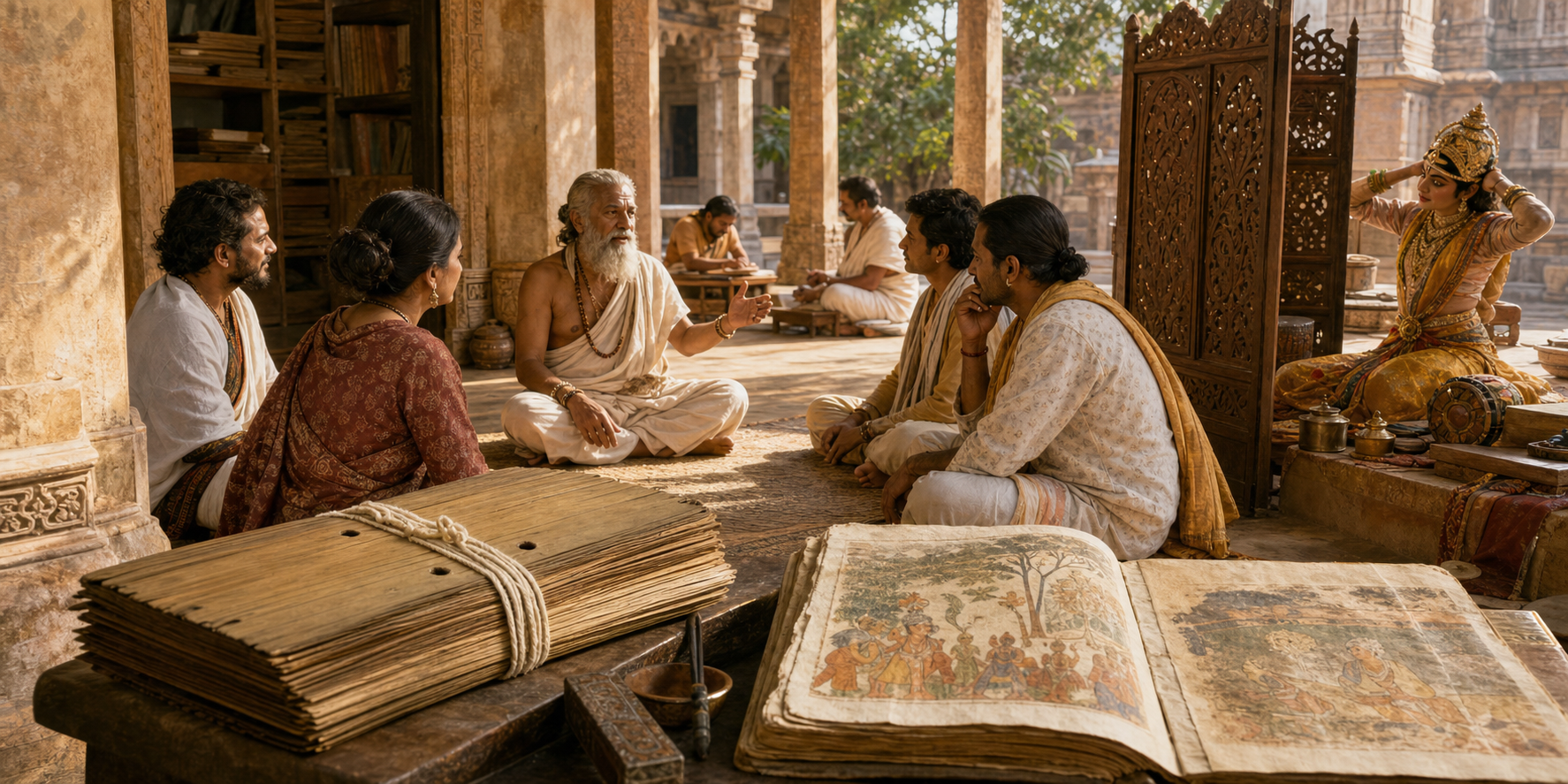
The word Ramayana can refer to the Valmiki Ramayana, a regional literary work, a devotional retelling, an oral performance, a temple tradition, or the larger civilizational story shared across generations. These forms are related, but they are not interchangeable. A detail remembered from a recitation may carry genuine religious meaning without appearing at the same point, in the same form, in every literary lineage.
Consider the first direct battlefield encounter between Rama and Ravana. The Valmiki Ramayana’s Yuddha Kanda distributes the Lanka campaign across several days and encounters, with the decisive Rama-Ravana battles occurring later. Some recitational lineages, however, frame an earlier meeting around the third day. The Kamba Ramayanam, Ramcharitmanas, and later interpretive traditions arrange and emphasize the epic material in their own ways. A responsible reader therefore describes a third-day encounter as belonging to particular narrative or recitational lineages, not automatically as the uncontested chronology of every Ramayana.
That distinction is not pedantry. It tells you whether a public claim is accurate, imprecise, or misleading. When someone says, ‘The Ramayana depicts this event,’ ask four immediate questions:
- Which named text or performance tradition is being discussed?
- Is the claim about an event in the narrative, a commentator’s interpretation, or a modern symbolic reading?
- Does the cited version actually contain the detail, or has a familiar retelling been projected back into another text?
- Would the claim remain accurate if it were rewritten to name its lineage explicitly?
The last question is especially useful. ‘A recitational tradition remembers an early face-off’ can be sound even when ‘Valmiki places the first face-off on day three’ is not. One added phrase can turn a confused assertion into a precise one.
This method also prevents a common mistake in the opposite direction. Discovering that a detail differs from the Valmiki sequence does not prove that it is a recent invention or an attack on Hinduism. Regional and oral transmission are part of the Ramayana’s civilizational life. The honest response is to locate the lineage, not erase it and not mislabel it.
Classical plurality permits interpretation, not intellectual carelessness
The Ramayana has never been read at only one level. It is sacred narrative, ethical instruction, devotional revelation, political reflection, literary art, and a map of the inner life. A scene can support several of these readings at once. The existence of several readings, however, does not make every assertion equally defensible.
In the battlefield contrast between Rama and Ravana, a martial reading notices archery, chariot movement, timing, and the selection and neutralization of astras. An ethical reading asks why force is used and what limits remain binding during war. A political reading contrasts sovereignty grounded in justice with sovereignty maintained through fear. A psychological reading sees Rama’s composure set against Ravana’s pride and agitation. A guna-based reading associates Rama’s clarity with sattva and Ravana’s fury with a rajas-tamas mixture.
These are interpretations because they draw meaning from conduct, character, and narrative structure. They should not be disguised as verbatim statements from a named recension. If a speaker says that Rama represents disciplined power, the claim can be debated through the pattern of his actions. If the speaker says that a particular verse expressly contains a modern political slogan, the burden changes: the verse, edition, and translation must be produced.
You can test an interpretation without demanding that every reader reach the same conclusion:
- Textual fit: Does the interpretation account for the scene as narrated, including inconvenient details?
- Traditional fit: Does it identify the school, retelling, or devotional frame from which it speaks?
- Conceptual fit: Are terms such as dharma, ahimsa, maryada, karma, or guna used with enough care to mean something?
- Moral consistency: Is the same interpretive standard applied to admired and disfavored characters?
- Transparency: Does the speaker distinguish textual description from personal judgment?
Dharmic plurality also extends beyond Hindu literary forms. Buddhist Ramayana retellings may place greater weight on self-mastery and compassion. The Jain Paumacariya approaches the narrative through ahimsa and karmic law and can reassign responsibility for the final blow. Such differences should not be flattened into a claim that all traditions teach an identical theology. Their value lies in showing how a civilizational narrative can be received through distinct doctrinal commitments while continuing to interrogate pride, duty, violence, and self-government.
This gives you a firm middle position. You need not treat every variation as sacrilege, and you need not treat every provocation as scholarship. A reinterpretation earns consideration by naming its frame, presenting reasons, and engaging the tradition fairly. Sneering at devotees, inventing textual support, or using the language of inquiry as cover for contempt does not become serious interpretation merely because someone calls it satire or criticism.
Separate textual error, moral insult, and legal offence
Many Ramayana controversies become confused because four different judgments are compressed into one emotional verdict. A statement can be textually wrong without being malicious. It can be legally protected yet morally coarse. It can cause sincere religious hurt without satisfying the elements of a criminal offence. It can also be deliberately inflammatory while remaining difficult to prosecute. Each possibility calls for a different response.
| Question | What you must establish | Proportionate first response |
|---|---|---|
| Is it textually wrong? | The exact claim, named Ramayana, relevant passage, and translation | Publish a precise correction and identify the lineage being confused |
| Is it a weak interpretation? | The reasoning, omitted context, and interpretive assumptions | Answer the argument rather than attacking the speaker’s identity |
| Is it morally insulting? | The full wording, audience, tone, repetition, and treatment of devotees | Request clarification, correction, withdrawal, or apology |
| Is it legally actionable? | The exact words, applicable law, intent, publication, harm, jurisdiction, and evidence | Preserve the complete record and obtain current advice from qualified Indian counsel |
The distinction became concrete in the Prakash Raj dispute. On 20 April 2026, he was reported to face a reported Rs 100 crore defamation notice from TTD Board Member Bhanup Prakash Reddy and a criminal complaint in Delhi over alleged remarks about the Ramayana. The precise words and their full context had not been publicly reproduced at that point. That missing information prevents a responsible outsider from deciding whether the remarks were textual criticism, satire, careless abuse, deliberate provocation, or something else.
A legal notice is a demand made by a party; it is not a judicial award. A criminal complaint is an allegation placed before the legal process; it is not a conviction. Even the large amount named in a notice does not establish that the claimed loss occurred or that a court will grant it. Before endorsing either guilt or exoneration, you need the exact statement, the complete setting, the pleadings, and the response of the person accused.
India protects expression under Article 19(1)(a), while Article 19(2) permits reasonable restrictions on grounds that include defamation, public order, and morality. These commitments operate together. Reverence does not erase free expression, and free expression does not make reputation, intention, or public order legally irrelevant.
The Supreme Court’s decisions identify distinctions that are often lost online. Ramji Lal Modi v. State of Uttar Pradesh in 1957 treated the religious-insult provision at issue as directed toward aggravated conduct involving deliberate and malicious intention. Shreya Singhal v. Union of India in 2015 distinguished discussion and advocacy from incitement. Subramanian Swamy v. Union of India in 2016 upheld criminal defamation while requiring careful application of the law. These principles do not mean that every offensive remark is lawful or that every painful remark is criminal. They mean that context, intention, statutory elements, and evidence matter.
Do not turn that general framework into personal legal advice. Applicable provisions, procedural posture, and available remedies must be checked against the law in force and the actual papers in a particular case. If you receive a notice, are named in a complaint, or are considering filing one, consult qualified counsel before publishing accusations, deleting records, issuing admissions, or mobilizing an online campaign. Those actions can change your legal position and cannot always be repaired by a later clarification.
Use a five-step test before you amplify a controversy

Your first public intervention often determines whether the discussion becomes an inquiry or a spectacle. Use the following sequence before reposting a clip, signing a demand, or accusing anyone of criminal conduct.
- Recover the complete statement. Find the full recording, transcript, date, venue, preceding question, and words immediately before and after the disputed passage. A caption written by an opponent is not a transcript. If the complete material is unavailable, say that the claim remains unverified.
- Classify the claim. Decide whether the speaker is making a textual assertion, theological judgment, moral criticism, political analogy, joke, or personal insult. Do not answer a theological claim as though it were a quotation from Valmiki, and do not excuse a personal slur merely because it appeared near literary commentary.
- Name the relevant Ramayana. Ask for the passage, recension, retelling, performance tradition, or commentator. If no lineage is supplied, narrow your own response: say that the assertion is unsupported as a claim about the Valmiki Ramayana rather than declaring it absent from every Ramayana tradition.
- Evaluate intent through evidence. Look at wording, repetition after correction, audience, declared purpose, and whether the speaker engages contrary evidence. Do not pretend to read a person’s mind. Deliberate malice is a serious allegation and should rest on more than the fact that devotees felt hurt.
- Choose the least escalatory response that can correct the wrong. Use a citation for a textual mistake, a rebuttal for a weak interpretation, a request for clarification when context is uncertain, and a demand for withdrawal or apology when the wording is plainly contemptuous. Reserve legal action for circumstances that qualified counsel believes satisfy actual legal requirements.
This order matters. If you begin with punishment, you create an incentive for everyone to exaggerate before the facts are known. If you begin by classifying the claim, you can still escalate when evidence warrants it, but your response remains intelligible to people outside your immediate camp.
A concise public response can follow this form: identify the exact claim; name the textual or ethical error; provide the relevant distinction; describe why the wording is harmful; request a specific remedy. For example: ‘This statement treats one modern reading as though it were the uncontested Valmiki narrative. The traditions must be distinguished. The ridicule directed at devotees is also unnecessary. Please clarify the textual basis and withdraw the insulting characterization.’
That formulation does four useful things. It corrects the record, preserves the distinction between disagreement and insult, identifies a repair, and avoids asserting criminal guilt. It also leaves room for a sincere clarification. If the speaker refuses to correct a demonstrable falsehood or repeats contempt after understanding the objection, the evidence for a stronger civic response becomes clearer.
A Dharmic response must not reproduce Ravana’s method

Public defense of the Ramayana should reflect the qualities for which Sri Rama is being defended. In the battlefield interpretation, Rama does not answer Ravana’s fury with uncontrolled fury of his own. He observes, protects allies, uses force for a defined purpose, and refuses to let pride determine the scale of his response. Capability remains under ethical command.
That model is directly applicable to a public controversy. Restraint does not mean passivity. You may correct a falsehood, condemn contempt, organize a lawful response, support an institution seeking redress, or argue vigorously for civilizational dignity. Restraint means that your methods remain answerable to dharma.
Do not abuse a speaker’s family, publish private information, threaten violence, fabricate quotations, or target unrelated people because you believe Sri Rama has been insulted. Those acts do not magnify devotion. They replace a defensible grievance with fresh adharma and allow the original issue to disappear behind the conduct of its supposed defenders.
Ahimsa also does not require pretending that humiliating speech is harmless. Words can corrode trust and reduce a living sacred tradition to material for social contempt. The appropriate correction is truth joined to proportion: document what happened, explain why it is wrong, ask for a defined remedy, and keep punishment within lawful institutions.
Where careless language caused unintended hurt, clarification or apology may restore more than litigation can. Where someone knowingly persists in misrepresentation, a sustained textual and civic rebuttal may be necessary. Where legal thresholds may genuinely be crossed, let evidence and due process do their work. In each case, the response should be chosen for its ability to restore order and accountability, not for its ability to generate the loudest display of anger.
This is also where the wider Dharmic family offers useful moral vocabulary. Hindu accounts of dharma, Buddhist emphasis on self-mastery and compassion, Jain attention to ahimsa and karmic consequence, and Sikh insistence on courage joined to righteousness need not be collapsed into one doctrine. They nevertheless warn against the same public failure: allowing a just concern to be captured by ego, cruelty, or collective frenzy.
Key takeaways
- Ask which Ramayana is being discussed before judging whether a narrative claim is true or false.
- Distinguish events in a named text from devotional interpretation, philosophical symbolism, and modern political analogy.
- Classical plurality does not excuse invented citations, careless generalization, or contempt for devotees.
- Textual error, weak interpretation, moral insult, and legal offence are separate judgments with different evidentiary thresholds.
- A notice or complaint begins a legal process; it does not establish liability or guilt.
- Verify the complete statement, correct precisely, request a defined remedy, and escalate only in proportion to the evidence.
- Defend Sri Rama in a manner consistent with Rama’s maryada: firm, truthful, controlled, and accountable.
The next time a Ramayana controversy reaches you, do not let the clip choose your response. Recover the words, identify the tradition, classify the disagreement, and act at the level the evidence supports. That discipline is not a retreat from reverence. It is how reverence becomes credible public dharma.
References
- DharmaRenaissance Blog – Dharma Confronts Fury: Rama and Ravana’s First Face-Off on Day Three of the Ramayana War
- Hindu Existence – High-Stakes Showdown: Prakash Raj Faces Rs 100 Cr TTD Notice, Delhi Case over Ramayana Remarks