
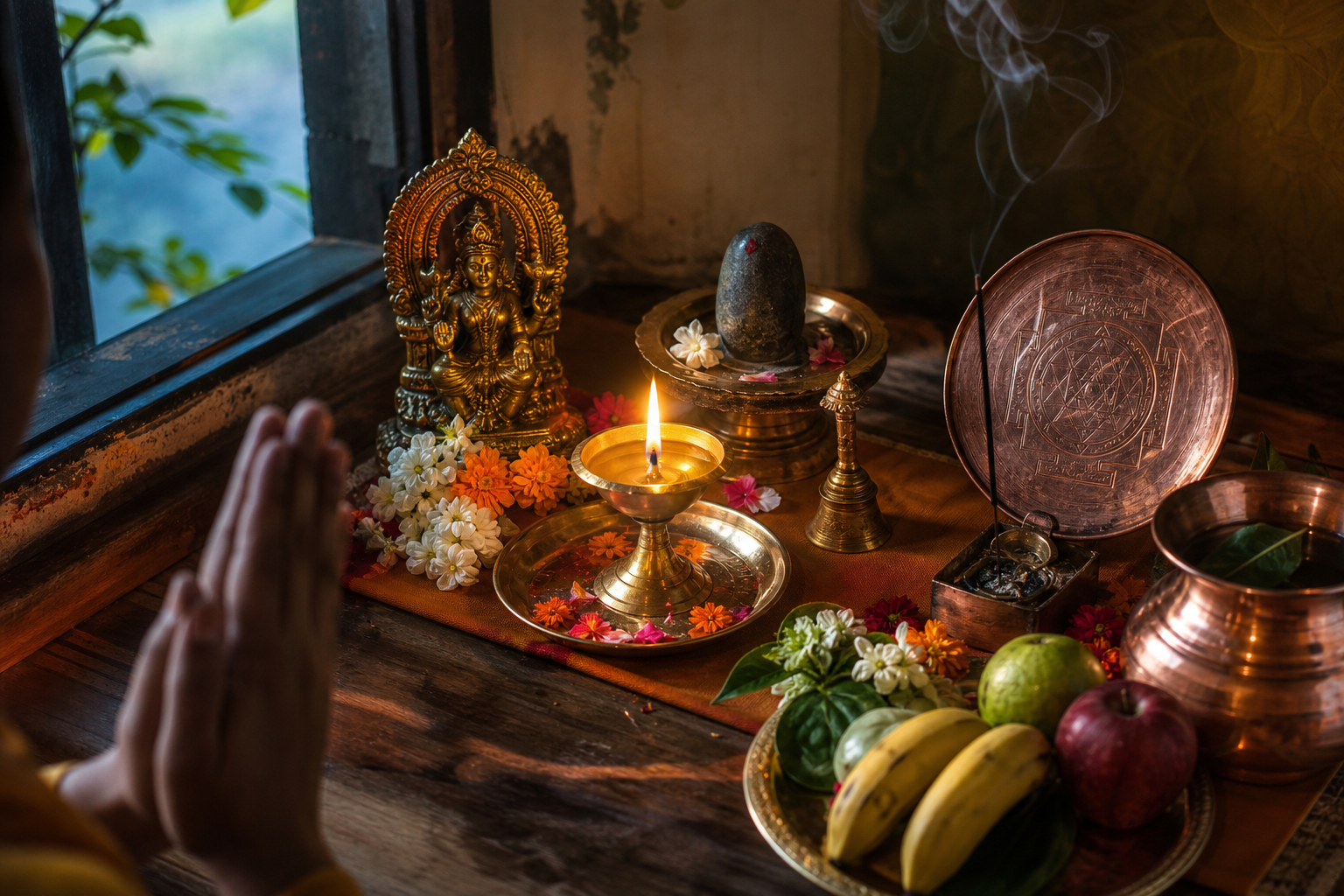
You know how to light the lamp, offer a flower, and fold your hands. Yet you may still wonder what the worship is asking you to see. Why does the bell sound before prayer? Why are leaves offered to one deity and not another? Why can a compassionate Divine Mother appear with a sword, skull cup, or garland of heads?
Treat the altar as a disciplined sacred language. You don’t need a universal dictionary of Hindu symbols. You need to notice what is present, understand how it functions in a particular tradition, and turn its meaning into conduct. That is how an inherited ritual becomes a living sadhana rather than a sequence you perform by memory.
Begin with relationship, not symbol decoding
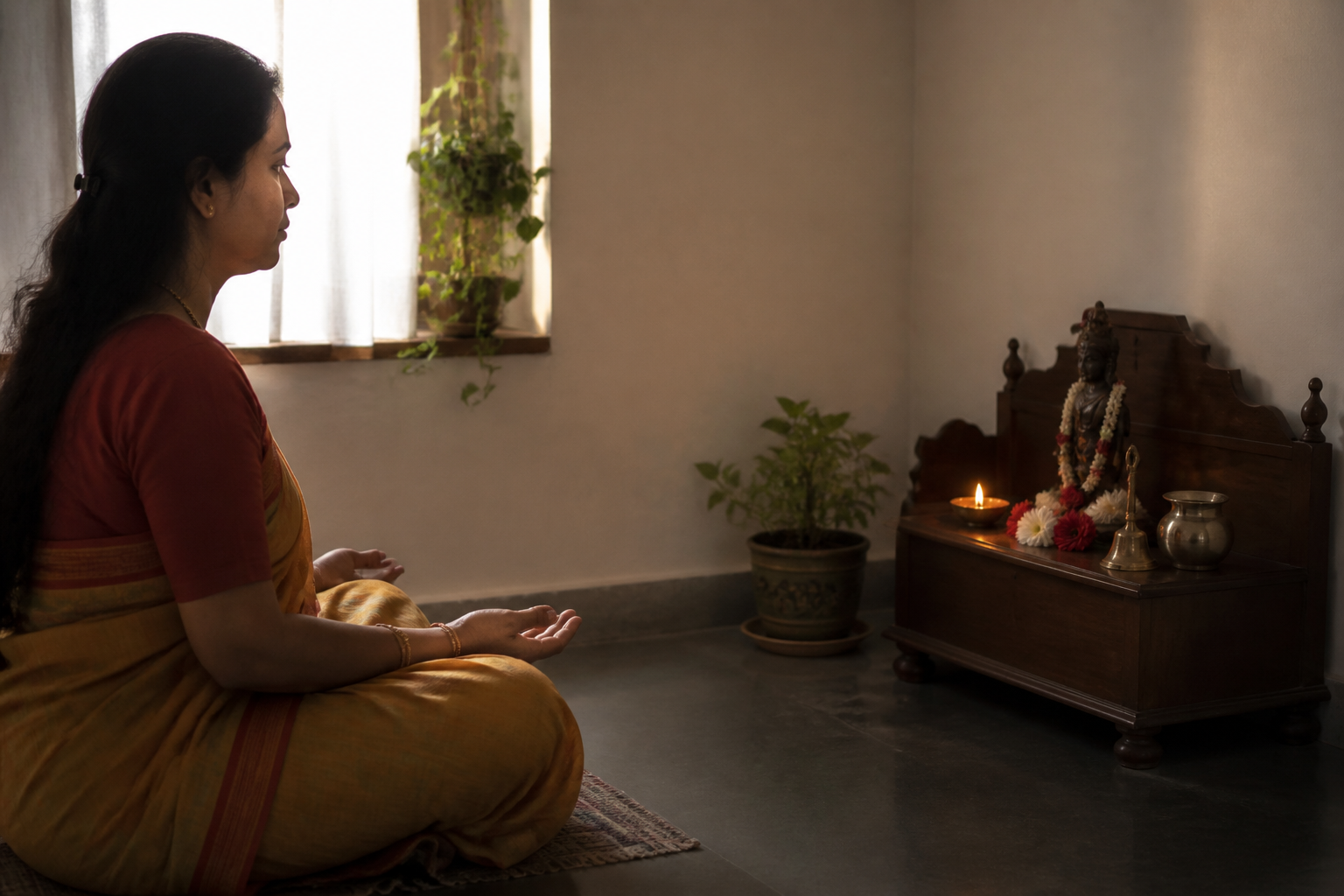
A sacred object can work on several levels at once. It can be an offering to the deity, a theological statement, a way of gathering the senses, and an instruction for your inner life. The deepa is a physical flame, but it also represents awareness overcoming avidya, or ignorance. Naivedya is actual food, but offering it changes your relationship with possession: what sustains you is first received with gratitude and then shared as prasada.
This is why the most useful question is not merely, “What does this object mean?” Ask, “What is this symbol asking me to notice or do?” A lamp calls for clarity. The abhaya mudra calls for freedom from fear. A cremation ground confronts attachment to what cannot last. Prasada turns divine grace into an ethic of receiving and sharing.
Don’t reduce a murti to a visual puzzle. Worship is a relationship with the deity, while symbolism educates the worshipper’s vision. If you catalogue every attribute but never allow the form to affect your choices, you have collected information without entering the practice.
At the same time, don’t force every image into one standardized interpretation. Hindu traditions preserve regional, sectarian, familial, and lineage-based variations. A symbol may carry several compatible meanings, and its emphasis can change with the deity and ritual setting. Use this order when you are uncertain:
- Begin with the interpretation preserved by your family, temple, guru, or sampradaya.
- Look at the symbol in relation to the whole image, not in isolation.
- Distinguish a widely shared meaning from a lineage-specific explanation.
- Ask what ethical or contemplative discipline the interpretation produces.
This last test matters. An interpretation that only makes the image seem exotic is spiritually thin. A reading that sharpens gratitude, discernment, courage, restraint, or devotion is much closer to the purpose of sacred symbolism.
Recognize the three principal forms on an altar
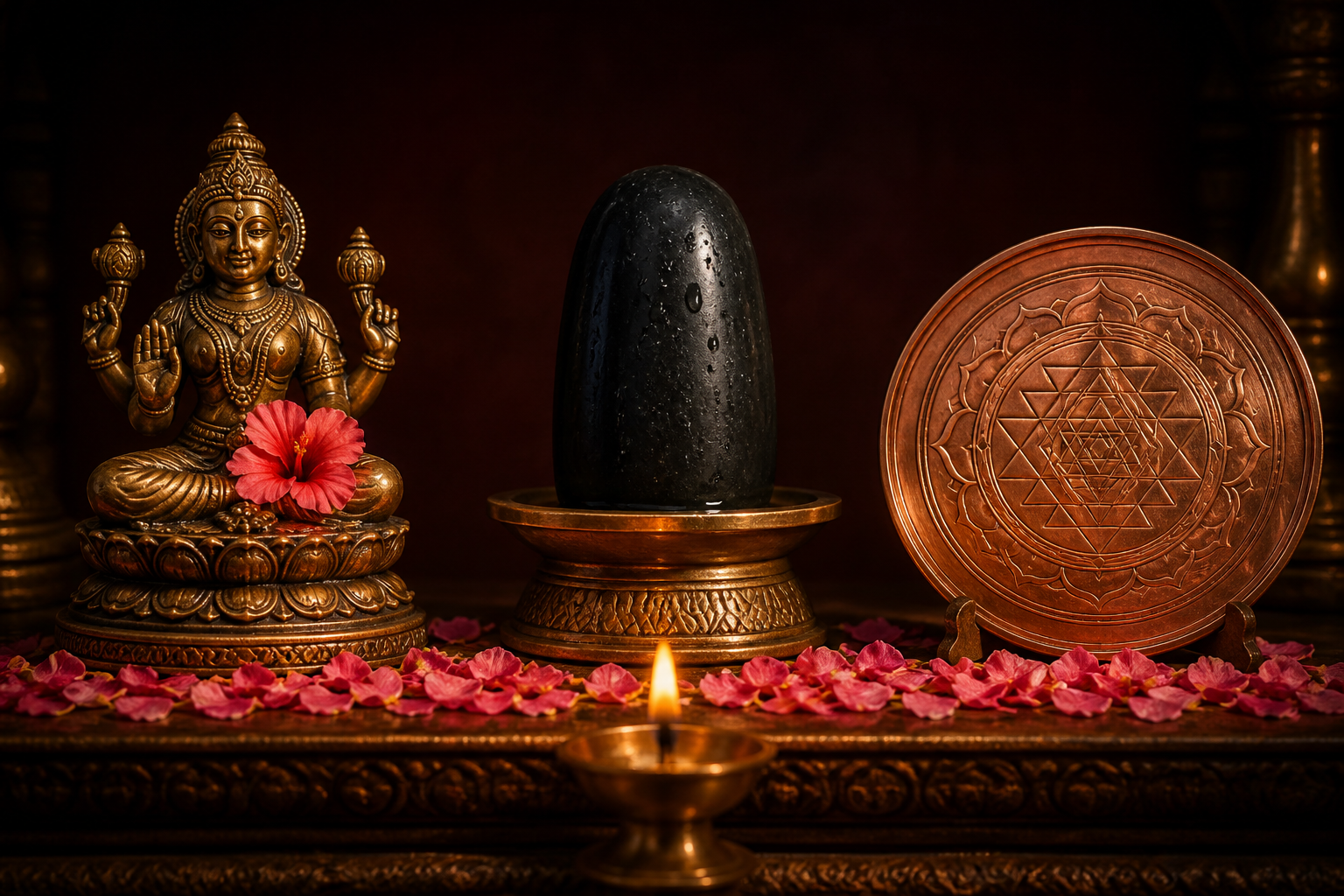
Before interpreting details, identify what kind of sacred representation you are seeing. Hindu worship can bring together murtis, geometric yantras, and naturally formed sacred stones. They are not competing stages in a hierarchy. Each gives attention a different way to approach divine presence.
The murti: form made available to relationship
With a murti, begin with the complete figure. Notice posture, number and position of the hands, facial expression, gaze, color, implements, ornaments, vehicle, companions, and surrounding landscape. Then ask how these parts work together. A weapon beside a gesture of protection does not communicate indiscriminate violence. It can show that compassion sometimes acts by cutting through delusion or defending dharma.
Direction also matters. One hand may promise protection while another offers a boon. A foot may rest upon a demon, a lotus, the earth, or another sacred figure. Read these relationships before assigning meaning to a single item.
The yantra: sacred meaning expressed through geometry
A yantra does not present the deity through a humanlike body. It organizes sacred meaning geometrically. Its symmetry, center, enclosing boundaries, and repeated forms gather wandering attention. Instead of asking what a face or weapon means, notice how your eye is led from outer multiplicity toward a center, or from the center outward into manifestation.
Don’t invent meanings for unfamiliar geometry. If a yantra belongs to a specific practice, learn its use from the tradition that preserves it. The practical lesson is simple: geometry can train concentration, but correct ritual use depends on context.
The shila: nature received as sacred form
A sacred stone makes an important claim without elaborate imagery: divine presence need not depend upon a sculpted likeness. The shaligrama is widely revered in relation to Vishnu, and the bana-linga in relation to Shiva. Some Panchayatana lineages use sphatika, or crystal, for Surya. Exact sets vary, so don’t assemble or relabel stones from a general chart when your household follows an inherited arrangement.
Placement adds another layer of meaning. In Panchayatana Puja, Shiva, Vishnu, Devi, Surya, and Ganapati are arranged in a quincunx, with the worshipper’s Ishta Devata at the center. The form associated with the Smarta tradition and Adi Sankara teaches unity without erasing difference: five distinct forms share one ordered sacred space.
When you encounter such an altar, locate the center before examining the individual objects. The center reveals the devotee’s chosen relationship; the surrounding forms reveal that devotion to one need not require contempt for another. If your family shrine follows a different parampara, don’t rearrange it merely to imitate Panchayatana worship. Learn the grammar of the altar you actually inherited.
Let fierce iconography turn fear into discipline
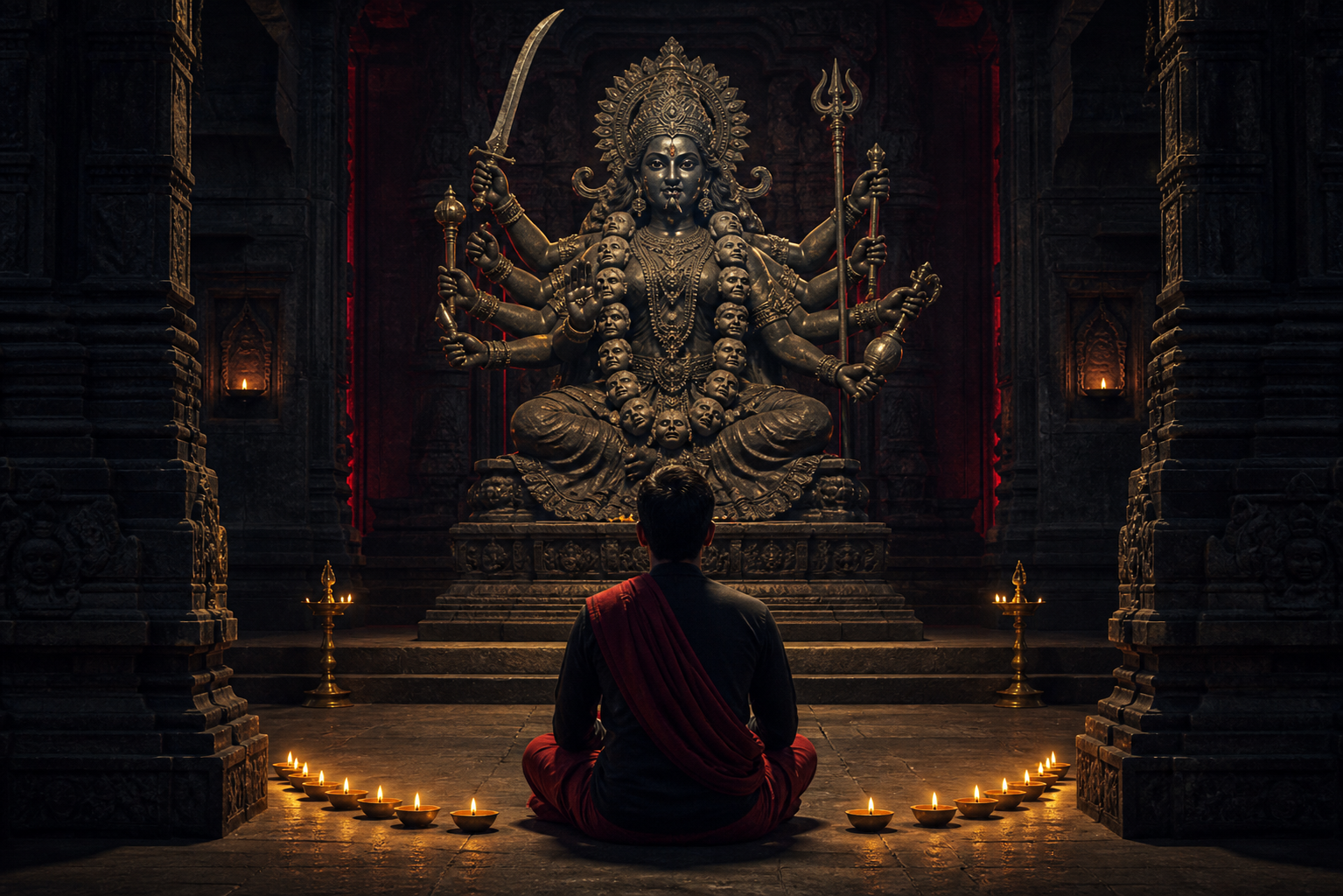
Fierce divine forms are easy to misread. One mistake is to treat every unsettling feature literally, as though the image glorified terror. Another is to soften the image until its challenge disappears. A fierce murti is often meant to interrupt complacency. It places impermanence, ego, ignorance, and moral courage directly before you.
Siddhikali offers a concentrated example. Her dark complexion, three eyes, tongue, weapons, skull cup, garland, gestures, and cremation-ground setting form a coherent contemplative field. These features should be read together, not as unrelated supernatural details.
The midnight or dark complexion points toward the boundless reality in which limited identities dissolve. The three eyes signify insight encompassing past, present, and future. The extended tongue is associated with the arresting of pride and the subjugation of ignorance. The khadga, or sword, cuts delusion; the trishula represents mastery across a threefold field of body, mind, and spirit.
The kapala, or skull cup, makes renunciation impossible to sentimentalize. What you cling to must eventually change. The mundamala, or garland of heads, can be read in relation to the letters and sounds of creation brought under wisdom. The cremation ground is not morbid decoration. It removes the ordinary distractions through which you avoid impermanence.
Siddhikali may stand or dance upon the passive form of Shiva. The contrast places dynamic Shakti against stillness and shows that all manifested activity unfolds upon a deeper ground. Her abhaya gesture offers fearlessness, while varada extends compassionate grace. The same form that destroys delusion also protects and gives. Fierceness and compassion are not opposites here; the removal of bondage is itself compassionate.
Her name also directs you beyond fascination with siddhis. Spiritual powers remain secondary to self-realization. The practical disciplines are steadiness of attention, ethical restraint, breath, meditation, and action aligned with dharma. If an image makes you hungry for extraordinary power but less responsible in ordinary life, you have read it backwards.
Use four questions when contemplating any fierce form:
- What is being destroyed? Name a delusion, attachment, or habit rather than imagining an external enemy.
- What must be faced? Notice where fear of loss or change is controlling your conduct.
- What is being protected? Identify the truth, duty, person, or boundary that requires courage.
- What balances the weapon? Look for a mudra, gaze, posture, or accompanying symbol that places power under compassion and dharma.
If you practice japa before such a form, use a mantra established in your household or received through your tradition. Complexity is not a measure of devotion. A known divine name, recited steadily with ethical reflection, is more useful than an esoteric formula adopted without context.
Read the offerings as a map of the five elements
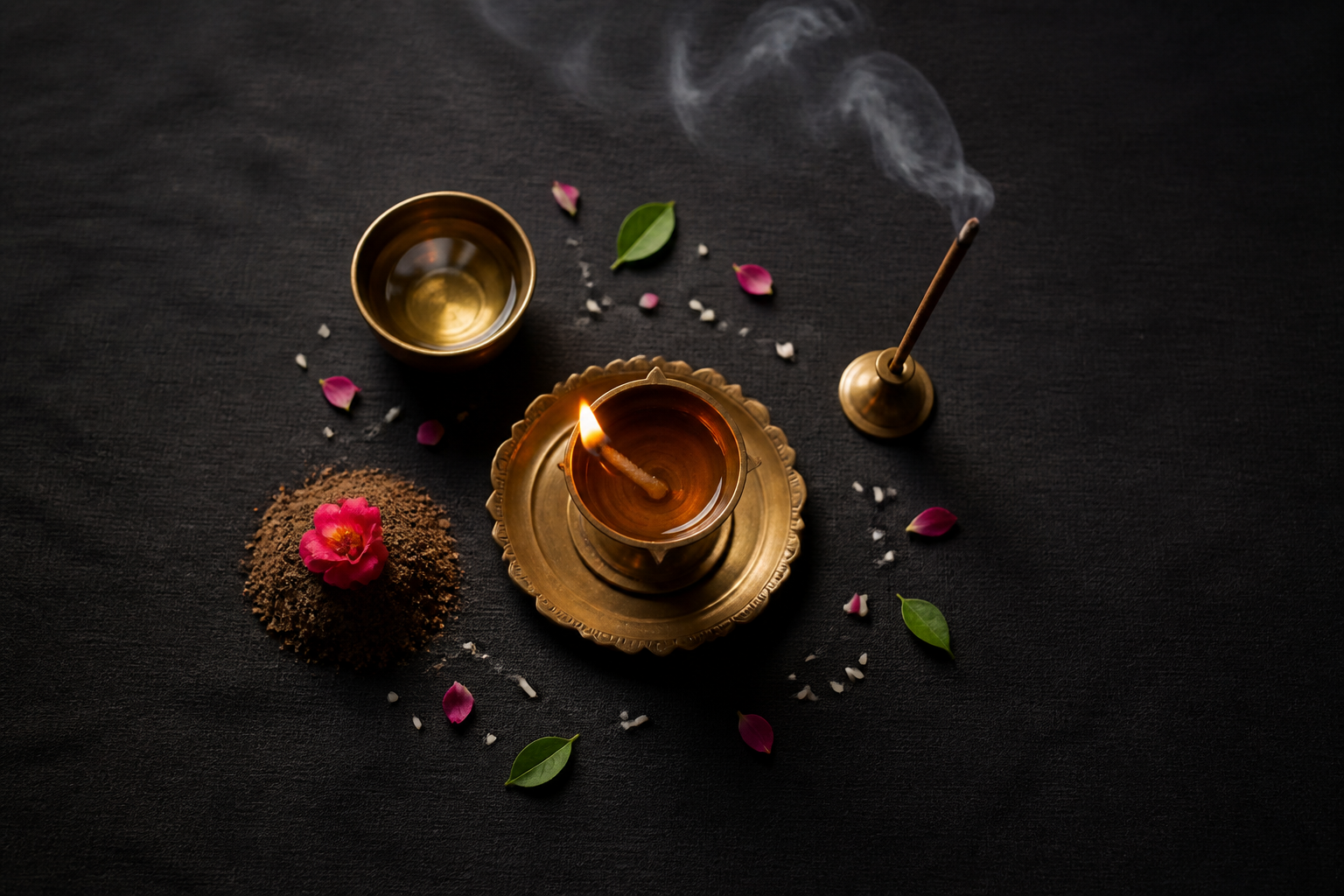
Puja does not address the intellect alone. Light, water, fragrance, sound, texture, color, and food bring the body into worship. The pancha bhutas provide one practical way to understand this sensory completeness. The correspondences are a contemplative map rather than an exhaustive rule for every ritual.
| Element | Ritual expressions | What to notice | Practice it can awaken |
|---|---|---|---|
| Earth | Flowers, leaves, grains, sacred stones, and the physical altar | Worship depends upon gifts drawn from the living world | Stability, gratitude, careful use of material resources |
| Water | Purification, abhisheka, and the kalasha | Life is sustained, cleansed, and renewed through flow | Purity of intention, adaptability, respect for what sustains life |
| Fire | Deepa and, where performed, homa | Light reveals what darkness conceals | Attention, discernment, willingness to remove ignorance |
| Air | Dhupa, fragrance, and conscious breath | An unseen presence can still alter the whole atmosphere | Subtle awareness and steadiness of breath |
| Space | Bell, mantra, resonance, and silence | Sound appears, travels, and resolves within openness | Receptivity, inner spaciousness, and freedom from mental crowding |
The deepa is therefore more than illumination for the shrine. When you light it, identify one matter that requires clearer seeing. Don’t make a vague promise to “be more aware.” Name the confusion: a duty you have delayed, a resentment distorting your judgement, or a decision you keep avoiding.
The kalasha gathers several life-bearing symbols in one form. Water, leaves, and coconut express purity, continuity, and abundance. Its fullness should deepen reverence rather than encourage extravagance. Use ritual materials carefully; waste contradicts the gratitude the vessel is meant to cultivate.
Flowers and leaves are not generic decoration. Bilva leaves are traditionally associated with offerings to Shiva, while Tulsi is offered to Vishnu. Turmeric and kumkum convey auspiciousness and the sanctity of embodied life. Sandalwood paste cools and centers. Learn what your deity and lineage customarily receive instead of treating every available material as interchangeable.
Sound marks a threshold. The bell interrupts ordinary mental momentum, and its resonance is associated with akasha, or space. The conch can announce an auspicious beginning and gather communal attention. Mantra then gives that attention direction. After ringing a bell, allow a short pause rather than rushing immediately into the next action. Hear the sound arise, spread, and fade. The silence after it is part of the practice.
Naivedya completes another movement: nourishment is returned symbolically to its source before being received as prasada. The value is not measured by cost or quantity. A simple offering made attentively can teach more than abundance displayed without gratitude. Once received, share it. The symbolism becomes real when offering changes possession into participation.
This elemental reading also gives you an ecological test. If flowers, leaves, water, food, or incense are used carelessly, the ritual’s reverence for nature has not reached behavior. Choose respectfully sourced materials, avoid needless excess, conserve water during abhisheka, and dispose of biodegradable offerings responsibly according to local conditions.
Use one symbol to connect puja with daily conduct
You don’t need to interpret the entire shrine in one sitting. Choose one symbol and complete the movement from observation to action. The following method works at a home altar or during a temple visit without requiring you to interrupt the ritual.
- Locate the center. Identify the principal deity or the form receiving the main worship. On a Panchayatana altar, note which Ishta Devata occupies the center.
- Name the mode of representation. Are you looking at a murti, yantra, shila, or an arrangement combining them? This tells you whether to attend first to bodily attributes, geometry, natural form, or spatial relationship.
- Observe before interpreting. Note posture, hands, objects, colors, offerings, sounds, and surroundings. Don’t decide what the image means after noticing only one dramatic detail.
- Follow the ritual action. Watch what is bathed, clothed, illuminated, perfumed, praised, fed, or circled. What happens to a sacred object often clarifies its meaning.
- Check the parampara. Ask a knowledgeable family member, priest, teacher, or practitioner how that community understands the symbol. Record variations instead of forcing them into a false single answer.
- Form one precise resolve. Translate the symbol into a specific action. The lamp may call you to make an overdue decision honestly. Abhaya may call you to hold a necessary boundary without hatred. Prasada may call you to share something you usually keep for yourself.
- Carry the resolve beyond the altar. Complete the action while the worship is still fresh in your memory. Otherwise the symbol remains admired but unapplied.
If you are beginning a simple Panchayatana practice, follow your lineage rather than assembling a random collection of attractive objects. Where the practice is appropriate, place the Ishta Devata at the center with the other four forms around it, offer water, light, incense, flowers, a brief known stotra or nama-japa, and simple naivedya. Regularity matters more than ornament. If you already have an inherited shrine, learn its order before making changes.
Key takeaways
- Sacred symbolism is not a universal code; begin with the deity, ritual setting, and lineage.
- Read the whole composition before interpreting a weapon, gesture, color, or offering by itself.
- Murtis, yantras, sacred stones, and altar arrangements offer different ways of focusing devotion.
- Fierce imagery directs power against ignorance and bondage; its protective and compassionate features keep that power aligned with dharma.
- The five elements make worship bodily and ecological through earth, water, fire, air, and space.
- A symbol has completed its work when it changes a concrete choice beyond the altar.
At your next puja, resist the urge to add another object or memorize ten more meanings. Choose the symbol already in front of you. Observe it carefully, learn how your tradition understands it, and write one sentence beginning, “This asks me to…” Then fulfill that sentence before the next worship. Sacred symbolism becomes intelligible through attention, but it becomes transformative through practice.
References
- DharmaRenaissance Blog – Goddess Siddhikali Iconography: The Complete Guide to Sacred Symbolism and Inner Power
- DharmaRenaissance Blog – Complete Guide to Panchayatana Puja Symbols: Discover the Sacred Power of Nature
