

A diya is lit in a government building. A video appears to show namaz inside a protected fort. Within minutes, the first is called inclusion by one camp and surrender by another, while the second is defended as religious freedom or denounced as an assault on heritage. If you react only to the religion involved, you will probably miss the question that actually decides the matter.
You need a test that protects Dharmic visibility without turning every restriction into persecution, and that protects shared heritage without treating one community as collectively guilty. The practical questions are straightforward: What kind of space is this? What rule governed it before the controversy? Was permission required? Has the same rule been applied to comparable conduct? What remedy fits the actual breach?
Key takeaways
- Religious visibility in public is not the same as religious control of public space. A civic Diwali observance can recognize citizens without making Hindu belief compulsory.
- A protected monument may restrict prayer, ceremonies, crowds, flames, sound, or other activities for conservation and visitor management. Such restrictions are legitimate only when they are clear, relevant, and consistently applied.
- Official recognition and unscheduled use are different categories. Comparing them as though they were identical produces heat rather than a fair judgment.
- Theological disagreement, disagreement over site rules, and religiously targeted exclusion are three different things. Answer each differently.
- Before sharing an inflammatory clip, establish the location, date, full sequence, applicable rule, permission status, and official response.
First classify the space, not the faith
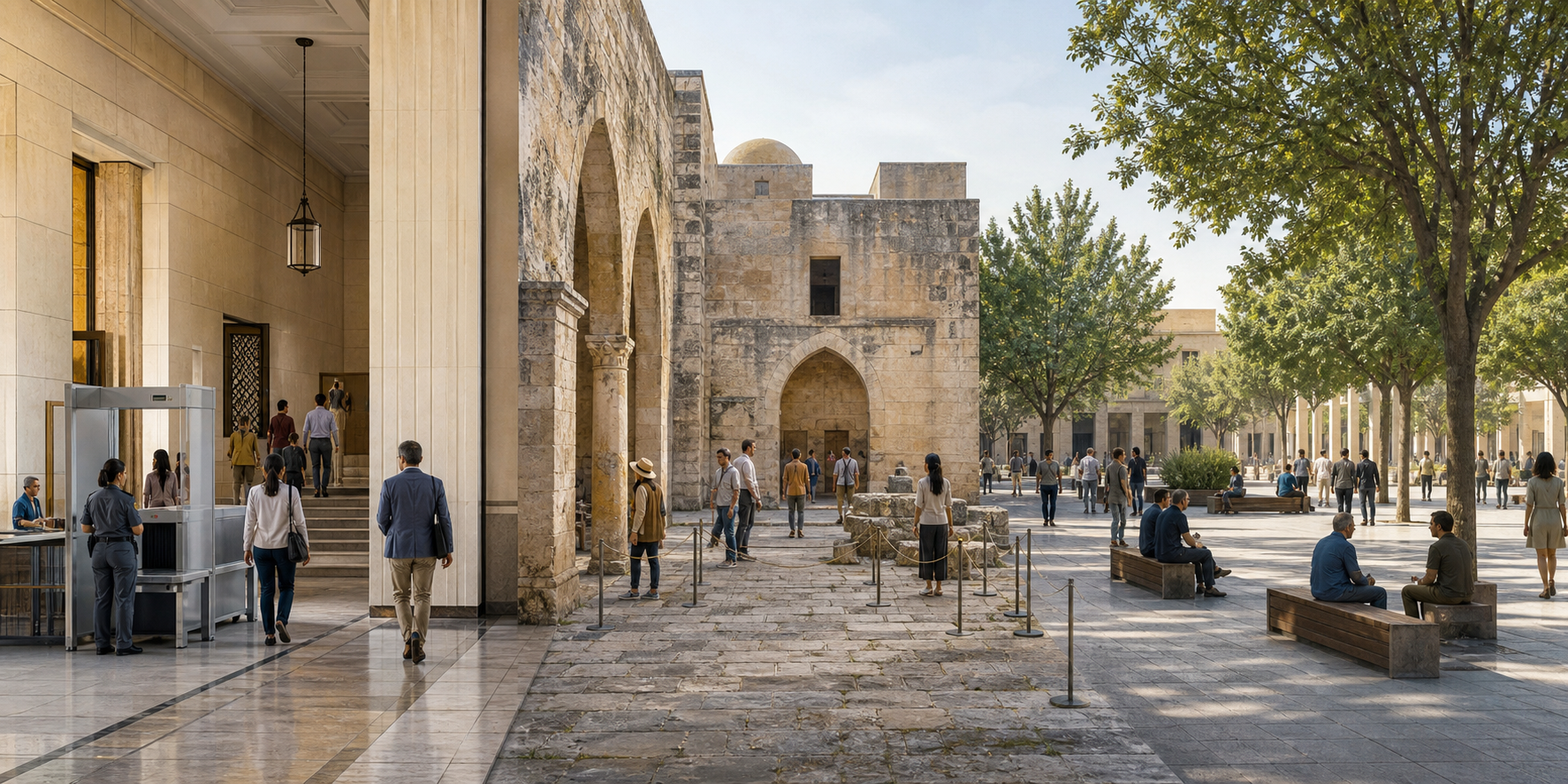
The phrase public space hides several different arrangements. A ceremonial room used for an invited civic observance is not managed like a fort under heritage protection. A park designed for ordinary community use is not managed like a narrow passage through a fragile monument. A publicly visible religious act is not necessarily an official endorsement, and an official greeting is not a transfer of public authority to a religious community.
Begin by identifying the function of the place at the time of the act:
- Civic and ceremonial space: A government institution may invite communities to mark festivals, recognize public service, or acknowledge the population it represents. The relevant questions are whether participation is voluntary, whether access to recognition is fair, and whether the event serves a civic purpose.
- Ordinary common-use space: Streets, squares, and parks often accommodate speech, assembly, celebration, and devotion, subject to rules concerning safety, obstruction, noise, scheduling, and cleanup. Permission may depend on the scale and effect of the activity rather than its theology.
- Protected or operational space: Heritage monuments and other specially managed sites can require stricter controls. Conservation, visitor movement, capacity, security, and the character of the site may justify limits that would make little sense in an open park.
- Dedicated sacred space: A temple, gurdwara, vihara, derasar, church, or mosque has a religious purpose of its own. Public access does not erase the institution’s responsibility to preserve its practices and rules.
This classification prevents a common mistake: assuming that every religious act must be allowed everywhere because religious freedom matters, or that any public religious expression threatens state neutrality. Neither claim holds up. Freedom of worship does not provide an automatic exemption from every site rule, while public recognition does not force observers to accept the recognized tradition as true.
| Question | What you need to establish | Why it matters |
|---|---|---|
| Who manages the place? | The institution or authority responsible for access, safety, conservation, and permissions | Rules must come from the body with responsibility for the site, not from the loudest account online. |
| What is the place for? | Civic ceremony, ordinary public use, heritage preservation, transit, or dedicated worship | A restriction connected to the site’s function is stronger than a restriction based merely on dislike of a faith. |
| What exactly happened? | The activity, duration, number of participants, use of sound or objects, obstruction, and any invitation or permission | A short private observance and an organized event may create different practical issues. |
| Did a rule already exist? | Published regulations, signs, permit conditions, or established operating procedures | A pre-existing rule is easier to defend than a prohibition invented after a disliked community appears. |
| What is the proper comparison? | Other activities with a similar scale, impact, permission status, and setting | Equal treatment concerns comparable conduct, not superficial similarity between unrelated events. |
| What remedy fits? | Guidance, removal, a warning, a permit process, investigation, or another proportionate response | Not every breach warrants criminalization, and not every targeted threat can be dismissed as mere disagreement. |
Apply one rule fairly, but compare like with like
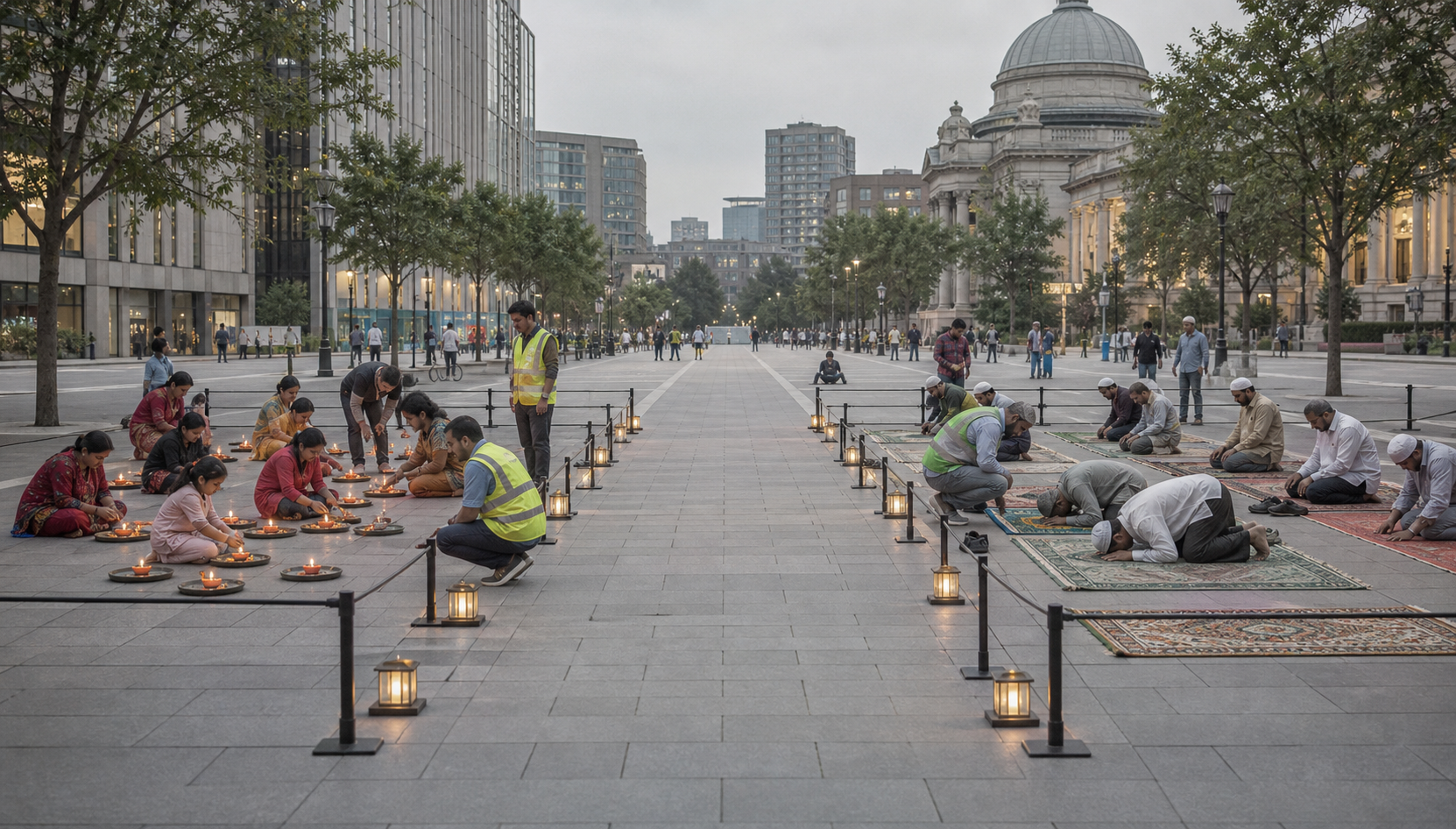
A sound public-space rule has three qualities. It exists before the dispute. It addresses a real feature of the site or activity. It applies to comparable conduct regardless of which community is involved. If an authority invokes conservation to stop namaz but permits unapproved ceremonies of a similar scale and effect for another faith, it owes the public an explanation. If it prohibits all unscheduled ceremonies at a protected monument, that is a materially different situation.
Comparable does not mean identical. An invited festival observance at a government venue and an unapproved devotional act at a protected monument differ in permission, purpose, management, and possible physical impact. Fairness asks whether similarly situated people receive the same treatment. It does not require every space to operate under the same rules.
Consider the White House Diwali observance. The ceremonial lighting of a diya recognized Indian-American contributions and presented Diwali within a civic setting. The hostile replies insisting that Hindu celebration had no place in the United States did not raise a neutral concern about venue management; they rejected the public belonging of Hindu Americans because of their religion. A citizen does not have to accept Hindu theology to accept that Hindu neighbors belong in national life.
Now consider Shaniwarwada. After a video circulated showing namaz inside the fort, police booked three women following preliminary verification. That fact does not by itself establish guilt, the precise character of the conduct, or the fairness of every response. Nor does it make Muslims collectively responsible. The proper inquiry concerns the fort’s rules, the permission status, the treatment of comparable activities, the evidence available to authorities, and due process for the people involved.
Two shortcuts should therefore be rejected. The claim that any prayer in a public place is automatically protected ignores legitimate management of shared sites. The claim that a prayer associated with a disliked community is automatically a provocation replaces evidence with identity. Both approaches make impartial stewardship impossible.
If you manage a monument, public building, or community venue, publish the rules before a dispute arises. State whether organized prayer, ceremonies, open flames, amplified sound, photography equipment, temporary structures, or group gatherings require permission. Provide a visible contact and a simple application route. At a high-footfall heritage site, multilingual notices, advance-permission procedures, and on-site guidance can prevent an avoidable breach from becoming a communal test of strength.
Separate policy disagreement from Hinduphobic exclusion
Not every criticism of a Hindu event is Hinduphobia. The label is strongest when it identifies religiously targeted exclusion, degradation, collective blame, or a double standard. If someone objects to all open flames in a government building because of a safety rule, examine the rule. If someone says Hindus should leave the country because Diwali was recognized, the issue is not fire safety or institutional neutrality. It is hostility to Hindu belonging.
Use three separate response lanes:
- Theological disagreement: A person may believe another religion is false. You do not need to settle theology to defend equal civic dignity. Reply only if a genuine interfaith conversation is possible.
- Policy disagreement: Ask for the written rule, the site’s purpose, the permission record, and comparable cases. This turns a culture-war slogan into a question that can be answered.
- Exclusion or targeted abuse: Preserve evidence, report credible threats through the appropriate channel, support the person targeted, and ask the institution involved to reaffirm equal treatment. Do not reproduce slurs more widely than accountability requires.
This distinction also protects the credibility of Hindu advocacy. If every disagreement is called hatred, genuine anti-Hindu exclusion becomes easier to dismiss. If direct demands that Hindus abandon their faith or leave their country are treated as ordinary debate, prejudice is normalized. Precision is not timidity. It tells allies, institutions, and undecided observers exactly what boundary was crossed.
Apply the same discipline when the controversy concerns another community. An alleged violation by three individuals does not justify suspicion of every Muslim, just as hostile replies from a cluster of self-identified Christian right-wing accounts do not justify hostility toward every Christian. The Diwali backlash showed how a small but conspicuous set of accounts can appear larger than it is once screenshots and angry replies begin circulating.
Do not let a viral clip write the facts for you

A short video can show that an act occurred. It usually cannot establish permission, prior warnings, the full duration, what happened outside the frame, or how rules were applied on another day. Virality rewards certainty before those gaps are filled. Your first responsibility is therefore not to announce a verdict. It is to identify what the clip proves and what it does not.
Before forwarding a public-space controversy, check six things:
- Find the earliest available upload. Reposted clips often lose dates, captions, preceding events, and replies that correct the original claim.
- Confirm the location and date. A correct-looking caption is not confirmation. Look for recognizable site features and a statement from the responsible institution or local authority.
- Describe only visible conduct. Say what people can actually be seen doing. Do not infer motive, conspiracy, official permission, or criminal liability from posture, clothing, or the uploader’s narration.
- Locate the applicable rule. Ask whether the restriction concerns religion itself or a neutral feature such as access, conservation, crowding, sound, flame, scheduling, or obstruction.
- Seek the right comparator. Compare activities at the same type of site with similar permission status and impact. A state-hosted reception in a ceremonial room is not the comparator for an unscheduled act inside a protected fort.
- Choose a proportionate response. Correct a false caption, request clarification, support better signage, challenge discriminatory enforcement, or report a credible threat. Do not escalate an administrative ambiguity into collective religious blame.
If you are personally named in a police complaint, booking, or legal notice, do not rely on social-media interpretations or make speculative admissions online. Preserve the complete material, note the relevant site instructions, and obtain qualified local legal advice. Public debate cannot determine an individual’s legal position.
If you publish about the incident, lead with the verified event and governing question. A useful opening would say that an activity occurred at a managed site and that authorities are examining whether it breached an existing rule. A damaging opening declares a community’s intent before evidence is available. The first informs readers; the second recruits them into a conclusion.
Put satya, ahimsa, and seva into the response
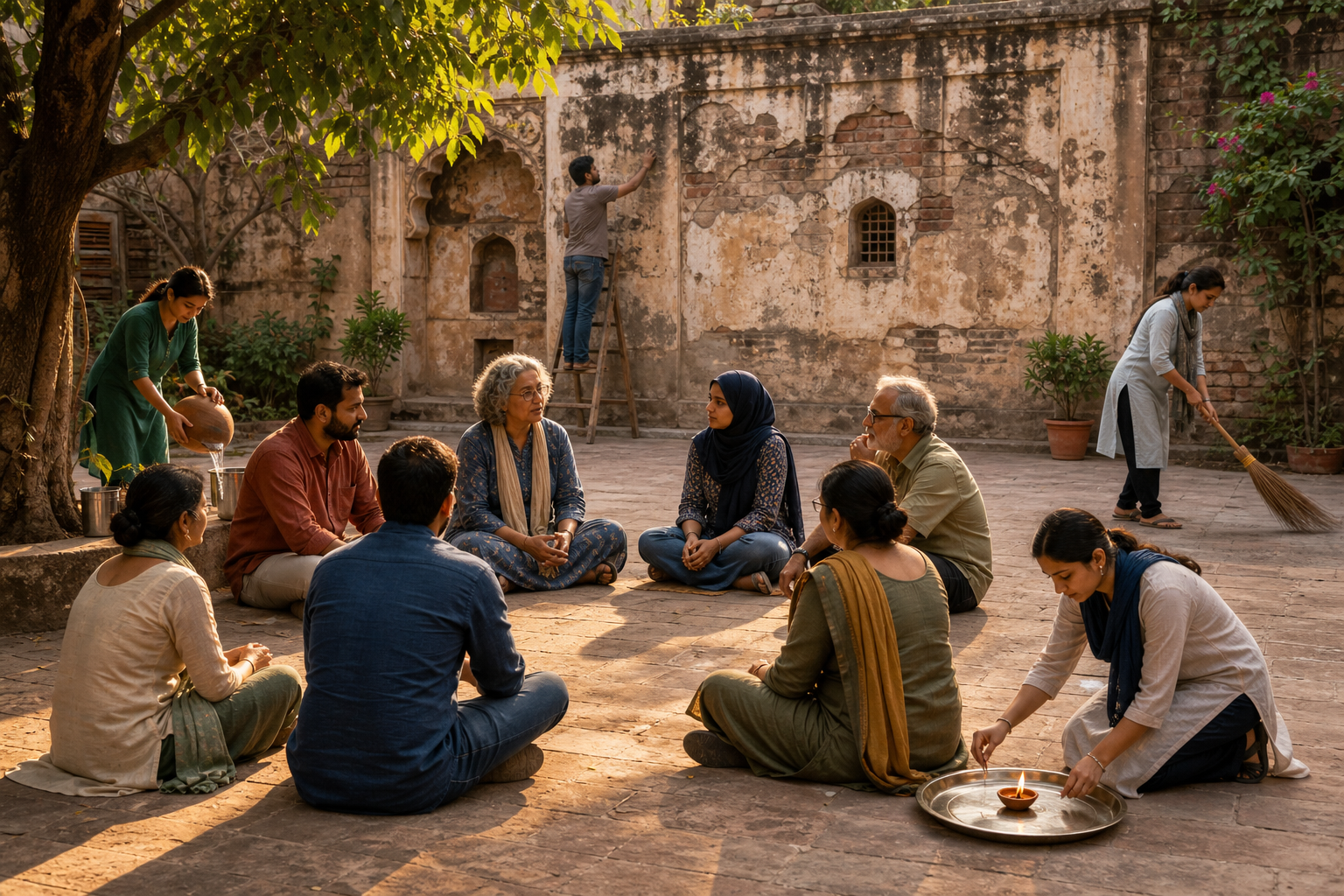
Dharmic pluralism is not passive tolerance, and it does not require you to pretend that all claims are equally sound. It asks for disciplined conduct while truth and justice are pursued. Satya keeps the facts intact. Ahimsa prevents a justified objection from becoming collective hatred. Seva turns a controversy into better public practice.
Begin with satya. Write a two-column note before you react: verified facts on one side, unanswered questions on the other. If permission status is unknown, say so. If police action is preliminary, preserve that qualification. If screenshots document a small cluster of hostile accounts, do not present them as the view of an entire country or political constituency.
Practice ahimsa without becoming silent. Name anti-Hindu abuse plainly when Hindu identity is the reason for exclusion. Defend a monument’s rules without insulting the worshippers involved. Refuse calls for retaliation, humiliation, or collective punishment. Ahimsa governs the means of resistance; it does not demand surrender of dignity or heritage.
Move toward seva. Ask what would make the next incident less likely: clearer signs, an accessible permit process, staff training, designated areas, better visitor guidance, a public explanation of enforcement, or a civic event that brings communities into respectful contact. For many Hindus, Buddhists, Jains, and Sikhs, Diwali carries an ethical language of light over darkness that can support cooperation across Dharmic and non-Dharmic communities without erasing their distinct teachings.
If you are organizing a religious observance in a shared venue, submit a short written plan. Include the purpose, proposed location, timing, expected attendance, sound, flames or lamps, objects to be placed, movement through the site, cleanup, and responsible contact. Ask for written approval and keep it available on the day. This protects the participants, the venue, and the wider community from disputes driven by missing information.
If you are responding as a community organization, make your public statement do two jobs in two sentences. First state the neutral rule you want applied. Then state the dignity that must not be violated. For example: protected-site requirements should be published and enforced consistently; no alleged breach by an individual justifies hostility toward an entire faith. That formulation is firm enough to defend heritage and fair enough to build a durable coalition.
The next time a public-space controversy reaches your phone, resist the demand to choose a community before you know the rule. Identify the space, verify the conduct, find the proper comparator, and insist on a proportionate remedy. You can defend the public presence of Dharma and the responsible stewardship of shared heritage at the same time.
References
- Hindu Human Rights – Video: Christian Right Wingers Have a Hinduphobic Heart Attack Over President Trump’s Diwali Event
- Struggle for Hindu Existence – Maharashtra Politics Heats Up Over Namaz at Pune’s Shaniwarwada Fort; Three Women Booked
