
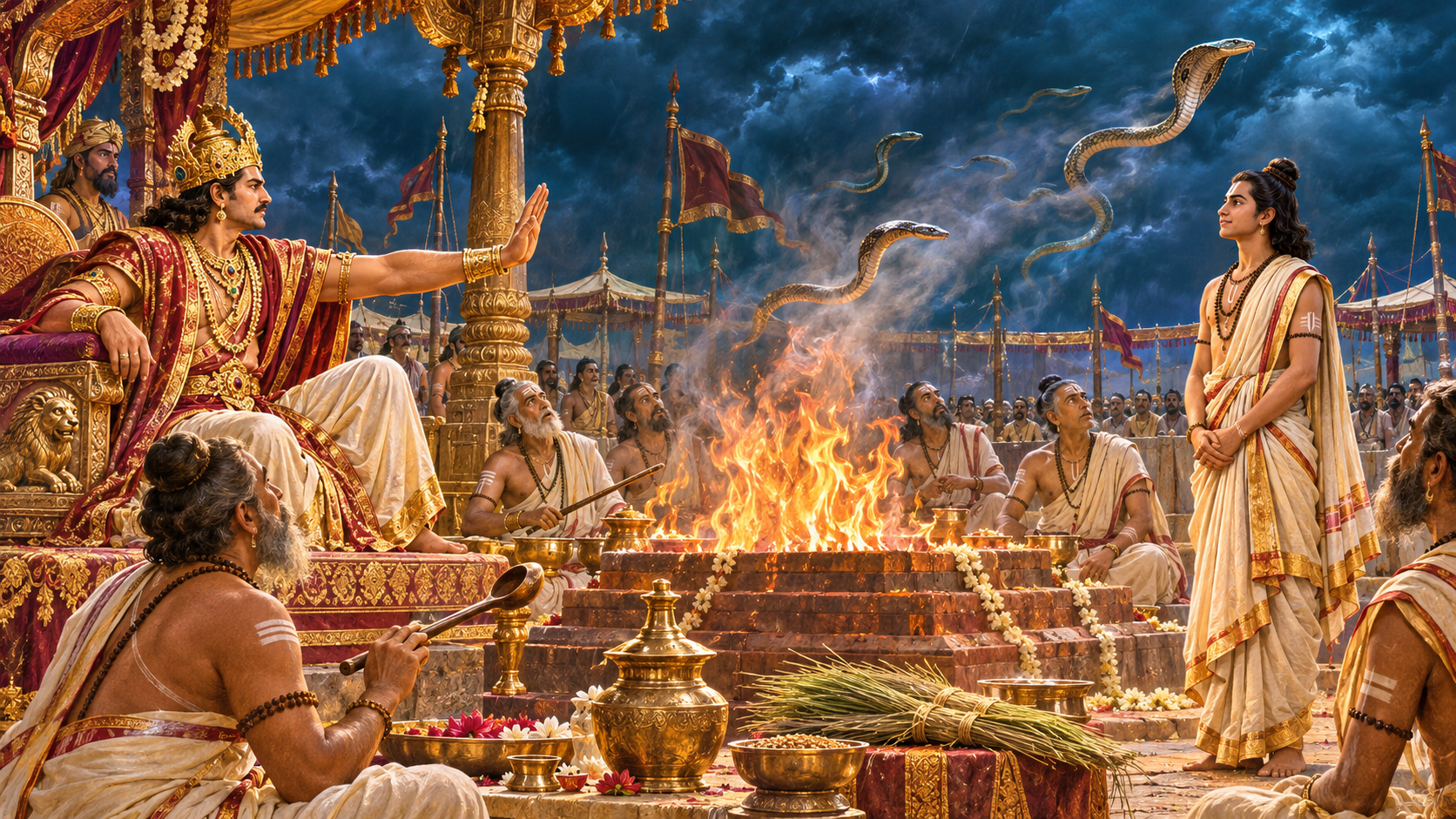
If you remember only that Astika stopped Janamejaya’s snake sacrifice, the unfinished rite can look like a loose end. It is the opposite. The sacrifice is prevented from reaching its intended conclusion, and that interruption supplies the episode’s moral resolution.
The distinction matters when you read the Mahabharata. Janamejaya has the authority, priests, ritual structure, and determination needed to continue. What he lacks is the right to treat completion itself as proof of dharma. The episode asks you to watch what happens when a king’s desire for vengeance meets a promise he cannot honour without restraining himself.
The sacrifice was stopped, not accidentally abandoned
Janamejaya, the son of Parikshit, undertakes the Sarpasatra, or snake sacrifice, after receiving counsel from his ministers. Behind that decision stands the death of Parikshit at the hands of Takshaka. The king’s grievance therefore begins with a particular act, but his response expands into a rite directed against serpents collectively.
That expansion is the first detail to notice. The rite does not merely seek an answer to Takshaka. It makes an entire class of beings bear the force of the king’s anger. The scale of the response is what allows vengeance to acquire the appearance of royal and ritual legitimacy.
Astika eventually intervenes and asks that the sacrifice cease. Janamejaya grants the request, so the rite ends before fulfilling its destructive aim. Calling it “unfinished” therefore does not mean that no sacrifice took place, that its performers were incompetent, or that the narrative forgot to provide an ending. The sacrifice began and had consequences. It was then deliberately halted.
A precise way to describe the event is this: Janamejaya’s Sarpasatra was stopped before its intended destruction of the serpent race could be completed. That wording preserves both halves of the episode—the reality of what the king began and the significance of his decision not to finish it.
The prediction changes the question you should ask

The interruption is announced before Astika brings it about. In the Astika Parva of the Adi Parva, chapter 47, a Suta connected with the preparation of the sacrificial ground foresees that the sacrifice will not be completed. A Brahmana, he indicates, will become the reason for its failure to reach completion.
This forecast is not a decorative omen. It changes the structure of the episode. Once the outcome has been disclosed, the important question is no longer whether Janamejaya will finish the sacrifice. You are being asked to notice how the predicted limit will enter a ceremony backed by royal command.
The answer is not that the ritual machinery suddenly breaks. Nor does an army overpower the king. The limit arrives through a Brahmana’s request and through Janamejaya’s own word. The king can command the sacrifice, but his authority also binds him when he makes a promise.
Do not read the prediction as an excuse to remove human agency. The warning establishes the destination, but it does not make the choices meaningless. Astika still has to intervene. Janamejaya still has to decide whether his word will remain valid when honouring it becomes costly. Foreknowledge supplies the frame; speech and choice complete the action.
Astika finds the boundary inside Janamejaya’s own authority
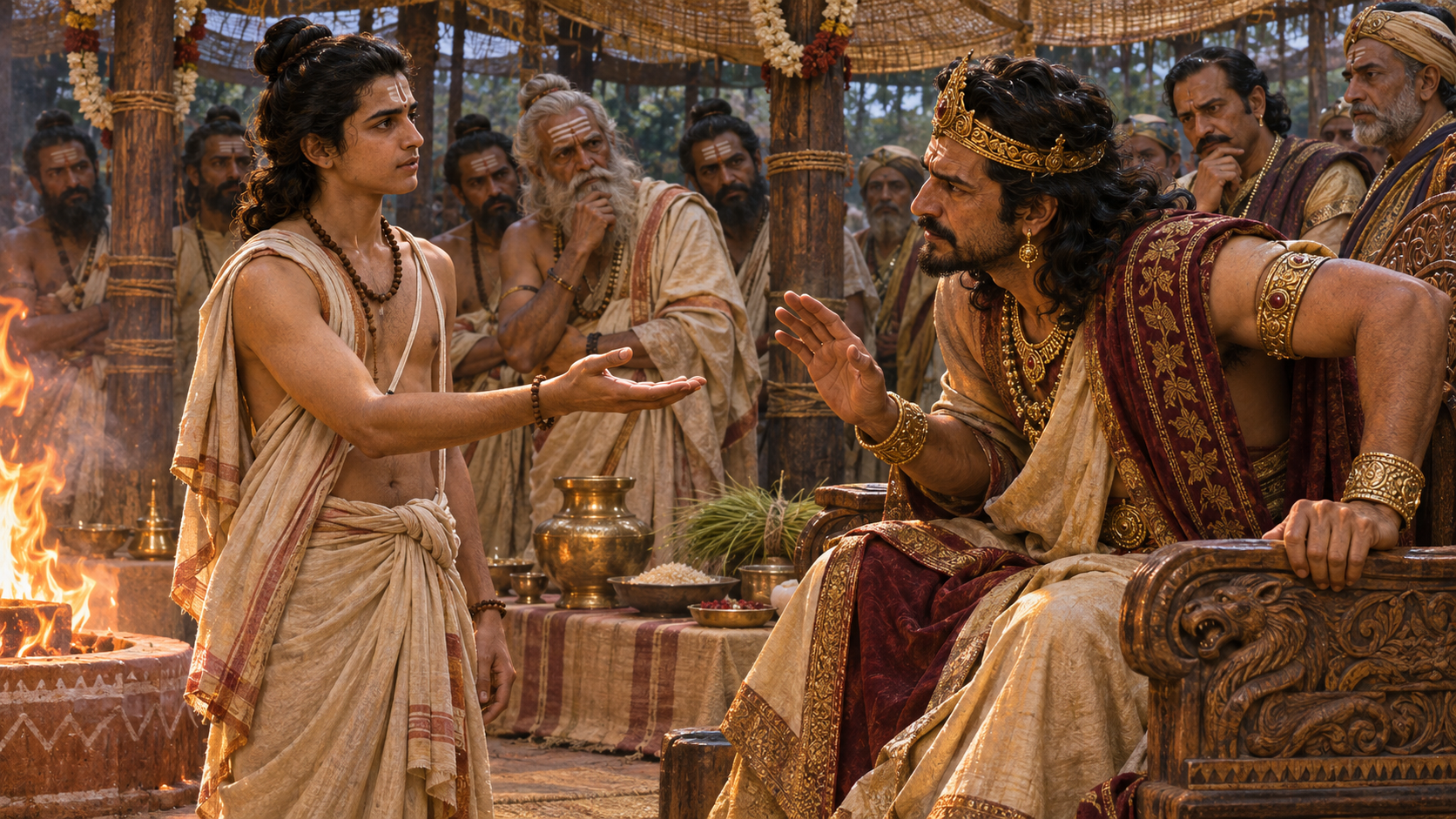
Astika does not end the sacrifice by claiming a greater army or a stronger appetite for destruction. He enters the king’s ritual world and receives the offer of a boon. When he chooses the cessation of the sacrifice as that boon, royal generosity becomes the means by which royal vengeance is restrained.
This is the episode’s sharpest turn. Janamejaya’s promise is easy to make while he assumes that the request will be compatible with his wishes. Its real value appears only when Astika asks for the one thing the king does not want to surrender: completion of the Sarpasatra.
You can read the scene by separating two commitments. The first is Janamejaya’s determination to answer his father’s death. The second is the obligation created when he offers Astika a boon. These commitments collide. The king cannot preserve both in their fullest form, and the decision to honour his word places a boundary around his anger.
That does not make Janamejaya’s original grief unreal or Takshaka’s deed irrelevant. Dharma does not require the story to pretend that no injury occurred. It requires the king to recognize that an injury does not automatically justify every response carried out in its name.
Astika’s intervention is therefore more than a rescue at the last moment. He reveals a route out of escalating vengeance that remains compatible with kingship: Janamejaya can stop because keeping his word is also a royal duty. Restraint does not have to arrive as humiliation. It can arise from the ruler’s fidelity to an obligation he has freely assumed.
Why incompletion becomes the dharmic resolution

Ritual completion and moral completion are not identical. A rite may proceed in an orderly manner and still serve an intention that must be limited. Conversely, stopping before the declared objective has been achieved may look like failure from the standpoint of vengeance while becoming success from the standpoint of restraint.
The episode gives you three tests for reading that tension. First, examine the movement from individual guilt to collective punishment. Janamejaya’s grievance concerns his father’s death, but the sacrifice reaches far beyond one offender. When the object of punishment expands, ask whether the original wrong still defines its boundaries.
Second, distinguish capacity from legitimacy. Janamejaya’s ability to organize a great sacrifice shows that he possesses power and ritual resources. It does not settle whether he should carry the undertaking to its furthest possible end. “Can this be completed?” and “Ought this to be completed?” are separate questions.
Third, look for the legitimate exit. Astika does not merely demand that the king become indifferent to his father. He activates an obligation already created by the king’s promise. The Mahabharata can therefore stop the destructive undertaking without treating royal speech, ritual order, or the initial injury as trivial.
This does not turn every abandoned duty into an act of dharma. Incompletion becomes meaningful here because continuing would extend vengeance beyond its original cause, while stopping honours another genuine obligation. The lesson is not “leave difficult work unfinished.” It is “do not mistake momentum, investment, or public commitment for moral permission to continue.”
If you apply the episode to a decision of your own, ask three concrete questions: What wrong am I actually answering? Who will bear the cost besides the person responsible? What truthful promise, boundary, or duty gives me a principled way to stop? Those questions preserve the structure of the episode without reducing it to a vague slogan about forgiveness.
Key takeaways for reading the Sarpasatra
- “Unfinished” means the sacrifice was deliberately stopped before achieving its intended destructive end; it does not mean that nothing happened.
- The Suta’s advance warning moves your attention from whether the rite will stop to how a limit will enter a king’s carefully controlled undertaking.
- Astika ends the sacrifice through a boon offered by Janamejaya, making the king’s own promise the boundary on his vengeance.
- The episode distinguishes ritual capacity from dharmic legitimacy: the power to finish an undertaking does not prove that finishing is right.
- Janamejaya’s restraint does not erase Parikshit’s death. It prevents one injury from becoming unlimited collective punishment.
- The practical question is not whether persistence is always virtuous, but whether the original aim remains just as its costs widen.
When you next read the Astika Parva, pause first at the prediction and then at the offered boon. The episode’s centre lies between those moments. One announces that vengeance will meet a limit; the other shows Janamejaya choosing to honour that limit. Read the unfinished sacrifice from there, and its apparent failure becomes a precise lesson in responsible power.
References

Leave a Reply
You must be logged in to post a comment.