

If you are deciding how to respond to the Telangana temple controversy, the useful question is not how loudly you can react. It is whether your response will protect the pujari, help establish what happened, secure fair action, and stop an alleged religious insult from becoming a wider communal conflict.
That requires two forms of resolve at once: Hindu institutions must not be expected to tolerate denigration, and an allegation must not be turned into a verdict before evidence is examined. You can defend both the temple and the truth by acting in the right order.
What is alleged, and what remains unestablished
The dispute concerns the Jammulamadugu Dattatreya Swamy Temple in Shantinagar, Vaddepalli Mandal, in Telangana’s Jogulamba Gadwal district. Pakkirappa serves there as the pujari and conducts its daily rituals.
Local residents allege that a pastor identified as Ashirvadam verbally abused Pakkirappa and made derogatory remarks about Hindu deities and beliefs. The allegation described publicly is therefore one of verbal abuse and religious denigration. It should not be retold as a physical assault unless separately verified evidence establishes that.
Residents reportedly submitted a formal complaint at Shantinagar Police Station. Police reportedly responded and began legal proceedings, while villagers also asked the District Collector to monitor the matter.
Those facts define the present public claim, but they do not decide it. The exact words allegedly spoken, their context, the number of direct witnesses, any recording, the police classification of the complaint, Ashirvadam’s response, and the result of an investigation have not been supplied. No case number or quoted police finding is available here either.
The responsible formulation is therefore precise: serious allegations have been made, residents have approached the police, and the allegations require a prompt and impartial investigation. Saying more than that risks weakening the demand for justice by attaching it to claims that have not yet been demonstrated.
Turn outrage into an evidence file authorities can act on

A temple committee’s first responsibility after such an incident is to preserve evidence, not to produce viral content. Memories diverge quickly, forwarded files lose context, and public retellings can blur the difference between what a witness heard and what someone later told them.
- Secure the pujari and the premises. Separate the people involved, prevent a renewed confrontation, and contact emergency services if anyone faces an immediate threat. Do not send a crowd to confront the accused.
- Write down each direct witness’s account separately. Record the words the witness personally heard, where the witness stood, who else was present, and the sequence of events. Mark second-hand information as second-hand. Do not ask witnesses to agree on a common version.
- Preserve original digital files. If video, audio, messages, or photographs exist, retain the untouched originals with their metadata. Make secure backups, record who supplied each file, and distribute copies only when necessary. A captioned clip or edited compilation is not a substitute for the original.
- Collect relevant temple records. Preserve visitor registers, duty records, entrance or common-area CCTV footage, and photographs of any relevant condition at the site. If a camera system automatically overwrites footage, secure the relevant segment before that happens.
- Keep the complete police trail. Retain the signed complaint, the acknowledgment issued by the station, the date and time of submission, and the name or designation of the receiving official. Do not announce that an FIR has been registered unless the document in hand establishes that fact.
- Name one liaison. One committee representative should communicate with the pujari, witnesses, police, district administration, and any lawyer. This reduces contradictory statements and prevents sensitive personal information from passing through uncontrolled messaging groups.
- Record subsequent conduct. Preserve any later threat, pressure on a witness, attempt to enter the temple disruptively, or request to withdraw the complaint. Report new conduct through lawful channels rather than answering it with intimidation.
If the committee is considering publishing names, recordings, addresses, or telephone numbers, obtain local legal advice first. Public disclosure can expose witnesses and the pujari to harassment, compromise an inquiry, or create defamation and privacy risks. Evidence can be given to investigators without turning private details into mobilisation material.
Use public language that is firm, exact, and defensible
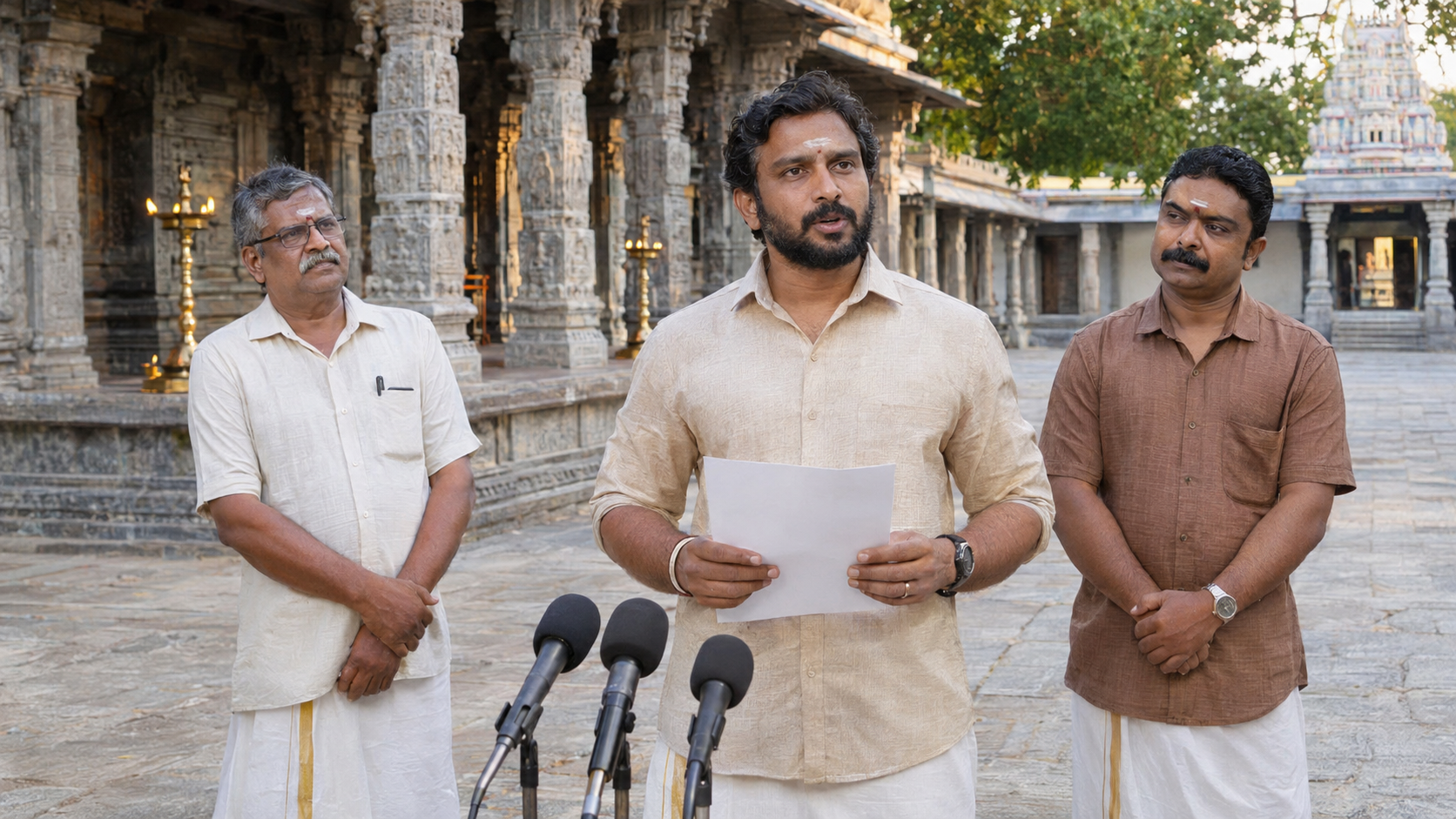
Careful language is not weakness. It keeps attention on the alleged conduct and the institutional response instead of giving opponents an easy dispute over exaggeration.
A defensible public statement could say: Residents have complained to Shantinagar Police Station that a temple pujari was verbally abused and Hindu deities were insulted. The allegations require a prompt, impartial investigation. We seek protection for the temple and its pujari, preservation of evidence, and action warranted by verified facts. We oppose retaliation or abuse against any community.
Before releasing a statement, apply four tests:
- Does every asserted fact come from a direct witness, an original record, or an official document?
- Are disputed claims clearly described as allegations rather than established guilt?
- Does the statement ask for a concrete remedy, such as evidence preservation, an impartial inquiry, protection, or an administrative review?
- Does it hold individuals responsible for their own alleged conduct without blaming Christians collectively?
Avoid labels that add facts not in evidence. Do not transform alleged verbal abuse into an “attack,” assert an organised conversion conspiracy without proof, call someone guilty before adjudication, or circulate unverified quotations as the exact words spoken. Do not publish addresses or encourage people to telephone, visit, threaten, or socially punish the accused.
Equal respect cannot mean that Hindus must quietly absorb contempt for their deities, pujaris, or sacred spaces. It also cannot mean collective punishment for the alleged act of one person. A Dharma-centred response joins truthful speech, self-command, protection of the sacred, and accountability through lawful means.
Build temple protection before the next confrontation
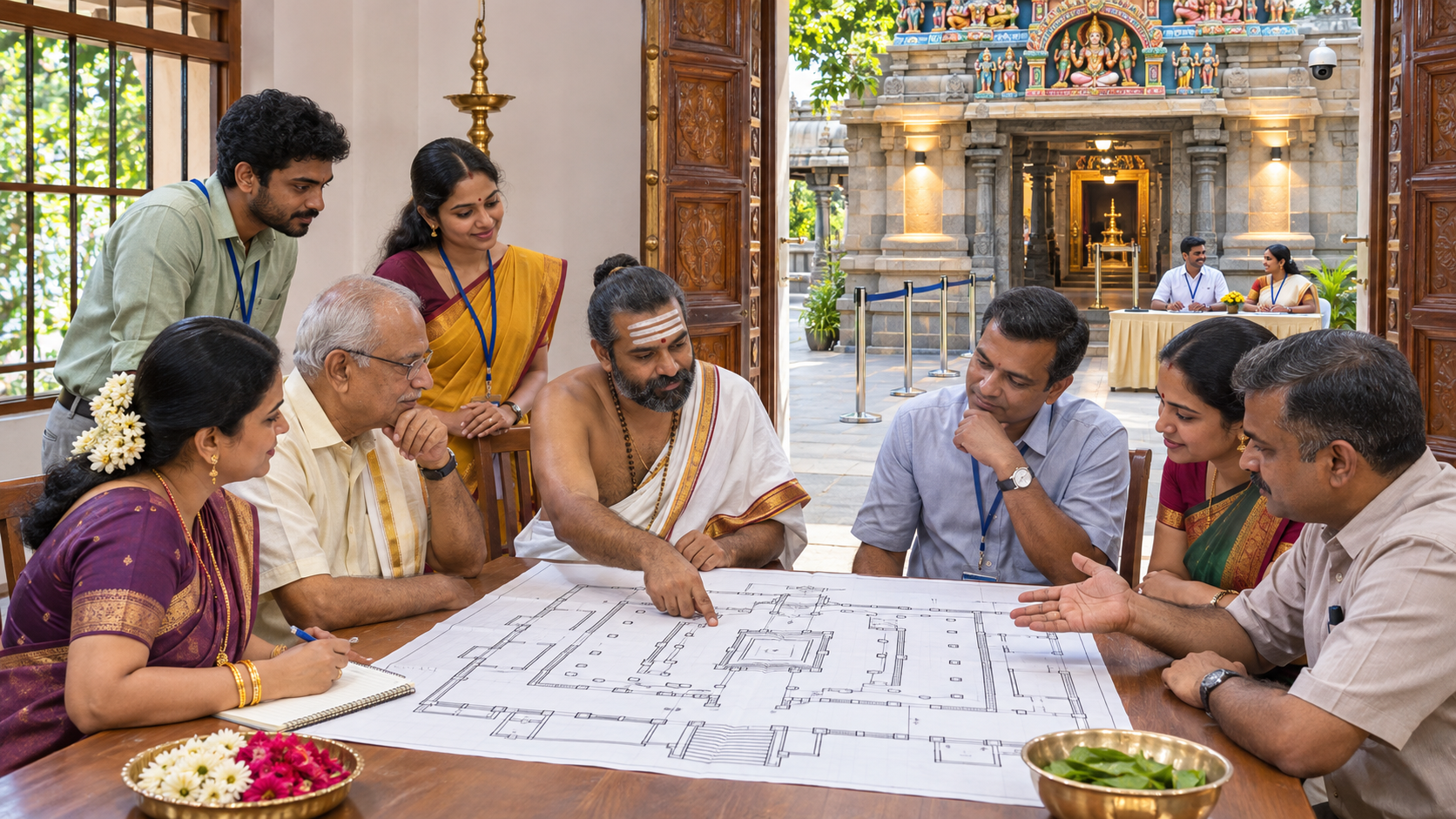
The villagers’ appeal for district-administration involvement points to a useful distinction. Police investigate alleged conduct; administrators can also help address recurring risks around a place of worship. Temple committees should be ready to use both channels without confusing their purposes.
A basic temple incident protocol should contain:
- An incident form with fields for time, location, exact conduct, direct witnesses, evidence files, immediate safety concerns, and action taken.
- Current contact details for the local police station, relevant district-administration office, committee office-bearers, and a local lawyer who can advise on procedure.
- A clear rule that threats, harassment, deliberate disruption of worship, and abuse of religious figures or beliefs are unacceptable on the premises, regardless of the visitor’s community.
- Two trained points of contact for de-escalation so the pujari is not forced to manage a hostile encounter while conducting worship.
- A named custodian for CCTV exports and digital evidence, with access controls and a simple log showing when a file was copied and to whom it was given.
- A spokesperson rule: volunteers and office-bearers should send media and public inquiries to one designated representative instead of offering competing accounts.
- A welfare plan for the pujari and direct witnesses, including safe transport or accompaniment when a credible safety concern arises.
At each committee meeting, verify that contact details still work, camera clocks are accurate, relevant footage can be exported, and incident forms are accessible. These checks are mundane, but they determine whether a serious complaint arrives as a coherent record or as a collection of conflicting messages.
Keep ordinary worship functioning unless a genuine safety risk makes that impossible. A calm volunteer presence, clear entry rules, and an orderly complaint process demonstrate that the temple will neither surrender its dignity nor become the site of retaliatory disorder.
Key takeaways for devotees and temple committees
- Describe this as an allegation of verbal abuse and insults to Hindu deities, not as a proven offence or a physical assault.
- Preserve original evidence and separate first-hand witness accounts before publishing clips or statements.
- Keep the complaint acknowledgment and procedural records; never claim an FIR or official finding without the corresponding document.
- Ask for specific outcomes: an impartial investigation, protection where needed, preservation of evidence, and action based on verified facts.
- Reject both silence about anti-Hindu denigration and collective blame against another religious community.
- Create a standing temple protocol so the next incident is handled through evidence, designated contacts, and disciplined communication.
Before the next community meeting, put the police paperwork and evidence log in one secure file, appoint the liaison, and agree on one fact-checked public statement. Those three actions will protect Pakkirappa and the temple more effectively than uncontrolled outrage, while giving authorities a clear record on which to act.
References

Leave a Reply
You must be logged in to post a comment.