
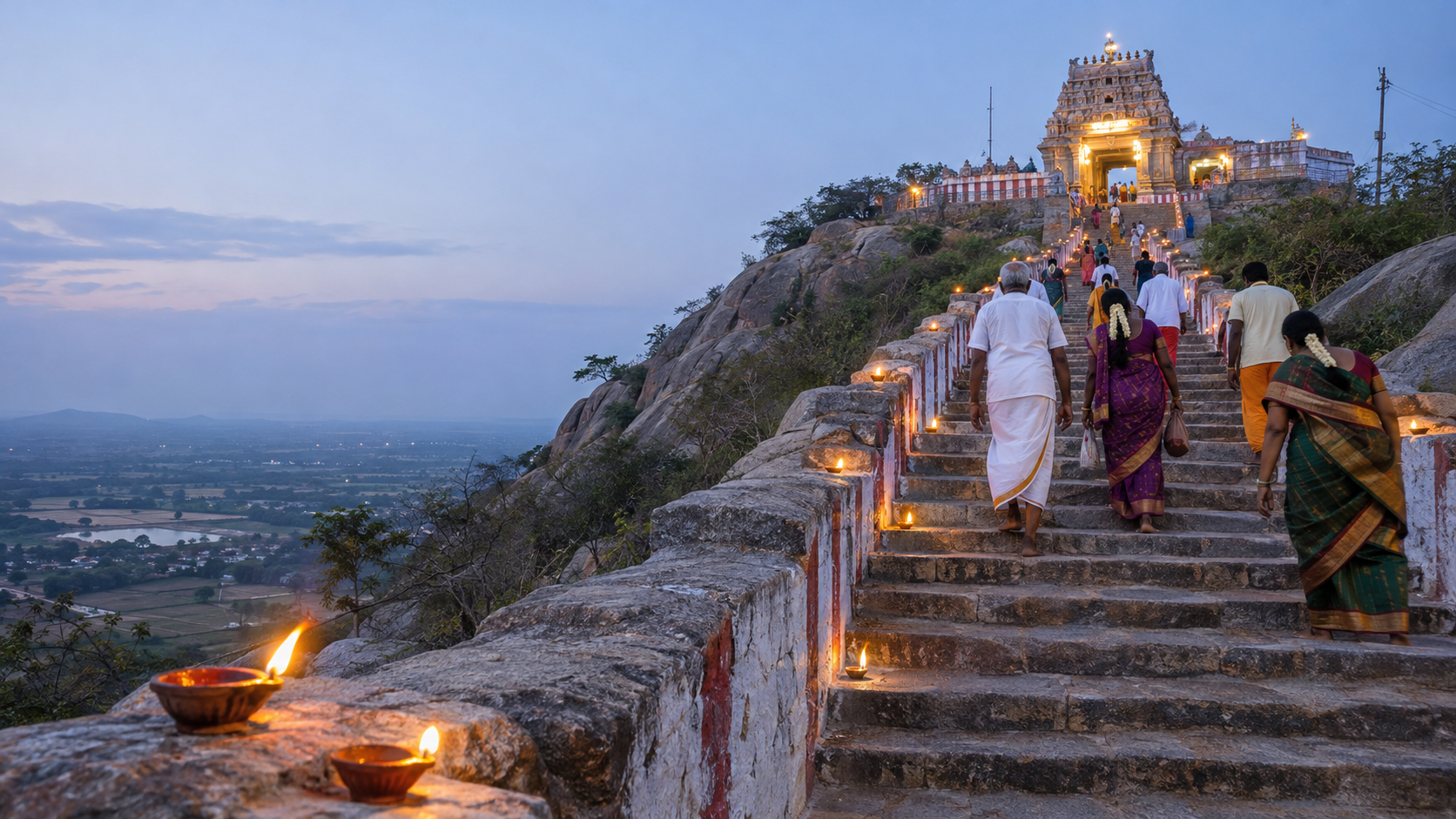
If you are considering a Karthigai pilgrimage to Sholingur, the important question is not simply whether this month is special. You need to know what the temple’s tradition means, what it does not promise, and how to prepare for darshan without turning a sacred encounter into a search for spectacle.
Sholingur asks you to hold two ideas together: Narasimha’s immense power and the stillness expressed by His yogic form. Karthigai adds the language of an awakening gaze. Understanding that relationship can change both how you plan the visit and how you stand before the deity.
Receive the opening of Narasimha’s eyes as darshan
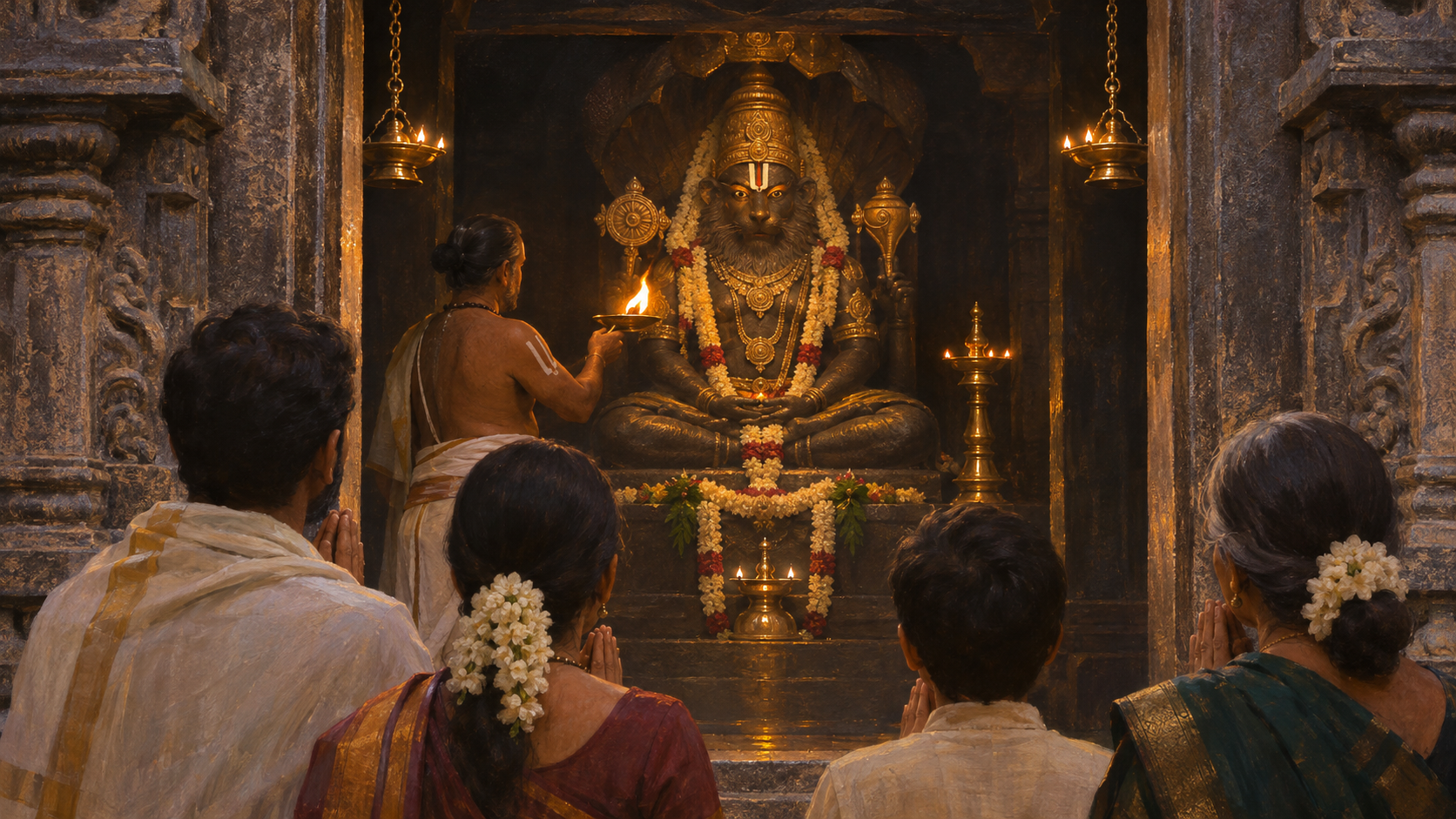
The Tamil month of Karthigai generally falls from mid-November to mid-December. At Sholingur, it carries the cherished belief that Lord Narasimha opens His eyes during Karthigai Masam.
This language belongs to the world of darshan. In Hindu worship, darshan is more than looking at a sacred image. The devotee comes to see the deity, but also to place himself or herself before the divine gaze. Being seen matters. The tradition of the opening eyes therefore gives Karthigai a particular devotional force: the Lord established in yogic stillness is contemplated as actively attending to His devotees.
Do not reduce that belief to a prediction of visible physical movement. A pilgrim who arrives determined to witness a spectacle can spend the entire darshan testing a claim and miss the encounter the claim is meant to deepen. Nor do you need to empty the belief of meaning and treat it as decorative folklore. Receive it in the devotional register in which it is offered.
A useful inner question is not, “Will I see the eyes move?” It is, “What in my life am I willing to place before Narasimha’s awakened gaze?” That might be fear, anger, confusion, a difficult duty, or a promise you have repeatedly postponed. The tradition then becomes a discipline of truthful presence rather than a test imposed on the deity.
Why the name Yoga Narasimha changes your approach
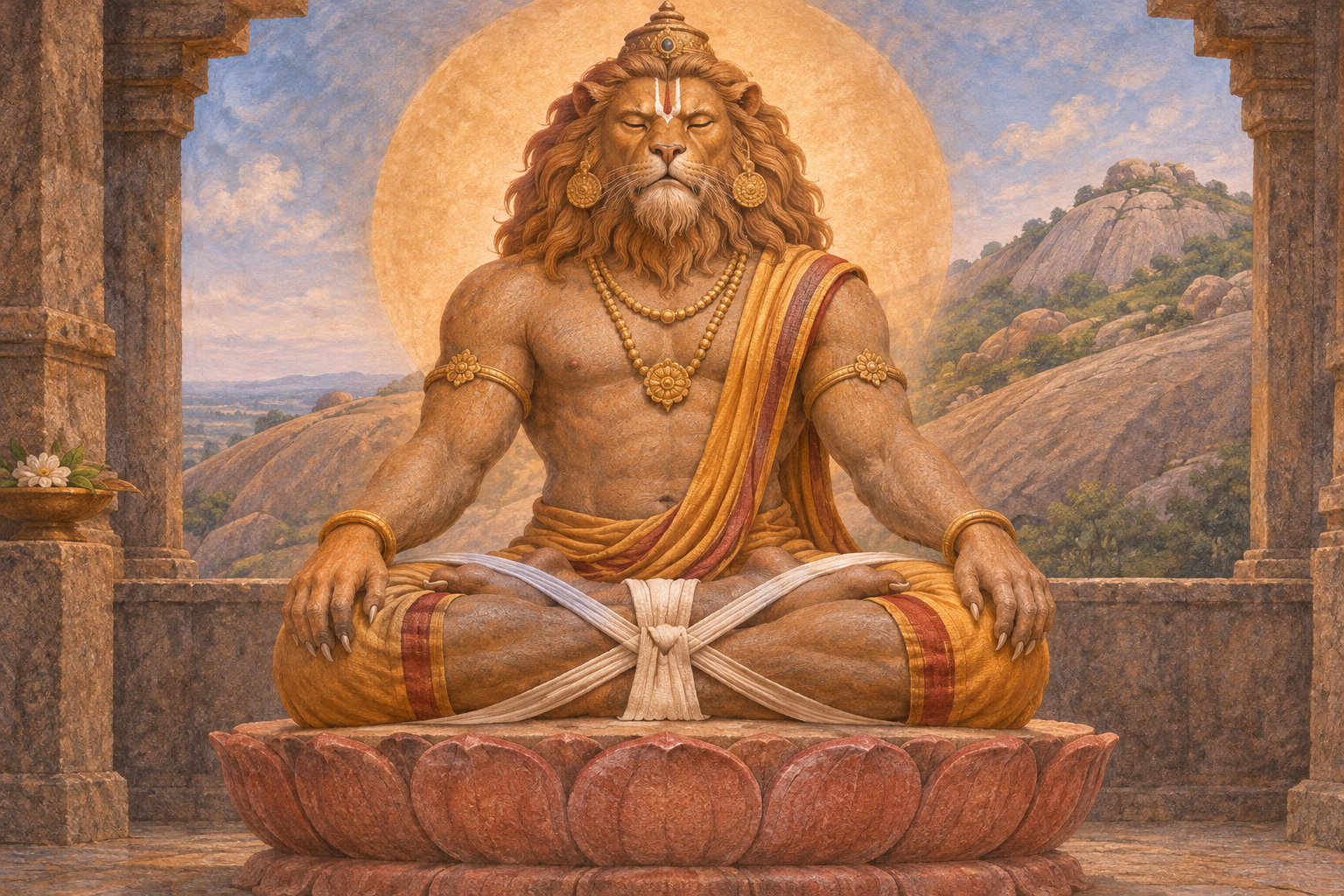
Narasimha is the man-lion form of Vishnu, widely remembered for the sudden force with which divine protection overcomes apparently invincible injustice. At Sholingur, however, you meet Him specifically as Yoga Narasimha. The name directs attention toward power gathered into meditation, not power displayed without restraint.
That distinction gives you a practical way to prepare. Do not approach only with a request that an external obstacle be destroyed. Ask what must become disciplined within you. Courage without self-command can become aggression. Intensity without clarity can become agitation. The yogic form holds protection and restraint together.
Sholingur also belongs to the sacred geography of Sri Vaishnava pilgrimage. Located between Kanchipuram and Tirupati, it is one of the 108 Divya Desams revered by Vaishnavites. That identity matters. You are not entering an isolated shrine whose significance rests on a seasonal belief alone; you are entering a temple situated within a larger Vaishnava landscape of remembrance, worship, and pilgrimage.
If your journey also includes Kanchipuram or Tirupati, resist treating Sholingur as an item to squeeze between two better-known destinations. Give it its own spiritual purpose. Decide in advance what you are bringing to Yoga Narasimha and what form of steadiness you hope to carry away.
Plan for the month, but verify the actual day
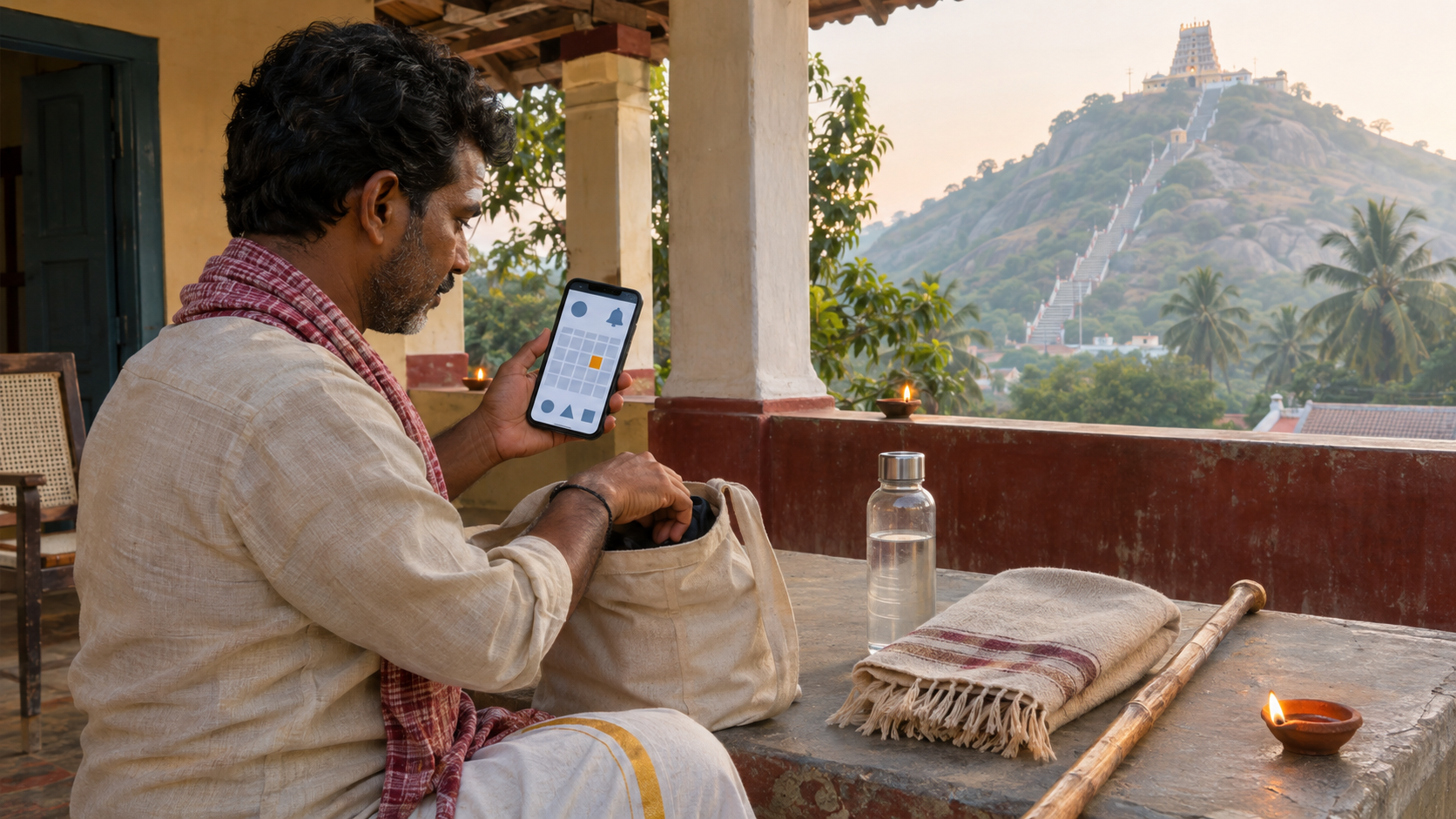
Karthigai’s approximate mid-November to mid-December window is enough to begin planning, but it is not a day-by-day temple calendar. Tamil calendar dates shift against the Gregorian calendar, and a month’s devotional significance does not tell you the opening periods, special observances, access arrangements, or expected conditions on the day you intend to visit.
Before committing to transport or a tightly timed itinerary, verify the practical details through a current temple contact or another reliable local channel. Ask precise questions rather than requesting “all the details.” You need to establish:
- The Gregorian start and end dates of Karthigai Masam in the year of your visit.
- The darshan opening periods on your intended date, including any break between sessions.
- Whether that date carries a special Karthigai observance or a change in normal arrangements.
- What route you will use to reach the place of darshan and whether anyone in your party needs to discuss mobility or access beforehand.
- Which offerings are accepted and what temple-specific conduct visitors are expected to follow.
Do not fill missing information with remembered timings from an older visit, an undated online comment, or the schedule of another temple. The sacred meaning of Karthigai is enduring; operating details are not. Build enough flexibility into the day that a delay does not turn your darshan into an anxious countdown to departure.
The location between Kanchipuram and Tirupati can help you situate Sholingur geographically, but the word “between” is not a travel-time estimate. Plan the actual route from your starting point and base the sequence of your pilgrimage on confirmed timings, not on the visual simplicity of a map.
Use a simple discipline before, during, and after darshan
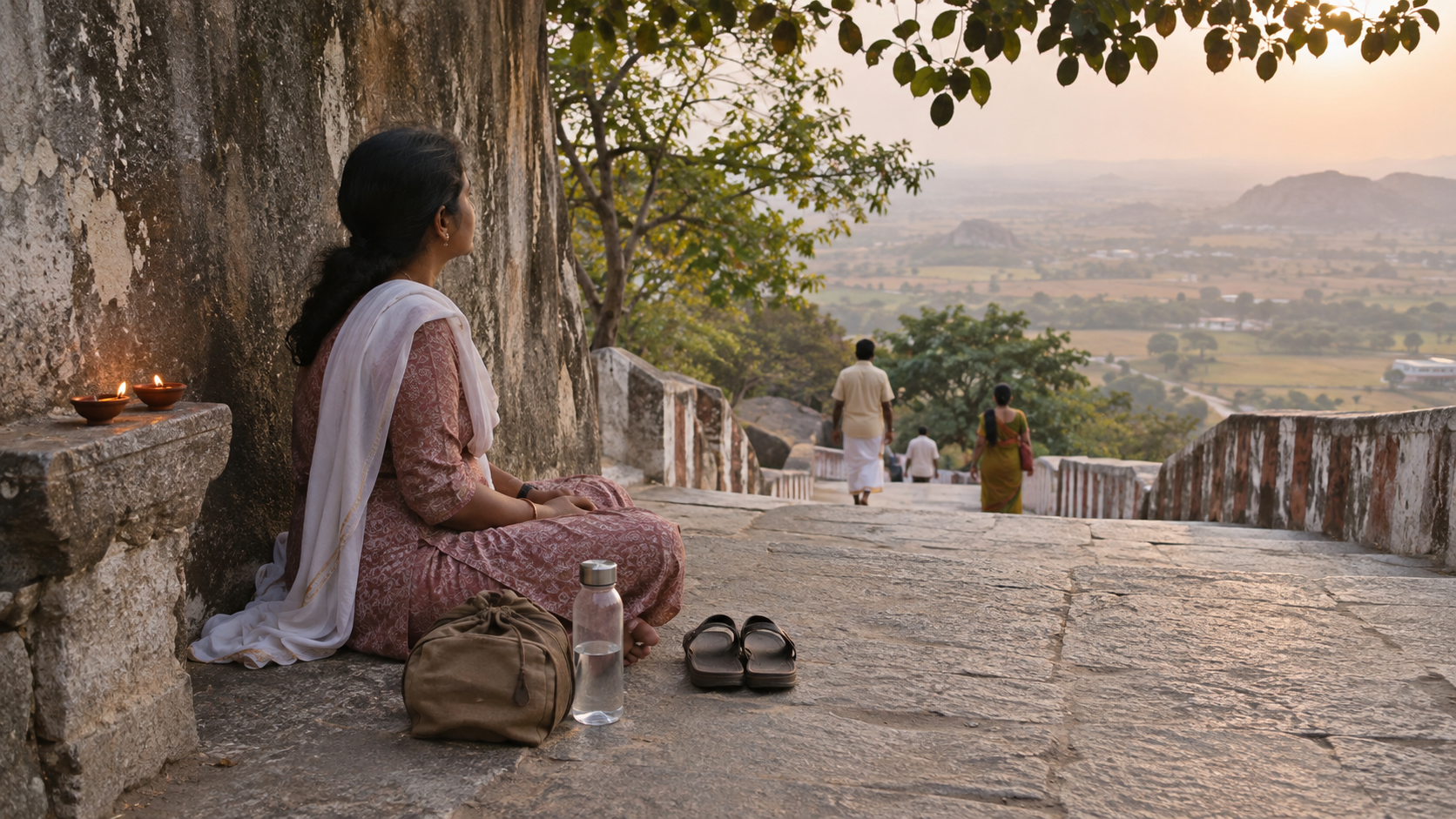
You do not need an elaborate private programme to make the visit meaningful. Temple custom and the guidance of the archakas take precedence inside the sacred space. Alongside that, you can use the following personal discipline to keep your attention from scattering.
- Choose one sankalpa before you arrive. Put your purpose into a single honest sentence. A focused prayer is easier to carry into darshan than a hurried catalogue of requests.
- Remember the full name Yoga Narasimha. Hold strength and self-mastery together. If you seek protection, also ask for the clarity to act responsibly once fear loosens its hold.
- Release the demand for a spectacle. The Karthigai tradition should sharpen your receptivity, not make you inspect the deity as though you were evaluating a performance.
- During darshan, let the idea of the divine gaze turn your attention inward. Name silently what you usually hide from yourself. Then allow a short interval of stillness instead of immediately adding another petition.
- After leaving, choose one concrete discipline that answers the prayer you made. It might be completing an avoided duty, restraining a destructive reaction, keeping a promise, or returning to daily prayer at a fixed time.
The final step prevents pilgrimage from becoming a self-contained emotional moment. Grace does not remove your responsibility to respond. A visit to a yogic form of Narasimha is especially well suited to a vow of steadiness: small enough to keep, clear enough to test, and serious enough to alter your conduct.
Key takeaways for your Karthigai visit
- Karthigai Masam generally falls from mid-November to mid-December, but you should confirm the exact dates for the year in which you plan to travel.
- The opening of Narasimha’s eyes is best approached as a sacred teaching about darshan and divine attention, not as a guaranteed visual event.
- Yoga Narasimha joins protective power to meditative restraint. Let that combination shape both your prayer and the action you take afterward.
- Sholingur is one of the 108 Divya Desams, so approach it as a major Vaishnava pilgrimage place rather than a convenient stop between Kanchipuram and Tirupati.
- Verify current timings, observances, access, and offering rules before fixing a tight itinerary.
Choose your intended Karthigai date, confirm the practical arrangements, and arrive with one clear sankalpa. Then let Yoga Narasimha’s gaze ask something of you as well: not merely devotion for a day, but greater courage and discipline when you return home.
References

Leave a Reply
You must be logged in to post a comment.