
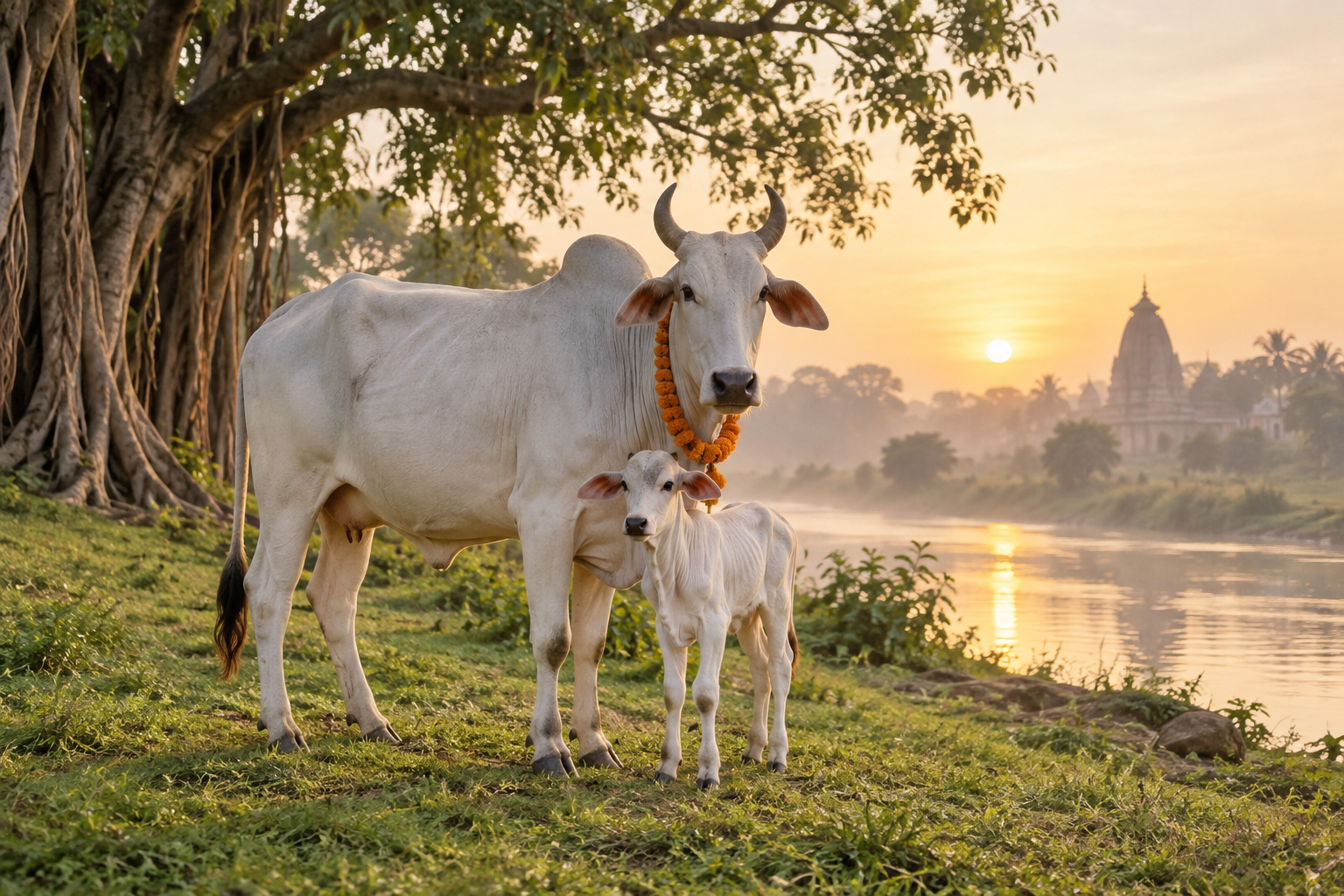
If someone tells you that Hindu reverence for the cow is only a modern political invention, you do not have to answer with a slogan. Nor do you need to pretend that every Hindu community in every century followed one identical diet.
The real question is narrower and more useful: does protecting the cow and avoiding beef have a serious basis in Hindu scripture and ethics? It does. That basis emerges cumulatively – from Vedic protection of cattle, the discipline of ahimsa, explicit classical warnings against slaughter, and the devotional world of Krishna.
Key takeaways
- Hindu beef avoidance does not depend on finding one Vedic sentence written like a modern statutory ban. Its basis is a layered religious tradition.
- The Vedic foundation is the exceptional value and protected status of cattle, including language associated with cows as beings not to be slain.
- Dharmashastra and the Mahabharata make the ethical mechanism clearer: meat requires injury, and responsibility extends beyond the person who physically kills the animal.
- The cow receives particular protection because she represents nourishment, generosity, maternal care, prosperity, and the sustaining bond between human life and nature.
- Historical variation in Hindu diets is real, but it does not erase the equally real development of a strong religious norm against killing cows and eating beef.
Why usefulness became a sacred obligation
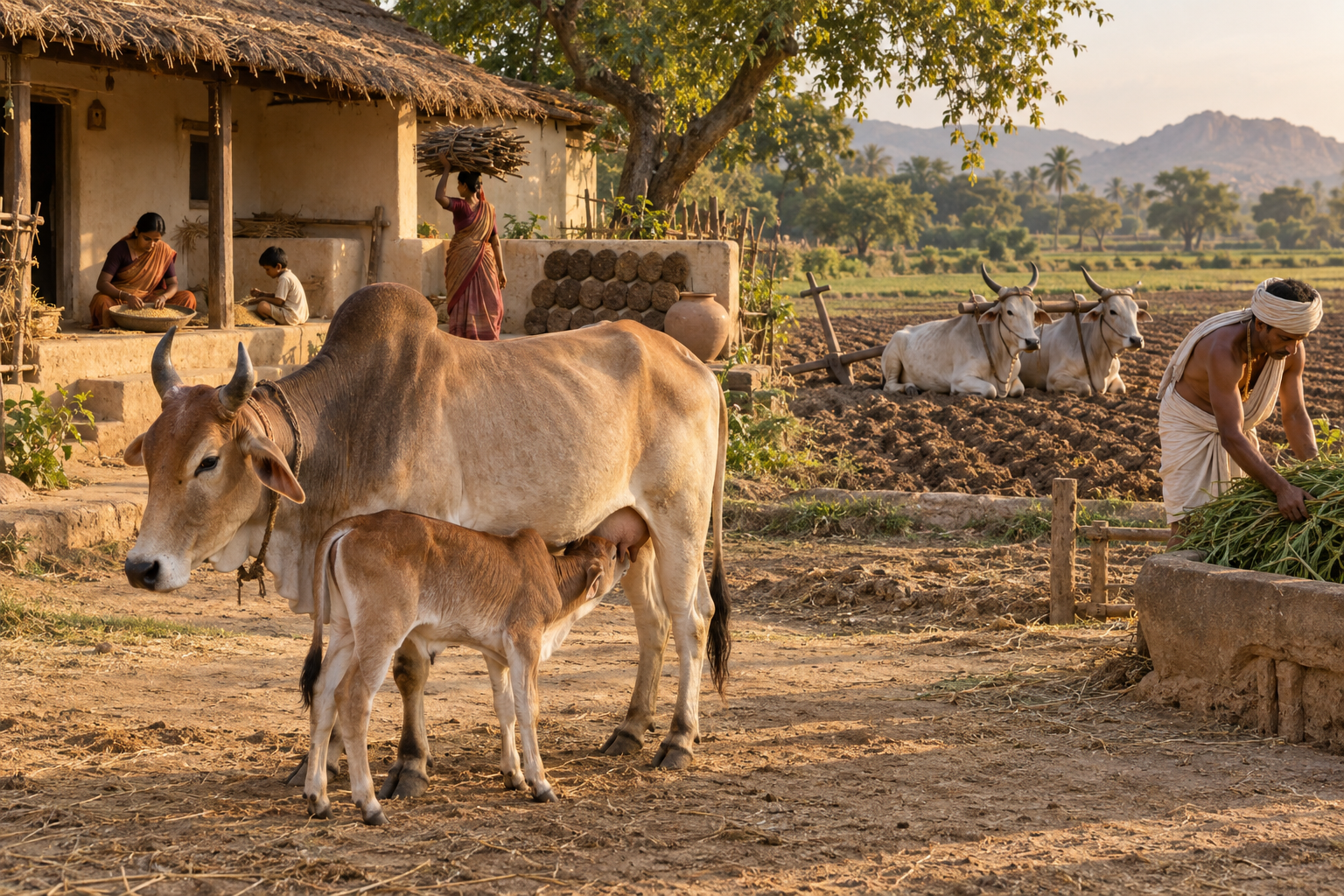
It is easy to misunderstand cow sanctity when the discussion begins and ends with food. A commodity is judged by what people can take from it. A sacred relationship asks what people owe in return. Hindu traditions place the cow in the second category.
The cow nourishes without requiring her own death. That fact supports a moral relationship built around receiving and reciprocating: human beings accept nourishment, while accepting a duty of care. The cow consequently signifies generosity, motherhood, prosperity, and non-injury. Her practical contribution to agrarian society matters, but usefulness alone does not explain sanctity. Hindu thought transforms dependence into obligation.
This distinction helps you answer a common but misleading question: must Hindus believe that an animal is a deity in exactly the same sense as a named form of Bhagavan before protecting her? No. Sacredness can also mean that a being occupies a protected place within dharma and must not be treated as an ordinary consumable object. Cow reverence is expressed through gratitude, restraint, care, and refusal to slaughter.
That is also why a purely economic explanation remains incomplete. Economic value can disappear when an animal is no longer productive. A dharmic obligation does not expire merely because exploitation has become more profitable than care.
The scriptural case develops layer by layer
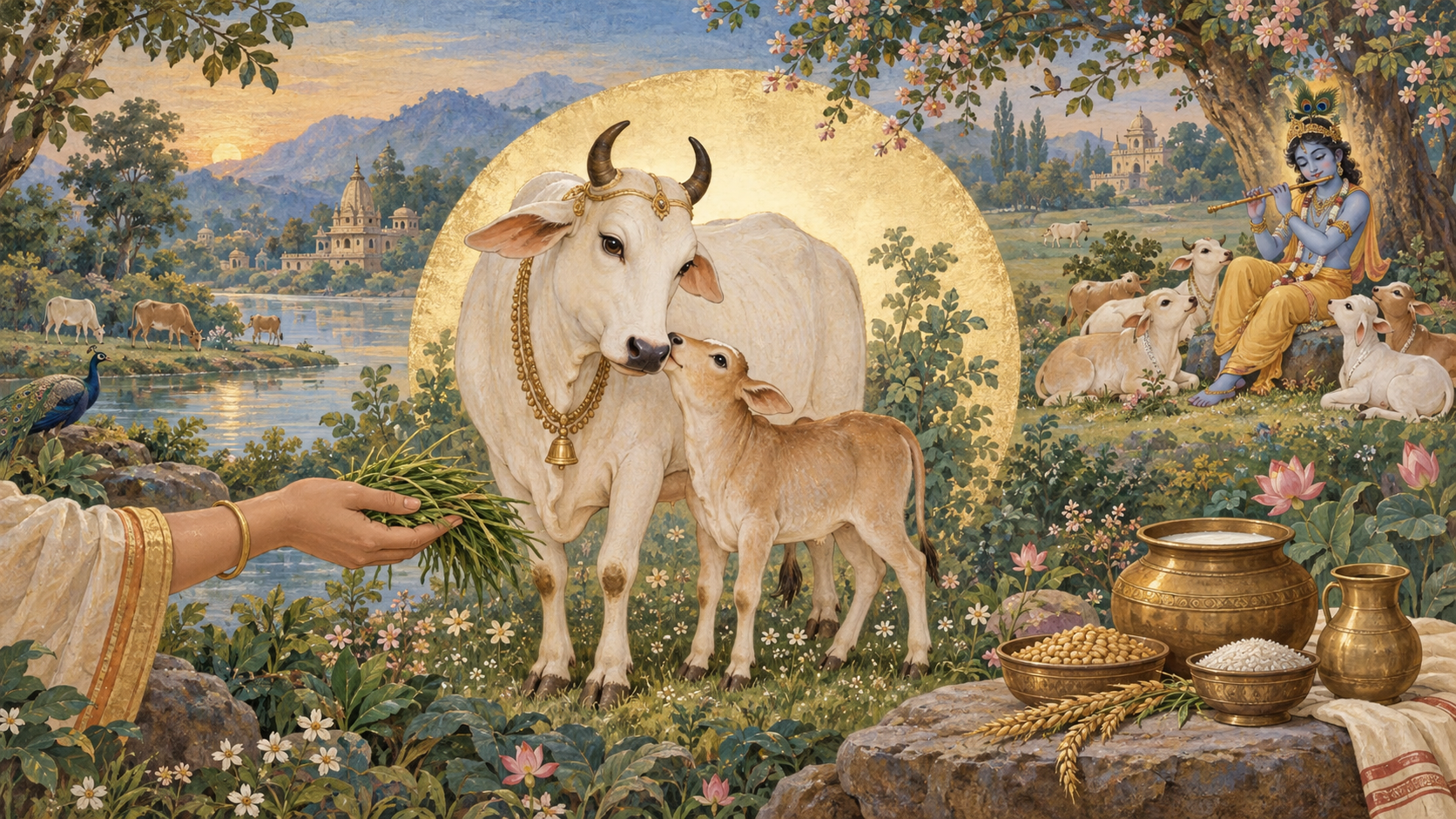
The Vedas establish exceptional value and protection
The Vedas should not be made to sound like a modern legal code. Their importance here lies in the religious world they disclose. In that world, cattle are closely associated with nourishment, household prosperity, and collective well-being.
Rig Veda 6.28 praises cows as bearers of nourishment and prosperity and asks that they remain secure and unharmed. That is more than a calculation of market value. It places their safety inside the community’s religious imagination.
The Vedic term aghnya, literally conveying the sense of one who is not to be killed or slain, is applied in connection with cows in several passages. Interpretations of individual passages have been disputed, so this word should not be presented as if it settled every question about every Vedic-era diet. It nevertheless shows that protective language concerning cows is not a recent addition to Hindu thought.
The concern also extends beyond cattle. Atharva Veda 8.6.23 condemns indiscriminate consumption involving male and female animals and their young, while Yajur Veda 14.8 is traditionally understood as calling for the protection of bipeds and quadrupeds. These passages supply an early moral setting in which the safety of living beings, and cattle in particular, belongs to an ordered society.
The careful conclusion is therefore stronger than either extreme. The Vedas are not a single, flat dietary statute, but neither are they religiously indifferent to the fate of cattle. They provide the vocabulary of value and protection upon which later Hindu ethics build.
Ahimsa explains why appetite does not end responsibility
Later normative teaching makes the mechanism more explicit. The question is no longer only whether an animal is valuable. It is whether satisfying a desire justifies the injury required to satisfy it.
Manusmriti contains permissions for meat in particular ritual or exceptional circumstances, so it cannot honestly be described as a uniform vegetarian rulebook. Yet its fifth chapter also presents a demanding argument for abstention. Manusmriti 5.48 reasons that meat cannot be obtained without harming a living being and therefore recommends avoiding it. Verse 5.49 asks the prospective eater to consider where meat comes from, including the binding and killing that precede the meal.
That reflection becomes a theory of shared responsibility in Manusmriti 5.51. Permission, killing, buying, selling, preparing, serving, and eating all create moral involvement. The person at the end of the chain cannot claim complete innocence merely because someone else performed the slaughter.
This is the crucial intersection behind beef prohibition. Ahimsa creates a general presumption against avoidable injury. The cow’s exceptional status makes the duty more specific and more stringent. The argument is not simply that one kind of flesh became socially unpopular. It is that killing a protected source of nourishment compounds the wrong inherent in taking animal life for consumption.
The Mahabharata and Puranic tradition make the duty explicit
The Mahabharata moves from reverence to unmistakable moral direction. In the Anushasana Parva, Bhishma treats cows as sources of welfare and presents their protection and gifting as acts of religious merit. A cow is not to be transferred to someone who intends to slaughter her. This matters because the duty includes foresight: knowingly placing the animal in the path of slaughter is not morally neutral.
Anushasana Parva, Section 115 connects abstention from meat with ahimsa and compassion. As in Manusmriti, responsibility reaches the killer, purchaser, and consumer rather than stopping with the hand that uses the weapon. More specifically, Anushasana Parva, Section 74 condemns killing, selling, and consuming cattle in severe religious terms. At this stage, cow protection is not merely an inference drawn from pastoral imagery. It is an articulated duty.
Puranic religion deepens that duty through a devotional vision of society. Bhagavata Purana 10.4.41 places cows and Brahmins alongside Vedic knowledge, austerity, truthfulness, mercy, and sacrifice as elements of a godly order. The cow belongs within a network of practices and institutions that sustain dharma.
Krishna’s identities as Gopala and Govinda give this teaching a form that devotees can immediately recognize. He lives among cowherds and protects cows. Protection is therefore not a decorative detail added to Krishna bhakti; it is woven into how Krishna’s character and his pastoral world are remembered. For a devotee, refusing beef is not only compliance with a prohibition. It is also consistency with the protective relationship embodied by Krishna.
Historical complexity does not cancel a religious norm
Did early Hindu texts know animal sacrifice and meat consumption? Yes. Did all Hindu communities follow precisely the same dietary discipline in every place and period? No. Those acknowledgements are necessary for an honest account, but they do not prove that cow sanctity or beef avoidance lacks scriptural roots.
The mistake is a logical one. Evidence against perfect historical uniformity is often treated as evidence against the existence of any authentic norm. But three different questions are being collapsed: what every person actually ate, what religious teachings held up as an ideal, and how that ideal became more fully expressed over time. A tradition can contain disputed practices, exceptions, and ethical development while still establishing a recognizable boundary.
The chronology matters. Vedic reverence supplies the early foundation. Dharmashastra connects food to injury and distributed responsibility. The Mahabharata states a strong duty to protect cattle and avoid their flesh. Puranic and Krishna traditions then place the cow within a devotional and civilizational vision of dharma. Contemporary politics may invoke cow protection, but it cannot be the origin of teachings already embedded in these older religious layers.
You therefore do not need to defend the implausible claim that Hindu food practice was always uniform. The better-supported claim is more precise: Hindu traditions developed a powerful and enduring religious case for cow protection, and that case makes abstention from beef a coherent expression of dharma rather than an arbitrary food taboo.
How to explain and practise the principle responsibly
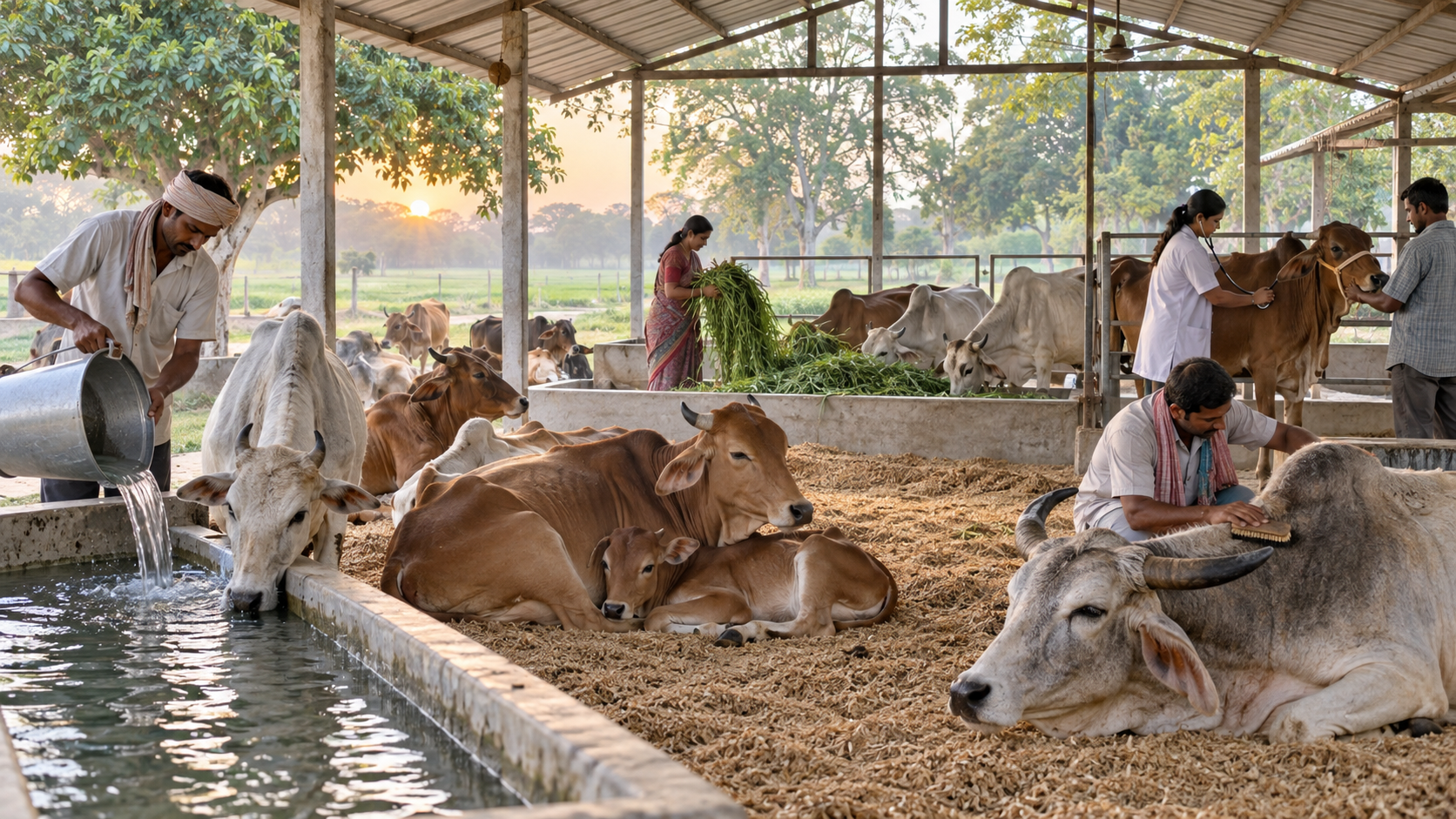
When this subject comes up in a family discussion, classroom, workplace, or public debate, four moves will keep your explanation accurate and useful.
- State the right kind of claim. Say that beef avoidance rests on a cumulative scriptural and ethical tradition. Do not make the whole case depend on one translated word or one isolated verse.
- Admit variation without surrendering the norm. Early sacrifice, limited permissions, and differences among communities complicate dietary history. They do not erase passages that protect cows or condemn their slaughter and consumption.
- Explain the moral mechanism. The cow is a protected giver of nourishment, while ahimsa asks whether desire can justify injury. Teachings on buying, selling, preparing, serving, and eating show why outsourcing slaughter does not remove responsibility.
- Keep ahimsa inside the defence of the cow. Cow protection loses its dharmic centre when it becomes an excuse for cruelty, hatred, or dehumanization. The means must remain answerable to the very principle used to defend the duty.
If you need a concise answer, use this one: Hindu beef avoidance is not based on a single rule detached from the rest of religion. It grows from Vedic protection of cattle, the wider discipline of ahimsa, explicit warnings in the Mahabharata, and the sacred place of cows in Krishna and Puranic traditions. Hindu diets have varied, but the religious case for not slaughtering or eating the cow is old, substantial, and internally coherent.
If you want your own conduct to reflect that teaching, the first decision is direct: do not treat beef as an ordinary dietary choice. Then apply the deeper test supplied by ahimsa. Consider not only what reaches your plate, but also the permission, purchase, preparation, and suffering that made it possible. That turns cow reverence from a symbol you defend into a discipline you practise.
References

Leave a Reply
You must be logged in to post a comment.